
This lesson focuses on the critical skill of maintaining safe following distances while operating large passenger vehicles. You will learn how vehicle size, weight, and momentum impact your stopping ability, ensuring you stay compliant with Turkish highway traffic regulations.
Lesson content overview
Operating a large passenger vehicle under a Class D licence (D Sınıfı Ehliyet) demands an advanced level of spatial awareness and defensive driving. Unlike passenger cars, buses and coaches carry heavy, dynamic loads consisting of passengers and their luggage. This massive increase in vehicle weight directly translates to longer stopping distances and a greater risk of catastrophic rear-end collisions if a safe following distance is not maintained.
Understanding the physics of deceleration, mastering practical time-gap estimation methods, and adjusting for variable road, load, and weather conditions are essential requirements for passing the Turkish Class D theory exam and ensuring public safety on the roads.
To comprehend why large vehicles require significantly larger safety cushions, you must break down what actually happens when you need to bring a bus to a complete halt. The total distance your vehicle travels from the moment you first spot a hazard to the moment the wheels stop turning is known as the Total Stopping Distance (Durma Mesafesi).
This distance is not instantaneous; it is the sum of three distinct physical phases:
[ Perception Distance ] + [ Reaction Distance ] + [ Braking Distance ] = Total Stopping Distance
Perception distance is the distance your bus travels from the instant a hazard becomes visible to the moment your brain recognizes it. For an alert, well-rested driver, this cognitive processing takes approximately 0.5 to 0.75 seconds. At highway speeds, a heavy vehicle covers a substantial distance during this split second before you even begin to move your foot.
Once your brain registers the danger, it must signal your body to act. The reaction distance is the physical space your vehicle covers while you move your foot from the accelerator pedal to the brake pedal. For the average professional driver, the reaction time is about 1.0 to 1.5 seconds.
Factors such as driver fatigue, distractions, or age can easily double this time. Even at a modest urban speed of 50 km/h, a bus covers nearly 14 metres per second. A delay of just one second in reaction translates directly to an extra 14 metres of forward travel before the brakes are even touched.
The braking distance is the physical distance the vehicle travels after you apply the brakes until it comes to a complete stop. This phase is heavily governed by laws of physics, particularly the kinetic energy of the vehicle, which is proportional to its mass and the square of its speed ().
Because a Class D bus can weigh upwards of 10 to 18 tonnes when fully loaded, its kinetic energy is immense compared to a light passenger car. Consequently, even with high-performance braking systems, a bus requires a much longer physical distance to dissipate this energy.
Air brake systems (pneumatic brakes), which are standard on large commercial buses and coaches, suffer from a physical phenomenon known as brake lag. Unlike hydraulic brakes in passenger cars, which transmit pressure almost instantly, air brakes require about 0.4 seconds for air to travel through the lines and actuate the brake drums or discs. This lag must be factored into your overall reaction and braking calculations.
Air Brake Lag Warning: Because pneumatic brakes rely on compressed air travelling through hoses to the brake chambers, there is a delay of roughly 0.4 seconds before the mechanical braking components engage. At 90 km/h, this "lag" adds approximately 10 metres of travel distance before deceleration actually begins.
Relying on pure visual estimation of distance in metres is notoriously difficult for drivers, especially when moving at high speeds. To overcome this, professional drivers use time-based or speed-based formulas to establish a reliable, dynamic safety cushion.
While passenger car drivers are taught the standard Two-Second Rule, this cushion is completely inadequate for large Class D vehicles. Under ideal conditions (dry pavement, clear visibility, light traffic), a professional bus driver should maintain a minimum Three-Second to Four-Second Rule.
To safely apply this method, follow these systematic steps:
Select a fixed marker: Identify a stationary object ahead, such as a traffic sign, road marking, overhead bridge, or lamp post.
Observe the lead vehicle: Note the exact moment the rear bumper of the vehicle directly ahead of you passes your selected marker.
Begin your count: Start counting slowly: "One-thousand-and-one, one-thousand-and-two, one-thousand-and-three, one-thousand-and-four."
Verify your position: If the front bumper of your bus reaches the chosen marker before you finish counting to at least "one-thousand-and-three," you are following too closely. You must gently ease off the accelerator to increase the gap.
Under the Turkish Highway Traffic Regulation (Karayolları Trafik Yönetmeliği), there is a fundamental legal guidelines regarding following distance:
Under normal traffic and environmental conditions, the minimum safe following distance (in metres) between two vehicles must be at least equal to half of the speed at which the vehicle is travelling (expressed as a numerical value in kilometres per hour).
For example, if you are driving a bus on a clear highway:
However, for large passenger transport vehicles, this "half-speed" rule represents the absolute legal bare minimum. Defensive driving instructors and professional transport associations recommend multiplying this distance by a factor of 1.5 or keeping a full time-gap buffer to account for the vehicle’s high gross weight.
A professional driver must never treat following distance as a fixed, unchangeable metric. Your spatial cushion must expand dynamically based on several critical operating variables.
The weight of your vehicle is highly variable. A bus running empty back to the depot behaves very differently from a bus carrying 50 passengers, their luggage, and a full tank of fuel.
Tire traction is highly dependent on the condition of the road surface. When friction decreases, your following distance must increase proportionally to prevent skidding and rear-end collisions.
Slippery Roads Warning: In Turkey, during autumn and winter, mountain passes (such as the Bolu Pass or Taurus crossings) are highly prone to sudden temperature drops and black ice. Always double your following distance when ambient temperatures hover near 0°C, even if the road surface looks dry.
Your ability to perceive a hazard is only as good as your visibility.
The Turkish Highway Traffic Law (No. 2918 - 2918 Sayılı Karayolları Trafik Kanunu) explicitly regulates following distances to protect road users.
If you encounter specific road signs indicating mandatory minimum distances, you must strictly comply with them:
Commercial driving requires overcoming bad habits and resisting traffic pressures. Below are critical mistakes that Class D candidates must avoid:
To succeed on your Class D exam and perform safely on the road, you must always think in terms of defensive cause-and-effect patterns:
This lesson covers the physics and regulations of safe following distances for Turkish Class D vehicles, explaining that total stopping distance equals perception distance (0.5–0.75s) plus reaction distance (1.0–1.5s) plus braking distance, with an additional 0.4-second air brake lag. Professional drivers must maintain a minimum three-to-four-second time gap or the half-speed distance in metres under Turkish Law No. 2918, which represents the absolute legal minimum for heavy vehicles. Key adjustments include adding one second when fully loaded, four to five seconds in rain, six seconds in snow, and eight to ten seconds on ice, while always remembering that retarders cannot replace service brakes for emergency stops.
A short set of high-value points that capture the most important learning from this lesson.
Total stopping distance equals perception distance plus reaction distance plus braking distance, and each phase must be accounted for when calculating safe gaps.
Class D buses require a minimum three-to-four-second following gap under ideal conditions, significantly longer than the two-second rule for passenger cars.
Air brake systems introduce a 0.4-second lag before deceleration begins, adding approximately 10 metres of travel at 90 km/h.
The Turkish Half-Speed Rule mandates a following distance equal to half your speed in metres, but this is the absolute legal minimum for heavy vehicles.
Following distance must dynamically expand based on load, road conditions (wet, snow, ice), and visibility to maintain a safe stopping buffer.
Explore all units and lessons included in this driving theory course.
Perception takes 0.5–0.75s, reaction takes 1.0–1.5s, and air brake lag adds 0.4s before braking begins—totalling significant distance before stopping.
Under Turkish Highway Traffic Law No. 2918 Article 56/1-c, drivers must maintain a safe following distance allowing them to stop under all circumstances.
A fully loaded bus requires at least one additional second of following distance compared to an empty bus due to increased mass and kinetic energy.
On icy roads, stopping distance can increase tenfold—maintain an eight-to-ten-second gap and avoid sudden brake or steering inputs.
Auxiliary brakes (retarders) are for speed control on descents only; only service brakes provide maximum emergency stopping power.
Assuming urban speeds allow close following, ignoring that pedestrians and cyclists make sudden stops and passengers can be injured even at low speeds.
Failing to recalculate following distance after picking up passengers, applying the same brake pressure as when empty.
Relying on retarders or exhaust brakes for emergency stops instead of the service brakes actuated by the foot pedal.
Tailgating passenger cars that merge into your safety cushion because a car can decelerate far faster than a bus.
Not adjusting for black ice when temperatures near 0°C, especially on mountain passes like Bolu, even if roads appear dry.
Lesson content overview
A short set of high-value points that capture the most important learning from this lesson.
Total stopping distance equals perception distance plus reaction distance plus braking distance, and each phase must be accounted for when calculating safe gaps.
Class D buses require a minimum three-to-four-second following gap under ideal conditions, significantly longer than the two-second rule for passenger cars.
Air brake systems introduce a 0.4-second lag before deceleration begins, adding approximately 10 metres of travel at 90 km/h.
The Turkish Half-Speed Rule mandates a following distance equal to half your speed in metres, but this is the absolute legal minimum for heavy vehicles.
Following distance must dynamically expand based on load, road conditions (wet, snow, ice), and visibility to maintain a safe stopping buffer.
Explore all units and lessons included in this driving theory course.
Perception takes 0.5–0.75s, reaction takes 1.0–1.5s, and air brake lag adds 0.4s before braking begins—totalling significant distance before stopping.
Under Turkish Highway Traffic Law No. 2918 Article 56/1-c, drivers must maintain a safe following distance allowing them to stop under all circumstances.
A fully loaded bus requires at least one additional second of following distance compared to an empty bus due to increased mass and kinetic energy.
On icy roads, stopping distance can increase tenfold—maintain an eight-to-ten-second gap and avoid sudden brake or steering inputs.
Auxiliary brakes (retarders) are for speed control on descents only; only service brakes provide maximum emergency stopping power.
Assuming urban speeds allow close following, ignoring that pedestrians and cyclists make sudden stops and passengers can be injured even at low speeds.
Failing to recalculate following distance after picking up passengers, applying the same brake pressure as when empty.
Relying on retarders or exhaust brakes for emergency stops instead of the service brakes actuated by the foot pedal.
Tailgating passenger cars that merge into your safety cushion because a car can decelerate far faster than a bus.
Not adjusting for black ice when temperatures near 0°C, especially on mountain passes like Bolu, even if roads appear dry.
Explore search topics learners often look for when studying Establishing Safe Following Distances for Large Vehicles. These topics reflect common questions about road rules, driving situations, safety guidance, and lesson level theory preparation for learners in Turkey.
Browse additional driving theory lessons that cover connected traffic rules, road signs, and common driving situations related to this topic. Improve your understanding of how different rules interact across everyday traffic scenarios.
Understand the mechanics of pneumatic brake systems and the impact of vehicle mass on stopping distances. This guide explains how kinetic energy, brake lag, and deceleration forces affect heavy passenger vehicles under various loading conditions in Turkish traffic conditions.
This lesson provides an in-depth understanding of the braking systems used in goods vehicles, including air and hydraulic brakes. Learners will explore the limitations of these systems, such as brake fade and overheating, especially under heavy loads. The lesson also covers essential maintenance practices and regular brake inspections to ensure optimal performance and safe stopping distances.
This lesson presents effective braking strategies designed to safeguard passengers and prevent wheel lock-up or skidding. Learners will become familiar with progressive braking, the use of ABS, and techniques for maintaining vehicle stability during sudden stops. Proper braking ensures passenger comfort and reduces accident risk, especially in adverse road conditions.

This lesson examines the effects of load dynamics on vehicle stability during acceleration and deceleration. Learners will learn how cargo can shift and affect handling, particularly during sudden speed changes or emergency braking situations. The lesson emphasizes proper load securing, gradual acceleration, and controlled braking to maintain stability and prevent serious accidents.

Learners will explore methods for achieving smooth acceleration and deceleration, focusing on gradual throttle application and progressive brake pressure to maintain passenger comfort and vehicle stability. The lesson highlights the importance of anticipating road conditions and traffic flow to avoid abrupt speed changes, thereby enhancing safety and reducing fuel consumption.
Learn how to adapt your driving style and following distances for rain, fog, and ice. This lesson covers traction management and visibility requirements for bus drivers operating in challenging environments to ensure passenger safety and control of large vehicles on Turkish highways.
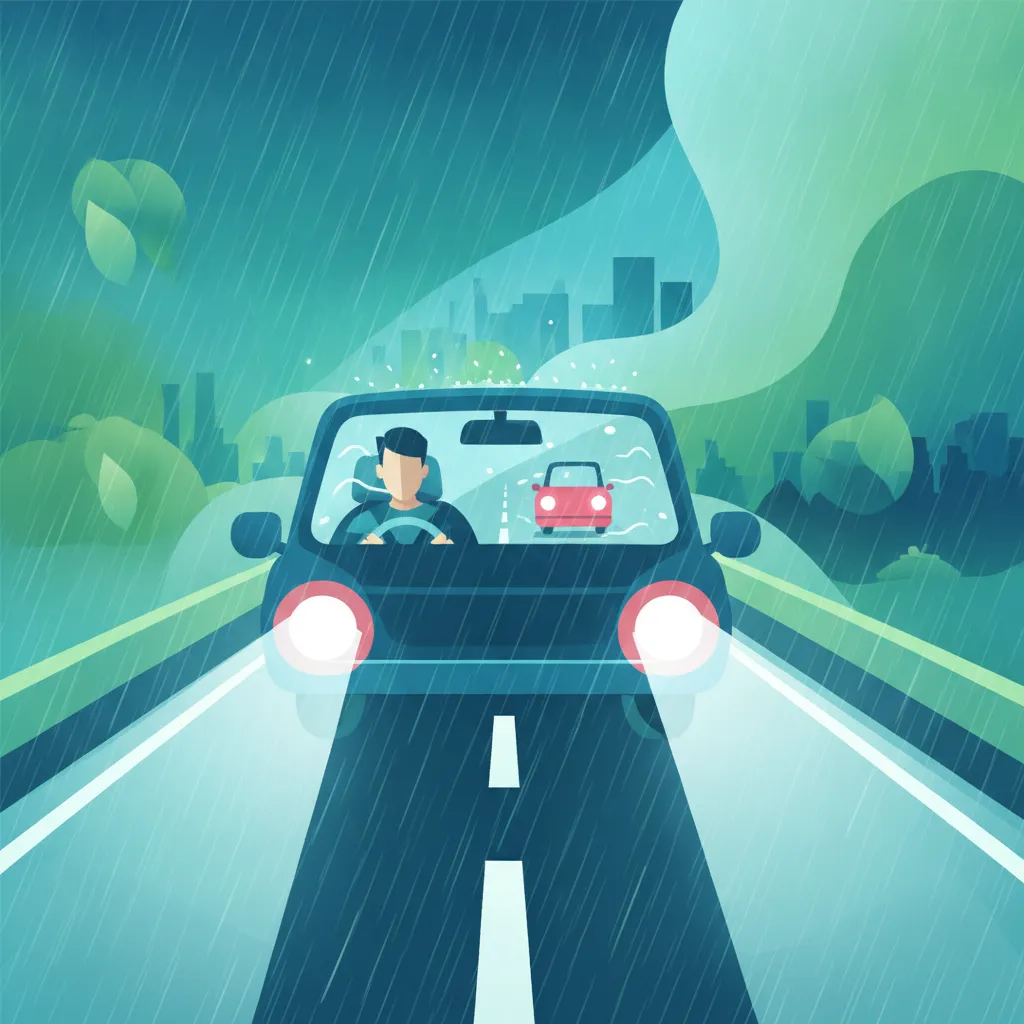
Learners will explore the specific challenges presented by adverse weather conditions, such as rain, fog, and nighttime driving. The lesson emphasizes the importance of adjusting speed, increasing following distances, and using appropriate lighting to maintain safety. Strategies for handling reduced road surface grip and visibility issues are discussed, ensuring drivers can adapt to changing weather while protecting passengers and other road users.

This lesson details defensive driving techniques for adverse weather conditions such as rain, snow, black ice, dense fog, and strong winds. It explains the physics of aquaplaning and how to regain vehicle control when losing traction on slippery surfaces. Drivers will learn how to adjust speed and increase safety gaps to prevent weather crashes.
This lesson focuses on the challenges of driving goods vehicles in adverse weather conditions, such as rain, fog, snow, and strong wind. Learners will explore safe speed management, increased following distances, proper use of headlights and windshield wipers, and techniques to maintain traction. The lesson emphasizes the importance of adapting driving behavior to the specific weather conditions.
Find clear answers to common questions learners have about Establishing Safe Following Distances for Large Vehicles. Learn how the lesson is structured, which driving theory objectives it supports, and how it fits into the overall learning path of units and curriculum progression in Turkey. These explanations help you understand key concepts, lesson flow, and exam focused study goals.
Larger vehicles have significantly more mass and momentum, meaning they require a longer time and distance to come to a complete stop. Following the standard distance meant for smaller cars can lead to dangerous rear-end collisions.
For a large passenger vehicle, you should maintain a minimum of at least 3 seconds of following distance behind the vehicle in front, which is increased in adverse weather or on steep downhill gradients.
The e-sınav often presents scenario-based questions where you must choose the correct distance or action based on images of varying traffic, road types, and weather conditions.
Yes. Carrying passengers adds weight to the vehicle, which affects braking efficiency and comfort. Smooth, anticipatory driving with a longer following distance is essential for passenger safety.
Use our comprehensive practice search to find exactly the Turkish driving theory questions you need to master. Whether reviewing specific road signs, traffic rules, or first aid scenarios, select your perfect practice set and boost your confidence for the official ehliyet sınavı.