
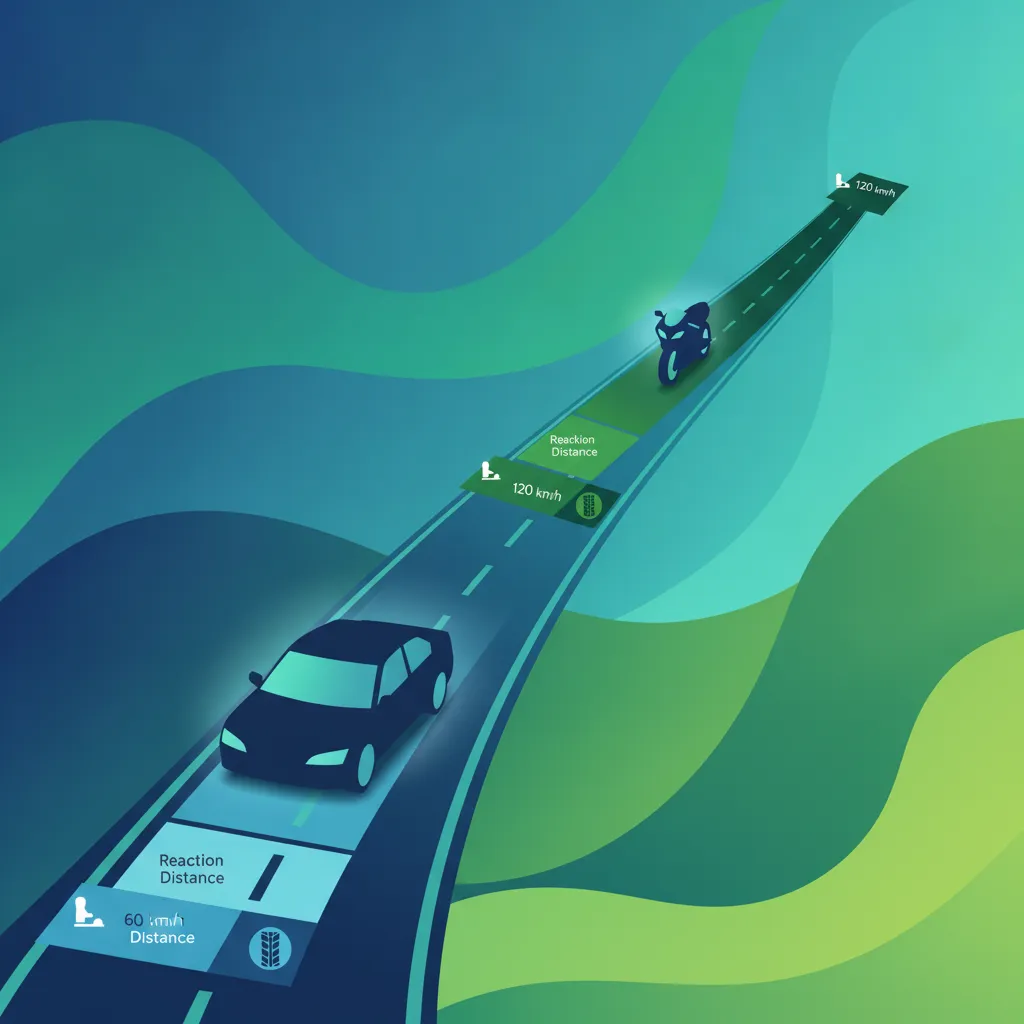
Stopping distance is the total distance your vehicle travels from the moment you identify a hazard until you come to a complete stop. It consists of two parts: your reaction distance and your braking distance. Higher speeds disproportionately increase this total distance, significantly impacting your ability to react safely to unexpected situations in Türkiye's traffic.
Theory topic content overview
Read the full theory topic guide for Speed & Stopping Distance with structured, easy-to-scan content built for learners in Turkey. This detailed section explains the exact rule, meaning, traffic context, comparison points, and exam logic behind this Turkish driving theory topic so you can study faster, understand the concept more clearly, and avoid common interpretation mistakes on the theory test.
Stopping distance is the total distance your vehicle travels from the moment you first perceive a hazard on the road until your vehicle comes to a complete stop. It is a crucial concept for driver safety and a fundamental part of the Turkish driving theory exam (Ehliyet Sınavı).
This total distance is comprised of two distinct parts:
reaction time. This is the time it takes for you to see a hazard, process it, decide to act, and physically move your foot to the brake pedal.Therefore, the formula is simple: Stopping Distance = Reaction Distance + Braking Distance.
Understanding how speed affects stopping distance is not just a theoretical exercise; it's a critical safety principle. In Türkiye's diverse traffic environments, from bustling city streets to high-speed motorways, the ability to stop safely directly impacts collision avoidance.
For your Ehliyet Sınavı, this concept is frequently tested to ensure you grasp:
Misjudging stopping distance is a leading cause of rear-end collisions and other accidents. A vehicle moving faster needs significantly more space to stop, drastically reducing the time and distance available to react to unexpected events like a sudden stop ahead, a pedestrian stepping out, or an animal entering the road.
The relationship between speed and stopping distance is not linear; it's exponential, particularly for braking distance. This is the core distinction you must understand.
Your reaction time is relatively constant for a given driver (typically around 1 to 1.5 seconds, though it can vary with fatigue, distractions, etc.). During this time, your vehicle continues to travel at its current speed.
linear relationship: Reaction distance is directly proportional to speed.
This is where the impact of speed becomes truly dramatic. Braking distance increases with the square of your speed. This is because the kinetic energy of a moving vehicle, which must be dissipated by the brakes, is proportional to the square of its velocity (K.E. = 0.5 * mass * velocity²).
exponential relationship: Braking distance is disproportionately affected by speed.
Because braking distance increases exponentially, even a small increase in speed significantly lengthens the total stopping distance. This dramatically reduces your safety margin and is a key reason why higher speeds increase collision risk. You need far more space to react and stop than many learners initially assume.
Beyond speed, several other factors influence both reaction and braking distance:
extending braking distance.Learners often confuse or underestimate the impact of speed.
hız sınırı) in Türkiye is the maximum legal speed under ideal conditions. It is NOT always a safe speed. Drivers must always adjust their speed to the conditions, ensuring they can stop within the visible clear distance ahead.physics of driving, particularly how kinetic energy scales quadratically with speed. This leads to a false sense of security at slightly higher speeds.Consider these scenarios in Türkiye:
stopping distance on wet roads is much greater than on a dry road, making a collision highly likely if you haven't reduced your speed significantly.Otoyol): On an Otoyol, vehicles travel at high speeds (e.g., 120 km/h). The safe following distance (takip mesafesi) must be substantial because a driver's reaction distance alone will be very long, and any emergency braking will require a huge braking distance. Maintaining adequate takip mesafesi is critical for motorway safety.Şehir İçi Yollar): Even at 50 km/h in an urban area in Ankara, if a child suddenly runs onto the road between parked cars, your total stopping distance might be too long to avoid an impact, especially if you are distracted or your tires are worn.Ehliyet Sınavı often includes questions designed to test this specific misconception.stopping distance physics required to dissipate kinetic energy.Always remember: Speed is the single biggest factor influencing your total stopping distance. In Turkish traffic, adjusting your speed appropriately is paramount for safety.
To ensure safe stopping and pass your Ehliyet Sınavı:
tehlike algılama).stop safely within the visible distance ahead.following distance at higher speeds, especially on motorways and in bad weather. This directly provides more reaction distance and braking distance.doubling your speed quadruples your braking distance, and thus dramatically increases total stopping distance. This knowledge saves lives and helps you excel in your Turkish driving theory exam.Stopping distance consists of two components: reaction distance, which increases linearly with speed, and braking distance, which increases exponentially due to kinetic energy being proportional to the square of velocity. This means that doubling your speed quadruples braking distance and more than doubles total stopping distance, drastically reducing your safety margin. Beyond speed, stopping distance is affected by driver condition (fatigue, distraction, impairment), vehicle condition (tire wear, brake maintenance, load), and environmental factors (road surface, visibility, gradient). Understanding this physics-based relationship is essential for hazard avoidance and forms a frequently tested concept in the Turkish Ehliyet Sınavı.
A short set of high-value points that capture the most important ideas from this theory explanation.
Stopping distance equals reaction distance plus braking distance, and each component responds differently to speed increases
Reaction distance grows linearly with speed (doubling speed doubles it), while braking distance grows exponentially (doubling speed quadruples it)
Kinetic energy, which brakes must dissipate, increases with the square of velocity, making high-speed braking dramatically more demanding
Speed is the single biggest factor affecting total stopping distance in any driving scenario
The posted speed limit is the maximum legal speed under ideal conditions, not a guarantee of safe speed for current conditions
The formula: Stopping Distance = Reaction Distance + Braking Distance
Braking distance increases by the square of speed (2x speed = 4x braking distance)
Reaction distance increases proportionally with speed (2x speed = 2x reaction distance)
Adverse conditions (rain, fatigue, worn tires, poor brakes) extend stopping distance significantly
Safe driving requires stopping within the visible clear distance ahead, not just within the speed limit
Believing doubling speed only doubles stopping distance instead of understanding the exponential braking effect
Failing to reduce speed for wet, icy, or low-visibility conditions common in Turkish roads
Assuming ABS technology dramatically shortens braking distance rather than improving brake control
Confusing reaction time (duration) with reaction distance (length traveled during that time)
Treating speed limits as safe speeds rather than maximum legal limits under ideal conditions
Start with a short, direct summary of Speed & Stopping Distance before reading the full explanation below.
Stopping distance is the sum of reaction distance (distance traveled during driver's reaction time) and braking distance (distance traveled while braking). As speed increases, reaction distance grows proportionally, but braking distance grows exponentially due to kinetic energy, meaning that even a small increase in speed can dramatically lengthen the total distance needed to stop a vehicle safely in Türkiye.
Review the most important terms, rule signals, and traffic concepts linked to Speed & Stopping Distance.
Explore related theory topic pages connected to Speed & Stopping Distance and continue with the next useful rule explanation.
See the common search queries learners use when trying to understand Speed & Stopping Distance in Turkey.

Dive deeper into specific Turkish driving theory topics like traffic signs, first aid, or vehicle mechanics. Each section offers clear explanations to enhance your understanding of official traffic legislation and prepare you effectively for every aspect of your upcoming ehliyet exam in Türkiye.
Explore Turkish Driving Theory TopicsTheory topic content overview
A short set of high-value points that capture the most important ideas from this theory explanation.
Stopping distance equals reaction distance plus braking distance, and each component responds differently to speed increases
Reaction distance grows linearly with speed (doubling speed doubles it), while braking distance grows exponentially (doubling speed quadruples it)
Kinetic energy, which brakes must dissipate, increases with the square of velocity, making high-speed braking dramatically more demanding
Speed is the single biggest factor affecting total stopping distance in any driving scenario
The posted speed limit is the maximum legal speed under ideal conditions, not a guarantee of safe speed for current conditions
The formula: Stopping Distance = Reaction Distance + Braking Distance
Braking distance increases by the square of speed (2x speed = 4x braking distance)
Reaction distance increases proportionally with speed (2x speed = 2x reaction distance)
Adverse conditions (rain, fatigue, worn tires, poor brakes) extend stopping distance significantly
Safe driving requires stopping within the visible clear distance ahead, not just within the speed limit
Believing doubling speed only doubles stopping distance instead of understanding the exponential braking effect
Failing to reduce speed for wet, icy, or low-visibility conditions common in Turkish roads
Assuming ABS technology dramatically shortens braking distance rather than improving brake control
Confusing reaction time (duration) with reaction distance (length traveled during that time)
Treating speed limits as safe speeds rather than maximum legal limits under ideal conditions
Start with a short, direct summary of Speed & Stopping Distance before reading the full explanation below.
Stopping distance is the sum of reaction distance (distance traveled during driver's reaction time) and braking distance (distance traveled while braking). As speed increases, reaction distance grows proportionally, but braking distance grows exponentially due to kinetic energy, meaning that even a small increase in speed can dramatically lengthen the total distance needed to stop a vehicle safely in Türkiye.
Review the most important terms, rule signals, and traffic concepts linked to Speed & Stopping Distance.
Explore related theory topic pages connected to Speed & Stopping Distance and continue with the next useful rule explanation.
See the common search queries learners use when trying to understand Speed & Stopping Distance in Turkey.
Dive deeper into specific Turkish driving theory topics like traffic signs, first aid, or vehicle mechanics. Each section offers clear explanations to enhance your understanding of official traffic legislation and prepare you effectively for every aspect of your upcoming ehliyet exam in Türkiye.
Explore Turkish Driving Theory TopicsUse this exam-focused revision tip to understand how Speed & Stopping Distance is likely to appear in theory questions for learners in Turkey. This section helps you identify the most testable part of the rule, avoid common traps, and remember the concept more effectively during Turkish driving theory exam preparation.
A common trap in the Turkish driving theory exam is confusing the linear increase of reaction distance with the exponential increase of braking distance. Remember: doubling your speed does not just double your stopping distance; it significantly *more* than doubles it, primarily due to the squared effect on braking distance. Always account for this multiplicative risk.
Read direct answers to the most common learner questions about Speed & Stopping Distance in Turkey. This FAQ focuses on rule confusion, practical meaning, comparison with similar concepts, and the exact uncertainties that appear most often in Turkish driving theory revision and exam preparation.
In Turkish driving theory, stopping distance is the total distance a vehicle travels from the moment a driver perceives a hazard until the vehicle comes to a complete stop. It's crucial for safe driving and frequently tested in the Ehliyet Sınavı.
Reaction distance increases directly and linearly with speed. This means if you double your speed, you will travel twice the distance during your fixed reaction time before you even apply the brakes.
Braking distance increases significantly with the square of the speed due to physics. Doubling your speed roughly quadruples your braking distance because your vehicle has four times the kinetic energy that needs to be dissipated.
Reaction distance is the distance covered from when you see a hazard until you start braking. Braking distance is the distance covered from when you apply the brakes until the vehicle stops. Together, they make up the total stopping distance.
Always adjust your speed to ensure you can stop safely within the visible distance ahead, considering road conditions, weather, traffic, and your vehicle's condition. In Türkiye, maintaining adequate following distance and anticipating hazards is key due to varying traffic dynamics.
Yes, understanding the relationship between speed and stopping distance is extremely important for the Turkish driving license exam (Ehliyet Sınavı). Questions often test your knowledge of how speed affects reaction and braking distances, and the implications for road safety.
Yes, a heavier vehicle generally requires a longer braking distance, especially when loaded. This is another factor drivers must consider alongside speed, road conditions, and tire quality for safe driving in Türkiye.
Use our comprehensive practice search to find exactly the Turkish driving theory questions you need to master. Whether reviewing specific road signs, traffic rules, or first aid scenarios, select your perfect practice set and boost your confidence for the official ehliyet sınavı.