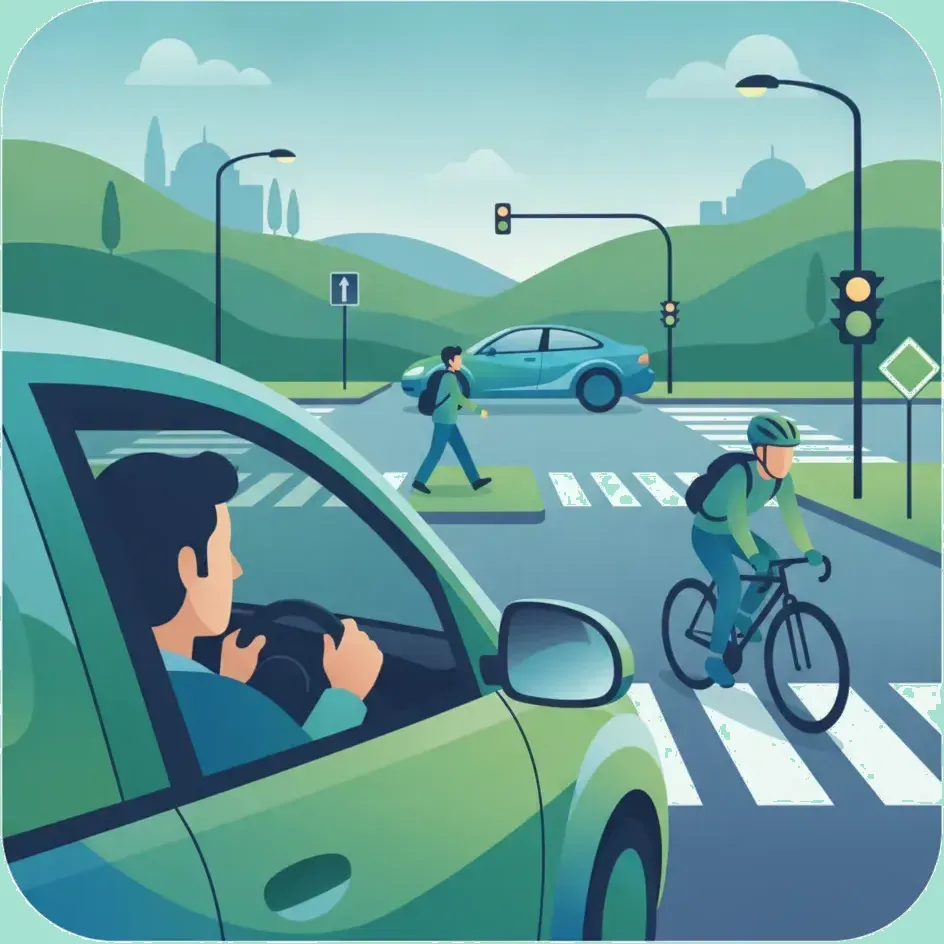
Turning a vehicle safely requires a precise sequence of actions to communicate your intentions and ensure the path is clear. This includes careful observation, clear signalling, correct lane positioning, and adjusting your speed. Neglecting any of these steps can lead to dangerous situations, particularly given the dynamic nature of Turkish road traffic and the emphasis on pedestrian safety.
Theory topic content overview
Read the full theory topic guide for Safe Turning Rules with structured, easy-to-scan content built for learners in Turkey. This detailed section explains the exact rule, meaning, traffic context, comparison points, and exam logic behind this Turkish driving theory topic so you can study faster, understand the concept more clearly, and avoid common interpretation mistakes on the theory test.
Safe turning is a fundamental driving skill that involves changing your vehicle's direction onto another road or into a driveway without causing disruption or danger to other road users. Far more than just steering, it requires a precise sequence of observation, communication, positioning, and controlled execution. In Türkiye's dynamic traffic, mastering safe turning maneuvers is crucial for preventing collisions, especially with vulnerable pedestrians and cyclists, and is a key focus of the ehliyet sınavı (driving theory exam).
Every turn at an intersection or road junction introduces a potential conflict point where your path may cross with other vehicles, pedestrians, or cyclists. Misjudging a turn, failing to communicate your intentions, or neglecting priority rules can lead directly to accidents.
In Türkiye, urban areas are often bustling with pedestrian activity, and cyclists are increasingly common. This makes vigilant observation and strict adherence to priority rules when turning paramount. The ehliyet exam specifically tests a driver's understanding of these conflict situations, emphasizing the responsibility drivers have to protect more vulnerable road users. A correct turning technique not only ensures safety but also contributes to smoother traffic flow.
Executing a safe turn is a systematic process that can be broken down into five critical phases:
Before you even touch your indicator, you must scan your surroundings.
Your turn signal (indicator) is your primary way of communicating your intentions to other drivers and road users.
Your vehicle's position on the road further clarifies your turning intention and prepares you for the turn itself.
This is often the most critical phase where mistakes happen.
Perform the turn smoothly and maintain control.
Several factors require a driver to adjust their turning technique:
While the general sequence applies, there are crucial differences, particularly emphasized in the Turkish driving test (ehliyet sınavı):
Consider these common situations:
Learners and even experienced drivers often make these errors:
The Turkish driving curriculum places significant emphasis on protecting vulnerable road users, especially pedestrians and cyclists. During the ehliyet sınavı, expect questions that test your understanding of priority rules at intersections, particularly when turning. Scenarios will often involve a vehicle turning and a pedestrian crossing, and the correct answer will almost always involve yielding to the pedestrian. Familiarity with specific trafik işaretleri indicating turning restrictions (e.g., 'No Left Turn' or 'No Right Turn') is also essential. Always remember the principle: the turning vehicle is responsible for yielding to those continuing straight or crossing their path.
Safe turning is less about instinct and more about a methodical, systematic approach. Always think ahead, communicate clearly, position correctly, yield when necessary, and execute smoothly. This proactive and defensive mindset, particularly regarding vulnerable road users, is the hallmark of a responsible driver on Turkish roads.
Safe turning in Turkish traffic requires a systematic five-phase approach: first observe by checking mirrors and scanning for pedestrians and cyclists, then signal your intentions clearly before changing position, position your vehicle correctly in the lane based on whether you're turning right or left, slow down and yield to pedestrians and oncoming traffic as required, and finally execute the turn smoothly while staying within your lane. The Turkish driving curriculum places strong emphasis on protecting vulnerable road users, particularly pedestrians who have priority almost whenever they are crossing the road you're entering. The ehliyet sınavı frequently tests these priority rules through scenario-based questions, making it essential for learners to internalize that the turning vehicle always bears responsibility for yielding to those continuing straight or crossing its path.
A short set of high-value points that capture the most important ideas from this theory explanation.
Safe turning follows a five-phase sequence: observe surroundings, signal your intention, position correctly in your lane, yield to traffic with priority, then execute the turn smoothly
In Türkiye, pedestrians crossing the road you are entering almost always have priority and you must yield to them before completing any turn
Lane positioning differs by turn direction: move toward the curb for right turns and toward the center line for left turns
Always re-check mirrors, blind spots, and scan for pedestrians or cyclists before entering the turning arc, even after signalling
The turning vehicle is always responsible for yielding to those continuing straight or crossing its path, not the other way around
Signal before slowing down or changing position, not after
For right turns, stay as close to the curb as safely possible without mounting the pavement; for left turns, position toward the center line
Oncoming traffic proceeding straight or turning right has priority over your left turn unless you have a specific green arrow
After completing a turn, manually cancel your indicator if it doesn't self-cancel
Different intersection types (T-junctions, cross-junctions, roundabouts) each require specific turning approaches and priority rule applications
Failing to check blind spots by turning your head—mirrors don't show cyclists or motorcycles in adjacent positions
Late or missing signals confuse other road users and can cause sudden braking or misjudgments
Ignoring pedestrian priority, which is a guaranteed failure point on the ehliyet sınavı and a major cause of accidents in Türkiye
Cutting corners or swinging too wide during the turn, which endangers pedestrians, cyclists, and opposing traffic
Turning at excessive speed reduces control and reaction time when hazards appear mid-maneuver
Start with a short, direct summary of Safe Turning Rules before reading the full explanation below.
To execute a safe turn, first observe your surroundings by checking mirrors and blind spots for other vehicles and pedestrians. Signal your intentions well in advance. Position your vehicle correctly in the lane to indicate your turning direction and avoid blocking others. Slow down to an appropriate speed, and always yield to oncoming traffic, pedestrians, and cyclists who have priority before completing your turn smoothly.
Review the most important terms, rule signals, and traffic concepts linked to Safe Turning Rules.
Explore related theory topic pages connected to Safe Turning Rules and continue with the next useful rule explanation.
See the common search queries learners use when trying to understand Safe Turning Rules in Turkey.

Dive deeper into specific Turkish driving theory topics like traffic signs, first aid, or vehicle mechanics. Each section offers clear explanations to enhance your understanding of official traffic legislation and prepare you effectively for every aspect of your upcoming ehliyet exam in Türkiye.
Explore Turkish Driving Theory TopicsTheory topic content overview
A short set of high-value points that capture the most important ideas from this theory explanation.
Safe turning follows a five-phase sequence: observe surroundings, signal your intention, position correctly in your lane, yield to traffic with priority, then execute the turn smoothly
In Türkiye, pedestrians crossing the road you are entering almost always have priority and you must yield to them before completing any turn
Lane positioning differs by turn direction: move toward the curb for right turns and toward the center line for left turns
Always re-check mirrors, blind spots, and scan for pedestrians or cyclists before entering the turning arc, even after signalling
The turning vehicle is always responsible for yielding to those continuing straight or crossing its path, not the other way around
Signal before slowing down or changing position, not after
For right turns, stay as close to the curb as safely possible without mounting the pavement; for left turns, position toward the center line
Oncoming traffic proceeding straight or turning right has priority over your left turn unless you have a specific green arrow
After completing a turn, manually cancel your indicator if it doesn't self-cancel
Different intersection types (T-junctions, cross-junctions, roundabouts) each require specific turning approaches and priority rule applications
Failing to check blind spots by turning your head—mirrors don't show cyclists or motorcycles in adjacent positions
Late or missing signals confuse other road users and can cause sudden braking or misjudgments
Ignoring pedestrian priority, which is a guaranteed failure point on the ehliyet sınavı and a major cause of accidents in Türkiye
Cutting corners or swinging too wide during the turn, which endangers pedestrians, cyclists, and opposing traffic
Turning at excessive speed reduces control and reaction time when hazards appear mid-maneuver
Start with a short, direct summary of Safe Turning Rules before reading the full explanation below.
To execute a safe turn, first observe your surroundings by checking mirrors and blind spots for other vehicles and pedestrians. Signal your intentions well in advance. Position your vehicle correctly in the lane to indicate your turning direction and avoid blocking others. Slow down to an appropriate speed, and always yield to oncoming traffic, pedestrians, and cyclists who have priority before completing your turn smoothly.
Review the most important terms, rule signals, and traffic concepts linked to Safe Turning Rules.
Explore related theory topic pages connected to Safe Turning Rules and continue with the next useful rule explanation.
See the common search queries learners use when trying to understand Safe Turning Rules in Turkey.
Dive deeper into specific Turkish driving theory topics like traffic signs, first aid, or vehicle mechanics. Each section offers clear explanations to enhance your understanding of official traffic legislation and prepare you effectively for every aspect of your upcoming ehliyet exam in Türkiye.
Explore Turkish Driving Theory TopicsUse this exam-focused revision tip to understand how Safe Turning Rules is likely to appear in theory questions for learners in Turkey. This section helps you identify the most testable part of the rule, avoid common traps, and remember the concept more effectively during Turkish driving theory exam preparation.
The Turkish driving theory exam frequently tests your knowledge of priority rules during turns, especially concerning pedestrians and oncoming traffic. Remember that pedestrians crossing the road you are entering almost always have priority, and you must yield to them. Pay close attention to scenario questions involving signalling and lane choice for both left and right turns.
Read direct answers to the most common learner questions about Safe Turning Rules in Turkey. This FAQ focuses on rule confusion, practical meaning, comparison with similar concepts, and the exact uncertainties that appear most often in Turkish driving theory revision and exam preparation.
The general sequence is: Observe (mirrors, blind spots, pedestrians), Signal (well in advance), Position (correct lane), Speed (reduce), Look (for priority users), and Turn (smoothly, maintaining speed).
You should start signalling early enough to give other road users, including those behind you and oncoming traffic, sufficient time to understand your intentions and react safely. A good rule of thumb is at least 30 meters before the turn.
Generally, you must yield to oncoming traffic when making a left turn. For both left and right turns, you must yield to pedestrians and cyclists who are crossing the road you intend to enter, as they typically have priority.
Correct lane positioning clearly communicates your intention to turn, prevents other drivers from trying to overtake you on the side you're turning towards, and helps you execute the turn safely without encroaching on other lanes or road users.
Common mistakes include failing to observe properly (especially blind spots), not signalling early enough, incorrect lane positioning, turning too wide or too sharply, and failing to yield to pedestrians or priority traffic.
Turning maneuvers are particularly hazardous for cyclists and pedestrians because they may be in your blind spot or crossing the road you are turning into. Always check thoroughly and yield to them, as they are vulnerable road users.
Use our comprehensive practice search to find exactly the Turkish driving theory questions you need to master. Whether reviewing specific road signs, traffic rules, or first aid scenarios, select your perfect practice set and boost your confidence for the official ehliyet sınavı.