
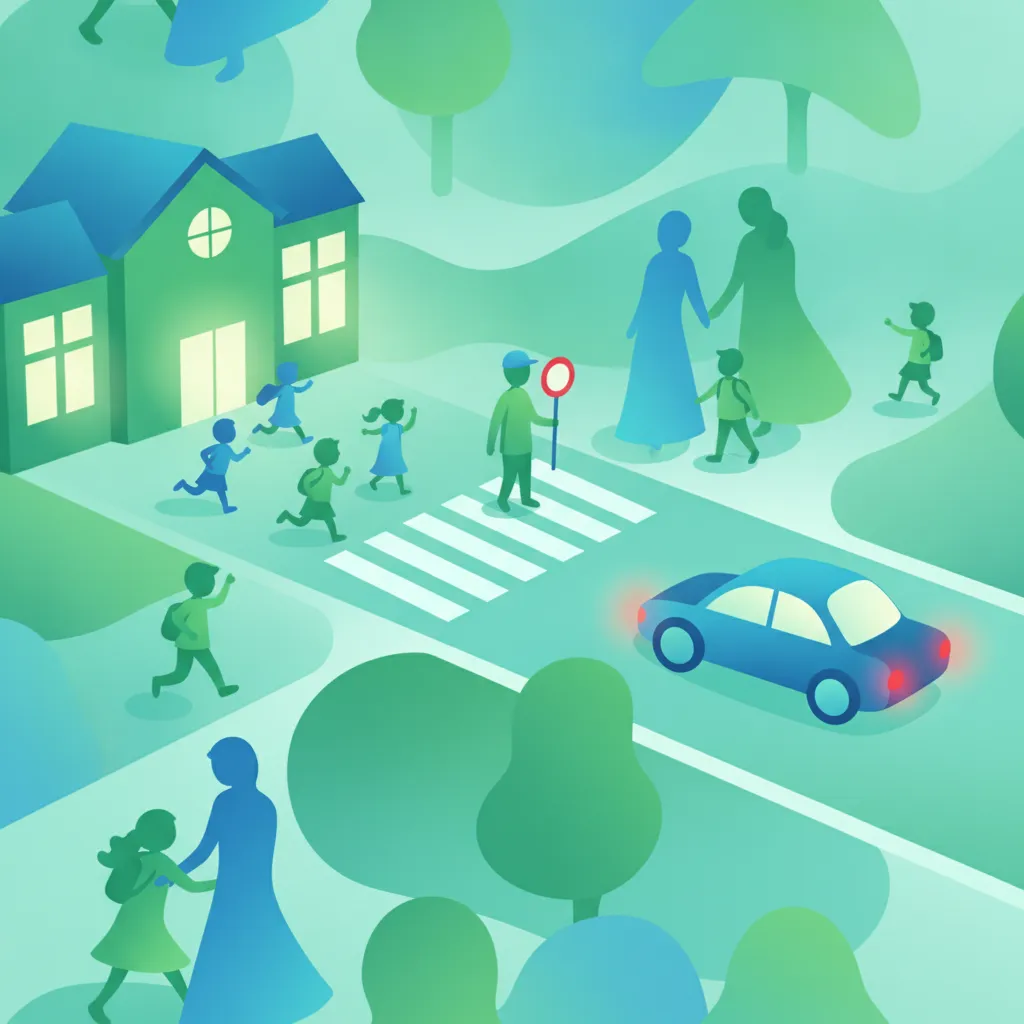
School zones are designated areas around educational institutions where children frequently cross roads, walk, or cycle. Drivers in Türkiye must understand and apply special precautions here, primarily reducing speed and maintaining heightened vigilance, to prevent accidents involving young pedestrians and cyclists. These areas often have specific rules and conditions that demand extra attention, particularly during school pick-up and drop-off times.
Theory topic content overview
Read the full theory topic guide for School Zone Driving with structured, easy-to-scan content built for learners in Turkey. This detailed section explains the exact rule, meaning, traffic context, comparison points, and exam logic behind this Turkish driving theory topic so you can study faster, understand the concept more clearly, and avoid common interpretation mistakes on the theory test.
School zones, often referred to as trafik okul bölgeleri in Türkiye, are specific areas around educational institutions where children frequently gather, walk, cycle, and cross roads. These zones demand exceptional vigilance from drivers due to the presence of highly vulnerable and often unpredictable road users: children. A comprehensive understanding of driving safely in school zones is not only crucial for road safety but also a key component of the Turkish ehliyet theory exam.
The primary reason for special precautions in school zones stems from the inherent characteristics of children in traffic. Unlike adults, children typically:
For these reasons, drivers in Türkiye carry a significant responsibility to adapt their driving to protect children in these environments, preventing accidents that can have severe consequences.
Navigating school zones safely involves a combination of reduced speed, heightened awareness, and anticipatory driving. Here are the key practices:
Even if no specific speed limit sign is posted, drivers must always reduce their speed to a level appropriate for the conditions, typically well below the standard urban speed limit. A lower speed provides:
Your focus should be entirely on the road and its surroundings:
Keep your foot ready to cover the brake pedal. If you see children near the road, even if they appear to be on the pavement, be prepared to stop instantly. This proactive stance is vital for avoiding collisions.
In Türkiye, school zones are often indicated by specific trafik işaretleri (traffic signs), which may include:
Always respect these signs and markings, as they are legally binding and designed for safety.
When a school bus in Türkiye stops and flashes its warning lights, it indicates that children are getting on or off. You must stop and wait until the lights are off and the bus starts moving again. Never attempt to pass a stopped school bus with its warning lights active.
If a crossing guard is present, follow their instructions precisely. They are authorized to direct traffic to ensure children cross safely.
Several conditions can further increase the risk in school zones:
It's critical for drivers, especially those preparing for their ehliyet sınavı, to differentiate children from adult pedestrians. While all pedestrians require attention, children's behavior is fundamentally different:
Children, conversely, might not possess these critical abilities, making them far more vulnerable and their actions harder to predict. Treating a child as you would an adult pedestrian is a dangerous mistake.
Consider these common situations that might appear in your ehliyet theory test:
Turkish driving exam candidates and new drivers frequently make these errors in school zones:
When driving in school zones in Türkiye, adopt a mindset of proactive defense. Every decision should prioritize the safety of children. Remember that their lives are in your hands. Always drive as though a child is about to step into your path, ensuring you have enough time and space to react safely. Your vigilance here is a testament to responsible driving and essential for passing your ehliyet exam.
School zones in Türkiye require drivers to exercise exceptional caution due to children's vulnerability as unpredictable road users who lack hazard perception and may behave impulsively. Key practices include reducing speed well below standard limits even without posted signs, constantly scanning for children between parked cars and near school entrances, and being prepared to stop instantly. Drivers must stop for school buses with activated warning lights and follow crossing guard instructions. Risk peaks during school arrival and dismissal times, and drivers should always assume a child might unexpectedly enter the roadway, treating this mindset as essential for both safety and the ehliyet theory exam.
A short set of high-value points that capture the most important ideas from this theory explanation.
Children in traffic lack hazard perception, act impulsively, have limited peripheral vision, and are easily distracted, making them far more unpredictable than adult pedestrians
Drivers must reduce speed in school zones even without posted signs, as lower speeds provide more reaction time and shorter braking distance
Drivers should scan constantly between parked cars, behind buses, and near driveways, assuming a child might run into the road without warning
When a school bus stops and flashes warning lights in Türkiye, drivers must stop and wait until the lights are off before proceeding
School zone risk peaks during morning arrival and afternoon dismissal times when pedestrian and bicycle traffic is highest
Children cannot accurately judge vehicle speed or recognize dangerous traffic situations the way adults can
A ball rolling into the street signals that a child may follow it into the road, requiring immediate speed reduction
School zones in Türkiye are marked with trafik işaretleri including triangular warning signs with child crossing symbols and specific lower speed limits
Always stop for a school bus displaying warning lights in Türkiye—this is a legally binding safety requirement
Treat children as fundamentally different from adult pedestrians; unlike adults, they rarely follow traffic signals or make eye contact with drivers
Assuming the posted speed limit is always safe without adjusting for conditions or peak school times
Scanning only straight ahead and missing children emerging from between parked vehicles or near side streets
Believing children will wait or act logically rather than anticipating sudden impulsive movements like chasing toys or friends
Using a mobile phone or becoming distracted by passengers, which is especially dangerous where unpredictable children are present
Failing to stop when a school bus activates its warning lights, which is both a serious safety hazard and a traffic violation
Start with a short, direct summary of School Zone Driving before reading the full explanation below.
School zones are areas requiring drivers to significantly reduce speed and increase their awareness due to the presence of children. In Türkiye, these zones emphasize protecting vulnerable road users who may act unpredictably. Drivers must be prepared to stop suddenly, watch for crossing guards and school buses, and anticipate children entering or exiting school grounds. Prioritizing safety here is crucial for avoiding accidents and passing your driving theory exam.
Review the most important terms, rule signals, and traffic concepts linked to School Zone Driving.
Explore related theory topic pages connected to School Zone Driving and continue with the next useful rule explanation.
See the common search queries learners use when trying to understand School Zone Driving in Turkey.

Dive deeper into specific Turkish driving theory topics like traffic signs, first aid, or vehicle mechanics. Each section offers clear explanations to enhance your understanding of official traffic legislation and prepare you effectively for every aspect of your upcoming ehliyet exam in Türkiye.
Explore Turkish Driving Theory TopicsTheory topic content overview
A short set of high-value points that capture the most important ideas from this theory explanation.
Children in traffic lack hazard perception, act impulsively, have limited peripheral vision, and are easily distracted, making them far more unpredictable than adult pedestrians
Drivers must reduce speed in school zones even without posted signs, as lower speeds provide more reaction time and shorter braking distance
Drivers should scan constantly between parked cars, behind buses, and near driveways, assuming a child might run into the road without warning
When a school bus stops and flashes warning lights in Türkiye, drivers must stop and wait until the lights are off before proceeding
School zone risk peaks during morning arrival and afternoon dismissal times when pedestrian and bicycle traffic is highest
Children cannot accurately judge vehicle speed or recognize dangerous traffic situations the way adults can
A ball rolling into the street signals that a child may follow it into the road, requiring immediate speed reduction
School zones in Türkiye are marked with trafik işaretleri including triangular warning signs with child crossing symbols and specific lower speed limits
Always stop for a school bus displaying warning lights in Türkiye—this is a legally binding safety requirement
Treat children as fundamentally different from adult pedestrians; unlike adults, they rarely follow traffic signals or make eye contact with drivers
Assuming the posted speed limit is always safe without adjusting for conditions or peak school times
Scanning only straight ahead and missing children emerging from between parked vehicles or near side streets
Believing children will wait or act logically rather than anticipating sudden impulsive movements like chasing toys or friends
Using a mobile phone or becoming distracted by passengers, which is especially dangerous where unpredictable children are present
Failing to stop when a school bus activates its warning lights, which is both a serious safety hazard and a traffic violation
Start with a short, direct summary of School Zone Driving before reading the full explanation below.
School zones are areas requiring drivers to significantly reduce speed and increase their awareness due to the presence of children. In Türkiye, these zones emphasize protecting vulnerable road users who may act unpredictably. Drivers must be prepared to stop suddenly, watch for crossing guards and school buses, and anticipate children entering or exiting school grounds. Prioritizing safety here is crucial for avoiding accidents and passing your driving theory exam.
Review the most important terms, rule signals, and traffic concepts linked to School Zone Driving.
Explore related theory topic pages connected to School Zone Driving and continue with the next useful rule explanation.
See the common search queries learners use when trying to understand School Zone Driving in Turkey.
Dive deeper into specific Turkish driving theory topics like traffic signs, first aid, or vehicle mechanics. Each section offers clear explanations to enhance your understanding of official traffic legislation and prepare you effectively for every aspect of your upcoming ehliyet exam in Türkiye.
Explore Turkish Driving Theory TopicsUse this exam-focused revision tip to understand how School Zone Driving is likely to appear in theory questions for learners in Turkey. This section helps you identify the most testable part of the rule, avoid common traps, and remember the concept more effectively during Turkish driving theory exam preparation.
Remember that the Turkish driving theory exam often includes scenarios testing your awareness in school zones. Focus on the *why*: children are unpredictable. Always choose the safest, slowest, and most cautious option when faced with a school zone question, even if no explicit speed limit sign is shown.
Read direct answers to the most common learner questions about School Zone Driving in Turkey. This FAQ focuses on rule confusion, practical meaning, comparison with similar concepts, and the exact uncertainties that appear most often in Turkish driving theory revision and exam preparation.
A school zone is an area near schools and educational institutions where children are likely to be present, requiring drivers to take extra precautions. These areas may or may not be explicitly marked with specific signs, but the presence of a school implies the need for caution.
While there might not always be a posted lower speed limit, the general rule in Turkish traffic law is to drive at a speed appropriate for the conditions, which means significantly reducing speed and being prepared to stop in school zones due to the unpredictable nature of children.
Children are considered vulnerable because they may have limited traffic awareness, act impulsively, and are less visible to drivers than adults. Their behavior is often unpredictable, making them highly susceptible to accidents.
Be alert for children crossing unexpectedly, stepping out from behind parked cars or buses, cycling on pavements, and groups of students congregating. Also, watch for crossing guards and school buses stopping to pick up or drop off students.
If a school bus is stopped with its warning lights flashing, indicating children are boarding or alighting, you must stop and wait until the lights are off and the bus resumes movement, ensuring no children are still crossing or in the road.
Türkiye uses standard road signs, including triangular warning signs for 'Children' (Çocuklar). These signs, along with 'Caution' (Dikkat) signs, alert drivers to the presence of schools and the need for heightened vigilance and reduced speed.
The ehliyet theory exam frequently includes questions on hazard perception and safe driving practices in vulnerable areas like school zones. You'll be tested on your knowledge of appropriate speeds, awareness, and reactions to child pedestrians.
The primary goal is to enhance the safety of children. By enforcing reduced speeds and increased driver vigilance, the risk of accidents involving young pedestrians and cyclists is significantly lowered, creating a safer environment around schools.
Use our comprehensive practice search to find exactly the Turkish driving theory questions you need to master. Whether reviewing specific road signs, traffic rules, or first aid scenarios, select your perfect practice set and boost your confidence for the official ehliyet sınavı.