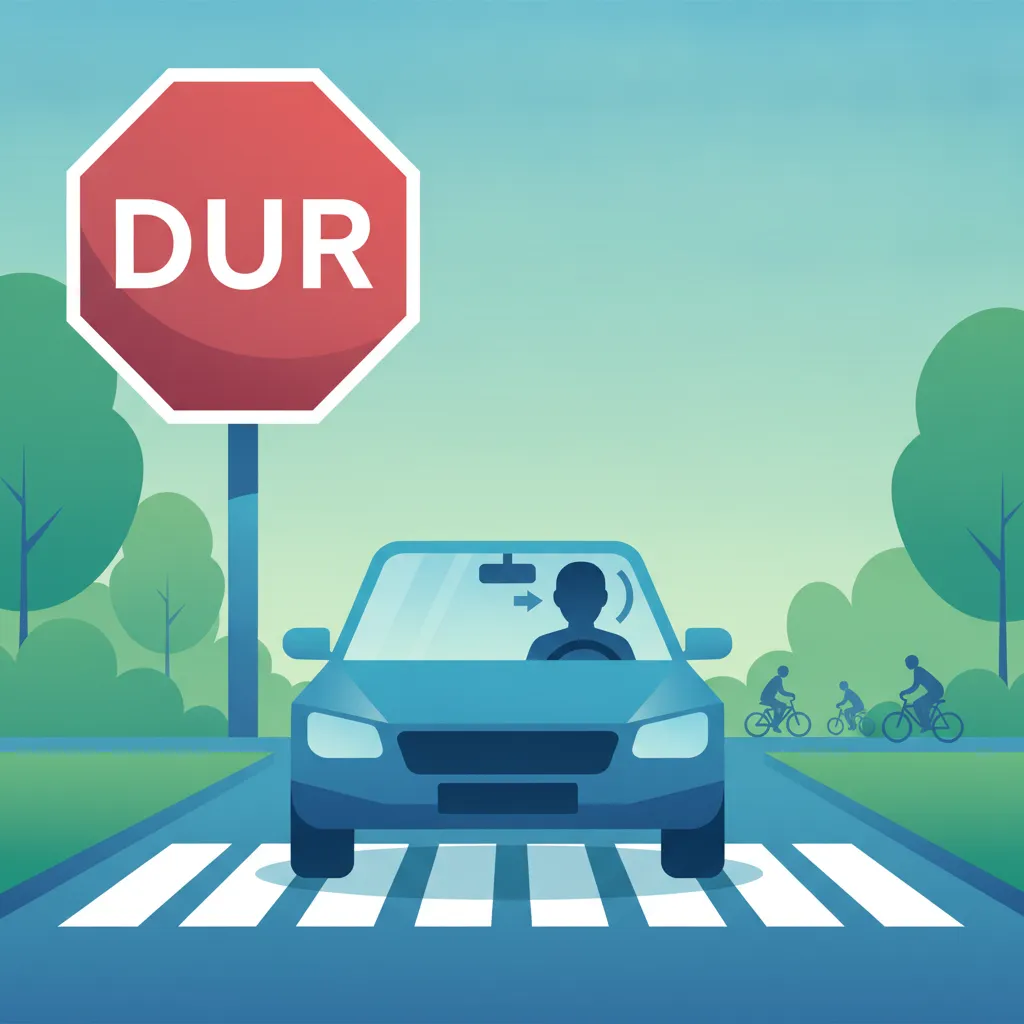
The stop sign, known as 'Dur Levhası' in Turkish, is a crucial regulatory sign that requires drivers to bring their vehicle to a full and complete stop. This page explains exactly what a driver must do at a stop sign, how to safely assess traffic before proceeding, and why this rule is fundamental for road safety and your ehliyet sınavı.
Theory topic content overview
Read the full theory topic guide for Stop Sign Rules with structured, easy-to-scan content built for learners in Turkey. This detailed section explains the exact rule, meaning, traffic context, comparison points, and exam logic behind this Turkish driving theory topic so you can study faster, understand the concept more clearly, and avoid common interpretation mistakes on the theory test.
A stop sign, universally recognised by its octagonal shape and the word "STOP," is a critical regulatory traffic sign that mandates drivers to bring their vehicle to a complete and absolute halt before proceeding. In Türkiye, this vital sign is known as "Dur Levhası" (Stop Sign).
Its primary purpose is to ensure drivers pause long enough to safely assess all intersecting traffic and road users, preventing collisions at high-risk points such as junctions with limited visibility, railway crossings, or where minor roads meet major thoroughfares. Unlike many other signs, the instruction from a Dur Levhası is non-negotiable: a full stop is always required, regardless of whether you perceive the road to be clear.
Understanding and strictly adhering to the Dur Levhası rule is paramount for several reasons specific to driving in Türkiye:
Ehliyet Sınavı): The Dur Levhası is a frequently tested topic in the ehliyet sınavı (Turkish driving license theory exam) and the practical driving test. A common point of failure is misunderstanding the complete stop requirement or confusing it with a yield sign.Dur Levhası is a serious traffic violation under Turkish law, carrying penalties and endangering lives. It demonstrates a disregard for fundamental safety rules.Dur Levhası unequivocally assigns priority to all other road users on the intersecting path, simplifying complex right-of-way situations and reducing ambiguity.Adhering to a Dur Levhası involves a specific sequence of actions to ensure maximum safety and compliance:
Dur Levhası, reduce your speed significantly and prepare to stop. Look for the sign itself and any accompanying white dur çizgisi (stop line) painted on the road.dur çizgisi. If there is no stop line, you must stop before entering the intersection, at a point where you have the best possible view of crossing traffic without obstructing it. Never stop in the intersection or on a pedestrian crossing.Several elements can influence how you interact with a Dur Levhası in Turkish traffic:
This is one of the most vital distinctions for learners in Türkiye and a common ehliyet sınavı question. Misunderstanding this difference is dangerous.
DUR Levhası (Stop Sign):
Yol Ver Levhası (Yield Sign / Give Way Sign):
The critical difference lies in the absolute requirement for a full stop with a Dur Levhası, regardless of whether you perceive the road to be clear.
Consider these practical situations with a Dur Levhası:
Dur Levhası at a junction with a main road. Buildings and parked cars severely restrict your view of traffic on the main road.
dur çizgisi. Then, carefully and slowly, edge your vehicle forward. Stop again if necessary, just enough to see clearly down the main road, without entering the lane of priority traffic. Only when you have a guaranteed safe gap, proceed.Dur Levhası before a pedestrian crossing. As you prepare to move, a pedestrian steps onto the crossing from your right.
Dur Levhası during rush hour. Traffic is heavy and fast-moving.
Learners taking their ehliyet sınavı and new drivers in Türkiye frequently make these mistakes regarding Dur Levhası rules:
Dur Çizgisi): Stopping with the front of the vehicle over the white stop line, or even into the intersection. This obstructs the view of other drivers and can cause collisions.Dur Levhası like a Yol Ver Levhası, incorrectly assuming they can proceed without stopping if the road appears empty.The ehliyet sınavı (driving theory exam) in Türkiye places significant emphasis on trafik işaretleri (traffic signs), and the Dur Levhası is a cornerstone of this section. Exam questions often test your understanding of:
complete stop.Dur Levhası and a Yol Ver Levhası.Dur Levhası.A thorough understanding of this topic is fundamental not just for passing your theory exam, but for developing safe driving habits critical for Turkish traffic.
To ensure you always comply with a Dur Levhası and drive safely in Türkiye:
dur çizgisi or intersection edge.This patient, disciplined approach is your best defense against accidents and ensures you drive responsibly according to Turkish traffic law.
The DUR Levhası (Stop Sign) in Turkish traffic is an octagonal regulatory sign requiring drivers to bring their vehicle to a complete, absolute halt before the stop line or intersection. The procedure follows 'Stop, Look, Wait, Go' – fully stop, scan for all road users including pedestrians and cyclists, wait until the path is completely clear, then proceed without impeding priority traffic. This rule is frequently tested in the ehliyet sınavı and carries legal penalties for violations. The critical distinction from the Yol Ver Levhası (Yield Sign) is that a yield sign never requires a complete stop if the road is clear, whereas the DUR Levhası mandates one without exception.
A short set of high-value points that capture the most important ideas from this theory explanation.
The DUR Levhası requires an absolute, complete halt – your wheels must be completely stationary, not just slowed down
Stop before the white dur çizgisi (stop line) or before entering the intersection at a point with best visibility
After stopping, actively scan all directions for vehicles, cyclists, and pedestrians before proceeding
The DUR Levhası differs fundamentally from the Yol Ver Levhası – yield signs do not require a complete stop
Priority is always given to other road users on the intersecting path when you have a stop sign
DUR Levhası = mandatory complete stop; Yol Ver Levhası = give way but may proceed without stopping if safe
Where to stop: before the dur çizgisi, or before the intersection if no line exists
When visibility is limited, stop at the line first, then creep forward to see, stop again if needed before entering
Pedestrians on or approaching a crossing always have priority – wait until they have cleared
Never proceed if you would cause any other road user to brake, swerve, or change speed
The 'rolling stop' – slowing down significantly but never fully stopping the vehicle
Stopping past the white stop line or inside the intersection, blocking the view of other drivers
Confusing the DUR Levhası with a Yol Ver Levhası and proceeding without stopping when the road appears clear
Not checking all directions thoroughly – a quick glance is insufficient
Proceeding too soon into a gap that is too small, forcing priority traffic to take evasive action
Start with a short, direct summary of Stop Sign Rules before reading the full explanation below.
A stop sign (DUR Levhası) means you must bring your vehicle to a complete stop before the white stop line or, if none, before the intersection where you have a clear view. After stopping, you must check for all other road users – including vehicles, cyclists, and pedestrians – and only proceed when it is completely safe and you will not impede traffic. This is a non-negotiable full stop, unlike a yield sign.
Review the most important terms, rule signals, and traffic concepts linked to Stop Sign Rules.
Explore related theory topic pages connected to Stop Sign Rules and continue with the next useful rule explanation.
See the common search queries learners use when trying to understand Stop Sign Rules in Turkey.

Dive deeper into specific Turkish driving theory topics like traffic signs, first aid, or vehicle mechanics. Each section offers clear explanations to enhance your understanding of official traffic legislation and prepare you effectively for every aspect of your upcoming ehliyet exam in Türkiye.
Explore Turkish Driving Theory TopicsTheory topic content overview
A short set of high-value points that capture the most important ideas from this theory explanation.
The DUR Levhası requires an absolute, complete halt – your wheels must be completely stationary, not just slowed down
Stop before the white dur çizgisi (stop line) or before entering the intersection at a point with best visibility
After stopping, actively scan all directions for vehicles, cyclists, and pedestrians before proceeding
The DUR Levhası differs fundamentally from the Yol Ver Levhası – yield signs do not require a complete stop
Priority is always given to other road users on the intersecting path when you have a stop sign
DUR Levhası = mandatory complete stop; Yol Ver Levhası = give way but may proceed without stopping if safe
Where to stop: before the dur çizgisi, or before the intersection if no line exists
When visibility is limited, stop at the line first, then creep forward to see, stop again if needed before entering
Pedestrians on or approaching a crossing always have priority – wait until they have cleared
Never proceed if you would cause any other road user to brake, swerve, or change speed
The 'rolling stop' – slowing down significantly but never fully stopping the vehicle
Stopping past the white stop line or inside the intersection, blocking the view of other drivers
Confusing the DUR Levhası with a Yol Ver Levhası and proceeding without stopping when the road appears clear
Not checking all directions thoroughly – a quick glance is insufficient
Proceeding too soon into a gap that is too small, forcing priority traffic to take evasive action
Start with a short, direct summary of Stop Sign Rules before reading the full explanation below.
A stop sign (DUR Levhası) means you must bring your vehicle to a complete stop before the white stop line or, if none, before the intersection where you have a clear view. After stopping, you must check for all other road users – including vehicles, cyclists, and pedestrians – and only proceed when it is completely safe and you will not impede traffic. This is a non-negotiable full stop, unlike a yield sign.
Review the most important terms, rule signals, and traffic concepts linked to Stop Sign Rules.
Explore related theory topic pages connected to Stop Sign Rules and continue with the next useful rule explanation.
See the common search queries learners use when trying to understand Stop Sign Rules in Turkey.
Dive deeper into specific Turkish driving theory topics like traffic signs, first aid, or vehicle mechanics. Each section offers clear explanations to enhance your understanding of official traffic legislation and prepare you effectively for every aspect of your upcoming ehliyet exam in Türkiye.
Explore Turkish Driving Theory TopicsUse this exam-focused revision tip to understand how Stop Sign Rules is likely to appear in theory questions for learners in Turkey. This section helps you identify the most testable part of the rule, avoid common traps, and remember the concept more effectively during Turkish driving theory exam preparation.
A common mistake in the Turkish driving theory exam and in practice is treating a stop sign like a yield sign, only slowing down. Remember, 'DUR' means a full, complete stop – your wheels must be absolutely still. Always verify that you've stopped before the line and checked all directions before proceeding, as this detail is often tested.
Read direct answers to the most common learner questions about Stop Sign Rules in Turkey. This FAQ focuses on rule confusion, practical meaning, comparison with similar concepts, and the exact uncertainties that appear most often in Turkish driving theory revision and exam preparation.
The primary requirement of a stop sign (DUR Levhası) in Turkey is to bring your vehicle to a complete and full stop before the designated stop line or the intersection itself, regardless of whether traffic is approaching.
Unlike a yield sign (YOL VER Levhası), which may allow you to proceed without stopping if the road is clear, a stop sign absolutely requires a complete stop. You must stop, then check for traffic, and only proceed when safe.
You should stop before the solid white stop line painted on the road. If there is no line, stop at a point where you have a clear view of the intersecting traffic without entering the intersection.
After stopping, you must carefully look for other vehicles, cyclists, and pedestrians from all directions. You may only proceed when your path is clear and you can do so without interfering with other road users or causing danger.
Yes, failing to stop at a stop sign is considered a serious traffic violation in Türkiye, as it significantly increases the risk of collisions at intersections and undermines traffic safety.
The ehliyet sınavı often includes questions differentiating the stop sign from other priority signs and testing your understanding of the 'complete stop' requirement and the correct procedure for proceeding safely.
The stop sign specifically applies to vehicles. Pedestrians and cyclists should always be aware of traffic rules and exercise caution, but the legal requirement for a 'complete stop' is for drivers of motor vehicles.
Use our comprehensive practice search to find exactly the Turkish driving theory questions you need to master. Whether reviewing specific road signs, traffic rules, or first aid scenarios, select your perfect practice set and boost your confidence for the official ehliyet sınavı.