This lesson explores the legal complexities of urban riding, focusing on lane restrictions and the specific infrastructure of French city centers. By understanding where you can legally ride, you will be better prepared to navigate high-density traffic without risking penalties or collisions during your riding journey.
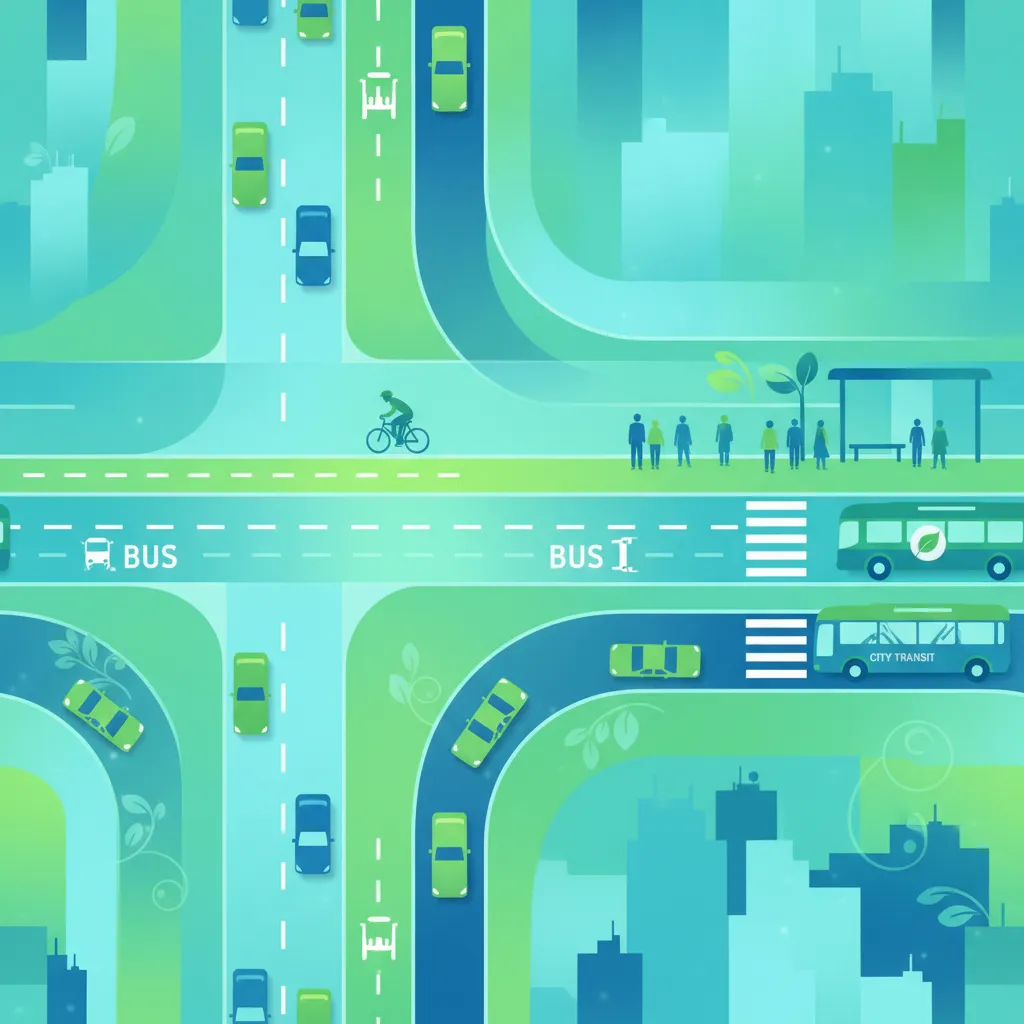
Lesson content overview
Navigating urban traffic requires a deep understanding of road design, legal boundaries, and the protective measures established for different categories of road users. In France, urban centers utilize specialized road infrastructure to prioritize public transport and protect vulnerable road users (VRUs). As a motorcycle rider preparing for your Category A, A1, or A2 licence, you must master the strict rules governing these exclusive lanes and understand the highly regulated framework of lane filtering (circulation inter-files).
This lesson details the legal constraints, safety risks, and operational parameters of riding within urban environments under the French Highway Code (Code de la route).
Urban road networks are shared ecosystems. To improve public transport efficiency and safeguard active mobility (such as cycling), municipal authorities designate specific portions of the roadway for exclusive use.
For motorcyclists, the temptation to use these lanes during peak traffic hours is high. However, doing so violates the principle of Lane Exclusivity. These exclusive lanes are legally isolated to ensure safety, reduce emissions, and streamline the flow of high-capacity or non-motorized vehicles. Encroaching on these spaces disrupts the safety hierarchy, reduces predictability, and significantly increases the risk of severe collisions.
Bus lanes (voies réservées aux transports en commun) are designed to insulate public transit vehicles from general traffic congestion.
Bus lanes in France are identified through a combination of vertical signage and horizontal road markings:
The type of separating line determines your lateral maneuverability:
Under the French Code de la route, motorcycles are strictly prohibited from riding in bus lanes, regardless of traffic conditions.
Common Misconception: Some riders believe that empty bus lanes can be used for overtaking or lane filtering during heavy congestion. This is a severe traffic violation. Bus lanes must remain clear at all times to allow emergency vehicles and public buses to transit without delay.
In some jurisdictions outside of France, local authorities may allow motorcycles in bus lanes. However, in France, this is not the national standard. Unless explicit, highly localized supplementary signage (panonceau) specifies otherwise (which is exceptionally rare and virtually non-existent for motorcycles), the ban is absolute.
Riding in a bus lane carries heavy legal and physical risks:
Cyclists are among the most vulnerable road users (VRUs). To support active mobility and prevent fatal accidents, French road infrastructure utilizes dedicated cycling lanes. Motorcyclists must understand the physical and legal separation of these spaces.
A physically separated cycling path located adjacent to the main roadway or sidewalk. It is often separated by a curb, bollards, or a green buffer strip, and is frequently painted red or green.
A designated lane located directly on the main roadway, separated from general traffic lanes only by a thick, broken white line and marked with bicycle symbols.
Cyclist infrastructure is signaled by specific regulatory signs:
Motorcycles are heavier, wider, and significantly faster than bicycles. The speed differential and mass discrepancy create a highly volatile environment if combined.
Observe Road Markings: Always identify the thick, broken white lines or colored asphalt designating a bande cyclable and keep your motorcycle fully to the left of these markings.
Check Blind Spots: Before turning right across a cycle path or lane, perform a visual check (the "shoulder check") to ensure no cyclists are approaching from your rear-right.
Respect Safe Passing Distances: When overtaking a cyclist on a road without a dedicated lane, you must maintain a lateral safety distance of at least 1 metre in urban areas (and 1.5 metres outside urban areas).
Encroaching on, driving on, or parking on a cycle path or lane is a serious offense under French law.
Lane filtering (circulation inter-files, or CIF) is the practice of riding a two-wheeled vehicle between columns of slow-moving or stationary traffic. In France, this practice is highly regulated and has historically been subject to multi-year experimental pilot programs across specific departments.
Lane filtering is not a permanent, nationwide right under the French Highway Code. Instead, it is authorized under an experimental framework in designated areas characterized by high traffic density.
Where CIF is experimentally permitted, motorcyclists must adhere to strict operational rules:
| Rule Category | Legal Requirement under CIF | Rationale |
|---|---|---|
| Road Type | Only permitted on dual-carriageways and motorways (autoroutes and voies rapides) with at least two lanes in each direction, separated by a physical central median (terre-plein central). The speed limit on these roads must be 70 km/h or higher. | High-speed roads with physical dividers have more predictable traffic flows and no risk of head-on collisions. |
| Positioning | You must ride strictly between the two leftmost lanes (Lanes 1 and 2, counting from the left). | Ensures all drivers know exactly where to expect filtering motorcycles, reducing unpredictable movements. |
| Traffic Condition | Only permitted when traffic is heavily congested and vehicles in both lanes are stationary or moving slowly. | If traffic is moving normally at standard speeds, filtering is highly dangerous and illegal. |
| Maximum Speed | Your speed while filtering must never exceed 50 km/h. | Limits the kinetic energy and ensures you can stop safely if a car suddenly changes lanes. |
| Speed Differential | Your speed relative to the surrounding traffic must not exceed a delta of 30 km/h. | If cars are moving at 10 km/h, your maximum speed must not exceed 40 km/h. |
| Termination | Once traffic speeds up and exceeds 50 km/h, you must immediately merge back into a standard lane and cease filtering. | Standard lane discipline must resume as soon as the bottleneck clears. |
Even within the experimental zones, lane filtering is absolutely forbidden in the following scenarios:
Hazard Lights Usage: While many riders use hazard warning lights (feux de détresse) while filtering, French regulations state that headlights (low beam/dipped beam) are mandatory. The use of hazard lights is tolerated but does not exempt you from speed limits or safe positioning rules.
To help you visualize these rules, let us analyze real-world driving situations that French motorcycle candidates frequently encounter.
Violating these space-management and lane-filtering rules results in severe cumulative penalties.
Understanding the "why" behind these laws will make you a safer, more defensive rider.
The French Highway Code emphasizes a clear safety hierarchy. Heavier, motorized vehicles bear a higher responsibility to protect lighter, non-motorized users.
  [Heavy Vehicles: Trucks / Buses]
                ↓
    [Light Vehicles: Cars / Vans]
                ↓
  [Motorcycles / Mopeds (Category A/A1/A2)]
                ↓
    [Cyclists / Personal Mobility Devices]
                ↓
          [Pedestrians]
As a motorcyclist, you occupy a middle tier. You are highly vulnerable to cars and buses, but you represent a significant danger to cyclists and pedestrians. Respecting exclusive lanes is how you uphold your responsibility within this hierarchy.
When you choose to filter lanes or encroach on reserved lanes, you drastically reduce your safety margins:
Explore all units and lessons included in this driving theory course.
Lesson content overview
Explore all units and lessons included in this driving theory course.
Explore search topics learners often look for when studying Urban Traffic Flow, Bus Lanes, and Cycle Paths. These topics reflect common questions about road rules, driving situations, safety guidance, and lesson level theory preparation for learners in France.
Browse additional driving theory lessons that cover connected traffic rules, road signs, and common driving situations related to this topic. Improve your understanding of how different rules interact across everyday traffic scenarios.
Learn how to proactively manage risks in dense city environments, including identifying blind spots of larger vehicles and predicting the movements of other road users. This lesson provides essential defensive riding techniques for category A motorcyclists to maintain safety in complex traffic flows and navigate hazardous urban road scenarios effectively.

This lesson provides practical strategies for managing the physical demands of slow, heavily congested city traffic. You will learn how to maintain excellent low-speed balance through correct body posture, rear brake modulation, and smooth clutch control. It also emphasizes the importance of preserving an adequate safety buffer when stopping behind other vehicles, allowing an immediate escape route if you face a rear-end threat.

This lesson teaches riders how to approach and cross both controlled and uncontrolled intersections in urban settings. You will practice the 'scanning cycle' technique to identify cross-traffic hazards and manage your defensive line of sight around physical obstructions. The lesson also highlights the critical importance of early signaling and positioning to ensure that turning passenger cars do not violate your safety zone.

This lesson teaches you how to establish and preserve a dynamic cushion of safety on all sides of your motorcycle. You will study how to apply the 'two-second rule' to keep a safe following distance, extending it to three or more seconds in adverse weather. Additionally, you will discover how to manage tailgating motorists safely without resorting to dangerous speed increases, ensuring you always maintain a clear escape route.
Explore the principles of lane positioning for visibility and safety while riding in France. This guide details legal requirements for maintaining space around your motorcycle, understanding lane markings, and executing safe maneuvers in mixed traffic without infringing on restricted infrastructure like bus lanes or cycle paths.

This lesson explores how dividing your travel lane into three distinct vertical zones allows you to adjust your positioning for optimal safety. You will learn to shift your line to avoid oil slicks in the lane center, road debris at the edges, and wind blasts from passing trucks. Crucially, the lesson covers how to adapt your lane position on blind bends to widen your field of vision and stay clear of oncoming traffic.

This lesson outlines the rules and practical safety limits of lane filtering, known as 'inter-files' riding, under French road guidelines. You will study the specific speed limits allowed during filtering, the conditions of high congestion where it is permitted, and where it remains completely banned. The lesson also highlights the critical need to anticipate sudden lane changes from frustrated car drivers stuck in stationary traffic queues.

This lesson details how to safely enter, cruise on, and exit French motorways, known as autoroutes, which feature high-speed traffic flows. You will master the process of matching highway speeds in the acceleration lane and performing blind spot checks before merging. The lesson also explains correct lane positioning to avoid aerodynamic turbulences from large semi-trucks, and how to safely prepare for decelerating at exit ramps.

This lesson covers the operational logic of traffic light signals in France, emphasizing the legal implications of the red, amber, and green cycles. You will study how to safely manage the amber phase to avoid rear-end collisions from vehicles behind while maintaining control. Additionally, you will discover the unique challenge of electromagnetic induction loops, which sometimes fail to detect lightweight motorcycles at quiet intersections.

This lesson explains the correct procedures for entering, circulating, and exiting roundabouts, which are highly prevalent throughout France. You will learn the exact lane choice strategies based on your intended exit, and how to use your turn indicators at each stage of the maneuver. The content also addresses the critical task of performing over-the-shoulder blind spot checks to avoid conflicts with overtaking vehicles when exiting.

This lesson covers the strict legal conditions under which you may overtake other vehicles on French roads, including necessary visibility criteria. You will master the step-by-step process of checking rearview mirrors, performing head checks, signaling, and maintaining a safe speed differential during the pass. It also details when overtaking is strictly forbidden, such as before intersections, near pedestrian crossings, or across solid lines.

This lesson provides a comprehensive breakdown of priority rules under French law, with special focus on the default rule of priorité à droite. You will learn to recognize when this rule applies, even in the absence of explicit signage, and how to verify that entering vehicles see you. It also explains how to read priority road indicators, stop signs, and yield signs, helping you manage right-of-way safely and confidently.
This lesson provides practical strategies for managing the physical demands of slow, heavily congested city traffic. You will learn how to maintain excellent low-speed balance through correct body posture, rear brake modulation, and smooth clutch control. It also emphasizes the importance of preserving an adequate safety buffer when stopping behind other vehicles, allowing an immediate escape route if you face a rear-end threat.

This lesson focuses on identifying regulatory signs, which are circular signs with red borders for prohibitions or blue backgrounds for obligations. You will learn about specific restrictions that impact motorcycle paths, including narrow lane access bans, motorcycle-specific speed limits, and overtaking prohibitions. Mastering these symbols is vital to ensuring compliance with French road law and avoiding immediate traffic penalty points.

This lesson details the legal and physical implications of horizontal markings, including solid white lines, broken warning lines, and cycle lane dividers. You will learn about the strict prohibition against crossing solid lines and how directional arrows dictate correct lane choices at complex junctions. Importantly, the lesson teaches you to recognize the physical hazard of wet road paint, which drastically reduces tire grip during braking.
Find clear answers to common questions learners have about Urban Traffic Flow, Bus Lanes, and Cycle Paths. Learn how the lesson is structured, which driving theory objectives it supports, and how it fits into the overall learning path of units and curriculum progression in France. These explanations help you understand key concepts, lesson flow, and exam focused study goals.
No, as a general rule, motorcycles are prohibited from using bus lanes in France unless a specific sign explicitly authorizes them. Using these lanes without permission can lead to heavy fines.
Experimental lane filtering (inter-files) is permitted under very specific conditions in certain French departments. You must adhere to speed limits and safety spacing; always check if the practice is currently allowed in the area you are riding.
You must never ride on or block cycle paths. Be aware that cyclists may exit or merge into traffic at intersections, so maintain a safe distance and always scan for them in your mirrors before changing position.
The exam frequently uses visual scenarios showing high-density urban areas. Knowing exactly which lanes are restricted is crucial for selecting the correct answers regarding safe and legal maneuver options.
Ready to focus your study? Use the practice search to find exactly the French driving theory questions you need for the Code de la route and permis de conduire ETG. Refine your knowledge on specific topics or challenging rules to boost your confidence and exam readiness.