
This lesson details the critical safety requirements for sharing the road with vulnerable users such as pedestrians and cyclists in France. You will learn how to identify school zones, navigate pedestrian islands, and apply correct passing distances when overtaking bicycles and scooters. Mastering these rules is essential for both your theory exam and real-world motorcycle safety.
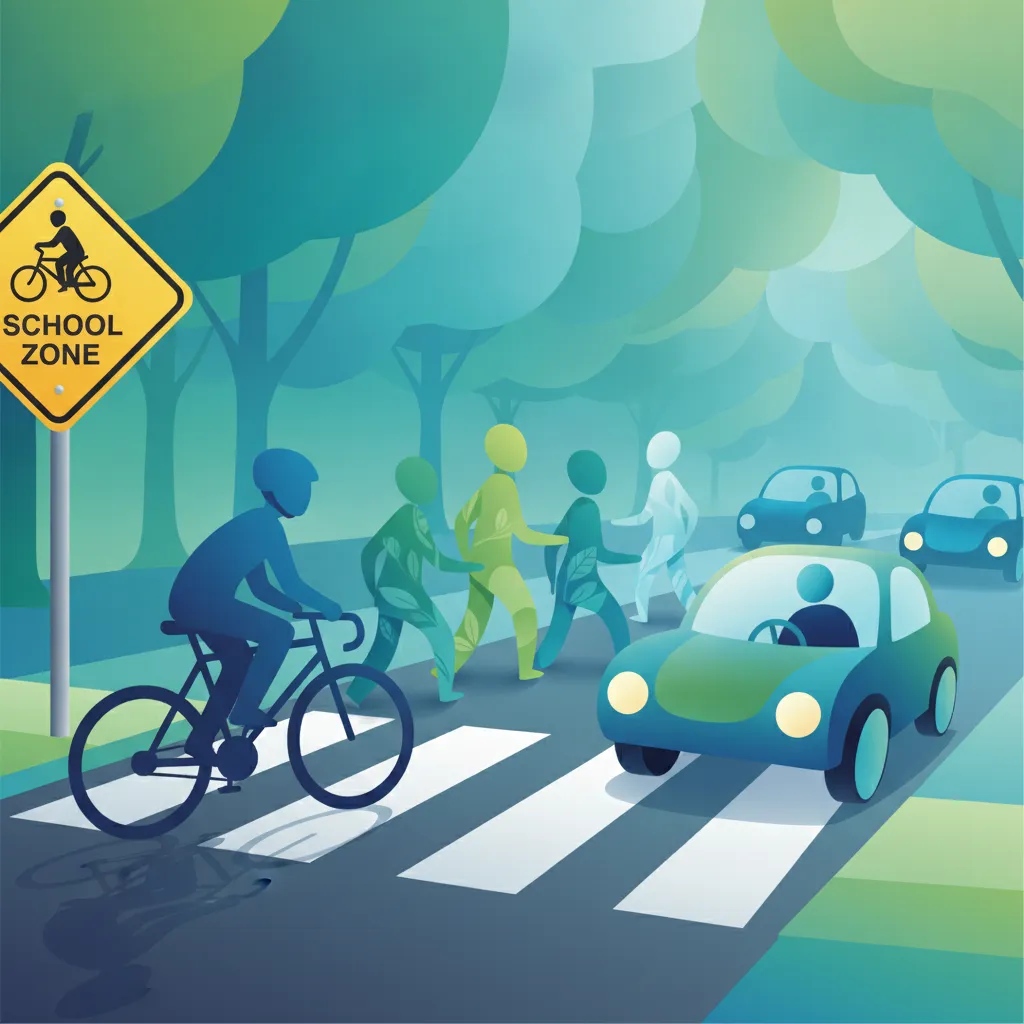
Lesson content overview
Navigating urban environments on a motorcycle requires a high level of sensory awareness and a deep understanding of the rules protecting vulnerable road users. In France, pedestrians, cyclists, and operators of personal electric scooters (Engins de Déplacement Personnel Motorisés or EDPM) are heavily protected by the Code de la route (French Highway Code).
For motorcycle riders preparing for the Épreuve Théorique Moto (ETM) for Category A, A1, or A2 licences, mastering these interaction rules is essential. Motorcyclists must balance their own vehicle stability while actively defending the safety of those sharing the street.
In France, a pedestrian crossing is officially designated as a passage pour piétons. It is marked by wide, white parallel bands painted across the roadway. Under French traffic law, pedestrians have absolute priority once they are on the crossing or have clearly indicated their intention to cross.
Under Article R415-11 of the Code de la route, drivers of all motorized vehicles must yield to any pedestrian who has regularly stepped onto the crossing, or who clearly manifests the intention to do so. This means you do not wait for the pedestrian to step in front of your motorcycle before stopping. If a pedestrian is standing at the curb, facing the crossing, and looking across, you are legally required to slow down and come to a complete stop.
Severe Penalties for Non-Compliance: Failure to yield to a pedestrian at a crossing in France is a serious traffic violation. It carries a heavy fine, a potential suspension of your driving licence, and an automatic deduction of 6 points from your French driver's licence.
When approaching a zebra crossing on a motorcycle, you must manage several physical and environmental risks:
A pedestrian island, or îlot refuge piéton, is a raised structure constructed in the middle of a wide roadway. It divides the crossing into distinct stages, allowing pedestrians to cross one direction of traffic at a time and wait safely in the center.
The presence of a pedestrian island modifies how you must evaluate the pedestrian's path:
School zones require extreme vigilance and proactive speed reduction. Children lack the peripheral vision, speed-judgment capabilities, and hazard-perception skills of adults. They are highly prone to sudden, unpredictable movements, such as darting out between parked cars to chase a ball or catch a school bus.
Upon entering a school zone, you must adapt your speed immediately. The speed limit is typically reduced to 30 km/h or 20 km/h, as indicated by local signage.
Reduce Speed Immediately: Lower your speed to 20 km/h or 30 km/h, even if no children are immediately visible.
Cover the Controls: Keep your hand resting lightly over the front brake lever and your foot poised over the rear brake pedal to minimize your physical reaction time.
Scan Under and Between Cars: Look for small feet, moving shadows, or school bags visible between parked vehicles that indicate a child is about to emerge.
Maintain Low Engine Revs: Avoid high-RPM acceleration or loud exhaust noise that might startle children or mask the sound of other traffic hazards.
To foster safer cities, French urban planning utilizes specialized "shared spaces" where the traditional priority of motorized traffic is reversed or heavily restricted.
A meeting zone (zone de rencontre) is a highly integrated shared space designed to accommodate all road users on equal terms.
In a zone de rencontre:
With the rapid expansion of cycling paths and electric scooter (trottinette électrique) usage in French cities, motorcycle riders must understand how to share lane space safely and execute overtaking maneuvers legally.
When overtaking a cyclist or a personal electric scooter traveling in your direction, you must maintain a safe lateral clearance (distance latérale de sécurité). The Code de la route defines precise minimum distances based on the driving environment:
The minimum physical gap you must maintain between your motorcycle and a cyclist or scooter rider when passing them. Under French law, this is:
If the road is too narrow to guarantee this lateral clearance, you are legally prohibited from overtaking. You must remain behind the cyclist or scooter until the road widens or oncoming traffic clears.
Understanding the consequences of your choices in urban environments is key to passing your motorcycle theory exam and staying safe on the road:
| Action / Condition | Immediate Physical Effect | Legal and Safety Consequence |
|---|---|---|
| Slowing to 20 km/h in school zones | Drastically reduces your stopping distance and increases your field of vision. | Enables you to stop instantly if a child darts out; avoids heavy speeding fines. |
| Maintaining less than 1.0m lateral gap when passing a cyclist | Air displacement and proximity can startle the rider, causing them to fall. | Severe accident risk; high fines and liability under French traffic laws. |
| Braking hard on wet zebra crossing paint | The motorcycle's front wheel loses traction easily due to slippery thermoplastic paint. | High risk of a low-side crash or skidding into the pedestrian crossing. |
| Failing to stop for a pedestrian showing intent to cross | Forces the pedestrian to halt or step back in fear. | 6-point deduction on your driving licence, a heavy fine, and potential licence suspension. |
To prepare for your theoretical exams, explore these curated practice resources and related articles focusing on French urban riding regulations and space management:
This lesson covers the essential French traffic law requirements for motorcycle riders regarding vulnerable road users. You must yield to pedestrians at zebra crossings when they indicate intent to cross, not just when they step onto the markings. School zones demand immediate speed reduction to 20-30 km/h and active scanning for unpredictable child movements. When overtaking cyclists or electric scooters, maintain the legally mandated lateral clearance of at least 1 metre in town and 1.5 metres outside town, and never overtake if the road is too narrow to guarantee these distances. The consequences of non-compliance are severe, including a 6-point deduction and potential licence suspension for failing to yield at crossings.
A short set of high-value points that capture the most important learning from this lesson.
Pedestrians have absolute priority at zebra crossings once they step on or clearly indicate their intention to cross under Article R415-11 of the Code de la route.
You must maintain at least 1.0 metre lateral clearance when overtaking cyclists or EDPM inside built-up areas, and at least 1.5 metres outside.
School zones require immediate speed reduction to 20-30 km/h and proactive scanning between parked vehicles for unpredictable child movements.
Zebra crossing paint has lower friction than asphalt—always complete braking before the white stripes, never on them.
In a zone de rencontre, pedestrians have priority over all vehicles including motorcycles, and the speed limit is capped at 20 km/h.
Explore all units and lessons included in this driving theory course.
Article R415-11 requires you to yield to pedestrians who have 'clearly manifested the intention' to cross—not just those already on the crossing.
Lateral safety distances: 1 metre minimum in town (en agglomération), 1.5 metres minimum outside town (hors agglomération).
Flashing amber beacons in school zones indicate active child presence—maintain heightened readiness to brake.
Pedestrian islands (îlots refuge) split crossings into stages; observe whether waiting pedestrians intend to continue after reaching the island.
If the road is too narrow to guarantee the mandatory lateral clearance, you are legally prohibited from overtaking cyclists or EDPM users.
Assuming you only need to yield once a pedestrian has physically stepped onto the crossing, rather than when they clearly show the intention to cross.
Passing cyclists too closely or at high speed, creating aerodynamic draft that can destabilize the rider.
Braking hard directly on zebra crossing paint, which has significantly lower grip than regular asphalt especially when wet.
Failing to check mirrors early when approaching crossings, increasing the risk of being rear-ended because car drivers behind cannot see why you stopped.
Not reducing speed in school zones when children are not immediately visible, assuming reduced limits only apply when children are in view.
Lesson content overview
A short set of high-value points that capture the most important learning from this lesson.
Pedestrians have absolute priority at zebra crossings once they step on or clearly indicate their intention to cross under Article R415-11 of the Code de la route.
You must maintain at least 1.0 metre lateral clearance when overtaking cyclists or EDPM inside built-up areas, and at least 1.5 metres outside.
School zones require immediate speed reduction to 20-30 km/h and proactive scanning between parked vehicles for unpredictable child movements.
Zebra crossing paint has lower friction than asphalt—always complete braking before the white stripes, never on them.
In a zone de rencontre, pedestrians have priority over all vehicles including motorcycles, and the speed limit is capped at 20 km/h.
Explore all units and lessons included in this driving theory course.
Article R415-11 requires you to yield to pedestrians who have 'clearly manifested the intention' to cross—not just those already on the crossing.
Lateral safety distances: 1 metre minimum in town (en agglomération), 1.5 metres minimum outside town (hors agglomération).
Flashing amber beacons in school zones indicate active child presence—maintain heightened readiness to brake.
Pedestrian islands (îlots refuge) split crossings into stages; observe whether waiting pedestrians intend to continue after reaching the island.
If the road is too narrow to guarantee the mandatory lateral clearance, you are legally prohibited from overtaking cyclists or EDPM users.
Assuming you only need to yield once a pedestrian has physically stepped onto the crossing, rather than when they clearly show the intention to cross.
Passing cyclists too closely or at high speed, creating aerodynamic draft that can destabilize the rider.
Braking hard directly on zebra crossing paint, which has significantly lower grip than regular asphalt especially when wet.
Failing to check mirrors early when approaching crossings, increasing the risk of being rear-ended because car drivers behind cannot see why you stopped.
Not reducing speed in school zones when children are not immediately visible, assuming reduced limits only apply when children are in view.
Explore search topics learners often look for when studying Pedestrian Crossings, School Zones, and Bicycles. These topics reflect common questions about road rules, driving situations, safety guidance, and lesson level theory preparation for learners in France.
Browse additional driving theory lessons that cover connected traffic rules, road signs, and common driving situations related to this topic. Improve your understanding of how different rules interact across everyday traffic scenarios.
Learn how to safely approach various intersection types, handle priority signs, and apply correct positioning techniques in urban settings. This guide covers the French Code de la route requirements for managing complex traffic flows, intersections, and multi-lane roundabouts to ensure safe passage as a motorcyclist.

France features a vast network of roundabouts (carrefours a sens giratoire) governed by specific entry and lane-use regulations. This lesson explains that vehicles entering a roundabout must yield to traffic already circulating inside. You will learn how to select the correct lane depending on your exit, use direction indicators properly, and yield to pedestrians and cyclists near roundabout exits.

This lesson analyzes the technical path a long wheelbase vehicle must take when turning at intersections and navigating roundabouts. Drivers will learn to calculate tail swing and rear-wheel tracking, intentionally swinging wide to clear roadside curbs and poles safely. The lesson emphasizes yielding protocols for pedestrians and cyclists who may be crossing the target street during the turn.
This lesson focuses on the skills required to safely enter, navigate, and exit roundabouts, a common feature in French urban environments. Learners will understand the need to yield to circulating traffic, select the appropriate lane upon entry, and signal intentions when exiting. By mastering these techniques, AM riders can safely integrate into roundabout traffic flow and reduce conflicts with other road users.
Some crossroads feature complex layouts or specific signs that modify standard priority rules, such as schematic diagrams (panonceaux schematiques). This lesson teaches you how to read these auxiliary signs, which depict the thick line of the priority road and thin lines of secondary roads. You will learn how to maintain priority when the main road curves and how to navigate non-standard intersection layouts.

Negotiating crossroads that lack active traffic light signals requires a clear reading of signs and painted stop or yield lines. This lesson details the obligations of stopping completely at stop signs and slowing down to yield at 'cedez le passage' markings. You will learn to assess cross-traffic speeds, determine priorities when multiple vehicles arrive, and execute turns safely.

This lesson explains the correct procedures for entering, circulating, and exiting roundabouts, which are highly prevalent throughout France. You will learn the exact lane choice strategies based on your intended exit, and how to use your turn indicators at each stage of the maneuver. The content also addresses the critical task of performing over-the-shoulder blind spot checks to avoid conflicts with overtaking vehicles when exiting.

Controlled intersections use traffic lights and accompanying signs to manage busy crossings systematically. This lesson covers how to safely proceed on a green light, negotiate left turns when yielding to oncoming traffic, and obey flashing amber lights. You will also learn the hierarchy of traffic control, where police officer gestures overrule both traffic lights and priority signs.

This lesson covers the operational logic of traffic light signals in France, emphasizing the legal implications of the red, amber, and green cycles. You will study how to safely manage the amber phase to avoid rear-end collisions from vehicles behind while maintaining control. Additionally, you will discover the unique challenge of electromagnetic induction loops, which sometimes fail to detect lightweight motorcycles at quiet intersections.
Learners will learn the critical steps for safely approaching and traversing intersections, emphasizing speed reduction, priority assessment, and adherence to right-of-way rules, including priorité à droite. The lesson covers recognizing stop lines, interpreting road markings, and maintaining a safe distance from other vehicles. By mastering these practices, AM riders can confidently navigate intersections while minimizing collision risk.

In France, the default rule at any intersection without clear priority signage is priority-to-the-right (priorite a droite). This lesson explains how to identify unsignaled junctions in urban and rural environments and when you must yield to incoming vehicles. You will learn to spot the standard yellow diamond priority signs and triangular warning signs that indicate whether you hold the priority.
Explore proactive risk management and hazard perception techniques when riding in dense urban environments. Understand how to anticipate the movements of vulnerable road users, interpret traffic light signals, and maintain optimal spatial awareness to prevent accidents and navigate shared road spaces safely.

This lesson provides practical strategies for managing the physical demands of slow, heavily congested city traffic. You will learn how to maintain excellent low-speed balance through correct body posture, rear brake modulation, and smooth clutch control. It also emphasizes the importance of preserving an adequate safety buffer when stopping behind other vehicles, allowing an immediate escape route if you face a rear-end threat.

Learners will develop the ability to anticipate potential hazards on the road, enhancing reaction times and defensive riding strategies. The lesson emphasizes constant scanning, early identification of threats such as sudden stops, pedestrian crossings, or unexpected lane changes, and appropriate response measures. By cultivating proactive risk assessment, AM riders can significantly reduce accident likelihood.
This final lesson integrates all course concepts into a single, cohesive approach to defensive riding and continuous risk assessment. You will study how to maintain a high-mileage visual lead, continuously scanning the road ahead for warning signs of conflict. By learning to assume that other motorists may not see you, you will build the proactive slowing habits and situational awareness needed to remain safe throughout your riding life.

This lesson provides global defensive driving strategies to minimize collision risks for all non-motorized and vulnerable road users. Drivers will learn to systematically lower vehicle speed in dense pedestrian zones, even when no active hazards are visible. By cultivating an anticipatory mindset and maintaining generous safety margins, professional drivers establish a protective safety envelope around their vehicle.

Certain groups of road users require heightened defensive attention from drivers due to physical limitations or unpredictable behaviors. This lesson covers how to recognize signs of visual impairment (white canes), mobility challenges, and the unpredictability of young children. You will learn to reduce your speed, extend yielding patience, and proactively secure extra space to protect these vulnerable users.
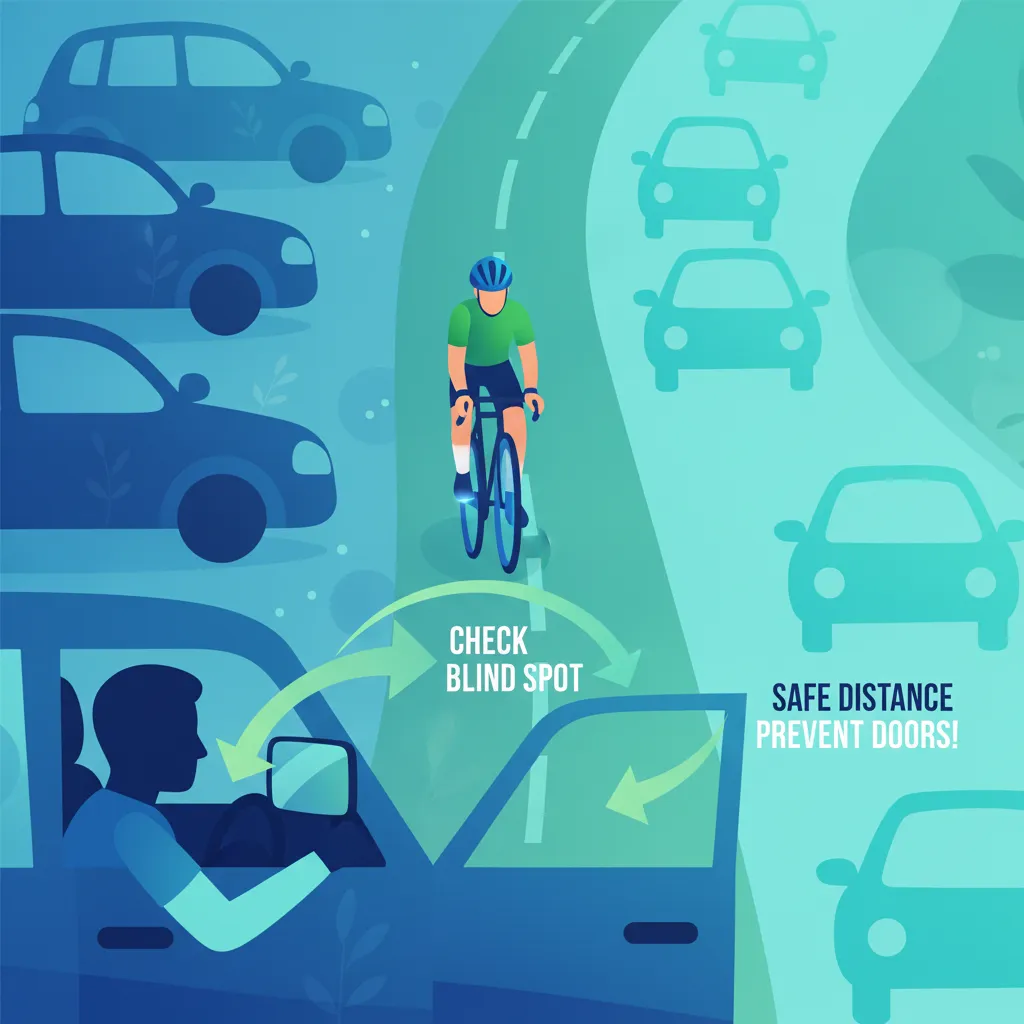
This lesson explains how to share the road safely with cyclists in both urban and rural environments. Drivers will study the legal minimum passing distances when overtaking cyclists, which is one meter in cities and one and a half meters outside urban areas. It also covers recognizing specialized cycling infrastructure, bike boxes at intersections, and preventing blind-spot collisions during right turns.

Rural roads account for a high percentage of severe accidents due to narrow widths, winding geometries, and sudden hazards. This lesson teaches strategies for negotiating sharp bends, handling agricultural machinery, and reacting to wildlife warning signs. You will learn to manage your vehicle's lane placement on roads with soft shoulders and understand speed limits on rural networks.

This lesson provides guidance on safe riding practices during nighttime, emphasizing proper headlamp usage, reflective clothing, and strategies to manage glare from oncoming traffic. Learners will learn to compensate for reduced peripheral vision and increased fatigue, as well as to identify common night road hazards in France. By applying these techniques, riders can enhance their visibility and safety after dark.

This lesson teaches riders how to approach and cross both controlled and uncontrolled intersections in urban settings. You will practice the 'scanning cycle' technique to identify cross-traffic hazards and manage your defensive line of sight around physical obstructions. The lesson also highlights the critical importance of early signaling and positioning to ensure that turning passenger cars do not violate your safety zone.
This lesson focuses on the inherent vulnerability of AM vehicles due to their limited mass, exposure, and visibility within mixed traffic flows on French roads. Learners will examine how blind spots, sudden lane changes by larger vehicles, and higher impact severity affect small vehicle safety. The content underscores the necessity for riders to adopt proactive safety measures, maintain safe distances, and be constantly aware of surrounding traffic dynamics.
Find clear answers to common questions learners have about Pedestrian Crossings, School Zones, and Bicycles. Learn how the lesson is structured, which driving theory objectives it supports, and how it fits into the overall learning path of units and curriculum progression in France. These explanations help you understand key concepts, lesson flow, and exam focused study goals.
In built-up areas, you must maintain at least 1 meter of lateral distance. Outside of built-up areas, that requirement increases to 1.5 meters to ensure the safety of the cyclist.
If a pedestrian shows a clear intention to cross, you must stop. In the French theory exam, failing to yield to a pedestrian who is waiting or starting to cross is considered a serious traffic violation.
You must significantly reduce your speed and remain hyper-vigilant. Pedestrians, especially children, may enter the road unexpectedly, so you must be ready to stop at any moment.
Yes, electric scooters (EDPM) are treated similarly to bicycles in terms of vulnerability. You must treat them with caution, maintain lateral distance, and respect their right to move within designated areas like cycle lanes.
Ready to focus your study? Use the practice search to find exactly the French driving theory questions you need for the Code de la route and permis de conduire ETG. Refine your knowledge on specific topics or challenging rules to boost your confidence and exam readiness.