
Learn the fundamental principles and specific prohibitions for overtaking (overhaling) in Denmark, as defined by Færdselsloven. This guide will equip you with the knowledge to safely execute or refrain from overtaking manoeuvres, understand restrictions at intersections and in poor visibility, and know the obligations of both overtaking and overtaken drivers, crucial for your Danish driving theory test.
Article content overview
Successfully navigating Denmark's roads requires a thorough understanding of traffic laws, and few rules are as critical to safety and exam success as those governing overtaking, or "overhaling" in Danish. This comprehensive guide, aligned with Denmark's Færdselsloven (Road Traffic Act), will equip you with the essential knowledge to overtake safely and legally, ensuring you are well-prepared for both your driving theory test and real-world driving scenarios. We will delve into the fundamental principles of safe overtaking, specific prohibitions, and the unique considerations for cyclists, all crucial for obtaining your Danish driving licence.
The overarching principle behind all overtaking manoeuvres in Denmark is that they must only be undertaken when it is demonstrably safe to do so, without endangering any other road users. This places a significant responsibility on the driver intending to overtake; you are the one who must assess the situation and ensure that the manoeuvre can be completed without creating a hazard. This includes considering the speed of oncoming traffic, the visibility ahead, the width of the road, and any potential actions of other vehicles or road users. If there is any doubt whatsoever about the safety of an overtake, it must be abandoned, and the driver should wait for a clearer opportunity.
Overtaking refers to a vehicle moving past another vehicle travelling in the same direction. In Denmark, this manoeuvre is subject to strict rules to ensure the safety of all road users.
Danish law clearly defines several situations where overtaking is expressly forbidden. Understanding these prohibitions is paramount, as they are frequently tested in the theory exam and violations carry serious consequences. These restrictions are in place to prevent collisions in areas where visibility is limited or where interactions with other traffic flows could be hazardous.
Overtaking immediately before or within a road junction (vejkryds) is generally prohibited. This is because junctions are areas where other vehicles may be turning, entering, or exiting the road, creating unpredictable movements. However, there are specific exceptions to this rule. Overtaking is permitted if vehicles are in dedicated lanes for traffic moving in the same direction, if you are overtaking a vehicle turning left to your right, or if the traffic at the junction is regulated by police or traffic signals. Furthermore, if the traffic on the crossing road has an unconditional right of way, overtaking might be permissible.
For obvious safety reasons, overtaking is strictly forbidden immediately before or on a railway crossing (jernbaneoverkørsel). The sudden approach of a train presents a high risk, and any manoeuvre that could impede your ability to stop safely or obstruct the crossing should be avoided.
Overtaking is prohibited when forward visibility is limited due to the crest of a hill (uoverskuelig bakke) or a road bend (vejkurve), unless the carriageway in your direction of travel has at least two lanes where oncoming traffic is not permitted. This is a critical safety rule designed to prevent head-on collisions on sections of road where you cannot see far enough ahead to ensure a safe overtake. The intention is to guarantee that you can complete the manoeuvre and return to your lane well before any oncoming vehicle becomes a hazard.
Road markings play a vital role in regulating traffic, and the centre line is particularly important for overtaking rules. A solid white centre line (ubrudt midterlinje) painted on the road is a clear indication that overtaking is prohibited from the side of the line closest to you. If the centre line is solid on both sides of the road, overtaking is forbidden in both directions. Conversely, a broken white centre line (perforeret midterlinje) generally indicates that overtaking is permitted, provided it is safe to do so. It is essential to always observe and obey these markings to ensure you do not undertake a prohibited manoeuvre.
A solid white line dividing the carriageway. On your side of the road, it signifies that overtaking is forbidden.
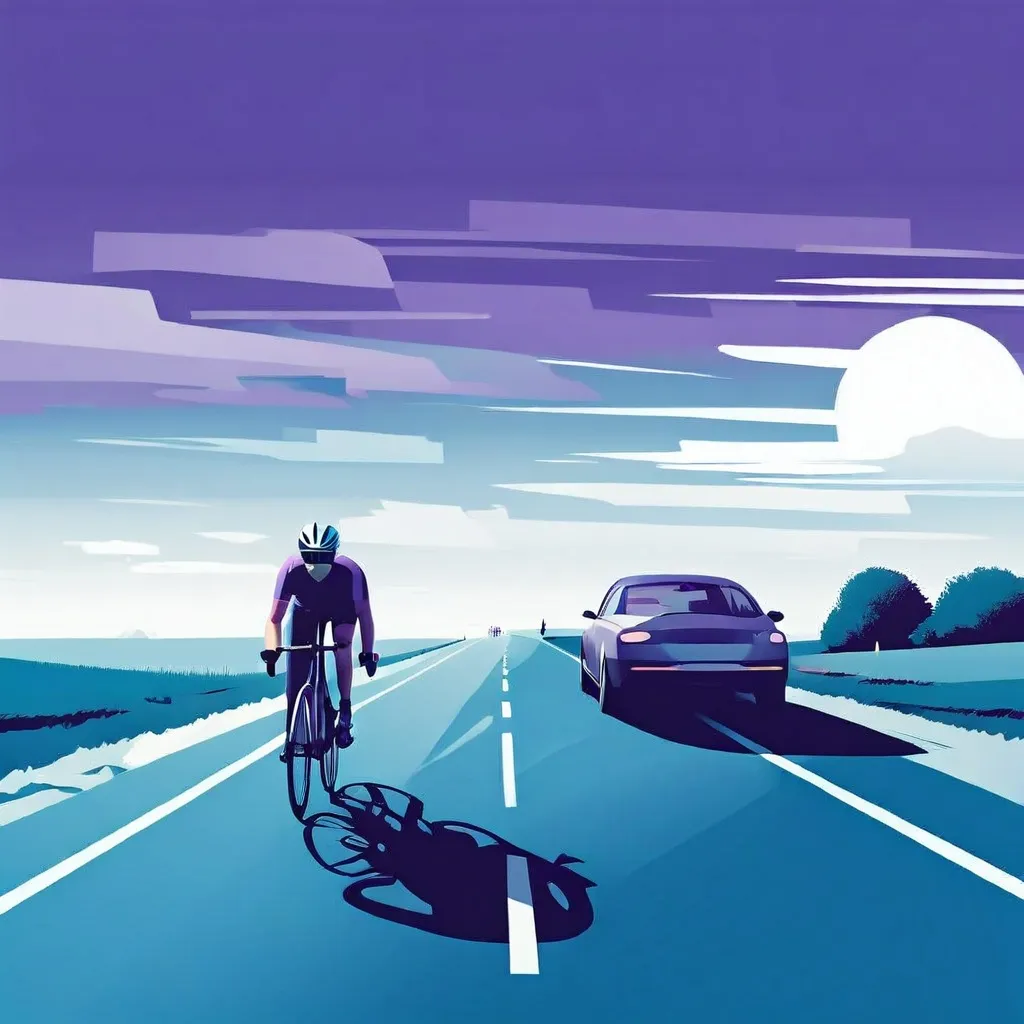
Denmark has a robust cycling infrastructure, and cyclists are vulnerable road users. The rules for overtaking cyclists are designed to provide them with maximum safety. When overtaking a bicycle or a two-wheeled small moped (lille knallert), you must reduce your speed and pass them with adequate clearance. The law stipulates a minimum side clearance of 1.5 metres. If the road width does not permit you to pass a cyclist with this minimum clearance while also maintaining a safe speed, you must follow the cyclist at their speed until a safe opportunity to pass arises. This means slowing down significantly and potentially waiting behind the cyclist until it is safe to move into a different lane or the road widens.
Remember that the general prohibition on overtaking in junctions, on hills, and in bends does not apply to overtaking two-wheeled bicycles and small mopeds. However, you must still ensure the manoeuvre is safe and adheres to the specific clearance and speed reduction rules for cyclists.
The driver being overtaken also has specific responsibilities under Danish traffic law. It is a violation for the driver of the vehicle being overtaken to accelerate (increase speed) in an attempt to prevent or obstruct the overtaking manoeuvre. The overtaken driver should maintain their current speed or, if it aids the overtake, even reduce their speed slightly. This ensures that the overtaking driver can complete their manoeuvre smoothly and safely.
Beyond the primary prohibitions, several other aspects of overtaking are important for drivers to understand. On roads with three or more lanes in the same direction, the leftmost lane is typically reserved for overtaking. However, it is generally not permissible to use the leftmost lane for overtaking on roads with only three lanes if it would impede faster traffic. It is also important to note that passing vehicles in a dedicated lane, such as a bus lane, is not considered overtaking in the traditional sense and has its own specific rules.
For drivers of motorcycles, the practice of 'lane splitting' – filtering between lanes of stationary or slow-moving traffic – is not explicitly permitted under Danish law and is generally viewed as a violation, as it can create hazards for both the motorcyclist and other road users.
The Danish theory exam will test your knowledge of these overtaking rules extensively. Questions will often present scenarios requiring you to identify when an overtake is safe, when it is prohibited, and what actions you should take. Pay close attention to the details of road markings, junction types, and visibility conditions presented in the exam questions. Understanding the underlying safety principles behind each rule will help you answer correctly, even in complex situations.
Be particularly aware of questions involving cyclists, junctions with traffic lights, and situations with limited visibility. These are common areas where learners make mistakes. Always consider the potential actions of all road users.
To truly master Danish overtaking rules and ensure you are ready for your theory test and the road, consistent practice is key. Engaging with practice questions that specifically target these regulations will solidify your understanding and highlight any areas needing further review.
To help you understand and remember these rules, here are some essential Danish terms and their definitions as they relate to overtaking:
By diligently studying these rules and practicing with relevant questions, you will build the confidence and competence needed to overtake safely and successfully navigate Denmark's roads.
This article covers Denmark's overtaking rules under Færdselsloven, emphasising that safety is the overarching principle and that overtaking is prohibited at junctions, railway crossings, and areas of limited visibility such as hill crests and bends. Road markings provide immediate visual guidance, with solid white lines forbidding overtaking and broken lines permitting it when safe. Special provisions apply to cyclists, requiring a 1.5 metre clearance and speed reduction, though cyclists are exempt from certain general prohibitions. The overtaken driver must not accelerate to obstruct an overtake, and lane splitting by motorcycles is not explicitly permitted. Thorough understanding of these rules is essential for both the Danish theory exam and safe real-world driving.
A short set of high-value points that capture the most important ideas from this article.
Overtaking must only occur when demonstrably safe with no risk to any road user, and any doubt means abandoning the manoeuvre.
Prohibitions at junctions, railway crossings, hills, and bends exist because visibility is limited and traffic movements are unpredictable.
Cyclists (bicycles and small mopeds) have special status: the 1.5 metre minimum clearance and speed reduction apply, but they are exempt from general overtaking prohibitions.
Road markings directly dictate legality: a solid centre line forbids overtaking from that side, while a broken line permits it if safe.
The overtaken driver must not accelerate to obstruct the manoeuvre and should maintain or slightly reduce speed.
Minimum 1.5 metres side clearance is required when overtaking cyclists and small mopeds; if the road is too narrow, follow at their speed.
Junction overtaking is prohibited unless vehicles are in dedicated same-direction lanes, you are overtaking a vehicle turning left to your right, or police/traffic signals regulate the junction.
Limited visibility due to a hill crest or bend prohibits overtaking unless your direction has at least two lanes with no oncoming traffic.
A solid white centre line always means overtaking is forbidden from that side; broken white line generally means it is allowed.
Lane splitting by motorcycles is not explicitly permitted and is treated as a potential violation in Denmark.
Assuming cyclists are subject to the same overtaking prohibitions as other vehicles; they are exempt from junction, hill, and bend restrictions but still require the 1.5 metre clearance.
Confusing road markings: learners sometimes believe a solid line only applies when another vehicle is present, but it always prohibits overtaking.
Not checking junction type carefully; overtaking near a junction is a common exam trap even when the junction appears simple.
Forgetting that the overtaken driver's obligation includes not accelerating, which can be tested in scenario-based exam questions.
Overlooking that multiple-lane rules require using the leftmost lane only for overtaking and not impeding faster traffic on three-lane roads.
Article content overview
A short set of high-value points that capture the most important ideas from this article.
Overtaking must only occur when demonstrably safe with no risk to any road user, and any doubt means abandoning the manoeuvre.
Prohibitions at junctions, railway crossings, hills, and bends exist because visibility is limited and traffic movements are unpredictable.
Cyclists (bicycles and small mopeds) have special status: the 1.5 metre minimum clearance and speed reduction apply, but they are exempt from general overtaking prohibitions.
Road markings directly dictate legality: a solid centre line forbids overtaking from that side, while a broken line permits it if safe.
The overtaken driver must not accelerate to obstruct the manoeuvre and should maintain or slightly reduce speed.
Minimum 1.5 metres side clearance is required when overtaking cyclists and small mopeds; if the road is too narrow, follow at their speed.
Junction overtaking is prohibited unless vehicles are in dedicated same-direction lanes, you are overtaking a vehicle turning left to your right, or police/traffic signals regulate the junction.
Limited visibility due to a hill crest or bend prohibits overtaking unless your direction has at least two lanes with no oncoming traffic.
A solid white centre line always means overtaking is forbidden from that side; broken white line generally means it is allowed.
Lane splitting by motorcycles is not explicitly permitted and is treated as a potential violation in Denmark.
Assuming cyclists are subject to the same overtaking prohibitions as other vehicles; they are exempt from junction, hill, and bend restrictions but still require the 1.5 metre clearance.
Confusing road markings: learners sometimes believe a solid line only applies when another vehicle is present, but it always prohibits overtaking.
Not checking junction type carefully; overtaking near a junction is a common exam trap even when the junction appears simple.
Forgetting that the overtaken driver's obligation includes not accelerating, which can be tested in scenario-based exam questions.
Overlooking that multiple-lane rules require using the leftmost lane only for overtaking and not impeding faster traffic on three-lane roads.
Explore related topics, search based questions, and concepts that learners often look up when studying Danish Overtaking Rules. These themes reflect real search intent and help you understand how this topic connects to wider driving theory knowledge in Denmark.
Find clear and practical answers to common questions learners often have about Danish Overtaking Rules. This section helps explain difficult points, remove confusion, and reinforce the key driving theory concepts that matter for learners in Denmark.
The primary rule is that you may only overtake when it can be done safely without endangering other road users. You, as the overtaking driver, bear full responsibility for the safety of the manoeuvre.
Overtaking is prohibited at or approaching pedestrian crossings, junctions, railway crossings, on hilltops with obstructed vision, on bends with insufficient visibility, and where a solid white centre line is present.
When overtaking cyclists, you must pass them with adequate clearance, a minimum of 1.5 metres, and at a reduced speed. If safe passing is not possible, you must follow at the cyclist's speed until a safe opportunity arises.
The driver being overtaken must not accelerate to prevent or obstruct the overtaking manoeuvre. They should maintain their current speed or, if necessary, reduce speed to facilitate a safe overtake.
No, a solid white centre line (ubrudt midterlinje) on your side of the road indicates that overtaking is prohibited from your direction.
Continue your learning journey by searching for additional articles or browsing our comprehensive topic categories. Deepen your knowledge of Danish road law, vehicle mechanics, and hazard perception to ensure complete preparation for your official theory exam.