
Driving in Denmark during nighttime conditions introduces several unique challenges for all drivers. With limited visibility due to darkness, drivers must carefully adjust their speed, properly use vehicle lighting, and remain highly attentive to detect potential hazards like pedestrians, cyclists, or obstacles. This guide covers the critical adaptations needed to drive safely and confidently after dark, in line with Danish traffic regulations.
Theory topic content overview
Read the full theory topic guide for Night Driving Safety with structured, easy-to-scan content built for learners in Denmark. This detailed section explains the exact rule, meaning, traffic context, comparison points, and exam logic behind this Danish driving theory topic so you can study faster, understand the concept more clearly, and avoid common interpretation mistakes on the theory test.
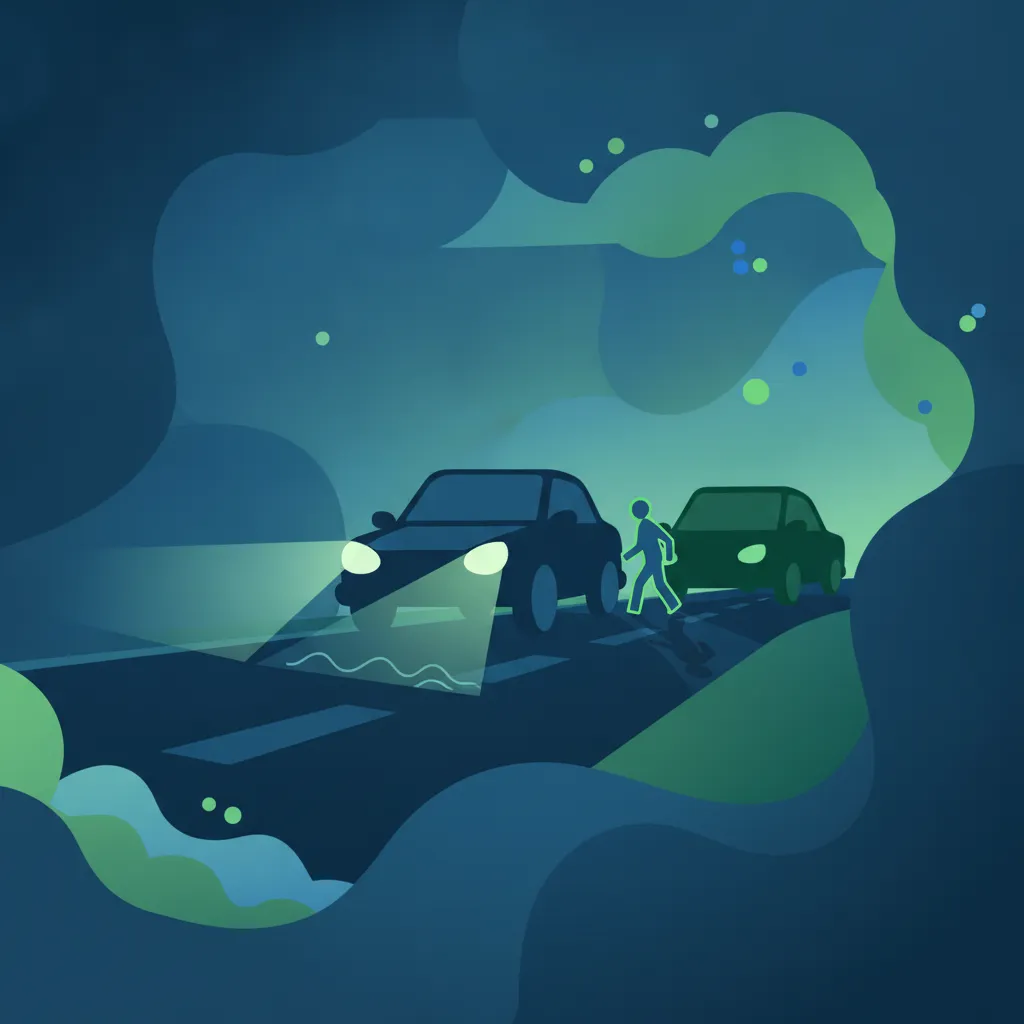
Driving at night, or kørsel i mørke in Danish, fundamentally changes the driving environment by significantly reducing visibility. Instead of the broad daylight perception we rely on, drivers become dependent on artificial light sources – primarily their vehicle's headlights and, where present, street lighting. This limited visual input demands a complete adaptation of driving behaviour, focusing intensely on speed, observation, and correct light usage to manage inherent risks on Danish roads.
The core challenge is that your ability to see and react to hazards is dramatically reduced. It's harder to spot pedestrians, cyclists, animals, road signs, or obstacles until they are much closer than in daylight. This decreased perception directly impacts your reaction time and available stopping distance.
Mastering safe driving at night is crucial for several reasons:
nærlys, fjernlys, positionslys, tågelygter) is not just good practice but a legal requirement to ensure both your visibility and the safety of other road users.Driving safely after dark requires a conscious shift in your approach behind the wheel.
This is the most critical principle for night driving in Denmark. Your speed must always be such that you can react to and stop for any unforeseen obstacle within the area illuminated by your headlights.
Nærlys): Your dipped beam lights typically illuminate the road for about 30-60 meters ahead. If you're driving at 80 km/h, your stopping distance can be significantly longer than this, highlighting why speed reduction is so vital on unlit roads with only nærlys.Fjernlys): Main beam lights offer a much greater range (up to 100-200 meters or more), but their use is restricted to situations where you won't dazzle other drivers or pedestrians. Even with fjernlys, hazards can appear suddenly.Practical Application: If you can only see 50 meters ahead, your stopping distance must be less than 50 meters. If it's not, you're driving too fast for the conditions. This rule applies even if the posted speed limit is higher; the legal speed limit is the maximum, not always the safe speed.
Lygteføring)Proper use of your vehicle's lighting system is fundamental to night driving safety and a common area for questions in the Danish theory test.
Nærlys): This is your standard driving light for all roads at night, especially on lit roads or when there's oncoming traffic. It must be used in tunnels and in conditions of poor visibility (rain, fog, snow) during the day too.Fjernlys): Use fjernlys on unlit roads outside built-up areas when nærlys does not provide sufficient visibility. Crucially, switch to nærlys immediately when:
Positionslys): These are for parking or standing only. They are never sufficient for driving in darkness.Tågelygter): In Denmark, fog lights should only be used in actual fog or during heavy precipitation (kraftig nedbør), and only if they do not cause inconvenience or dazzle other road users. They are not a substitute for proper headlights in normal darkness.Lyssignal): Instead of using your horn (lydsignal) to warn others, you should generally flash your headlights (lyssignal), unless there is immediate danger.Blænding)Oncoming headlights can cause temporary blindness, known as glare. This is a significant night driving hazard.
Night driving increases the risk of fatigue. Your body's natural sleep cycle makes you more susceptible to drowsiness after dark, especially during long journeys or between midnight and 6 AM.
Beyond darkness itself, several factors can compound the challenges of driving at night:
Nærlys) vs. Main Beam (Fjernlys): Understand the specific purpose and conditions for using each. Nærlys is standard; fjernlys is for enhancing visibility only when it won't inconvenience others.landevej) at 80 km/h: You're driving with nærlys. A deer suddenly jumps onto the road 40 meters ahead. If your reaction time is 1 second and your braking distance at 80 km/h on dry asphalt is around 40-50 meters, you will likely hit the deer. This demonstrates why you must reduce your speed significantly on unlit roads to ensure you can stop within the 30-60 meter range of your nærlys.fjernlys on a dark stretch of road. As you see headlights approaching in the distance, you must immediately switch to nærlys. This prevents you from dazzling the oncoming driver, which could lead to an accident. Switch back to fjernlys only once the other vehicle has passed and the road ahead is clear.fjernlys to nærlys as you enter an area with street lighting. Even if no other traffic is immediately visible, the ambient light makes fjernlys unnecessary and potentially dazzling for residents or pedestrians.fjernlys): Failing to dip headlights in time for oncoming traffic or when following another vehicle closely.tågelygter rules: Using fog lights unnecessarily, which can dazzle others and is against regulations in Denmark.The Danish theory test (teoriprøve) places significant emphasis on night driving rules. You will frequently encounter questions related to:
nærlys and fjernlys: Scenarios involving oncoming traffic, following vehicles, and street lighting.positionslys and tågelygter: Understanding their specific, limited applications.Remember that at night, your speed must always be dictated by the distance you can clearly see ahead. If you can only see 50 meters, your stopping distance must not exceed 50 meters. This principle, coupled with correct and considerate use of your vehicle's lighting, is the foundation for safe driving at night on Danish roads. Stay vigilant, adapt your driving, and ensure your vehicle is fit for the darkness.
Night driving in Denmark requires adapting speed to ensure you can always stop within your headlight range, which is typically much shorter than daylight stopping distances. The correct use of lighting—nærlys as standard, fjernlys only when safe, and never positionslys for driving—is both a safety requirement and a tested topic. Managing glare by shifting your gaze and maintaining a clean windshield are practical skills, while recognizing fatigue symptoms and taking breaks is essential for safe night journeys. These principles form the foundation for both safe driving and success in the Danish theory test.
A short set of high-value points that capture the most important ideas from this theory explanation.
Your speed must always allow you to stop within the range illuminated by your headlights, regardless of posted speed limits
Use nærlys (dipped beam) as your standard driving light at night; it illuminates roughly 30-60 meters ahead
Switch to fjernlys (main beam) only on unlit roads when it won't dazzle oncoming traffic or pedestrians
Always dip to nærlys immediately when approaching oncoming vehicles or following another vehicle closely
Fatigue is especially dangerous at night due to your body's natural sleep cycle, peaking between midnight and 6 AM
Nærlys provides 30-60 meters of visibility; fjernlys extends to 100-200 meters but has strict usage conditions
Positionslys (parking lights) are for parking only and are never sufficient for driving in darkness
Tågelygter (fog lights) are restricted to actual fog or heavy precipitation only
When experiencing glare, shift your gaze to the right edge of your lane or road shoulder
The legal speed limit is the maximum under ideal conditions; safe speed at night is always dictated by your visibility range
Driving too fast on unlit roads, forgetting that your stopping distance must fit within your headlight range
Failing to switch from fjernlys to nærlys quickly enough when meeting oncoming traffic or approaching curves
Using parking lights (positionslys) instead of proper headlights, believing they provide sufficient illumination
Ignoring early signs of fatigue and pushing through tiredness instead of taking a break
Using fog lights unnecessarily or in conditions where they cause dazzle to other road users
Start with a short, direct summary of Night Driving Safety before reading the full explanation below.
Driving at night means significantly reduced visibility, making it harder to spot hazards and judge distances. Drivers must adapt by reducing speed, using the correct headlights (nærlys and fjernlys) to ensure they can stop within their illuminated range, and actively scanning for dangers. Being aware of headlight glare from oncoming traffic and the increased risk of fatigue is also crucial for safe driving after dark on Danish roads.
Review the most important terms, rule signals, and traffic concepts linked to Night Driving Safety.
Explore related theory topic pages connected to Night Driving Safety and continue with the next useful rule explanation.
See the common search queries learners use when trying to understand Night Driving Safety in Denmark.

Dive into detailed explanations of Danish traffic legislation, road signs, and driving conventions. Solidify your understanding of key theory topics and prepare confidently for all sections of your official Danish driving license theory exam.
Explore Driving Theory TopicsTheory topic content overview
A short set of high-value points that capture the most important ideas from this theory explanation.
Your speed must always allow you to stop within the range illuminated by your headlights, regardless of posted speed limits
Use nærlys (dipped beam) as your standard driving light at night; it illuminates roughly 30-60 meters ahead
Switch to fjernlys (main beam) only on unlit roads when it won't dazzle oncoming traffic or pedestrians
Always dip to nærlys immediately when approaching oncoming vehicles or following another vehicle closely
Fatigue is especially dangerous at night due to your body's natural sleep cycle, peaking between midnight and 6 AM
Nærlys provides 30-60 meters of visibility; fjernlys extends to 100-200 meters but has strict usage conditions
Positionslys (parking lights) are for parking only and are never sufficient for driving in darkness
Tågelygter (fog lights) are restricted to actual fog or heavy precipitation only
When experiencing glare, shift your gaze to the right edge of your lane or road shoulder
The legal speed limit is the maximum under ideal conditions; safe speed at night is always dictated by your visibility range
Driving too fast on unlit roads, forgetting that your stopping distance must fit within your headlight range
Failing to switch from fjernlys to nærlys quickly enough when meeting oncoming traffic or approaching curves
Using parking lights (positionslys) instead of proper headlights, believing they provide sufficient illumination
Ignoring early signs of fatigue and pushing through tiredness instead of taking a break
Using fog lights unnecessarily or in conditions where they cause dazzle to other road users
Start with a short, direct summary of Night Driving Safety before reading the full explanation below.
Driving at night means significantly reduced visibility, making it harder to spot hazards and judge distances. Drivers must adapt by reducing speed, using the correct headlights (nærlys and fjernlys) to ensure they can stop within their illuminated range, and actively scanning for dangers. Being aware of headlight glare from oncoming traffic and the increased risk of fatigue is also crucial for safe driving after dark on Danish roads.
Review the most important terms, rule signals, and traffic concepts linked to Night Driving Safety.
Explore related theory topic pages connected to Night Driving Safety and continue with the next useful rule explanation.
See the common search queries learners use when trying to understand Night Driving Safety in Denmark.
Dive into detailed explanations of Danish traffic legislation, road signs, and driving conventions. Solidify your understanding of key theory topics and prepare confidently for all sections of your official Danish driving license theory exam.
Explore Driving Theory TopicsUse this exam-focused revision tip to understand how Night Driving Safety is likely to appear in theory questions for learners in Denmark. This section helps you identify the most testable part of the rule, avoid common traps, and remember the concept more effectively during Danish driving theory exam preparation.
The Danish theory test often focuses on how your speed must be adjusted to match your visibility range when driving at night. Remember that you must always be able to stop within the area illuminated by your headlights. Also, know when to switch between 'nærlys' and 'fjernlys' to avoid dazzling others.
Read direct answers to the most common learner questions about Night Driving Safety in Denmark. This FAQ focuses on rule confusion, practical meaning, comparison with similar concepts, and the exact uncertainties that appear most often in Danish driving theory revision and exam preparation.
Night driving significantly reduces your visual range and depth perception, making it harder to spot hazards, judge distances, and react quickly compared to daytime conditions, increasing the risk of accidents.
In Denmark, use 'nærlys' (low beam) as your normal light on lit roads. Use 'fjernlys' (high beam) on unlit roads if 'nærlys' isn't sufficient for your speed, but only if you won't blind other road users. Only use 'positionslys' (parking lights) when parked or stopped.
You must always adapt your speed so that you can stop your vehicle within the distance illuminated by your headlights. This often means driving slower than the posted speed limit, especially on unlit or unfamiliar roads.
Avoid looking directly into oncoming headlights. Instead, focus your gaze slightly towards the right edge of your lane or the road markings to maintain orientation while reducing the impact of glare.
Fatigue severely impairs your concentration, reaction time, and decision-making abilities, making it much more dangerous to drive at night when your body naturally wants to rest. It's best to stop and rest if you feel tired.
You may use fog lights (tågelygter) at night, but only in conditions of actual fog or heavy precipitation, and only if they do not inconvenience other road users. They are not for general use in clear darkness.
Use our powerful search tool to pinpoint specific Danish driving theory topics, road signs, or traffic situations you need to review. Start exploring relevant practice sets now to reinforce your knowledge and build confidence for your upcoming driving licence exam.