
Seat belts are one of the most effective safety features in any vehicle, designed to protect you and your passengers during sudden stops or collisions. In Denmark, strict rules govern their use, making it vital for all drivers to understand not only the legal requirements but also the physics behind how they prevent serious injuries by counteracting inertia and distributing impact forces.
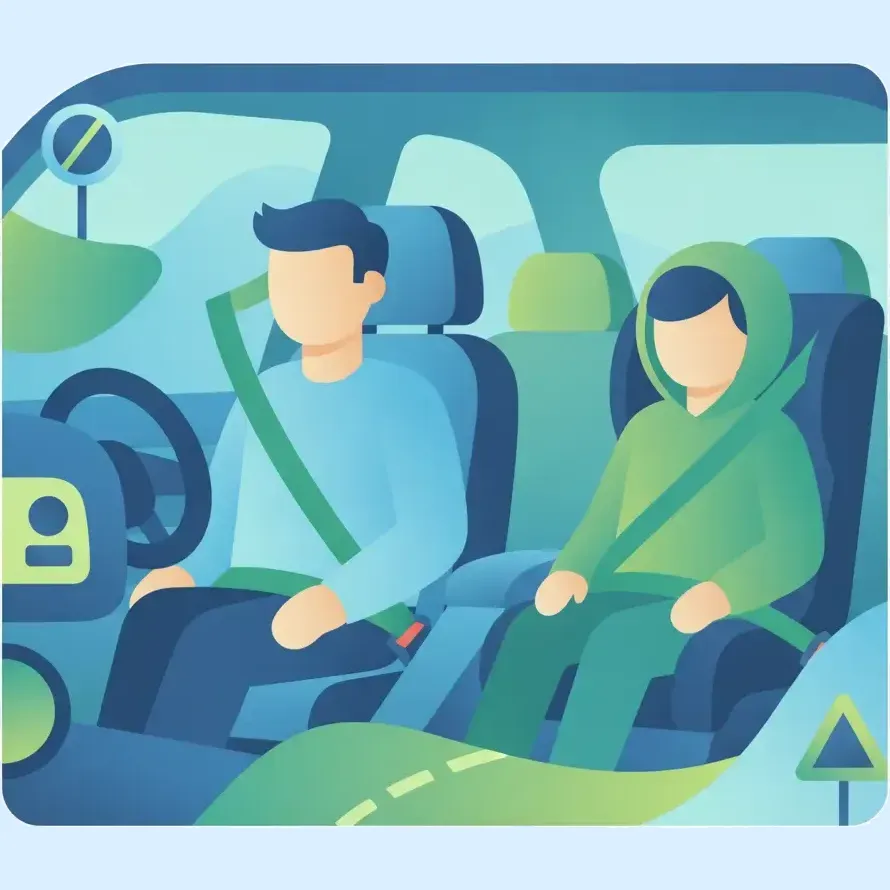
Theory topic content overview
Read the full theory topic guide for Seat Belt Safety with structured, easy-to-scan content built for learners in Denmark. This detailed section explains the exact rule, meaning, traffic context, comparison points, and exam logic behind this Danish driving theory topic so you can study faster, understand the concept more clearly, and avoid common interpretation mistakes on the theory test.
Seat belts are arguably the most fundamental safety feature in any modern vehicle, serving as the first line of defence against injury during sudden deceleration or collisions. Their primary purpose is to restrain occupants, preventing them from being thrown forward into the vehicle's interior components (like the steering wheel, dashboard, or windshield) or, critically, ejected from the vehicle altogether. In Denmark, understanding and correctly using seat belts is not just a safety recommendation; it is a strict legal requirement and a core component of the Danish driving theory test.
The importance of seat belts extends far beyond simply complying with the law. They are meticulously engineered to save lives and mitigate the severity of injuries by managing the immense forces unleashed during a crash.
Færdelsloven), seat belt use is mandatory for all occupants of a vehicle where seat belts are fitted, regardless of whether they are sitting in the front or rear.To understand how seat belts work, it's essential to grasp the concept of inertia. When a vehicle is travelling, you, as an occupant, are moving at the same speed as the vehicle. If the vehicle suddenly stops or crashes, your body wants to continue moving forward at its previous speed due to inertia.
Seat belts counteract this inertial force through several mechanisms:
Without a seat belt, your body becomes an unsecured projectile within the vehicle, risking severe trauma from striking interior surfaces or other occupants.
In Denmark, the rules for seat belt use are clear and strictly enforced:
It's a common misconception that airbags alone are sufficient for safety. Airbags are supplemental restraint systems (supplerende sikkerhedssystemer) designed to work in conjunction with seat belts.
Without a seat belt, an airbag can be dangerous, as the unbelted occupant might hit the rapidly deploying airbag with excessive force.
Learners and even experienced drivers often make mistakes regarding seat belts:
Your seat belt is your single most effective piece of safety equipment. Always make it the first thing you do when you get into a car, and the last thing you check for your passengers before driving off. For your Danish driving theory test, remember not only the legal mandate but also the fundamental safety principles: how seat belts leverage physics to prevent injury by counteracting inertia and distributing impact forces. This understanding is key to becoming a responsible and safe driver on Danish roads.
Seat belts are the most fundamental safety feature in any vehicle, designed to restrain occupants during collisions by counteracting inertia and distributing crash forces across the body's strongest areas. In Denmark, their use is mandatory for all occupants under the Danish Traffic Act, with specific requirements for correct positioning and child restraints until 135 cm tall. Modern belts incorporate pretensioners and load limiters for controlled deceleration, and they work alongside airbags as supplemental systems rather than being replaced by them. Understanding both the legal requirements and the physics behind seat belt protection is essential for safe driving and the Danish theory test.
A short set of high-value points that capture the most important ideas from this theory explanation.
Seat belts are mandatory for all vehicle occupants in Denmark when seat belts are fitted, regardless of seating position
They protect by counteracting inertia and distributing crash forces across the body's strongest parts (pelvis and chest)
Correct belt positioning is essential: lap belt low across the pelvis, shoulder belt across the chest, with no slack
Airbags are supplemental restraint systems that work in conjunction with seat belts, not as replacements
Drivers are legally responsible for ensuring all passengers under 15 years old are correctly belted or in appropriate child restraints
The lap portion of the seat belt must sit low across the pelvis, never across the stomach area
Never place the shoulder belt under the arm, behind the back, or with slack as this can cause severe internal injuries
Children must use approved child restraints until they reach 135 cm in height before using a standard seat belt
Modern seat belts include pretensioners (instant tightening) and load limiters (controlled webbing release) for safer deceleration
Very limited exceptions exist for professional drivers making frequent short stops; for most private vehicle use, belt use is universal
Incorrect belt positioning, such as placing the shoulder strap under the arm or behind the back, which severely reduces protection
Adding slack to the belt or wearing excessively bulky clothing that prevents a snug fit
Assuming seat belts are unnecessary for short trips or low-speed driving, when most accidents occur close to home
Believing airbags alone provide sufficient protection without realizing they require seat belts to function safely
Drivers failing to check that all passengers, especially children, are properly secured before driving
Start with a short, direct summary of Seat Belt Safety before reading the full explanation below.
Seat belts are essential safety devices designed to restrain vehicle occupants during sudden deceleration or collisions, preventing them from striking interior surfaces or being ejected. They work by distributing crash forces across the body's strongest parts, significantly reducing the risk of severe injury or fatality. In Denmark, seat belt use is mandatory for all occupants, and correct fitting is crucial for maximum protection, reflecting its high importance in traffic safety regulations.
Review the most important terms, rule signals, and traffic concepts linked to Seat Belt Safety.
Explore related theory topic pages connected to Seat Belt Safety and continue with the next useful rule explanation.
See the common search queries learners use when trying to understand Seat Belt Safety in Denmark.

Dive into detailed explanations of Danish traffic legislation, road signs, and driving conventions. Solidify your understanding of key theory topics and prepare confidently for all sections of your official Danish driving license theory exam.
Explore Driving Theory TopicsTheory topic content overview
A short set of high-value points that capture the most important ideas from this theory explanation.
Seat belts are mandatory for all vehicle occupants in Denmark when seat belts are fitted, regardless of seating position
They protect by counteracting inertia and distributing crash forces across the body's strongest parts (pelvis and chest)
Correct belt positioning is essential: lap belt low across the pelvis, shoulder belt across the chest, with no slack
Airbags are supplemental restraint systems that work in conjunction with seat belts, not as replacements
Drivers are legally responsible for ensuring all passengers under 15 years old are correctly belted or in appropriate child restraints
The lap portion of the seat belt must sit low across the pelvis, never across the stomach area
Never place the shoulder belt under the arm, behind the back, or with slack as this can cause severe internal injuries
Children must use approved child restraints until they reach 135 cm in height before using a standard seat belt
Modern seat belts include pretensioners (instant tightening) and load limiters (controlled webbing release) for safer deceleration
Very limited exceptions exist for professional drivers making frequent short stops; for most private vehicle use, belt use is universal
Incorrect belt positioning, such as placing the shoulder strap under the arm or behind the back, which severely reduces protection
Adding slack to the belt or wearing excessively bulky clothing that prevents a snug fit
Assuming seat belts are unnecessary for short trips or low-speed driving, when most accidents occur close to home
Believing airbags alone provide sufficient protection without realizing they require seat belts to function safely
Drivers failing to check that all passengers, especially children, are properly secured before driving
Start with a short, direct summary of Seat Belt Safety before reading the full explanation below.
Seat belts are essential safety devices designed to restrain vehicle occupants during sudden deceleration or collisions, preventing them from striking interior surfaces or being ejected. They work by distributing crash forces across the body's strongest parts, significantly reducing the risk of severe injury or fatality. In Denmark, seat belt use is mandatory for all occupants, and correct fitting is crucial for maximum protection, reflecting its high importance in traffic safety regulations.
Review the most important terms, rule signals, and traffic concepts linked to Seat Belt Safety.
Explore related theory topic pages connected to Seat Belt Safety and continue with the next useful rule explanation.
See the common search queries learners use when trying to understand Seat Belt Safety in Denmark.
Dive into detailed explanations of Danish traffic legislation, road signs, and driving conventions. Solidify your understanding of key theory topics and prepare confidently for all sections of your official Danish driving license theory exam.
Explore Driving Theory TopicsUse this exam-focused revision tip to understand how Seat Belt Safety is likely to appear in theory questions for learners in Denmark. This section helps you identify the most testable part of the rule, avoid common traps, and remember the concept more effectively during Danish driving theory exam preparation.
In the Danish theory test, questions about seat belts often focus on their safety function, the law regarding their use for all occupants, and how they protect against inertia. Remember that incorrect use (e.g., placing the belt behind the back or under the arm) significantly reduces protection and is also a common exam trap.
Read direct answers to the most common learner questions about Seat Belt Safety in Denmark. This FAQ focuses on rule confusion, practical meaning, comparison with similar concepts, and the exact uncertainties that appear most often in Danish driving theory revision and exam preparation.
Seat belts are crucial because they prevent occupants from being thrown forward or ejected during a collision, distributing impact forces over stronger body parts and dramatically reducing the risk of serious injury or death.
Yes, in Denmark, it is mandatory for all occupants of a vehicle equipped with seat belts to wear them, regardless of their seating position. This is a fundamental part of Danish traffic law.
During a crash, a seat belt works by holding your body firmly in place, counteracting the force of inertia that would otherwise propel you forward. It spreads the impact energy across your pelvis and chest, which are more resistant to injury.
Yes, failing to wear a seat belt when required by Danish law can result in a significant fine for both the driver and any unbelted passengers, emphasizing the seriousness of the regulation.
A seat belt should always be worn snugly across your shoulder and lap. The shoulder strap should pass over the middle of your shoulder and chest, while the lap strap should be low across your hips, never under your arm or behind your back.
Yes, children must be properly secured in a vehicle. Depending on their height and weight, they must use an approved child restraint system or a regular seat belt if they are tall enough, adhering to specific Danish regulations for child safety.
Use our powerful search tool to pinpoint specific Danish driving theory topics, road signs, or traffic situations you need to review. Start exploring relevant practice sets now to reinforce your knowledge and build confidence for your upcoming driving licence exam.