
In this lesson, you will learn the critical procedures for managing motorcycle breakdowns and accidents on German roads. This is a vital component of the German Motorcycle Licence (A, A1, A2) curriculum, ensuring you are prepared to act decisively and safely in emergencies.
Lesson content overview
Riding a motorcycle offers freedom and exhilaration, but it also comes with a responsibility to understand how to react safely and effectively in unforeseen circumstances. For anyone undertaking the German Motorcycle Licence Theory Course (Classes A, A1, A2), mastering proper response procedures for vehicle breakdowns, crashes, and other emergency situations is not just recommended, it is crucial for personal safety and the safety of all road users. This lesson provides comprehensive guidance on managing unexpected incidents on German roads, ensuring you know the correct legal and practical steps to take until professional help arrives.
The immediate aftermath of a breakdown or accident can be chaotic and dangerous. A systematic approach, prioritizing safety and communication, is essential to mitigate risks. The core principles of emergency response for motorcyclists are universal, focusing on preparation, visibility, and prompt action.
Prioritize Personal Safety First: Your safety, and the safety of others, always comes before assessing vehicle damage or moving objects. Do not put yourself in further danger.
A vehicle breakdown is the unintended loss of your motorcycle's functionality, requiring immediate action. This could range from engine failure to a tire puncture or electrical issues. Being stranded on or near the roadway poses a significant risk to both you and other drivers.
If your motorcycle breaks down, your first priority is to assess the situation and ensure your immediate safety.
Stay Calm and Assess the Situation: Rapidly evaluate if you can safely move your motorcycle. If you are on a highway or a fast-moving road, even a short distance can make a big difference.
Move to a Safe Location: If possible, maneuver your motorcycle off the roadway. This could mean pushing it onto the hard shoulder (Standstreifen) of a motorway, into a lay-by, or onto the verge of a rural road. According to § 24 StVO (Straßenverkehrs-Ordnung), you are obliged to move a stopped vehicle out of the way of traffic if feasible.
Activate Hazard Warning Lights: Immediately switch on your motorcycle's hazard warning lights (Warnblinkanlage). These lights signal to other road users that your vehicle is stationary and potentially poses a hazard. This is crucial for preventing secondary incidents.
Put on Your High-Visibility Vest: If you have one, put on your high-visibility vest (Warnweste). This makes you much more visible to other drivers, especially in low light or adverse weather conditions.
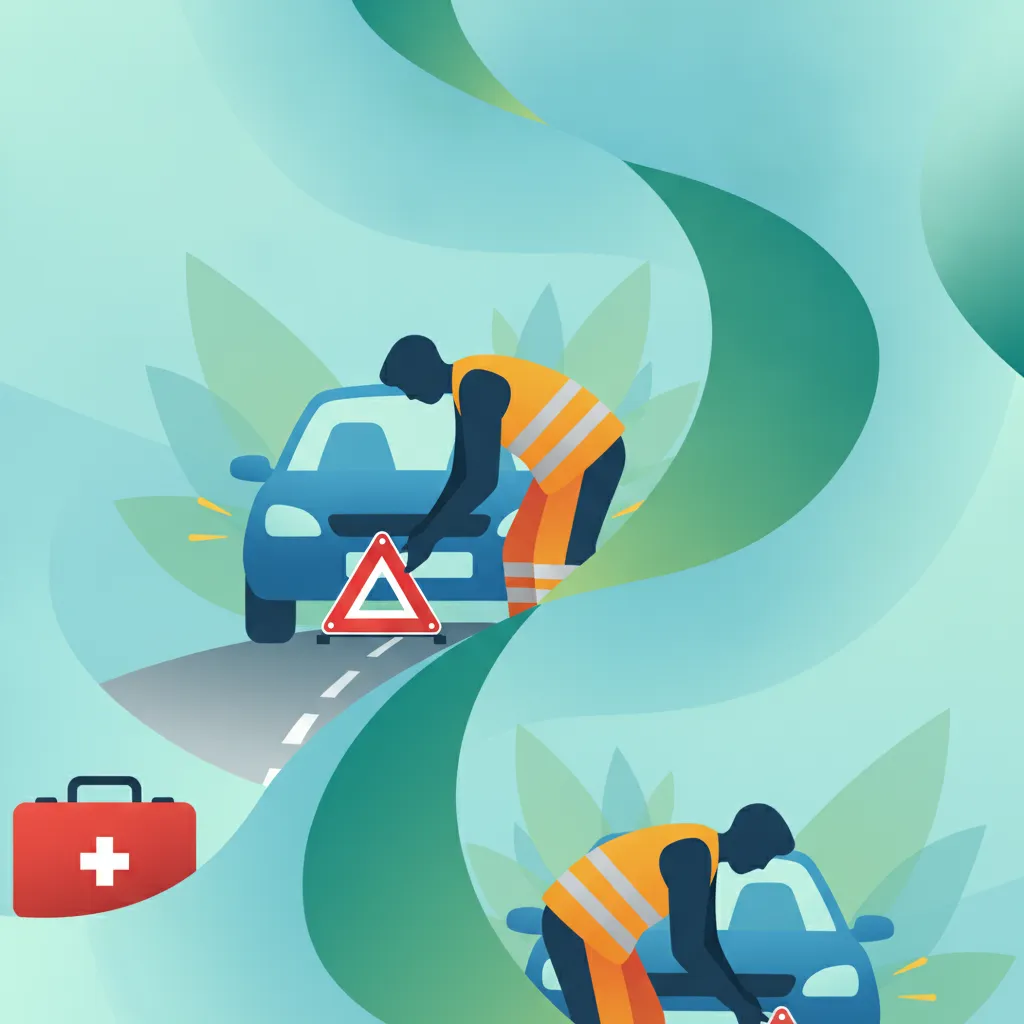
Once you and your motorcycle are in the safest possible location, the next step is to make the scene as visible as possible to approaching traffic. This is where hazard warning signals and the emergency triangle become essential.
Built-in flashing amber lights on a vehicle that illuminate simultaneously to indicate that the vehicle is stationary and may pose a danger to other road users.
In Germany, § 25 StVO mandates the use of hazard warning lights when a vehicle is stationary on the roadway in a position that could endanger traffic. While motorcycles are not legally required to carry an emergency triangle (Warndreieck) or a first-aid kit, it is highly recommended to carry both. If you have an emergency triangle:
Retrieve the Triangle: Take your emergency triangle out of your luggage.
Walk Against Traffic: Carefully walk against the direction of traffic flow to place the triangle. This allows you to see oncoming vehicles and ensures you are visible.
Place at Appropriate Distance: Place the emergency triangle firmly on the road surface at a sufficient distance behind your motorcycle.
Ensure Visibility: The triangle should be clearly visible and not obstructed by hills, bends, or other vehicles.
Common Mistake: Leaving your vehicle on the main road without proper warning signals is dangerous and can lead to fines. Failing to deploy the emergency triangle, or placing it too close to the vehicle, significantly reduces its effectiveness.
Once the scene is secure, contact the appropriate services for assistance.
Roadside Assistance: If you have a membership with an organization like ADAC or an equivalent breakdown service, call their emergency number.
Insurance Provider: Contact your insurance company, as they may offer roadside assistance as part of your policy.
Emergency Services (Police): If your breakdown presents a significant danger to traffic that you cannot manage (e.g., an unmovable motorcycle blocking a lane on a motorway), or if you feel unsafe, call the police on 110. They can assist with traffic management and arrange for towing if necessary.
Provide Clear Information: Be prepared to give your exact location (road name/number, nearest kilometer marker, direction of travel), the nature of the breakdown, and any immediate dangers.
Accidents are unforeseen and often traumatic. Proper accident scene management is vital for the safety of those involved and other road users, as well as for legal compliance. In Germany, every citizen has a legal obligation to render assistance at the site of an accident.
After a collision, your immediate actions can prevent further injury and secure the scene.
Stop Immediately: If you are involved in an accident or witness one, stop your vehicle safely as close to the scene as possible without obstructing rescue efforts.
Activate Hazard Warning Lights: Switch on your hazard warning lights immediately to alert other drivers.
Assess Danger: Look for immediate dangers such as spilled fuel, fire, or oncoming traffic. If it's safe to do so, turn off your motorcycle's engine and the engines of any other involved vehicles.
Ensure Personal Safety: Put on your high-visibility vest. If there are no immediate dangers, move yourself and any uninjured passengers or witnesses to a safe location, away from the road, such as behind a crash barrier or well away from the traffic lane. § 2 StVO emphasizes the general duty of care and safety for all road users.
Secure the Scene: Deploy an emergency triangle if you have one, following the distance guidelines mentioned earlier. This acts as an early warning for approaching vehicles.
In Germany, the duty to render assistance (Hilfeleistungspflicht, § 323c StGB) is a legal obligation. Failing to provide assistance, even if you weren't involved in the accident, can lead to legal consequences.
Basic medical procedures performed at the scene of an injury or illness to provide immediate care and preserve life until professional medical help arrives.
Further Learning: Basic first aid techniques, including assessing injuries, CPR, and managing bleeding, are covered in detail in Lesson 9.4: First Aid Fundamentals and Accident Scene Management for Riders. Review this lesson to ensure you are prepared.
Check for Injuries: Carefully approach any injured persons. Check for consciousness, breathing, and severe bleeding. Do not move injured persons unless they are in immediate danger (e.g., vehicle fire).
Call Emergency Services: Immediately call the emergency services. The European emergency number 112 connects you to both medical rescue (Rettungsdienst) and the fire brigade (Feuerwehr). For police, you can also call 110.
Administer First Aid: Provide basic first aid based on your training. This might include:
Stay with the Injured: Remain with the injured person(s) until professional help arrives, continuously monitoring their condition.
Prompt and accurate communication with emergency services is paramount.
Call 112 (Emergency Services) or 110 (Police): In Germany, 112 connects you to medical and fire services, while 110 connects you to the police.
Provide Essential Information:
Use Emergency Call Boxes (Notrufsäulen): On motorways and major rural roads, emergency call boxes are available every 2 kilometers (1.2 miles). An arrow on the guardrail directs you to the nearest one. Using these boxes automatically transmits your location, making it quicker for services to find you.
Common Mistakes: Delaying contact with emergency services, providing vague or incomplete information, or assuming someone else has already called can significantly hinder timely assistance.
Beyond rendering first aid and securing the scene, specific legal obligations apply after an accident in Germany.
Being prepared significantly improves your response in an emergency. Beyond your mandatory protective motorcycle clothing, consider these additional items:
Your response procedures must adapt to the specific context of the incident, particularly regarding weather and road conditions.
Effectively managing breakdowns and accidents is a critical skill for every motorcyclist in Germany. By following established protocols, you not only protect yourself and your motorcycle but also fulfill your legal and ethical responsibilities to other road users.
Remember, preparation and knowledge are your best allies in an emergency. Stay calm, act decisively, and always prioritize safety.
This lesson covers critical emergency response procedures for motorcyclists in Germany, including breakdown management, accident scene security, and legal obligations. Key actions include activating hazard lights immediately, deploying warning triangles at specified distances, wearing high-visibility vests, and contacting emergency services (112 or 110) with precise location information. German law mandates the duty to render assistance (Hilfeleistungspflicht) at accident scenes, and leaving without authorization constitutes a criminal offense. Riders must adapt procedures to road type and weather conditions, with motorways requiring greater triangle distances due to higher speeds.
A short set of high-value points that capture the most important learning from this lesson.
Move your motorcycle off the roadway to a safe location if possible, as required by § 24 StVO
Activate hazard warning lights immediately upon stopping to alert other road users
Deploy emergency triangles at 50m (urban), 100m (rural), or 150-200m (motorway) distances
Call emergency services 112 for medical/rescue or 110 for police, providing exact location and injury details
Your legal duty to render assistance (Hilfeleistungspflicht) under § 323c StGB requires providing basic first aid at accident scenes
Explore all units and lessons included in this driving theory course.
Hazard warning triangle distances: 50m urban, 100m rural, 150-200m motorway
European emergency number 112 connects to rescue and fire services; 110 is for police
Leaving an accident scene without authorization constitutes hit-and-run (Unerlaubtes Entfernen vom Unfallort, § 142 StGB)
Warndreieck (emergency triangle) and Warnweste (high-visibility vest) are highly recommended even though not mandatory for motorcycles
Emergency call boxes (Notrufsäulen) on motorways automatically transmit your location when used
Leaving a disabled motorcycle on the main road without hazard lights or triangle deployed
Placing the emergency triangle too close to the vehicle, reducing warning effectiveness for fast-moving traffic
Providing vague or incomplete information when calling emergency services, delaying response
Moving injured persons unless they face immediate danger from fire or other hazards
Departing the scene after an accident without exchanging details or waiting for police when called
Lesson content overview
A short set of high-value points that capture the most important learning from this lesson.
Move your motorcycle off the roadway to a safe location if possible, as required by § 24 StVO
Activate hazard warning lights immediately upon stopping to alert other road users
Deploy emergency triangles at 50m (urban), 100m (rural), or 150-200m (motorway) distances
Call emergency services 112 for medical/rescue or 110 for police, providing exact location and injury details
Your legal duty to render assistance (Hilfeleistungspflicht) under § 323c StGB requires providing basic first aid at accident scenes
Explore all units and lessons included in this driving theory course.
Hazard warning triangle distances: 50m urban, 100m rural, 150-200m motorway
European emergency number 112 connects to rescue and fire services; 110 is for police
Leaving an accident scene without authorization constitutes hit-and-run (Unerlaubtes Entfernen vom Unfallort, § 142 StGB)
Warndreieck (emergency triangle) and Warnweste (high-visibility vest) are highly recommended even though not mandatory for motorcycles
Emergency call boxes (Notrufsäulen) on motorways automatically transmit your location when used
Leaving a disabled motorcycle on the main road without hazard lights or triangle deployed
Placing the emergency triangle too close to the vehicle, reducing warning effectiveness for fast-moving traffic
Providing vague or incomplete information when calling emergency services, delaying response
Moving injured persons unless they face immediate danger from fire or other hazards
Departing the scene after an accident without exchanging details or waiting for police when called
Explore search topics learners often look for when studying Proper Response Procedures for Breakdowns, Crashes, and Emergency Situations. These topics reflect common questions about road rules, driving situations, safety guidance, and lesson level theory preparation for learners in Germany.
Browse additional driving theory lessons that cover connected traffic rules, road signs, and common driving situations related to this topic. Improve your understanding of how different rules interact across everyday traffic scenarios.
Understand the essential steps for responding to motorcycle breakdowns and accidents according to German traffic law (StVO). This lesson covers securing the scene, managing visibility, and contacting emergency services for A1, A2, and A license holders.
This lesson provides clear, actionable steps for managing a breakdown or being involved in an accident. It covers how to safely move the vehicle off the road, use warning signals, and secure the area. The procedure for contacting roadside assistance and the authorities is also explained in detail.
This lesson outlines a clear, systematic procedure for managing a vehicle breakdown safely and efficiently. It covers immediate actions such as activating hazard lights, placing a warning triangle, and moving the vehicle to a safe location if possible. Learners will understand how to communicate the situation to passengers, decide if an evacuation is necessary, and contact the appropriate breakdown services for assistance.
This lesson provides clear, step-by-step instructions on what to do at the scene of a traffic accident. It covers the immediate priorities: stopping, securing the area with a warning triangle, and putting on a high-visibility vest. The lesson details how to make an effective emergency call to '112' and what information to provide, as well as the procedure for exchanging insurance details with other parties involved.
This lesson provides a step-by-step guide for safely managing a vehicle breakdown on the road. It includes instructions on performing an emergency stop, deploying hazard lights and warning triangles, and contacting assistance. The content emphasizes maintaining safety for both the driver and other road users during the breakdown.
This lesson introduces riders to fundamental first aid principles and the proper management of an accident scene to prevent further harm. It covers basic life-saving actions, such as checking for consciousness, controlling severe bleeding, and positioning a casualty safely. The lesson also addresses the critical decision of when and how to remove a helmet and how to effectively communicate with emergency services.
This lesson covers the essential actions to take at an accident scene, focusing on personal safety and providing basic first aid. It explains how to make an effective emergency call to 112 and what information to provide. The lesson also details the legal requirements for documenting and reporting an accident for police and insurance purposes.
This lesson informs riders about the legal ramifications of dangerous riding and traffic violations under German law. It outlines potential penalties, including fines, points, and license suspension, as well as the impact on insurance. The content also provides a step-by-step guide on the correct procedures for reporting an accident to the police and documenting the scene for legal and insurance purposes.

This lesson focuses on the safe navigation of road tunnels, covering aspects like adjusting to changes in lighting at the entrance and exit. It explains the importance of adhering to specific tunnel speed limits and maintaining lane discipline. Learners will also be taught the correct emergency procedures to follow in case of a breakdown, accident, or fire inside a tunnel.
Learn how to manage a motorcycle accident scene safely and effectively. Covers procedures for roadside emergencies, legal obligations for reporting, and essential first aid concepts relevant to German driving theory for A, A1, and A2 licenses.
This lesson introduces riders to fundamental first aid principles and the proper management of an accident scene to prevent further harm. It covers basic life-saving actions, such as checking for consciousness, controlling severe bleeding, and positioning a casualty safely. The lesson also addresses the critical decision of when and how to remove a helmet and how to effectively communicate with emergency services.
This lesson covers the essential actions to take at an accident scene, focusing on personal safety and providing basic first aid. It explains how to make an effective emergency call to 112 and what information to provide. The lesson also details the legal requirements for documenting and reporting an accident for police and insurance purposes.
This lesson provides clear, actionable steps for managing a breakdown or being involved in an accident. It covers how to safely move the vehicle off the road, use warning signals, and secure the area. The procedure for contacting roadside assistance and the authorities is also explained in detail.
This lesson provides clear, step-by-step instructions on what to do at the scene of a traffic accident. It covers the immediate priorities: stopping, securing the area with a warning triangle, and putting on a high-visibility vest. The lesson details how to make an effective emergency call to '112' and what information to provide, as well as the procedure for exchanging insurance details with other parties involved.
This lesson covers the legal and moral obligation to provide first aid at an accident scene. It outlines basic, life-saving measures such as assessing an injured person's condition, placing them in the recovery position, and the principles of controlling bleeding. The lesson also explains the correct placement of the warning triangle ('Warndreieck') to effectively warn oncoming traffic of the hazard ahead.
This lesson informs riders about the legal ramifications of dangerous riding and traffic violations under German law. It outlines potential penalties, including fines, points, and license suspension, as well as the impact on insurance. The content also provides a step-by-step guide on the correct procedures for reporting an accident to the police and documenting the scene for legal and insurance purposes.

This lesson teaches crucial risk awareness and accident prevention strategies for motorcyclists. It examines common accident scenarios and teaches riders how to identify potential hazards in advance. Key concepts include defensive riding, maintaining situational awareness, and understanding how a proactive mindset contributes to a safer riding experience on the road.
Find clear answers to common questions learners have about Proper Response Procedures for Breakdowns, Crashes, and Emergency Situations. Learn how the lesson is structured, which driving theory objectives it supports, and how it fits into the overall learning path of units and curriculum progression in Germany. These explanations help you understand key concepts, lesson flow, and exam focused study goals.
Move your motorcycle to the hard shoulder or a designated emergency bay immediately if safe to do so. Switch on your hazard lights, put on your high-visibility vest before stepping off, and move to a safe position behind the crash barrier.
Yes, under German law, you are required to provide assistance if you are involved in or encounter an accident, provided it does not endanger your own life. This includes securing the scene and alerting emergency services.
On motorways, the warning triangle should be placed approximately 150 to 200 metres behind the vehicle. On urban roads, 50 metres is standard, and on rural roads, you should adjust based on visibility and speed.
Yes, the fundamental principles of securing a scene, warning other road users, and reporting accidents apply to all motor vehicles on German roads, regardless of license class.
Begin your targeted revision now. Use our practice search to quickly find specific German driving theory questions. Filter by StVO rules, road signs, or hazard perception to create your focused study plan. Master challenging areas and prepare confidently for your theoretical driving test.