
Warning signs (znaki ostrzegawcze) are triangular road signs designed to alert drivers to potential hazards ahead, requiring them to exercise 'szczególna ostrożność' (special caution). These signs provide advance notice of situations like sharp curves, intersections, pedestrian crossings, or changes in road conditions. Understanding them allows you to adjust your speed and behavior proactively, enhancing safety on Polish roads and ensuring you pass your theory exam.
Theory topic content overview
Read the full theory topic guide for Warning Signs & Road Hazards with structured, easy-to-scan content built for learners in Poland. This detailed section explains the exact rule, meaning, traffic context, comparison points, and exam logic behind this Polish driving theory topic so you can study faster, understand the concept more clearly, and avoid common interpretation mistakes on the theory test.
Znaki Ostrzegawcze)Warning signs, known as znaki ostrzegawcze in Poland, are crucial elements of the Polish road traffic system. They are designed to alert drivers to potential hazards or changes in road conditions ahead, giving you sufficient time to react safely and proactively. Unlike prohibitory or mandatory signs, znaki ostrzegawcze do not dictate a specific action but rather prepare you for what lies ahead, obliging all road users to exercise szczególna ostrożność (special caution).
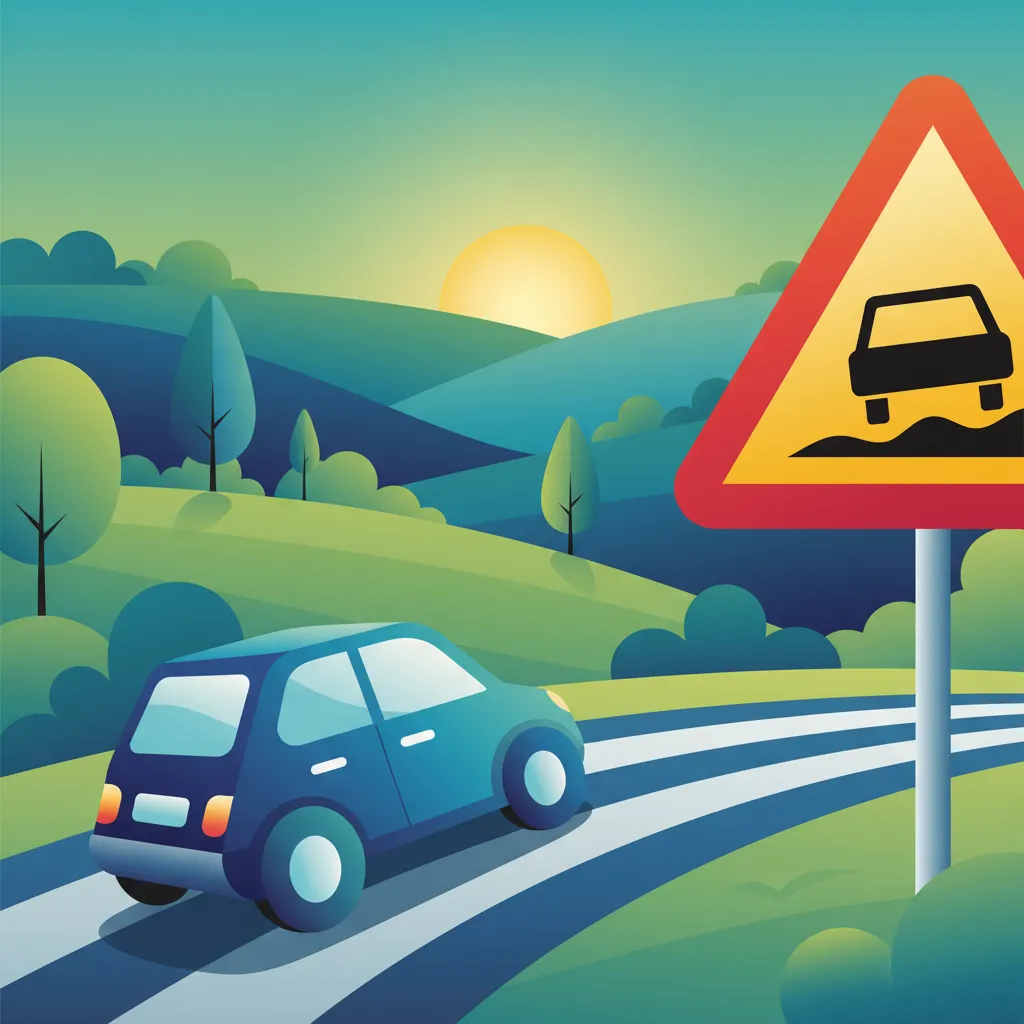
These signs are typically triangular in shape with a distinctive red border, a black symbol, and a yellow background. This universal design makes them immediately recognizable as warnings, even before you can decipher the specific symbol.
Mastering the interpretation of znaki ostrzegawcze is fundamental for safe driving in Poland and for successfully passing your Polish driving theory exam. Here's why:
Szczególna Ostrożność): In Polish traffic law, the presence of a warning sign legally obliges drivers to exercise szczególna ostrożność. This means more than just general caution; it requires heightened vigilance, readiness to react, and a proactive adjustment of your driving style to the specific conditions indicated.znaki ostrzegawcze, their meaning, the required szczególna ostrożność, and their placement distances are very common in the Polish driving theory test.Warning signs are strategically placed to give drivers adequate reaction time before reaching the actual hazard. In Poland, the placement distances are standardized:
There is one notable exception: the A-7 "Give Way" sign (ustąp pierwszeństwa) acts as both a warning and a priority sign, often placed closer to the intersection it governs due to its immediate impact on right-of-way.
Upon seeing a znak ostrzegawczy, a driver in Poland must:
szczególna ostrożność.The znaki ostrzegawcze cover a wide array of potential hazards in Poland. Some common categories include:
niebezpieczny zakręt w prawo), A-3/A-4 "Dangerous Curves" (niebezpieczne zakręty), or A-12 "Road Narrows" (zwężenie jezdni). These demand reduced speed and careful steering.skrzyżowanie dróg) where priority is not otherwise defined, or A-6 "Intersection with a Minor Road" (skrzyżowanie z drogą podporządkowaną). These require readiness to yield or increased vigilance.przejście dla pieszych) or A-24 "Cyclists" (rowerzyści) alert you to areas where vulnerable road users may be present.oszronienie jezdni) warn of slippery conditions, A-11 "Uneven Road" (nierówna droga), or A-28 "Loose Gravel" (sypki żwir). These call for significantly reduced speed and smooth vehicle control.Inne Niebezpieczeństwo): The A-30 "Other Danger" (inne niebezpieczeństwo) sign is particularly important in Poland. It is always accompanied by a tabliczka (supplementary plate) that specifies the exact nature of the hazard. Examples include tabliczki indicating crosswinds, road accidents, or even specific types of road users. This sign highlights the importance of always reading the accompanying plate.Ostrożność vs. Szczególna OstrożnośćIn Polish traffic law, there's a critical difference between general caution (ostrożność) and szczególna ostrożność (special caution).
Ostrożność (Caution): This is the basic level of care expected from every driver at all times. It means driving attentively, respecting rules, and being generally aware of your surroundings.Szczególna Ostrożność (Special Caution): This is a legally heightened standard of care, explicitly required in specific situations, most notably when a warning sign is present. It implies:
Failing to exercise szczególna ostrożność when legally required can have serious consequences and is a common point of focus in Polish driving exams.
Let's look at how warning signs guide decision-making in typical Polish driving situations:
szczególna ostrożność. You should immediately lift off the accelerator, potentially brake gently, and smoothly reduce your speed well before entering the curve. You'll also mentally prepare for reduced visibility through the bend and potential oncoming traffic or hidden obstacles.szczególna ostrożność means reducing your speed, covering the brake, and actively scanning both sides of the road and the crossing itself. You are prepared to stop immediately if a pedestrian steps out.Oszronienie Jezdni): You're driving in cooler weather and see the A-31 sign. This demands extreme szczególna ostrożność. Your speed must be drastically reduced, sudden braking or steering avoided, and you should be prepared for loss of traction, even if the road looks clear.szczególna ostrożność.Tabliczki: Failing to read the supplementary plates (like with A-30 "Other Danger"), which provide vital specific information about the hazard.Szczególna OstrożnośćThe essence of mastering znaki ostrzegawcze in Poland is proactive anticipation. These triangular signs are not suggestions; they are directives to heighten your awareness and adapt your driving before the hazard becomes immediate. Always remember that the legal requirement for szczególna ostrożność is paramount. By internalizing the message of each warning sign and applying this special caution, you enhance your safety, protect other road users, and demonstrate the responsible driving skills expected on Polish roads and in your theory exam.
Polish warning signs (znaki ostrzegawcze) are triangular, red-bordered signs with black symbols on yellow backgrounds that alert drivers to upcoming hazards rather than prohibiting actions. Their presence legally mandates 'szczególna ostrożność'—a heightened standard of care involving increased vigilance, readiness to react, and speed adjustment beyond simply obeying limits. Signs are placed 150–300 metres ahead on faster roads and up to 100 metres on slower roads, giving drivers time to identify, assess, and adapt to dangers such as curves, intersections, pedestrian crossings, or hazardous road conditions. Understanding the specific meaning of each sign type (A-series), reading all supplementary plates, and correctly interpreting placement distances are essential for both safe driving and passing the Polish theory exam.
A short set of high-value points that capture the most important ideas from this theory explanation.
Warning signs (znaki ostrzegawcze) are triangular with red borders, black symbols on yellow backgrounds, and serve as advance alerts—not prohibitions.
The presence of any warning sign legally obliges drivers to exercise 'szczególna ostrożność' (special caution), requiring heightened vigilance and proactive speed adjustment.
Warning signs are placed 150–300 metres before hazards on roads with speed limits exceeding 60 km/h, and up to 100 metres on slower roads.
Different sign categories alert to specific hazards: road geometry (A-1, A-3, A-4), intersections (A-5, A-6), pedestrians/cyclists (A-16, A-24), and road conditions (A-11, A-28, A-31).
The A-30 'Other Danger' sign is always accompanied by a tabliczka (supplementary plate) that specifies the exact hazard—never ignore these plates.
Szczególna ostrożność means increased vigilance, readiness to react, and speed adjustment below the legal limit if necessary—more than just general caution.
Warning signs do NOT prohibit actions; they prepare you to adapt your driving behaviour for upcoming hazards.
A-7 'Give Way' is unique—it functions as both a warning and priority sign, often placed closer to the intersection than other warning signs.
The A-30 sign alone tells you nothing; you must always read the accompanying tabliczka to understand the specific danger.
Standard placement: 150–300m before danger on faster roads; up to 100m on roads with 60 km/h or less.
Confusing warning signs with prohibitory signs—A-1 warns about a curve but does not prohibit taking it.
Failing to read supplementary plates (tabliczki), especially with A-30 'Other Danger', which leaves the hazard unidentified.
Not adjusting speed appropriately when seeing a warning sign—'szczególna ostrożność' requires proactive deceleration, not just awareness.
Misjudging reaction distances because learners don't internalize the 150–300m and 100m placement rules.
Treating warning signs as optional suggestions rather than legal directives requiring specific 'szczególna ostrożność' behaviour.
Start with a short, direct summary of Warning Signs & Road Hazards before reading the full explanation below.
Warning signs in Poland (znaki ostrzegawcze) are typically triangular road signs with a red border and a black symbol on a yellow background that alert drivers to potential dangers or changes in road conditions ahead. Their primary purpose is to give you enough time to react appropriately, often by reducing speed or increasing vigilance, and always by exercising 'szczególna ostrożność'. They do not impose prohibitions but rather prepare you for what's to come, helping prevent accidents by fostering proactive driving.
Review the most important terms, rule signals, and traffic concepts linked to Warning Signs & Road Hazards.
Explore related theory topic pages connected to Warning Signs & Road Hazards and continue with the next useful rule explanation.
See the common search queries learners use when trying to understand Warning Signs & Road Hazards in Poland.

Continue your preparation by exploring specific Polish driving theory topics in detail. Review each section to reinforce your understanding of traffic rules, road signs, and safe driving practices. Our comprehensive explanations are structured to support your learning journey and help you confidently approach the official driving licence theory exam.
Polish Driving Theory TopicsTheory topic content overview
A short set of high-value points that capture the most important ideas from this theory explanation.
Warning signs (znaki ostrzegawcze) are triangular with red borders, black symbols on yellow backgrounds, and serve as advance alerts—not prohibitions.
The presence of any warning sign legally obliges drivers to exercise 'szczególna ostrożność' (special caution), requiring heightened vigilance and proactive speed adjustment.
Warning signs are placed 150–300 metres before hazards on roads with speed limits exceeding 60 km/h, and up to 100 metres on slower roads.
Different sign categories alert to specific hazards: road geometry (A-1, A-3, A-4), intersections (A-5, A-6), pedestrians/cyclists (A-16, A-24), and road conditions (A-11, A-28, A-31).
The A-30 'Other Danger' sign is always accompanied by a tabliczka (supplementary plate) that specifies the exact hazard—never ignore these plates.
Szczególna ostrożność means increased vigilance, readiness to react, and speed adjustment below the legal limit if necessary—more than just general caution.
Warning signs do NOT prohibit actions; they prepare you to adapt your driving behaviour for upcoming hazards.
A-7 'Give Way' is unique—it functions as both a warning and priority sign, often placed closer to the intersection than other warning signs.
The A-30 sign alone tells you nothing; you must always read the accompanying tabliczka to understand the specific danger.
Standard placement: 150–300m before danger on faster roads; up to 100m on roads with 60 km/h or less.
Confusing warning signs with prohibitory signs—A-1 warns about a curve but does not prohibit taking it.
Failing to read supplementary plates (tabliczki), especially with A-30 'Other Danger', which leaves the hazard unidentified.
Not adjusting speed appropriately when seeing a warning sign—'szczególna ostrożność' requires proactive deceleration, not just awareness.
Misjudging reaction distances because learners don't internalize the 150–300m and 100m placement rules.
Treating warning signs as optional suggestions rather than legal directives requiring specific 'szczególna ostrożność' behaviour.
Start with a short, direct summary of Warning Signs & Road Hazards before reading the full explanation below.
Warning signs in Poland (znaki ostrzegawcze) are typically triangular road signs with a red border and a black symbol on a yellow background that alert drivers to potential dangers or changes in road conditions ahead. Their primary purpose is to give you enough time to react appropriately, often by reducing speed or increasing vigilance, and always by exercising 'szczególna ostrożność'. They do not impose prohibitions but rather prepare you for what's to come, helping prevent accidents by fostering proactive driving.
Review the most important terms, rule signals, and traffic concepts linked to Warning Signs & Road Hazards.
Explore related theory topic pages connected to Warning Signs & Road Hazards and continue with the next useful rule explanation.
See the common search queries learners use when trying to understand Warning Signs & Road Hazards in Poland.
Continue your preparation by exploring specific Polish driving theory topics in detail. Review each section to reinforce your understanding of traffic rules, road signs, and safe driving practices. Our comprehensive explanations are structured to support your learning journey and help you confidently approach the official driving licence theory exam.
Polish Driving Theory TopicsUse this exam-focused revision tip to understand how Warning Signs & Road Hazards is likely to appear in theory questions for learners in Poland. This section helps you identify the most testable part of the rule, avoid common traps, and remember the concept more effectively during Polish driving theory exam preparation.
In the Polish theory exam, pay close attention to warning signs that indicate specific road conditions or require particular caution. Remember that 'szczególna ostrożność' (special caution) is always legally required when these signs are present. Also, be aware of the typical distances these signs are placed before the actual hazard, as this is a common test question.
Read direct answers to the most common learner questions about Warning Signs & Road Hazards in Poland. This FAQ focuses on rule confusion, practical meaning, comparison with similar concepts, and the exact uncertainties that appear most often in Polish driving theory revision and exam preparation.
The main purpose of warning signs is to alert drivers to potential dangers or changes in road conditions ahead on Polish roads. They provide advance notice, allowing drivers to prepare and react safely, usually by exercising 'szczególna ostrożność' (special caution).
In Poland, most warning signs (znaki ostrzegawcze) are triangular with a red border and a black symbol on a yellow background. This distinctive design ensures they are easily recognized as warnings at a glance.
'Szczególna ostrożność' (special caution) is a key legal concept in Polish traffic law. When encountering a warning sign, it means you must increase your vigilance and readiness to react to potential dangers, adjusting your driving behavior and speed accordingly.
The placement distance varies. On roads where the speed limit exceeds 60 km/h, warning signs are typically placed 150m to 300m before the hazard. On other roads, they are placed up to 100m from the danger point. An exception is the 'yield' sign (A-7), which is placed closer.
Warning signs do not typically impose prohibitions (like 'no entry') or strict 'stop' obligations. Instead, they alert you to a potential danger or situation, obliging you to proceed with increased caution and adapt your driving, such as reducing speed or being ready to brake.
Yes, warning signs can be combined with supplementary plates (tabliczki) placed below them. These plates often specify the nature of the hazard, its distance, or the length of the dangerous section, providing more detailed information for drivers.
Build custom practice sessions tailored precisely to your needs. Focus on areas requiring improvement, review specific Polish road signs, or master complex traffic rules to ensure full preparation for your official driving license exam.