
This lesson breaks down the critical components of stopping distance: reaction distance, braking distance, and total stopping distance. You will learn how vehicle speed, road conditions, and tire quality affect these calculations, ensuring you are prepared for both the MTSK e-sınav and real-world safety.
Lesson content overview
When preparing for your Turkish Driving License Category B Theory Course (and the official MTSK e-sınav), understanding how a vehicle comes to a complete halt is one of the most critical safety concepts you will study. Many driver candidates falsely assume that pressing the brake pedal results in an instant stop. In reality, stopping a moving vehicle is a complex physical and psychological process that requires significant time and space.
Failing to estimate stopping distances accurately is a leading cause of rear-end collisions (arkadan çarpma), which is considered a primary fault (asli kusur) under Turkish Traffic Law No. 2918. This comprehensive guide covers the physics, calculations, legal regulations, and external factors that dictate how and when your vehicle will stop.
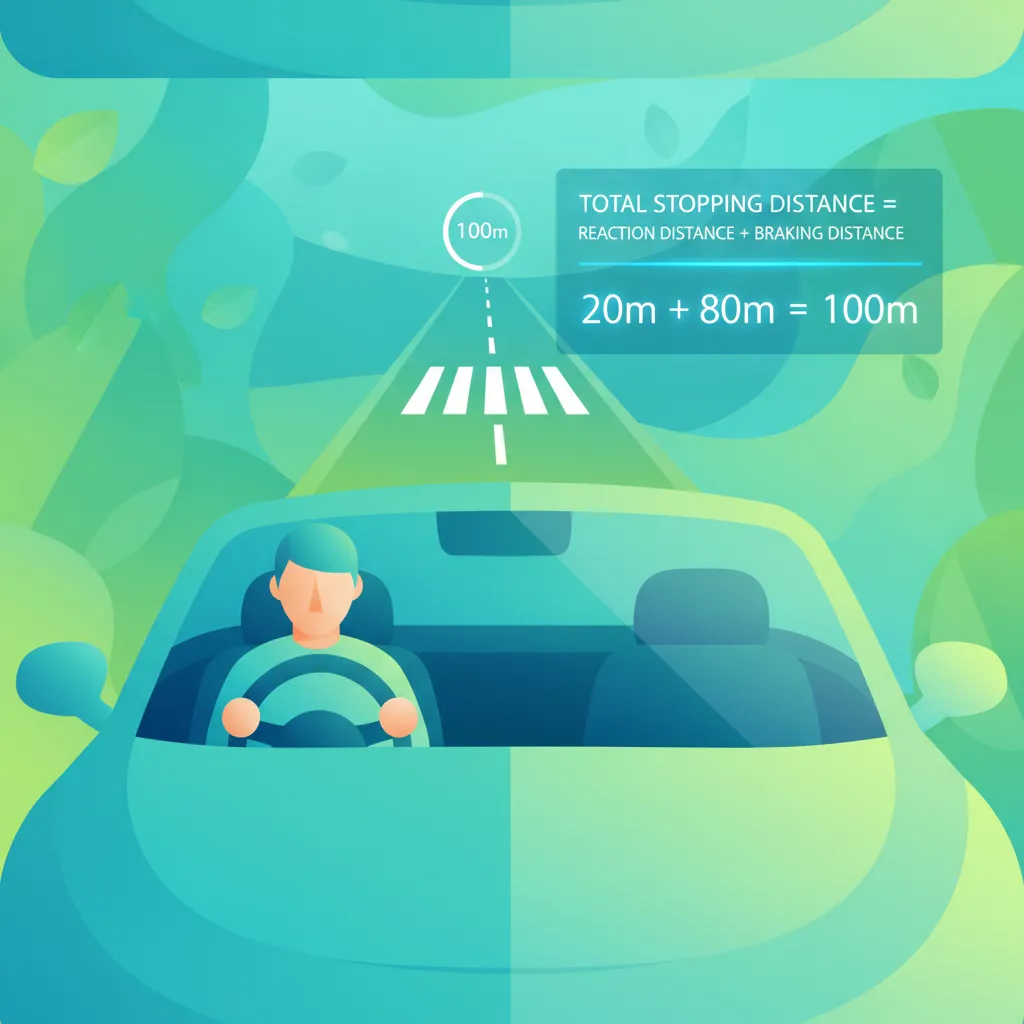
Total stopping distance (toplam durma mesafesi) is the entire distance your vehicle travels from the exact moment you perceive a hazard to the exact moment your vehicle comes to a complete, motionless standstill. It is not a single action but the sum of two distinct sequential phases:
In Turkish traffic theory, this is expressed as:
Understanding the division between these two phases is vital for safe driving and passing your driving theory exam. The first phase is governed by human psychology and physiology, while the second phase is dictated by the laws of physics, mechanical engineering, and environmental conditions.
Reaction Distance (intikal mesafesi or reaksiyon mesafesi) is the distance your vehicle travels from the moment your eyes detect a hazard until your foot physically transitions to and applies pressure on the brake pedal.
Before your foot even touches the brake pedal, your brain must execute three quick, consecutive processes:
Under normal, healthy conditions, the average driver's total perception-reaction time is approximately 1.5 seconds. In optimal conditions, an highly alert driver may react in about 0.75 to 1.0 second.
Even at moderate speeds, your vehicle covers a massive distance during this split second. Never underestimate the distance traveled before the brakes are even activated.
To find the distance traveled during your reaction phase, you must convert your speed from kilometers per hour (km/h) to meters per second (m/s).
The mathematical conversion is:
For example, if you are driving at 50 km/h:
If we assume a standard reaction time of 1.5 seconds, the reaction distance is calculated as:
At 100 km/h, the speed in meters per second is:
For the same 1.5-second reaction time, the reaction distance doubles:
Since reaction distance is entirely dependent on the driver’s cognitive state, any factor that impairs the brain or slows motor functions will increase this distance:
Braking Distance (fren mesafesi) is the distance your vehicle travels from the moment you apply the brakes until the vehicle comes to a complete stop. This phase is governed strictly by mechanical forces, kinetic energy, and friction.
The energy an object possesses due to its motion. The formula for kinetic energy is , where is mass and is velocity.
Because kinetic energy is proportional to the square of the velocity (), braking distance does not increase linearly with speed. Instead, it increases quadratically.
If you double your speed, your kinetic energy—and thus your braking distance—increases by four times (). If you triple your speed, your braking distance increases by nine times ().
When combined with your reaction distance, the total space needed to stop climbs exponentially as you speed up. This physical law is why speed limits are strictly enforced on Turkish motorways (otoyollar) and urban roads.
Your total stopping distance is highly dynamic. It changes constantly based on environmental, mechanical, and situational variables.
The friction between your tires and the road surface (known as traction) is the single most important factor in halting your vehicle's physical momentum.
Your tires are the only points of contact with the road.
A heavier vehicle carries more kinetic energy. When a vehicle is fully loaded with passengers and luggage, or if a Category B vehicle is towing a light trailer, its braking system must work significantly harder to dissipate the energy. Drivers must compensate for heavy loads by initiating braking much earlier.
Worn brake pads, warped brake rotors, or old brake fluid (which can boil under heavy use) diminish braking efficiency. Regular vehicle inspection (araç muayenesi) is a legal obligation in Turkey to ensure these systems are operating safely.
To prevent rear-end collisions resulting from sudden stops, Turkish traffic laws mandate that drivers maintain a safe following distance (takip mesafesi).
Under standard dry conditions, the basic rule of thumb taught for the Turkish driving exam is the Half-Speed Rule: your safe following distance in meters should be at least half of your current speed value in km/h.
A more precise way to measure safe following distance on the go is the 2-Second Rule, known in Turkish driver training as the "88-89 Rule" (88-89 Kuralı).
Choose a stationary object along the road ahead, such as a traffic sign, lamp post, or bridge.
As soon as the rear bumper of the vehicle in front of you passes that object, start counting at a normal speaking pace: "eighty-eight, eighty-nine" (which takes exactly two seconds to say).
If your front bumper reaches the chosen object before you finish saying "eighty-nine," you are following too closely (yakın takip) and must back off.
The 2-Second (88-89) rule is meant for optimal weather and road conditions. In wet, foggy, or icy conditions, you must increase this gap to 3, 4, or even more seconds to accommodate the drastically increased braking distance.
Turkish traffic regulations impose specific following distance rules for certain vehicle types and zones:
Understanding the theory of stopping distance helps you avoid common, highly dangerous driving errors:
Tailgating is the act of driving too closely behind another vehicle. If the lead vehicle performs an emergency stop, the tailgating driver will crash into them before their foot even reaches the brake pedal. This is because their reaction distance alone is longer than the entire gap between the two cars.
Many modern vehicles are equipped with an Anti-lock Braking System (ABS).
ABS does not necessarily shorten your braking distance. Instead, its primary function is to prevent your wheels from locking up, which allows you to maintain steering control while braking heavily.
If your tires are bald, ABS will activate much earlier because the tires lose grip instantly. On loose gravel or deep snow, ABS can actually increase braking distances, meaning you must leave an even greater buffer zone.
This lesson covers the two-phase model of stopping distance: reaction distance (governed by human perception and decision-making, averaging 1.5 seconds) and braking distance (dictated by physics and environmental friction). Speed converts from km/h to m/s by dividing by 3.6, and braking distance grows with the square of velocity, meaning doubling speed quadruples braking distance. External factors including weather conditions, tire tread depth, vehicle load, road gradient, and brake efficiency all substantially alter stopping performance. Turkey's official 88-89 Rule provides a practical 2-second following distance that must be extended under adverse conditions to prevent rear-end collisions.
A short set of high-value points that capture the most important learning from this lesson.
Total stopping distance equals reaction distance plus braking distance; both phases are essential and independent.
Speed directly determines reaction distance proportionally, but braking distance increases quadratically—if speed doubles, braking distance quadruples.
Under normal conditions, average perception-reaction time is 1.5 seconds, covering approximately 21 meters at 50 km/h and 42 meters at 100 km/h.
The 88-89 (2-second) rule is the practical method for maintaining safe following distance in Turkey, and must be extended in adverse conditions.
Vehicle load, tire condition, weather, road gradient, and brake efficiency all dynamically alter braking distance beyond theoretical calculations.
Explore all units and lessons included in this driving theory course.
Convert km/h to m/s by dividing by 3.6 to calculate reaction distance (speed × reaction time).
The Half-Speed Rule states safe following distance equals half your speed in meters (e.g., 90 km/h requires 45 m minimum).
Wet roads can double braking distance; icy surfaces can increase it up to 10 times compared to dry asphalt.
Minimum legal tread depth in Turkey is 1.6 mm, though 3 mm is recommended for wet weather safety.
Tailgating (yakın takip) causing a rear-end collision is considered primary fault (asli kusur) under Turkish Traffic Law No. 2918.
Assuming braking distance doubles linearly with speed instead of understanding the quadratic relationship.
Forgetting that reaction distance already begins before brakes are applied—many drivers underestimate this phase entirely.
Applying the 2-second rule without adjusting for rain, fog, snow, or downhill gradients, which dramatically increase required stopping space.
Believing ABS always shortens braking distance; ABS prevents wheel lockup for steering control but may not reduce stopping distance on loose surfaces.
Neglecting tire condition and pressure, which directly reduce traction and extend braking distance even at moderate speeds.
Lesson content overview
A short set of high-value points that capture the most important learning from this lesson.
Total stopping distance equals reaction distance plus braking distance; both phases are essential and independent.
Speed directly determines reaction distance proportionally, but braking distance increases quadratically—if speed doubles, braking distance quadruples.
Under normal conditions, average perception-reaction time is 1.5 seconds, covering approximately 21 meters at 50 km/h and 42 meters at 100 km/h.
The 88-89 (2-second) rule is the practical method for maintaining safe following distance in Turkey, and must be extended in adverse conditions.
Vehicle load, tire condition, weather, road gradient, and brake efficiency all dynamically alter braking distance beyond theoretical calculations.
Explore all units and lessons included in this driving theory course.
Convert km/h to m/s by dividing by 3.6 to calculate reaction distance (speed × reaction time).
The Half-Speed Rule states safe following distance equals half your speed in meters (e.g., 90 km/h requires 45 m minimum).
Wet roads can double braking distance; icy surfaces can increase it up to 10 times compared to dry asphalt.
Minimum legal tread depth in Turkey is 1.6 mm, though 3 mm is recommended for wet weather safety.
Tailgating (yakın takip) causing a rear-end collision is considered primary fault (asli kusur) under Turkish Traffic Law No. 2918.
Assuming braking distance doubles linearly with speed instead of understanding the quadratic relationship.
Forgetting that reaction distance already begins before brakes are applied—many drivers underestimate this phase entirely.
Applying the 2-second rule without adjusting for rain, fog, snow, or downhill gradients, which dramatically increase required stopping space.
Believing ABS always shortens braking distance; ABS prevents wheel lockup for steering control but may not reduce stopping distance on loose surfaces.
Neglecting tire condition and pressure, which directly reduce traction and extend braking distance even at moderate speeds.
Explore search topics learners often look for when studying Stopping Distance Calculation. These topics reflect common questions about road rules, driving situations, safety guidance, and lesson level theory preparation for learners in Turkey.
Browse additional driving theory lessons that cover connected traffic rules, road signs, and common driving situations related to this topic. Improve your understanding of how different rules interact across everyday traffic scenarios.
Learn the legal requirements for maintaining safe following distances on Turkish roads, including the application of the 88-89 rule. Understand how to calculate appropriate gaps between vehicles based on speed and road conditions to prevent rear-end collisions and maintain traffic safety.
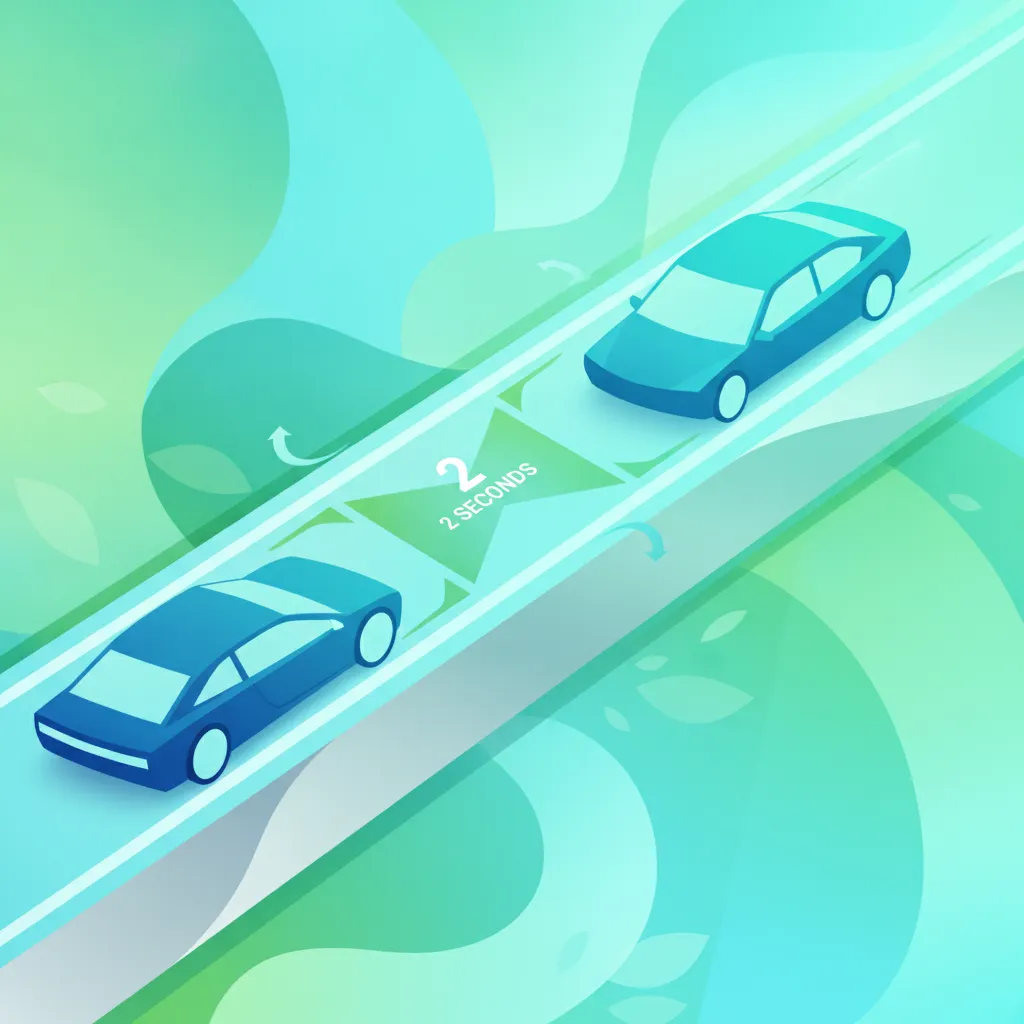
This lesson focuses on the principles governing safe following distances between vehicles. Topics include understanding time and distance gaps, reaction times, and braking distances. Learners will explore guidelines for maintaining proper following distances based on speed and road conditions. Real-world examples demonstrate the importance of safe following practices in preventing rear-end collisions.
This lesson focuses on the importance of maintaining safe following distances for goods vehicles, taking into account longer braking distances and increased load. Learners will learn how to calculate appropriate gaps based on speed, road conditions, and vehicle dynamics. The lesson emphasizes safe following practices to prevent rear-end collisions and improve overall traffic safety in Turkey.
Learners will learn how to calculate and maintain safe following distances, accounting for the longer braking distances and reaction times inherent to larger passenger vehicles. The lesson emphasizes the importance of a sufficient time gap to allow for safe stopping and to prevent rear-end collisions, particularly in varying traffic conditions.
This lesson explains the specific rules, driving etiquette, and safety protocols for operating a vehicle on high-speed Turkish motorways. It covers correct lane usage, overtaking procedures, emergency lane restrictions, and how to maintain consistent high speeds safely. Drivers will learn to avoid dangerous tailgating and sudden lane changes.

Protecting vulnerable road users is a core legal and ethical responsibility for all motorized vehicle operators in Turkey. This lesson covers the absolute requirement to yield to pedestrians at marked crosswalks, zebra crossings, and designated school zones. You will learn how to identify these zones early, reduce your speed proactively, and maintain heightened situational awareness for children or distracted pedestrians who may step onto the road unexpectedly.

This lesson focuses on the specific needs and challenges faced by children, elderly, and disabled pedestrians. Topics include recognizing vulnerable road users, understanding their behavior, and providing additional safety measures. The lesson also discusses school zones, pedestrian crossing assistance, and strategies to mitigate risks. Real-world examples demonstrate how drivers can anticipate dangers.

Proper road positioning is your primary shield against being squeezed, sideswiped, or overlooked by larger motor vehicles in daily traffic. This lesson explains how to ride in the center or slightly off-center of your lane to prevent unsafe overtaking within the same lane. You will study how to identify the massive blind spots of buses and trucks, maintain appropriate following distances, and execute overtaking maneuvers with maximum safety margin and clear signal warning.

This lesson focuses on the specific considerations for ensuring the safety of pedestrians and schoolchildren around bus stops and terminals. Learners will explore strategies for slowing down, stopping at appropriate distances, and maintaining heightened vigilance. The lesson also covers effective communication with children and the importance of secure boarding and alighting processes to prevent accidents.
Focusing on pedestrian safety, this lesson addresses the unique considerations motorcyclists must take when approaching zebra crossings, traffic signal-controlled pedestrian crossings, and designated school zones. Learners will understand the legal obligations to yield to pedestrians, especially children, and the importance of reducing speed in these high-risk areas. The lesson also provides practical tips for ensuring visibility.
Find clear answers to common questions learners have about Stopping Distance Calculation. Learn how the lesson is structured, which driving theory objectives it supports, and how it fits into the overall learning path of units and curriculum progression in Turkey. These explanations help you understand key concepts, lesson flow, and exam focused study goals.
Reaction distance is the distance covered from the moment you see a hazard until you apply the brake. Braking distance is the distance the car travels from the moment the brakes are applied until it comes to a full stop. Total stopping distance is the sum of both.
Wet, icy, or loose road surfaces significantly reduce tire traction, which increases the required braking distance compared to a dry, clean asphalt surface. Always adjust your speed downward when conditions are poor to maintain a safe stopping buffer.
You won't need a calculator, but you must understand the principle that doubling your speed quadruples your braking distance. Exam questions usually focus on your ability to judge safe gaps based on these fundamental physical rules.
Yes, worn-out tires with insufficient tread depth struggle to grip the road, especially in the rain. This significantly increases your braking distance, which is why regular vehicle maintenance is a key part of the Category B curriculum.
Use our comprehensive practice search to find exactly the Turkish driving theory questions you need to master. Whether reviewing specific road signs, traffic rules, or first aid scenarios, select your perfect practice set and boost your confidence for the official ehliyet sınavı.