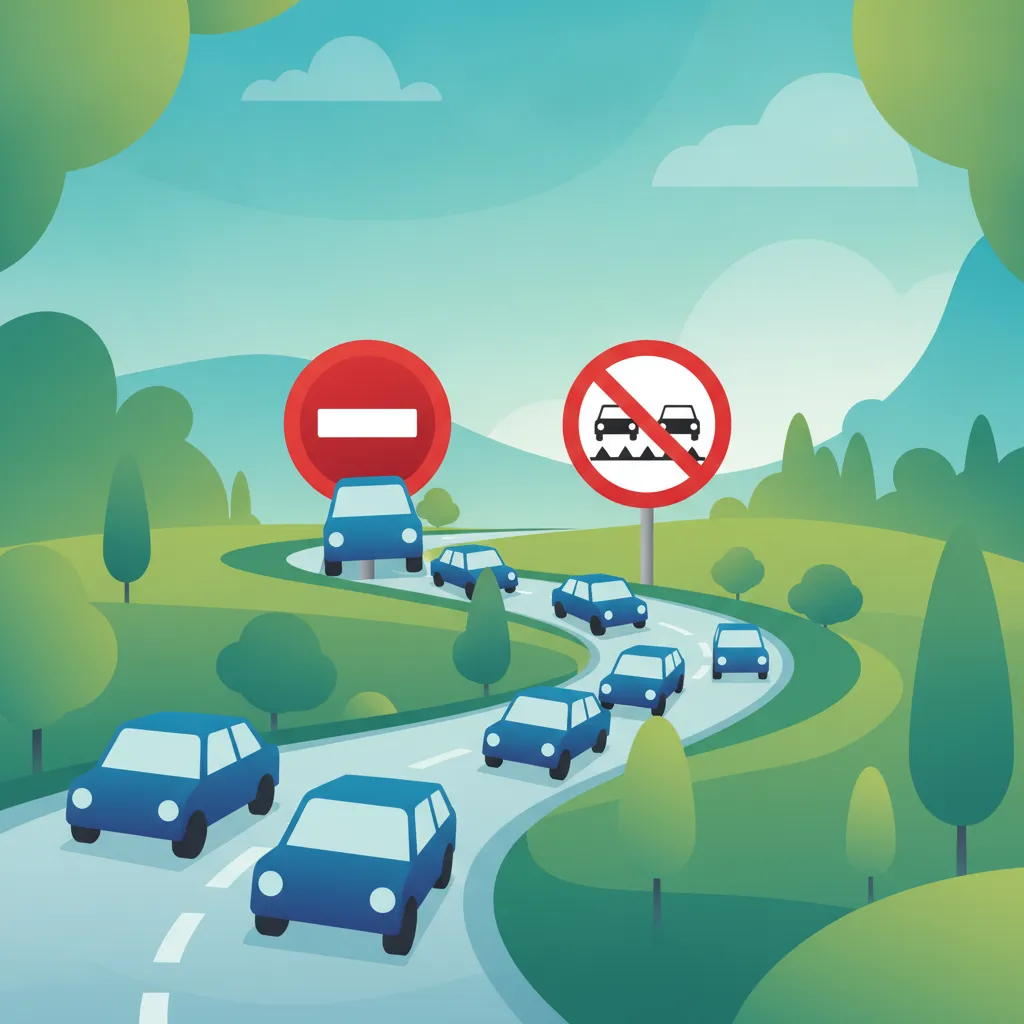
Prohibition signs, officially known as 'Verbotszeichen' in Germany, are traffic signs that indicate specific actions drivers are not allowed to perform. They are crucial for maintaining order, preventing dangerous situations, and ensuring smooth traffic flow. Recognizing and obeying these signs is a fundamental part of safe driving and a key requirement for passing the German driving theory exam.
Theory topic content overview
Read the full theory topic guide for Prohibition Signs Explained with structured, easy-to-scan content built for learners in Germany. This detailed section explains the exact rule, meaning, traffic context, comparison points, and exam logic behind this German driving theory topic so you can study faster, understand the concept more clearly, and avoid common interpretation mistakes on the theory test.
Prohibition signs, known in German traffic law as Verbotszeichen, are a category of road signs that explicitly forbid specific actions or behaviors for drivers and other road users. Unlike warning signs, which alert you to potential dangers, or mandatory signs, which instruct you to perform an action, Verbotszeichen issue a direct, legally binding command: "Do not do this." They are fundamental to maintaining order, ensuring safety, and regulating the flow of traffic on German roads, as defined by the Straßenverkehrs-Ordnung (StVO).
The most common visual characteristic of Verbotszeichen is their circular shape with a prominent red border. This design makes them immediately recognizable as signs indicating a restriction or prohibition.
For anyone learning to drive in Germany or navigating its roads, a deep understanding of Verbotszeichen is non-negotiable.
Einfahrt verboten), reduce accident risks (e.g., Überholverbot on dangerous stretches), and manage traffic density. Ignoring a prohibition sign is a direct risk to yourself and others.Verbotszeichen convey their instructions directly and unequivocally. When you encounter one, you must understand its specific meaning and adapt your driving behavior accordingly.
Überholverbot (No Overtaking).Ende der Verbotsstrecke sign) or until the next major intersection.Understanding the diverse range of Verbotszeichen is essential for navigating German roads. Here are some of the most common types:
Einfahrt verboten, Zeichen 267): A red circle with a white horizontal bar. This is one of the most critical signs, indicating that you are not allowed to enter a street or area in this direction. Often found at the exit of one-way streets or at access points where traffic flow is restricted.Überholverbot, Zeichen 276/277): A red-bordered circle depicting two cars, one red and one black, with the red one on the left. Prohibits all motor vehicles from overtaking other motor vehicles. A variation exists specifically for trucks (Überholverbot für LKW).Zulässige Höchstgeschwindigkeit, Zeichen 274): A red-bordered circle with a number inside (e.g., "50"). This indicates the maximum speed allowed in kilometers per hour. Remember, this is the legal maximum, not necessarily the safe speed under all conditions.Absolutes Haltverbot, Zeichen 283): A blue circle with a red diagonal line. This sign means you are absolutely forbidden to stop, even briefly, for any reason other than traffic flow (e.g., red light, traffic jam). Loading/unloading or picking up/dropping off passengers is also forbidden.Eingeschränktes Haltverbot or Parkverbot, Zeichen 286): A blue circle with a red diagonal cross. This sign prohibits parking. You are generally allowed to stop for up to three minutes for loading/unloading or picking up/dropping off passengers, provided you do not obstruct traffic.Verbot für Fahrzeuge aller Art, Zeichen 250, etc.): A red-bordered circle with a specific vehicle pictogram (e.g., a bicycle, a motorcycle, a truck). These signs prohibit only the depicted vehicle type from entering.Wendeverbot, Zeichen 272): A red-bordered circle with an arrow indicating a U-turn with a red diagonal line through it. Prohibits making a U-turn.Learners often confuse similar-looking signs or misinterpret the nuances of prohibitions, especially within the German context.
Absolutes Haltverbot (No Stopping) vs. Eingeschränktes Haltverbot / Parkverbot (No Parking): This is a classic confusion point.
Höchstgeschwindigkeit sign (Zeichen 274) states the maximum legal speed. However, drivers must always adjust their speed to road, weather, and traffic conditions. Driving at the legal maximum might be unsafe in rain, fog, or heavy traffic.Let's look at how Verbotszeichen impact driving decisions:
Verbot für Fußgänger, Zeichen 259). This prohibits pedestrians. More commonly, Durchfahrt verboten (no entry for all vehicles, Zeichen 250) or specific vehicle prohibitions might restrict access to such zones, often with Zusatzzeichen for delivery times. Entering outside permitted times would result in a fine.Überholverbot (Zeichen 276) sign. This means you must not attempt to overtake any vehicle, even slow ones, until you pass the Ende des Überholverbots (Zeichen 282) sign. This ensures safety where visibility or road width is limited.Parkverbot (Zeichen 286) with a Zusatzzeichen saying "Mo-Fr 8-18h". This means you can only park outside these hours. If you need to stop to quickly drop off a friend within these hours, you can do so for up to three minutes, provided you don't block traffic. However, stopping for longer or leaving the vehicle would be a violation. If it were Absolutes Haltverbot (Zeichen 283), even that brief stop would be forbidden.Halteverbot and Parkverbot: This is perhaps the most frequent error, leading to fines, especially in urban areas. Remember the single diagonal line (no stopping at all) versus the cross (brief stops permitted).Ende der Verbotsstrecke sign (e.g., a grey sign with diagonal lines) or the next major intersection. Many learners incorrectly assume a prohibition ends automatically after a short distance.Gefahrzeichen (warning) with a Verbotszeichen (prohibition) can lead to either unnecessary caution or, more dangerously, ignoring a mandatory restriction.In Germany, all traffic signs, including Verbotszeichen, are standardized according to the Straßenverkehrs-Ordnung (StVO). This robust legal framework ensures consistency and clarity across the country. The design, placement, and legal interpretation of these signs are strictly regulated.
The German theory test (Theorieprüfung) will specifically present actual Verbotszeichen from the StVO catalog and expect precise answers regarding their meaning and application. It's not enough to generally know what a "no entry" sign means; you must recognize the specific German Einfahrt verboten (Zeichen 267) and understand its exact implications under German law.
Always remember that Verbotszeichen are non-negotiable legal commands designed for your safety and the safety of others. When you see a circular sign with a red border in Germany, immediately interpret it as a "DO NOT" instruction. Take a moment to understand the symbol and check for any Zusatzzeichen below that might modify its application. By internalizing these prohibitions, you ensure not only compliance with German traffic law but also a much safer driving experience.
Start with a short, direct summary of Prohibition Signs Explained before reading the full explanation below.
Prohibition signs are German traffic signs that forbid specific actions, such as 'no entry' or 'no overtaking'. Typically circular with a red border, they legally restrict road users to ensure safety and regulate traffic. Ignoring these signs can lead to hazards, fines, and points in Flensburg. Understanding 'Verbotszeichen' is essential for safe driving and passing your German driving test.
Review the most important terms, rule signals, and traffic concepts linked to Prohibition Signs Explained.
Explore related theory topic pages connected to Prohibition Signs Explained and continue with the next useful rule explanation.
See the common search queries learners use when trying to understand Prohibition Signs Explained in Germany.

Solidify your understanding of German road rules. Explore specific theory topics in detail, from priority rules to complex Autobahn situations. Review key concepts and prepare thoroughly for every aspect of your official driving license theory examination.
German Driving Theory TopicsTheory topic content overview
Start with a short, direct summary of Prohibition Signs Explained before reading the full explanation below.
Prohibition signs are German traffic signs that forbid specific actions, such as 'no entry' or 'no overtaking'. Typically circular with a red border, they legally restrict road users to ensure safety and regulate traffic. Ignoring these signs can lead to hazards, fines, and points in Flensburg. Understanding 'Verbotszeichen' is essential for safe driving and passing your German driving test.
Review the most important terms, rule signals, and traffic concepts linked to Prohibition Signs Explained.
Explore related theory topic pages connected to Prohibition Signs Explained and continue with the next useful rule explanation.
See the common search queries learners use when trying to understand Prohibition Signs Explained in Germany.
Solidify your understanding of German road rules. Explore specific theory topics in detail, from priority rules to complex Autobahn situations. Review key concepts and prepare thoroughly for every aspect of your official driving license theory examination.
German Driving Theory TopicsUse this exam-focused revision tip to understand how Prohibition Signs Explained is likely to appear in theory questions for learners in Germany. This section helps you identify the most testable part of the rule, avoid common traps, and remember the concept more effectively during German driving theory exam preparation.
In the German theory exam, prohibition signs are often presented with scenarios where ignoring them leads to immediate danger or incorrect priority. Pay close attention to any supplementary signs (Zusatzzeichen) that modify the prohibition, such as time restrictions or specific vehicle types affected. Always assume a prohibition is continuous unless explicitly stated otherwise.
Read direct answers to the most common learner questions about Prohibition Signs Explained in Germany. This FAQ focuses on rule confusion, practical meaning, comparison with similar concepts, and the exact uncertainties that appear most often in German driving theory revision and exam preparation.
A prohibition sign in Germany (Verbotszeichen) is a traffic sign that indicates a specific action is legally forbidden. These signs are used to regulate traffic flow and enhance road safety, often featuring a red circular border.
'No entry' (Zeichen 267) forbids vehicles from entering a road, often found at one-way street exits. 'No overtaking' (Zeichen 276/277) prohibits drivers from passing other vehicles on that specific road section, depending on the vehicle type or number.
Many German prohibition signs are easily recognizable by their circular shape with a prominent red border, and a symbol or number in black on a white background indicating the specific restriction.
Most prohibition signs in Germany apply continuously, but some may include supplementary signs (Zusatzzeichen) that specify conditions like time of day, specific days, or certain vehicle types for which the prohibition is valid.
Ignoring a prohibition sign can lead to traffic violations, fines (Bußgeld), penalty points (Punkte in Flensburg), and in severe cases, even a driving ban (Fahrverbot), as well as increased risk of accidents.
All official German traffic signs, including prohibition signs, are detailed in the Straßenverkehrs-Ordnung (StVO), specifically in Anlage 2 (Vorschriftzeichen).
Yes, 'no parking' (eingeschränktes Haltverbot - Zeichen 283) and 'no stopping' (absolutes Haltverbot - Zeichen 286) are key prohibition signs in Germany, each with specific rules regarding stopping and parking your vehicle.
Begin your targeted revision now. Use our practice search to quickly find specific German driving theory questions. Filter by StVO rules, road signs, or hazard perception to create your focused study plan. Master challenging areas and prepare confidently for your theoretical driving test.