
Stopping distance, or Anhalteweg in German, is the total distance your vehicle travels from the moment you detect a hazard to when it comes to a complete halt. This essential concept is not just about braking; it involves both your reaction time and the vehicle's braking capability. Understanding its components and the factors that influence it is key to anticipating dangers and maintaining a safe following distance in German traffic.
Theory topic content overview
Read the full theory topic guide for Stopping Distance (Anhalteweg) with structured, easy-to-scan content built for learners in Germany. This detailed section explains the exact rule, meaning, traffic context, comparison points, and exam logic behind this German driving theory topic so you can study faster, understand the concept more clearly, and avoid common interpretation mistakes on the theory test.
Stopping distance, known in German driving theory as Anhalteweg, is one of the most fundamental concepts for road safety and a critical element in the German driving licence exam. It represents the total distance your vehicle travels from the precise moment you recognise a hazard to the point where your vehicle comes to a complete standstill. Anhalteweg is not a single, fixed number; it is a dynamic measurement influenced by numerous factors, most notably your speed.
Mastering this concept means understanding its two main components and how they combine to determine the overall distance needed to stop safely on German roads.
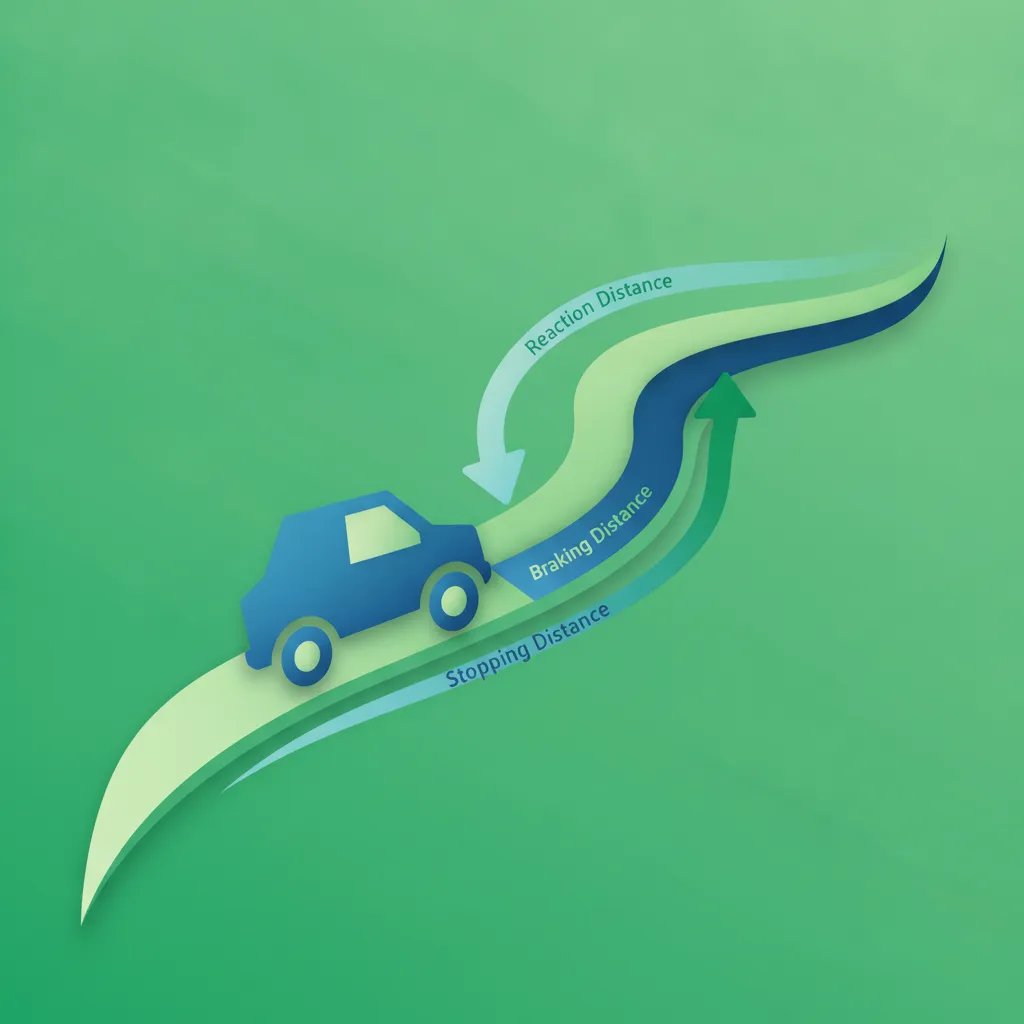
The total stopping distance (Anhalteweg) is always the sum of two distinct phases:
Anhalteweg = Reaktionsweg + Bremsweg
In German driving theory, understanding this breakdown is crucial, as exam questions frequently test your ability to differentiate between these components and calculate their approximate values under various conditions.
For all drivers in Germany, a thorough grasp of Anhalteweg is vital for several reasons:
Straßenverkehrs-Ordnung (StVO).One of the most critical aspects of Anhalteweg is its relationship with speed. This relationship is not linear, it's exponential:
(Speed in km/h ÷ 10) × 3. So at 50 km/h, Reaktionsweg ≈ 15m. At 100 km/h, Reaktionsweg ≈ 30m.(Speed in km/h ÷ 10) × (Speed in km/h ÷ 10). So at 50 km/h, Bremsweg ≈ 25m. At 100 km/h, Bremsweg ≈ 100m.Combining these:
This illustrates why even a small increase in speed can lead to a drastically longer stopping distance and why speeding in Germany, especially on the Autobahn without speed limits, still requires a responsible assessment of road conditions.
While speed is the primary factor, many other conditions significantly alter your total stopping distance:
abgefahrene Reifen) or tires with insufficient tread depth (unzureichende Profiltiefe) have less grip, especially in wet conditions, severely compromising braking performance.In the German driving theory test, learners often trip up on these points:
Notbremsweg (emergency braking distance) is approximately half of the Bremsweg calculated with the standard formula.Consider these practical situations on German roads:
halber Tacho (half speedometer value in meters) rule for following distance is so critical and why sudden braking can easily lead to chain collisions if distances are not kept.Landstraße) in winter conditions, even at a seemingly moderate 30 km/h, your braking distance could be 8-10 times longer than on dry roads. This transforms a 9m normal Bremsweg into 70-90m, making your Anhalteweg exceptionally long and requiring drastically reduced speeds and increased following distances.These scenarios highlight that simply knowing the speed limit is insufficient; you must always adapt your speed (angepasste Geschwindigkeit) to your visibility, road conditions, and your vehicle's capabilities to ensure your Anhalteweg is shorter than the clear distance ahead.
The core lesson from understanding Anhalteweg for your German driving theory and practical driving is simple yet profoundly important: Always maintain a safe following distance and adjust your speed to ensure your total stopping distance is always less than the visible clear road ahead.
Recognise that your personal reaction time is a constant factor, but your braking distance changes dramatically with speed and external conditions. This knowledge empowers you to make safer decisions, anticipate hazards, and maintain the necessary Sicherheitsabstand to prevent accidents on German roads.
Start with a short, direct summary of Stopping Distance (Anhalteweg) before reading the full explanation below.
Stopping distance (Anhalteweg) is the sum of reaction distance (Reaktionsweg) and braking distance (Bremsweg). Reaction distance is the distance covered before braking begins, while braking distance is the distance covered from brake application until the vehicle stops. Speed has an exponential effect on stopping distance, meaning even small increases in speed significantly lengthen the total stopping path.
Review the most important terms, rule signals, and traffic concepts linked to Stopping Distance (Anhalteweg).
Explore related theory topic pages connected to Stopping Distance (Anhalteweg) and continue with the next useful rule explanation.
See the common search queries learners use when trying to understand Stopping Distance (Anhalteweg) in Germany.

Solidify your understanding of German road rules. Explore specific theory topics in detail, from priority rules to complex Autobahn situations. Review key concepts and prepare thoroughly for every aspect of your official driving license theory examination.
German Driving Theory TopicsTheory topic content overview
Start with a short, direct summary of Stopping Distance (Anhalteweg) before reading the full explanation below.
Stopping distance (Anhalteweg) is the sum of reaction distance (Reaktionsweg) and braking distance (Bremsweg). Reaction distance is the distance covered before braking begins, while braking distance is the distance covered from brake application until the vehicle stops. Speed has an exponential effect on stopping distance, meaning even small increases in speed significantly lengthen the total stopping path.
Review the most important terms, rule signals, and traffic concepts linked to Stopping Distance (Anhalteweg).
Explore related theory topic pages connected to Stopping Distance (Anhalteweg) and continue with the next useful rule explanation.
See the common search queries learners use when trying to understand Stopping Distance (Anhalteweg) in Germany.
Solidify your understanding of German road rules. Explore specific theory topics in detail, from priority rules to complex Autobahn situations. Review key concepts and prepare thoroughly for every aspect of your official driving license theory examination.
German Driving Theory TopicsUse this exam-focused revision tip to understand how Stopping Distance (Anhalteweg) is likely to appear in theory questions for learners in Germany. This section helps you identify the most testable part of the rule, avoid common traps, and remember the concept more effectively during German driving theory exam preparation.
A common mistake in the German theory test is confusing braking distance (Bremsweg) with the total stopping distance (Anhalteweg). Remember that Anhalteweg *always* includes both your reaction distance (Reaktionsweg) and the actual braking distance. Also, be aware that the effect of speed on stopping distance is exponential, not linear – a small increase in speed means a much larger stopping distance.
Read direct answers to the most common learner questions about Stopping Distance (Anhalteweg) in Germany. This FAQ focuses on rule confusion, practical meaning, comparison with similar concepts, and the exact uncertainties that appear most often in German driving theory revision and exam preparation.
Stopping distance (Anhalteweg) is the total distance a vehicle travels from the moment a driver perceives a hazard until the vehicle comes to a complete stop. It combines reaction distance and braking distance.
Reaction distance (Reaktionsweg) is the distance your vehicle covers during the time it takes for you to perceive a hazard, process the information, decide to brake, and move your foot to the brake pedal. In German theory, a standard reaction time of one second is often assumed for calculations.
Braking distance (Bremsweg) is the distance your vehicle travels from the moment you apply the brakes until it comes to a complete stop. This distance is heavily influenced by speed, road conditions, and the vehicle's braking system.
In Germany, as elsewhere, stopping distance increases significantly with speed. While reaction distance increases proportionally with speed, braking distance increases approximately with the square of the speed. This means doubling your speed can quadruple your braking distance, and thus your total stopping distance.
Key factors increasing stopping distance include higher speed, poor road conditions (wet, icy, gravel), worn tires, faulty brakes, driver fatigue, distraction, alcohol/drugs, and reduced visibility (e.g., fog, heavy rain).
Understanding Anhalteweg is vital for the German driving test because it underpins many questions related to safe following distances, hazard perception, and adapting speed to conditions. You need to grasp the conceptual relationships, not just memorize exact numbers.
Begin your targeted revision now. Use our practice search to quickly find specific German driving theory questions. Filter by StVO rules, road signs, or hazard perception to create your focused study plan. Master challenging areas and prepare confidently for your theoretical driving test.