Right of way is a core principle of safe driving, dictating which road user may proceed first when paths converge. In Iceland, these rules are governed by official traffic legislation and are crucial for all drivers. This page will guide you through how to interpret traffic signals, road signs, and general rules like the 'hægri reglan' to confidently determine priority.
Theory topic content overview
Read the full theory topic guide for Right of Way Rules with structured, easy-to-scan content built for learners in Iceland. This detailed section explains the exact rule, meaning, traffic context, comparison points, and exam logic behind this Icelandic driving theory topic so you can study faster, understand the concept more clearly, and avoid common interpretation mistakes on the theory test.
Right of way is a cornerstone of safe driving, preventing collisions and ensuring an orderly flow of traffic. In Icelandic traffic, understanding and correctly applying right of way rules is not just a legal requirement but a fundamental skill for every driver, vital for passing your theory exam and navigating roads safely. These rules dictate who has priority to proceed first when the paths of different road users converge or intersect.
The Icelandic Transport Authority (Samgöngustofa) sets out clear regulations for determining right of way, which all drivers must master. This involves a clear hierarchy of rules that drivers must follow, from explicit instructions by police to general unwritten conventions.
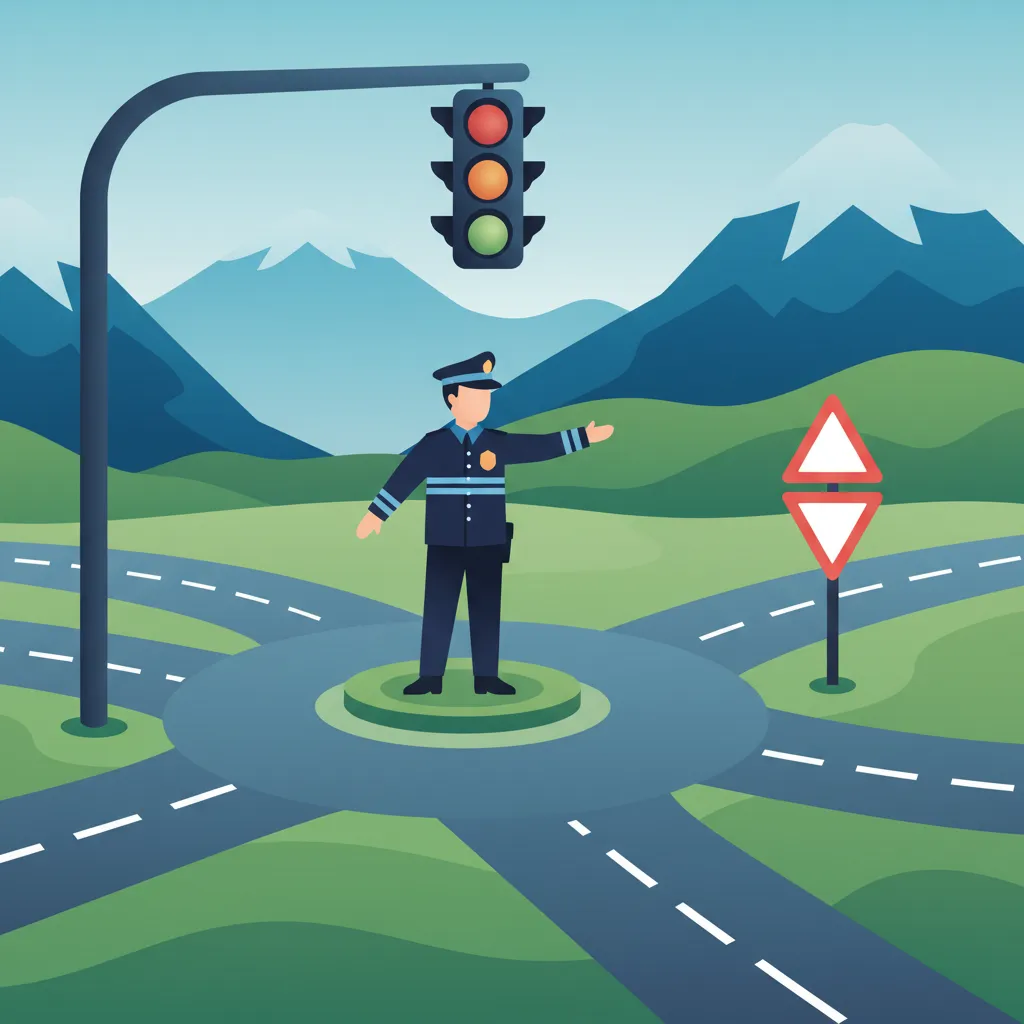
Determining who has priority on Icelandic roads follows a strict hierarchy. Drivers must always assess the situation in this order:
The hægri reglan is a fundamental principle in Icelandic traffic law. It states that at an uncontrolled intersection – an intersection without traffic lights, "Give Way" or "Stop" signs, or priority road signs – you must yield to any vehicle approaching from your right.
This rule is designed to ensure clarity and safety where there are no other explicit instructions. It's a common area of confusion and a frequent subject in the Icelandic driving theory exam.
How it works: Imagine you are approaching an intersection.
Example: You are driving straight through an intersection with no signs or lights. A car approaches from the road to your right. That car has priority, and you must slow down or stop to let them pass before you proceed.
In Iceland, vehicles already circulating within a roundabout generally have priority over vehicles entering the roundabout. You must yield to traffic approaching from your left inside the roundabout before you enter. This is crucial for maintaining smooth traffic flow in these common Icelandic junctions.
Pedestrians using a marked pedestrian crossing (zebra crossing) or a crossing controlled by a pedestrian signal usually have priority. Drivers must slow down, be prepared to stop, and give way to pedestrians who are waiting to cross or are already crossing. Even if a pedestrian crosses outside a marked area, drivers still have a responsibility to exercise extreme caution and avoid a collision.
Beyond pedestrians, other vulnerable road users like cyclists and motorcyclists also require special consideration. While they may not always have explicit right of way, drivers are expected to be extra vigilant and give them ample space, especially when turning or changing lanes.
When turning left, you must generally yield to oncoming traffic that is proceeding straight or turning right. You must also yield to pedestrians crossing the road you are turning into. When turning right, you must yield to any pedestrians or cyclists crossing the road you are turning into.
When merging onto a main road, highway, or changing lanes, drivers must yield to traffic already in the lane they wish to enter. Use mirrors, check blind spots, and signal clearly and in good time.
Never assume you have priority. Always verify. Even if a sign suggests you are on a main road, stay vigilant for unexpected situations or other drivers' mistakes.
A common error in the Icelandic theory exam and on the road is missing a subtle "Give Way" sign or road marking. Always scan the intersection thoroughly.
At uncontrolled intersections, the hægri reglan is often overlooked, leading to dangerous situations. Remember it is the default rule when no other instructions are present.
Failing to give priority or show extra caution to pedestrians and cyclists is a significant mistake that can have serious consequences. Always be ready to stop for them.
Mastering right of way rules in Iceland will not only help you pass your driving theory test but will also build the foundation for confident, safe, and responsible driving on all Icelandic roads.
Right of way in Icelandic traffic operates through a strict hierarchy where police signals take highest priority, followed by traffic lights, then signs and markings, and finally the hægri reglan as the default rule at uncontrolled intersections. The hægri reglan specifically requires yielding to traffic approaching from the right, while roundabouts favor circulating traffic and pedestrian crossings grant priority to those on foot. Key distinctions between yielding (proceed if safe) and stopping (complete halt required) are essential for both safe driving and exam success. Always scan intersections thoroughly, never assume priority, and remember that Icelandic weather conditions may require extra caution beyond what the rules strictly mandate.
A short set of high-value points that capture the most important ideas from this theory explanation.
Right of way in Iceland follows a clear hierarchy: police signals override everything, then traffic lights, then signs and markings, and finally the hægri reglan.
The hægri reglan (right-hand rule) requires you to yield to vehicles approaching from your right at any uncontrolled intersection.
At roundabouts, vehicles already inside have priority over those entering; yield to traffic approaching from your left.
Pedestrians on marked crossings have priority, and drivers must slow down and be prepared to stop for them.
Never assume you have priority—always verify by checking for signals, signs, and other road users before proceeding.
A 'Gefa eftir' (Give Way) sign means you may proceed if clear but must stop if needed; a 'Stöðva' (Stop) sign always requires a complete halt.
Main roads ('Aðalbraut') are marked with a yellow diamond and grant priority over side roads, until a diagonal-stripe sign indicates the main road ends.
When turning left, yield to oncoming traffic going straight or turning right; turning right requires yielding to pedestrians and cyclists crossing.
In Icelandic weather, you may need to yield even when you technically have priority to ensure safety.
Merging or entering traffic must always yield to vehicles already in the target lane.
Failing to apply the hægri reglan at uncontrolled intersections because drivers are focused on other traffic or distracted.
Confusing 'Gefa eftir' (yield) with 'Stöðva' (stop)—yield allows proceeding without stopping if safe, while stop always requires a complete halt.
Overlooking a subtle 'Give Way' sign or the triangular 'shark teeth' road markings that accompany it.
Assuming other drivers will yield their priority, rather than staying defensive and prepared to react.
Neglecting to give extra caution to cyclists and motorcyclists, particularly when turning or changing lanes.
Start with a short, direct summary of Right of Way Rules before reading the full explanation below.
Right of way determines which road user has priority to proceed first at points where traffic paths conflict. In Iceland, priority is established first by police signals, then traffic lights, followed by traffic signs and road markings. If none of these are present, general rules like the 'hægri reglan' (right-hand rule) apply, requiring you to yield to traffic from the right, ensuring orderly and safe flow.
Review the most important terms, rule signals, and traffic concepts linked to Right of Way Rules.
Explore related theory topic pages connected to Right of Way Rules and continue with the next useful rule explanation.
See the common search queries learners use when trying to understand Right of Way Rules in Iceland.

Ready to master Icelandic driving theory? Explore our comprehensive sections. Review road rules, traffic signs, and critical concepts. Build essential knowledge for confident and safe driving in Iceland. Start studying today.
Explore Icelandic Driving TheoryTheory topic content overview
A short set of high-value points that capture the most important ideas from this theory explanation.
Right of way in Iceland follows a clear hierarchy: police signals override everything, then traffic lights, then signs and markings, and finally the hægri reglan.
The hægri reglan (right-hand rule) requires you to yield to vehicles approaching from your right at any uncontrolled intersection.
At roundabouts, vehicles already inside have priority over those entering; yield to traffic approaching from your left.
Pedestrians on marked crossings have priority, and drivers must slow down and be prepared to stop for them.
Never assume you have priority—always verify by checking for signals, signs, and other road users before proceeding.
A 'Gefa eftir' (Give Way) sign means you may proceed if clear but must stop if needed; a 'Stöðva' (Stop) sign always requires a complete halt.
Main roads ('Aðalbraut') are marked with a yellow diamond and grant priority over side roads, until a diagonal-stripe sign indicates the main road ends.
When turning left, yield to oncoming traffic going straight or turning right; turning right requires yielding to pedestrians and cyclists crossing.
In Icelandic weather, you may need to yield even when you technically have priority to ensure safety.
Merging or entering traffic must always yield to vehicles already in the target lane.
Failing to apply the hægri reglan at uncontrolled intersections because drivers are focused on other traffic or distracted.
Confusing 'Gefa eftir' (yield) with 'Stöðva' (stop)—yield allows proceeding without stopping if safe, while stop always requires a complete halt.
Overlooking a subtle 'Give Way' sign or the triangular 'shark teeth' road markings that accompany it.
Assuming other drivers will yield their priority, rather than staying defensive and prepared to react.
Neglecting to give extra caution to cyclists and motorcyclists, particularly when turning or changing lanes.
Start with a short, direct summary of Right of Way Rules before reading the full explanation below.
Right of way determines which road user has priority to proceed first at points where traffic paths conflict. In Iceland, priority is established first by police signals, then traffic lights, followed by traffic signs and road markings. If none of these are present, general rules like the 'hægri reglan' (right-hand rule) apply, requiring you to yield to traffic from the right, ensuring orderly and safe flow.
Review the most important terms, rule signals, and traffic concepts linked to Right of Way Rules.
Explore related theory topic pages connected to Right of Way Rules and continue with the next useful rule explanation.
See the common search queries learners use when trying to understand Right of Way Rules in Iceland.
Ready to master Icelandic driving theory? Explore our comprehensive sections. Review road rules, traffic signs, and critical concepts. Build essential knowledge for confident and safe driving in Iceland. Start studying today.
Explore Icelandic Driving TheoryUse this exam-focused revision tip to understand how Right of Way Rules is likely to appear in theory questions for learners in Iceland. This section helps you identify the most testable part of the rule, avoid common traps, and remember the concept more effectively during Icelandic driving theory exam preparation.
A common mistake in the Icelandic theory exam is misinterpreting priority at uncontrolled intersections or overlooking a subtle 'Give Way' sign. Always scan intersections for signs or signals first, and if none are present, remember the 'hægri reglan' is usually the default rule for vehicles.
Read direct answers to the most common learner questions about Right of Way Rules in Iceland. This FAQ focuses on rule confusion, practical meaning, comparison with similar concepts, and the exact uncertainties that appear most often in Icelandic driving theory revision and exam preparation.
The 'hægri reglan' is Iceland's right-hand rule. It means that at uncontrolled intersections (without signs or signals), you must yield to any vehicle approaching from your immediate right.
The hierarchy is: 1) Police signals, 2) Traffic lights, 3) Traffic signs (e.g., Stop, Give Way, Main Road), 4) Road markings, and 5) General rules like the 'hægri reglan' and rules for special vehicles.
Pedestrians generally have priority when crossing at a marked pedestrian crossing (zebra crossing) or when traffic lights indicate they can cross. Drivers must always be extra cautious around pedestrians, especially children and the elderly.
At an uncontrolled intersection where no signs, signals, or markings indicate otherwise, the 'hægri reglan' applies: vehicles approaching from the right have priority.
Priority signs, such as the Give Way (víkja) sign or Stop (stöðva) sign, explicitly tell you when to yield to other traffic. A Main Road (aðalbraut) sign indicates you have priority over traffic entering or crossing from side roads.
In Iceland, vehicles already in the roundabout typically have priority over vehicles wishing to enter, unless specific signs or signals indicate otherwise. Always check for signs and yield to traffic inside the roundabout when entering.
Utilize our advanced practice set search to pinpoint the exact Icelandic driving theory topics you need to review. Filter by subject, difficulty, or question type to create a highly effective study plan and ensure you are fully prepared for your official driving licence test in Iceland.