
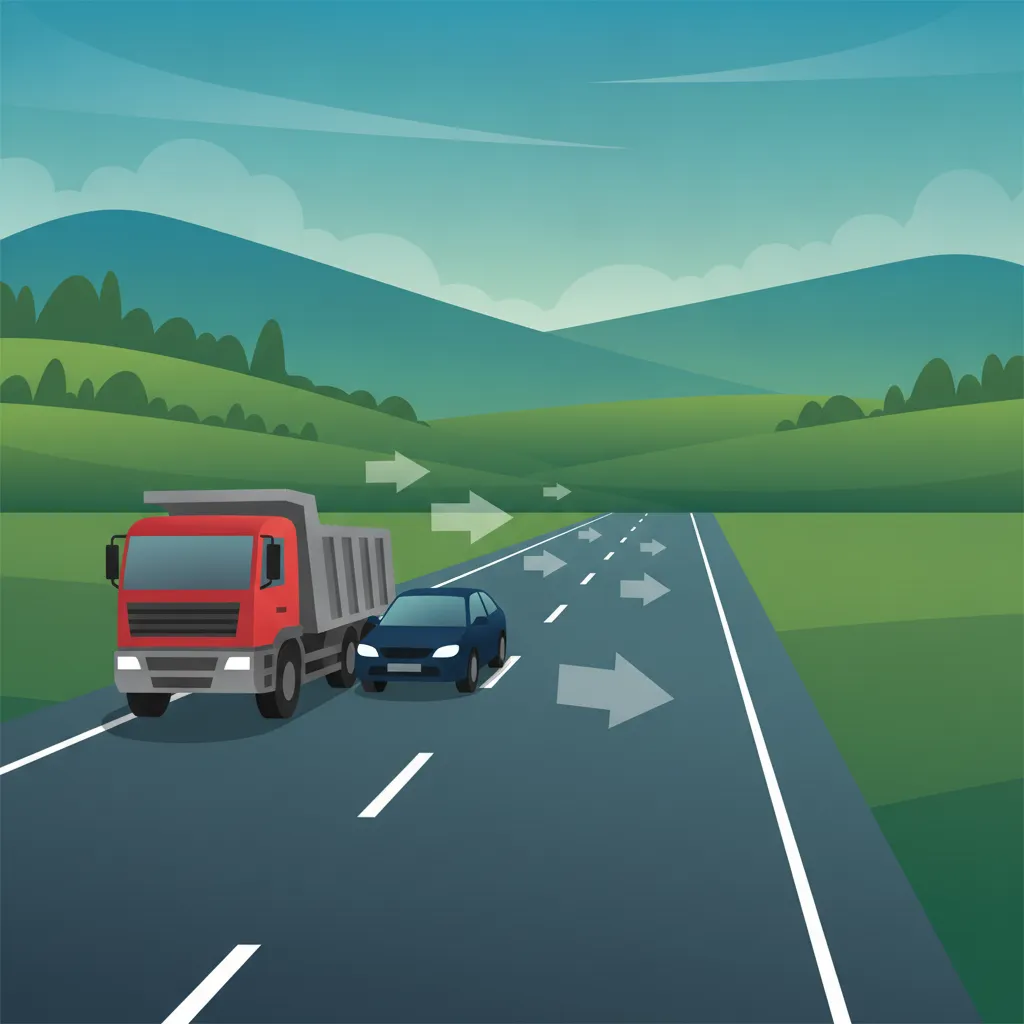
Tailgating occurs when a driver follows another vehicle too closely, leaving insufficient space to react safely. This dangerous practice significantly increases the risk of rear-end collisions. Understanding the relationship between speed, reaction time, and braking distance is fundamental to safe driving in Türkiye and for passing your ehliyet sınavı.
Theory topic content overview
Read the full theory topic guide for Tailgating & Safe Distance with structured, easy-to-scan content built for learners in Turkey. This detailed section explains the exact rule, meaning, traffic context, comparison points, and exam logic behind this Turkish driving theory topic so you can study faster, understand the concept more clearly, and avoid common interpretation mistakes on the theory test.
Tailgating occurs when a driver follows another vehicle too closely, failing to maintain a safe and adequate distance. This dangerous practice leaves insufficient room to react and stop safely if the vehicle ahead suddenly slows down or brakes. It is a primary cause of rear-end collisions and a serious concern for road safety on Turkish roads and globally.
The core problem with tailgating is the elimination of your safety margin. Without sufficient space, you lose the crucial time needed to perceive a hazard, decide on an action, and then physically execute that action (like braking) before an impact. This makes you entirely reliant on the lead driver's actions and eliminates your ability to respond to unexpected events.
Understanding tailgating requires a grasp of two fundamental concepts:
Stopping Distance is the sum of your reaction distance (distance traveled during reaction time) and your braking distance. When you tailgate, you effectively reduce or eliminate your available stopping distance, making a collision almost inevitable if the vehicle ahead makes an abrupt stop. This relationship is critical for the ehliyet sınavı and practical driving in Türkiye.
The most practical and widely recommended method for maintaining a safe following distance, relevant for Turkish traffic regulations and everyday driving, is the time-based rule. This involves allowing a minimum number of seconds to pass between the moment the vehicle in front of you passes a fixed point (like a signpost or shadow) and the moment your vehicle reaches that same point.
To apply this, choose a stationary object on the side of the road (e.g., a tree, bridge, or road sign). When the rear of the vehicle in front passes that object, start counting "one thousand one, one thousand two..." If you reach the object before you finish counting to two, you are following too closely. Adjust your speed to increase the gap.
The ideal safe following distance is not fixed; it constantly changes based on several variables that increase your stopping distance:
ehliyet sınavı questions), or impairment will lengthen your reaction time.Tailgating is considered aggressive and reckless driving under Turkish traffic regulations for several reasons:
otoyol) or urban roads.ehliyet).Learners and even experienced drivers often make mistakes related to following distance:
To ensure safety and pass your ehliyet sınavı, actively manage your following distance:
For both the Turkish driving theory exam and lifelong safe driving, remember this: maintaining a safe following distance is your primary safety buffer against rear-end collisions. It provides you with the crucial time and space to react, anticipate, and avoid accidents. Always adjust your distance to suit your speed, road conditions, and the flow of traffic. Prioritizing space management is a hallmark of a responsible and skilled driver in Türkiye.
Start with a short, direct summary of Tailgating & Safe Distance before reading the full explanation below.
Tailgating is following another vehicle too closely, leaving insufficient room to stop safely if the lead vehicle brakes suddenly. It is a major cause of rear-end collisions because it eliminates the necessary reaction and braking distance. Maintaining a safe following distance, often guided by time-based rules, is essential for road safety and a key requirement in Turkish traffic regulations.
Review the most important terms, rule signals, and traffic concepts linked to Tailgating & Safe Distance.
Explore related theory topic pages connected to Tailgating & Safe Distance and continue with the next useful rule explanation.
See the common search queries learners use when trying to understand Tailgating & Safe Distance in Turkey.

Dive deeper into specific Turkish driving theory topics like traffic signs, first aid, or vehicle mechanics. Each section offers clear explanations to enhance your understanding of official traffic legislation and prepare you effectively for every aspect of your upcoming ehliyet exam in Türkiye.
Explore Turkish Driving Theory TopicsTheory topic content overview
Start with a short, direct summary of Tailgating & Safe Distance before reading the full explanation below.
Tailgating is following another vehicle too closely, leaving insufficient room to stop safely if the lead vehicle brakes suddenly. It is a major cause of rear-end collisions because it eliminates the necessary reaction and braking distance. Maintaining a safe following distance, often guided by time-based rules, is essential for road safety and a key requirement in Turkish traffic regulations.
Review the most important terms, rule signals, and traffic concepts linked to Tailgating & Safe Distance.
Explore related theory topic pages connected to Tailgating & Safe Distance and continue with the next useful rule explanation.
See the common search queries learners use when trying to understand Tailgating & Safe Distance in Turkey.
Dive deeper into specific Turkish driving theory topics like traffic signs, first aid, or vehicle mechanics. Each section offers clear explanations to enhance your understanding of official traffic legislation and prepare you effectively for every aspect of your upcoming ehliyet exam in Türkiye.
Explore Turkish Driving Theory TopicsUse this exam-focused revision tip to understand how Tailgating & Safe Distance is likely to appear in theory questions for learners in Turkey. This section helps you identify the most testable part of the rule, avoid common traps, and remember the concept more effectively during Turkish driving theory exam preparation.
In the ehliyet sınavı, tailgating questions often test your understanding of how various factors (speed, road conditions, reaction time) impact safe following distance. Always choose the answer that prioritizes the longest safe distance, as it offers the most margin for error and prevents dangerous rear-end collisions.
Read direct answers to the most common learner questions about Tailgating & Safe Distance in Turkey. This FAQ focuses on rule confusion, practical meaning, comparison with similar concepts, and the exact uncertainties that appear most often in Turkish driving theory revision and exam preparation.
Tailgating is the act of driving too close to the vehicle in front, leaving inadequate space to react and stop safely if the lead vehicle slows down or stops unexpectedly.
Tailgating is dangerous because it drastically reduces the time and distance available to react to sudden changes, making rear-end collisions highly likely, especially at higher speeds or in poor conditions on Turkish roads.
A common method is the 'two-second rule': choose a fixed point ahead (like a sign or tree) and when the vehicle in front passes it, count 'one-thousand-one, one-thousand-two'. If you pass the same point before you finish counting, you are following too closely. Increase this to 3-4 seconds in adverse conditions.
Yes, absolutely. The faster you drive, the longer it takes for your vehicle to stop. Therefore, you must increase your following distance significantly as your speed increases to maintain the same safety margin.
Turkish traffic law emphasizes maintaining a safe distance to prevent accidents. While specific numerical distances aren't always mandated, the principle of 'sufficient distance' (takip mesafesi) based on speed and road conditions is strictly enforced. The two-second rule is a widely accepted practical guideline.
Tailgating can lead to significant fines in Türkiye due to reckless driving or causing an accident. More importantly, it can result in serious injuries or fatalities from rear-end collisions.
Reaction distance is how far your vehicle travels from when you perceive a hazard until you apply the brakes. Braking distance is how far your vehicle travels from when you apply the brakes until it comes to a complete stop. Safe following distance must account for both.
Use our comprehensive practice search to find exactly the Turkish driving theory questions you need to master. Whether reviewing specific road signs, traffic rules, or first aid scenarios, select your perfect practice set and boost your confidence for the official ehliyet sınavı.