
The 'Give Way' sign, known as 'Vigepligt' in Denmark, instructs drivers to yield to other traffic before entering an intersection or crossing another road. Unlike a stop sign, it doesn't always require a complete stop, but demands careful assessment and yielding if other road users are approaching or already on the priority road. Mastering this rule is essential for safe driving and passing the Danish theory exam.
Theory topic content overview
Read the full theory topic guide for Give Way Sign Rules with structured, easy-to-scan content built for learners in Denmark. This detailed section explains the exact rule, meaning, traffic context, comparison points, and exam logic behind this Danish driving theory topic so you can study faster, understand the concept more clearly, and avoid common interpretation mistakes on the theory test.
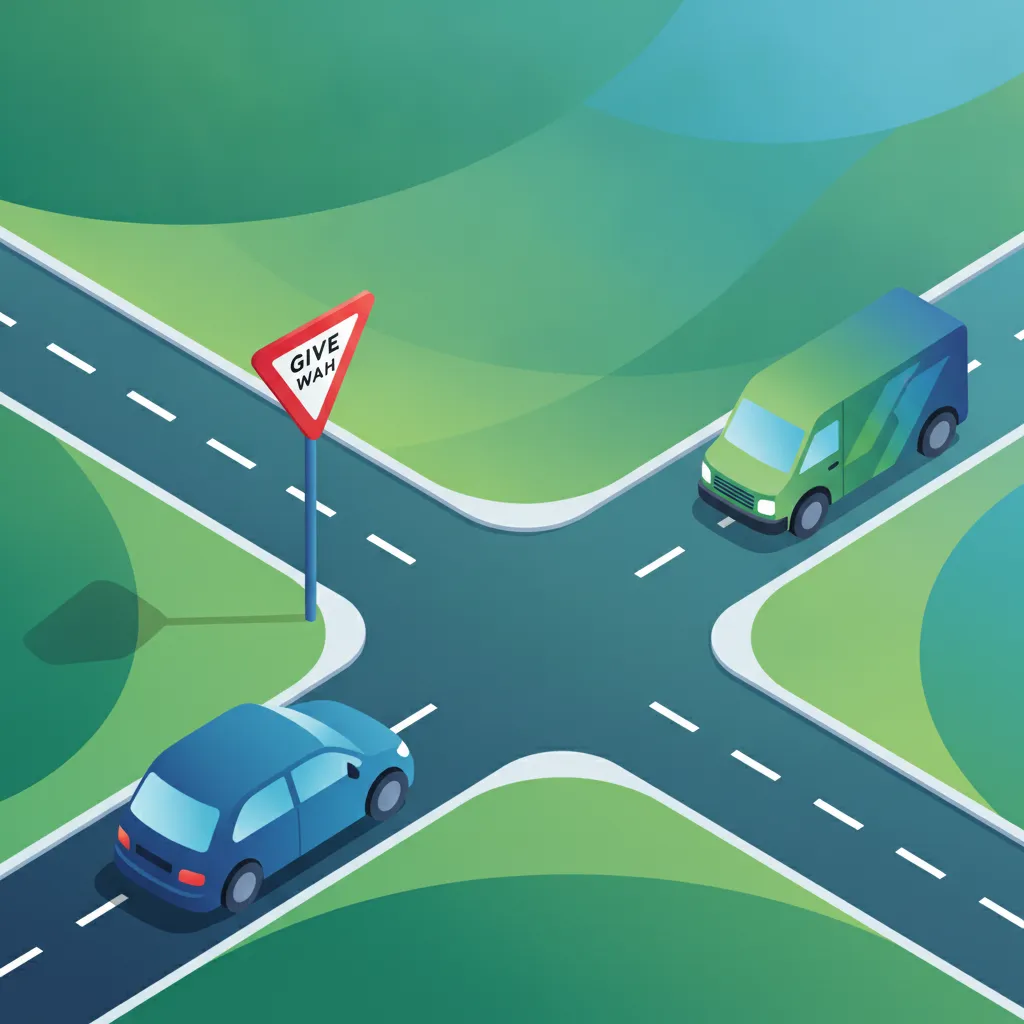
The Give Way sign, universally recognized by its inverted triangular shape with a red border and white background, is known as Vigepligt in Denmark. This crucial Danish traffic sign indicates that drivers must yield the right of way to traffic on the intersecting road before proceeding. It's a fundamental rule designed to ensure safety and maintain the flow of traffic at junctions where some roads have priority over others.
Essentially, Vigepligt means you must allow other road users to go first if your entry onto or across their path would cause them to slow down, brake, or change direction. You are obliged to assess the traffic situation and only proceed when it is safe to do so without interfering with priority traffic.
Mastering the rules surrounding the Give Way sign (Vigepligt) is not just about passing your Danish driving theory test; it's vital for everyday safety on Danish roads. Misinterpreting this sign is a common cause of collisions at intersections. Denmark's dense cycling infrastructure and active pedestrian culture make correct yielding especially critical, as vulnerable road users often have priority or are easily overlooked. Understanding Vigepligt ensures you can:
Vigepligt scenarios are frequently tested, requiring precise knowledge of observation and yielding behavior.When approaching a Give Way sign (Vigepligt) in Denmark, your actions should follow a clear, systematic process:
Give Way sign. Begin scanning the intersection early for other traffic, including vehicles, cyclists, and pedestrians, from all directions (left, right, and straight ahead if turning).Stop sign where a full stop is mandatory, with Vigepligt, a complete stop is only required if necessary to yield to priority traffic or if visibility is poor.Several factors influence how you apply the Give Way (Vigepligt) rule:
Vigepligt, you must also consider traffic in the lanes you are turning into, and crucially, pedestrians and cyclists on the path you are crossing.A common point of confusion for learners in Denmark is the difference between a Give Way sign (Vigepligt) and a Stop sign (Stopskilt). While both relate to priority rules Denmark, their requirements are distinct:
Give Way Sign (Vigepligt):
Stop Sign (Stopskilt):
Give Way sign, only proceeding when safe.Another distinction in Danish traffic regulations is unmarked intersections where no signs are present. Here, the rule of højrevigepligt (right-of-way from the right) generally applies, meaning you must yield to traffic coming from your right. The Give Way sign overrides højrevigepligt by explicitly assigning priority to the road it faces.
Let's look at how the Give Way sign (Vigepligt) plays out in common Danish driving theory scenarios:
Vigepligt sign. You slow down, checking for traffic from your left and right, and critically, for cyclists on the dedicated cycle path alongside the main road who are continuing straight or turning left. You must yield to them before turning right.Vigepligt sign indicates you must yield. A car is approaching from your left on the main road, far enough away that you could technically pull out. However, if they would need to lift their foot off the accelerator or brake even slightly, you must wait for a larger gap.Vigepligt sign, most roundabouts in Denmark operate on the principle of yielding to traffic already in the roundabout. You must approach slowly, check for traffic within the roundabout and from your left, and only enter when a safe gap allows you to do so without impeding flow.Learners frequently make these errors regarding Danish Give Way sign rules:
Vigepligt. The goal is to yield, not always to stop.The Give Way sign (Vigepligt) is your instruction to be patient, observe thoroughly, and prioritize the safety and smooth flow of traffic already on the main road. Always approach with caution, significantly reduce your speed, and be ready to stop if any vehicle, cyclist, or pedestrian has priority. Remember, "yield" means giving way if your actions would cause others to react, not just waiting for the road to be completely empty. This understanding is key to safe driving and success in your Danish driving test.
The Give Way sign (Vigepligt) is an inverted red triangle instructing drivers in Denmark to yield to traffic on intersecting roads. The key rule is to slow down, observe traffic from all directions including cyclists and pedestrians, and only proceed when doing so will not force any priority traffic to react. Unlike a Stop sign, Vigepligt does not require a mandatory full stop unless traffic conditions or poor visibility make it necessary. Common mistakes include approaching too fast, stopping unnecessarily, overlooking vulnerable road users, and assuming other drivers will yield correctly.
A short set of high-value points that capture the most important ideas from this theory explanation.
The Give Way sign (Vigepligt) means you must yield to all traffic on the intersecting road without necessarily coming to a complete stop
Always reduce speed significantly when approaching a Vigepligt sign so you can stop if needed and properly assess all traffic
Check all directions (left, right, and ahead for turning) before proceeding, including vulnerable road users
Proceed only when your entry will not force any priority traffic to brake, slow, or change direction
Vigepligt scenarios are frequently tested in the Danish theory exam and require precise observation and yielding behavior
Vigepligt requires yielding, not always stopping—only stop if necessary to avoid impeding traffic
Stop sign (Stopskilt) requires a mandatory full stop; Vigepligt does not unless visibility or traffic demands it
Inverted red triangle shape distinguishes Give Way from Stop signs (octagonal shape)
Cyclists and pedestrians on Denmark's dense cycling infrastructure often have priority and are easily overlooked when turning
At unmarked intersections, højrevigepligt applies—yield to traffic from your right—but Vigepligt signs override this rule
Approaching too fast means you cannot assess traffic properly or stop safely if priority vehicles appear
Stopping completely when the road is clearly free disrupts traffic flow unnecessarily since a full stop is not always required
Focusing only on other vehicles and failing to check for cyclists and pedestrians, especially when turning across cycle paths
Assuming other drivers will yield correctly—always be prepared to yield even when you believe you have priority
Only checking one direction or having a narrow field of vision causes priority traffic from other angles to be missed
Start with a short, direct summary of Give Way Sign Rules before reading the full explanation below.
The 'Give Way' sign (Vigepligt) in Denmark means you must yield to all traffic on the intersecting road before proceeding. You must slow down and be prepared to stop if necessary, only continuing when it is safe and you will not force other vehicles to brake or change direction. This applies unless other signs or signals indicate otherwise, ensuring priority for traffic already in motion.
Review the most important terms, rule signals, and traffic concepts linked to Give Way Sign Rules.
Explore related theory topic pages connected to Give Way Sign Rules and continue with the next useful rule explanation.
See the common search queries learners use when trying to understand Give Way Sign Rules in Denmark.

Dive into detailed explanations of Danish traffic legislation, road signs, and driving conventions. Solidify your understanding of key theory topics and prepare confidently for all sections of your official Danish driving license theory exam.
Explore Driving Theory TopicsTheory topic content overview
A short set of high-value points that capture the most important ideas from this theory explanation.
The Give Way sign (Vigepligt) means you must yield to all traffic on the intersecting road without necessarily coming to a complete stop
Always reduce speed significantly when approaching a Vigepligt sign so you can stop if needed and properly assess all traffic
Check all directions (left, right, and ahead for turning) before proceeding, including vulnerable road users
Proceed only when your entry will not force any priority traffic to brake, slow, or change direction
Vigepligt scenarios are frequently tested in the Danish theory exam and require precise observation and yielding behavior
Vigepligt requires yielding, not always stopping—only stop if necessary to avoid impeding traffic
Stop sign (Stopskilt) requires a mandatory full stop; Vigepligt does not unless visibility or traffic demands it
Inverted red triangle shape distinguishes Give Way from Stop signs (octagonal shape)
Cyclists and pedestrians on Denmark's dense cycling infrastructure often have priority and are easily overlooked when turning
At unmarked intersections, højrevigepligt applies—yield to traffic from your right—but Vigepligt signs override this rule
Approaching too fast means you cannot assess traffic properly or stop safely if priority vehicles appear
Stopping completely when the road is clearly free disrupts traffic flow unnecessarily since a full stop is not always required
Focusing only on other vehicles and failing to check for cyclists and pedestrians, especially when turning across cycle paths
Assuming other drivers will yield correctly—always be prepared to yield even when you believe you have priority
Only checking one direction or having a narrow field of vision causes priority traffic from other angles to be missed
Start with a short, direct summary of Give Way Sign Rules before reading the full explanation below.
The 'Give Way' sign (Vigepligt) in Denmark means you must yield to all traffic on the intersecting road before proceeding. You must slow down and be prepared to stop if necessary, only continuing when it is safe and you will not force other vehicles to brake or change direction. This applies unless other signs or signals indicate otherwise, ensuring priority for traffic already in motion.
Review the most important terms, rule signals, and traffic concepts linked to Give Way Sign Rules.
Explore related theory topic pages connected to Give Way Sign Rules and continue with the next useful rule explanation.
See the common search queries learners use when trying to understand Give Way Sign Rules in Denmark.
Dive into detailed explanations of Danish traffic legislation, road signs, and driving conventions. Solidify your understanding of key theory topics and prepare confidently for all sections of your official Danish driving license theory exam.
Explore Driving Theory TopicsUse this exam-focused revision tip to understand how Give Way Sign Rules is likely to appear in theory questions for learners in Denmark. This section helps you identify the most testable part of the rule, avoid common traps, and remember the concept more effectively during Danish driving theory exam preparation.
A common mistake in the Danish theory test is assuming you always have to stop at a 'Give Way' sign, or conversely, not slowing down enough to assess traffic. Remember, the rule is to 'yield' – meaning only proceed when it's genuinely safe and you don't impede other traffic. Always check both left and right, and be especially aware of cyclists and pedestrians.
Read direct answers to the most common learner questions about Give Way Sign Rules in Denmark. This FAQ focuses on rule confusion, practical meaning, comparison with similar concepts, and the exact uncertainties that appear most often in Danish driving theory revision and exam preparation.
The 'Give Way' sign (Vigepligt) primarily means you must yield to traffic on the main road or intersecting road. You must not proceed if doing so would cause other road users to slow down, stop, or change their course.
No, unlike a 'Stop' sign, you do not always have to come to a complete stop. You must slow down significantly and be prepared to stop, but if the intersecting road is clear and it's safe to proceed without affecting other traffic, you may continue without stopping.
The key difference is the mandatory stop. A 'Stop' sign (Stop) always requires you to come to a complete halt before the stop line, while a 'Give Way' sign (Vigepligt) only requires you to stop if there is traffic you must yield to.
You must give way to all traffic approaching from the road you are joining or crossing. This includes cars, motorcycles, buses, cyclists, and pedestrians, unless specific circumstances (like a police officer's signal) indicate otherwise.
In Denmark, the 'Give Way' sign is an inverted white triangle with a red border. This distinct shape makes it recognizable even if obscured or if its colors are faded.
Failing to yield at a 'Give Way' sign can lead to dangerous situations, collisions, and traffic violations, potentially resulting in fines, penalty points, or even license revocation in Denmark, depending on the severity.
Yes, 'Give Way' signs are very common at the entrance to roundabouts in Denmark. Drivers entering a roundabout must yield to traffic already circulating within the roundabout, which is designated as having priority.
Use our powerful search tool to pinpoint specific Danish driving theory topics, road signs, or traffic situations you need to review. Start exploring relevant practice sets now to reinforce your knowledge and build confidence for your upcoming driving licence exam.