
This lesson explores the essential requirements for motorcycle helmets, a critical component of passive safety for Category A, A1, and A2 riders. You will learn to identify different helmet configurations, understand international safety standards, and comply with specific French regulations regarding visibility and equipment.

Lesson content overview
Selecting, fitting, and maintaining a high-quality motorcycle helmet is the single most critical safety decision any rider will make. In France, the helmet is not merely highly recommended protective equipment—it is a strict legal requirement under the Code de la route (Article R412-1).
This lesson covers the physics of head protection, the differences between helmet configurations, the rigorous European testing standards, anatomical fit procedures, the fastening systems, and the specific retro-reflective requirements unique to riding on French roads.
To understand why helmet standards are so strict, it is essential to understand the physics of a motorcycle crash. When a rider’s head strikes an obstacle or the road surface, two distinct impacts occur:
This second impact is what causes concussions, traumatic brain injuries (TBI), and diffuse axonal injury.
The mechanism by which a helmet absorbs kinetic energy, spreading the deceleration of the skull over a longer period of time (measured in milliseconds) to reduce the peak g-force transmitted to the brain.
A certified helmet works by absorbing the kinetic energy of an impact through the controlled destruction of its inner liner, which is typically made of Expanded Polystyrene (EPS). This deceleration protection limits the forces transmitted to the head to a level below the threshold of fatal brain trauma. Under testing regulations, the peak acceleration experienced by a standard headform during an impact must not exceed 250g (250 times the force of gravity).
Motorcycle helmets are classified into three primary design categories, each offering different balances of safety, convenience, ventilation, and aerodynamic stability.
The full-face helmet offers the highest level of protection because it features a continuous, solid outer shell with an integrated chin bar.
A hybrid design that features a hinged chin bar, allowing the rider to flip the front section upward, transforming the full-face helmet into an open-face configuration when stationary.
The "Jet" helmet covers the top, back, and sides of the head but lacks any chin bar or jaw protection.
In France and across the European Union, a helmet must meet strict manufacturing and safety testing standards to be legal for use on public roads.
Helmets certified under foreign standards alone—such as the American DOT (Department of Transportation) or Snell standards—are illegal to use on public roads in France unless they also carry the official European ECE certification.
For over two decades, the ECE 22.05 standard regulated helmet safety. This standard tested impact absorption, retention system strength, field of vision, and penetration resistance (using a helium spray/CH.01 test to verify shell integrity under specific chemical exposures).
In 2020, the ECE 22.06 standard was introduced, featuring significantly more rigorous safety requirements:
To verify that your helmet is legally compliant in France, look for the green or white fabric label sewn onto the chin strap. It contains critical regulatory information:
Even the highest-rated ECE 22.06 full-face helmet will fail to protect your head if it does not fit your unique anatomy. A loose helmet can rotate or fly off during an impact, and it fails to decelerate the skull properly, which can lead to severe secondary head injuries.
Measure Your Head Circumference: Wrap a flexible measuring tape horizontally around your head, approximately 2.5 cm above your eyebrows and just above your ears. This measurement in centimetres corresponds directly to standard manufacturer size charts.
The Initial Slide-On: When pulling the helmet on, grasp the two chin straps and pull them outwards. The helmet should feel snug but should not cause sharp pain or immediate pressure points.
The Cheek Pad Check: Your cheeks should be gently pushed up, similar to "chipmunk cheeks." There should be no gap between your forehead and the internal comfort lining.
The Head Shake Test: Shake your head side-to-side and up-and-down. The skin on your temples and face should move with the helmet. If the helmet slides freely across your skin, it is too large.
The Roll-Off (Retention) Test: Fasten the chin strap. Reach around the back of the helmet at the base of your skull and attempt to pull the helmet forward and off your head. If you can pull it over your eyes, the helmet is either too large or the strap is improperly adjusted.
A helmet is only protective if it remains secured to your head during an accident. The retention system (chin strap) must be fastened every time you ride, even on short trips.
One of the most unique and strictly enforced aspects of French motorcycle safety law is the requirement for retro-reflective stickers on all helmets used on public roads.
This law applies to both riders and passengers, regardless of whether they are French citizens or international tourists riding in France.
Every helmet worn in France must have four retro-reflective stickers permanently affixed to its exterior surface:
An optical property where light rays are reflected back in the direction of their source (e.g., a car's headlights), regardless of the angle of incidence.
Riding a motorcycle or scooter in France with a helmet that does not have these four reflective stickers is a Class 4 traffic violation (contravention de 4ème classe).
If stopped by the police, you face a hefty fine and a deduction of points from your driving license.
A helmet is a delicate piece of safety engineering. Proper maintenance is essential to ensure it performs correctly when needed.
Even if a helmet has never been involved in an impact, it should be replaced every five years from its first date of use. The materials within the helmet—such as the EPS liner, internal glues, and comfort padding—gradually degrade over time due to exposure to UV radiation, hair oils, sweat, cosmetics, and atmospheric pollution.
The EPS liner inside a helmet is designed for single-use deformation. Once it compresses during an impact, it loses its spring back capability and cannot absorb energy a second time.
If you drop your helmet from a height onto a hard surface (such as a garage floor or concrete road), you must replace it. Even if the outer shell appears pristine and scratch-free, the internal EPS layer may have compressed, leaving a hidden void that offers zero protection in a subsequent crash.
A rider is commuting home at 23:00 on a rainy winter evening in Paris. Because of the wet asphalt and oncoming headlights, visibility is extremely poor.
If the rider is wearing a matte-black helmet without the French-mandated retro-reflective stickers, other drivers approaching from side junctions may struggle to spot the rider's head movement. With the retro-reflective stickers correctly installed, the headlight beams of turning cars bounce directly back to the drivers' eyes, raising the rider's conspicuity and preventing a classic "looked-but-failed-to-see" intersection collision.
While riding on a French motorway (autoroute) at 110 km/h in 30°C heat, a rider wearing a modular helmet feels uncomfortably warm.
This lesson covers the essential French legal requirements and technical standards for motorcycle helmets, including the three helmet configurations (full-face, modular, jet), the differences between ECE 22.05 and the more rigorous ECE 22.06 standards that include rotational acceleration testing, and how to interpret the certification labels including P/J dual homologation for modular helmets. The lesson explains the unique French R15 regulation requiring four retro-reflective stickers per helmet (18 cm² minimum each), the anatomical fitment procedure, and the critical maintenance rules governing replacement after five years of use or any single impact event. Understanding these requirements ensures both exam success and life-saving compliance on French roads.
A short set of high-value points that capture the most important learning from this lesson.
Full-face helmets provide the highest protection, covering skull, face, jaw, and chin, with approximately 35% of all motorcycle impacts occurring in the chin area
ECE 22.06 is the current European standard that introduces rotational acceleration tests and higher impact speed testing, unlike the older ECE 22.05
Modular helmets are only legal to ride with the chin bar open if they carry P/J dual homologation certification; uncertified modular helmets in open position violate French safety standards
In France, all motorcycle helmets must have four retro-reflective stickers (minimum 18 cm² each) permanently affixed as a legal requirement under R15 regulation, applying to all riders including tourists
Helmet protection depends on proper anatomical fit and a secured retention system; even a perfect ECE 22.06 helmet fails if it is loose or unfastened during a crash
Explore all units and lessons included in this driving theory course.
Foreign standards alone (DOT, Snell) are insufficient; helmets must carry European ECE approval to be legal on French public roads
The ECE certification label contains: the E-mark with country code, the regulation version number (05 or 06), and the homologation letter (P, J, or P/J)
The EPS liner provides single-use deceleration protection; any compression from impact or hard drop requires immediate replacement regardless of shell appearance
NP (Non-Protective) classification on modular helmets means the chin bar does not protect the jaw and cannot be legally worn closed when protective headgear is required
Retro-reflective stickers must not cover venting holes, visor tracks, or safety labels, and must be made of material that does not damage the helmet shell
Assuming any modular helmet can be ridden with the chin bar up without verifying P/J dual homologation on the certification label
Believing a helmet is still protective after dropping it on a hard surface simply because the outer shell looks undamaged
Purchasing a helmet with only DOT certification thinking it is road-legal in France; ECE certification is mandatory under French law
Confusing the 18 cm² sticker surface area requirement with other dimensions or believing one sticker suffices instead of four
Riding with an improperly fastened retention system on short trips, not realizing that the helmet must stay on the head during the entire crash sequence
Lesson content overview
A short set of high-value points that capture the most important learning from this lesson.
Full-face helmets provide the highest protection, covering skull, face, jaw, and chin, with approximately 35% of all motorcycle impacts occurring in the chin area
ECE 22.06 is the current European standard that introduces rotational acceleration tests and higher impact speed testing, unlike the older ECE 22.05
Modular helmets are only legal to ride with the chin bar open if they carry P/J dual homologation certification; uncertified modular helmets in open position violate French safety standards
In France, all motorcycle helmets must have four retro-reflective stickers (minimum 18 cm² each) permanently affixed as a legal requirement under R15 regulation, applying to all riders including tourists
Helmet protection depends on proper anatomical fit and a secured retention system; even a perfect ECE 22.06 helmet fails if it is loose or unfastened during a crash
Explore all units and lessons included in this driving theory course.
Foreign standards alone (DOT, Snell) are insufficient; helmets must carry European ECE approval to be legal on French public roads
The ECE certification label contains: the E-mark with country code, the regulation version number (05 or 06), and the homologation letter (P, J, or P/J)
The EPS liner provides single-use deceleration protection; any compression from impact or hard drop requires immediate replacement regardless of shell appearance
NP (Non-Protective) classification on modular helmets means the chin bar does not protect the jaw and cannot be legally worn closed when protective headgear is required
Retro-reflective stickers must not cover venting holes, visor tracks, or safety labels, and must be made of material that does not damage the helmet shell
Assuming any modular helmet can be ridden with the chin bar up without verifying P/J dual homologation on the certification label
Believing a helmet is still protective after dropping it on a hard surface simply because the outer shell looks undamaged
Purchasing a helmet with only DOT certification thinking it is road-legal in France; ECE certification is mandatory under French law
Confusing the 18 cm² sticker surface area requirement with other dimensions or believing one sticker suffices instead of four
Riding with an improperly fastened retention system on short trips, not realizing that the helmet must stay on the head during the entire crash sequence
Explore search topics learners often look for when studying Helmet Types, Standards, and Proper Use. These topics reflect common questions about road rules, driving situations, safety guidance, and lesson level theory preparation for learners in France.
Browse additional driving theory lessons that cover connected traffic rules, road signs, and common driving situations related to this topic. Improve your understanding of how different rules interact across everyday traffic scenarios.
Learn about the critical importance of visibility for motorcycle riders, including the legal requirements for reflective gear, proper use of motorcycle lights, and how to stay visible to other road users during day and night riding in accordance with the French Code de la route.

This lesson explores practical methods to make yourself visible to other road users, preventing the classic 'sorry mate, I didn't see you' hazard. You will analyze the use of high-visibility yellow or orange retro-reflective waistcoats, which are legally required to be carried on board in France. Additionally, you will study optimal headlight utilization and correct placement of auxiliary indicators to capture driver attention.

This lesson provides guidance on safe riding practices during nighttime, emphasizing proper headlamp usage, reflective clothing, and strategies to manage glare from oncoming traffic. Learners will learn to compensate for reduced peripheral vision and increased fatigue, as well as to identify common night road hazards in France. By applying these techniques, riders can enhance their visibility and safety after dark.

This lesson addresses the distinct safety considerations for riding during daylight hours versus nighttime, covering topics such as managing glare from the sun and ensuring adequate lighting after dark. Learners will learn strategies to maintain visibility, stay alert, and adapt riding techniques to varying light conditions, including the use of reflective gear. Emphasis is placed on proactive planning to mitigate risks associated with reduced visibility, thereby fostering safe riding practices.

This lesson emphasizes that driving a motorcycle in France involves unique moral and social responsibilities towards vulnerable road users like cyclists and pedestrians. You will examine the importance of defensive riding habits, civil road etiquette, and the prioritizing of shared road safety. Understanding these principles helps to prevent dangerous situations, respect local communities, and lower overall accident statistics.

Learners will examine how the strategic use of lighting and reflectors significantly enhances rider visibility to other road users, especially in low-light conditions. The lesson outlines the legal requirements for front and rear lights, the benefits of daytime running lights, and the role of retroreflective strips on clothing. By following these guidelines, AM riders can improve their conspicuity, reducing the risk of collisions during both day and night riding in France.

This lesson covers the technical and behavioral adaptations needed to ride safely at night under reduced ambient lighting. You will learn the legal parameters for switching between high and low beams, and how to avoid looking directly into oncoming headlights to preserve your night vision. The lesson also emphasizes the heightened threat of rider fatigue after dark and how to utilize retro-reflective clothing to make yourself visible.

This lesson explores how dividing your travel lane into three distinct vertical zones allows you to adjust your positioning for optimal safety. You will learn to shift your line to avoid oil slicks in the lane center, road debris at the edges, and wind blasts from passing trucks. Crucially, the lesson covers how to adapt your lane position on blind bends to widen your field of vision and stay clear of oncoming traffic.

Learners will explore techniques for maintaining control and safety while riding in rain, focusing on reduced braking efficiency, hydroplaning prevention, and visibility challenges. The lesson emphasizes appropriate speed reduction, tire condition checks, and the use of rain gear to enhance rider comfort and protection. By mastering these adaptations, riders can navigate wet French conditions with confidence.

This lesson covers the strict legal conditions under which you may overtake other vehicles on French roads, including necessary visibility criteria. You will master the step-by-step process of checking rearview mirrors, performing head checks, signaling, and maintaining a safe speed differential during the pass. It also details when overtaking is strictly forbidden, such as before intersections, near pedestrian crossings, or across solid lines.

This lesson covers the operational logic of traffic light signals in France, emphasizing the legal implications of the red, amber, and green cycles. You will study how to safely manage the amber phase to avoid rear-end collisions from vehicles behind while maintaining control. Additionally, you will discover the unique challenge of electromagnetic induction loops, which sometimes fail to detect lightweight motorcycles at quiet intersections.
Understand the comprehensive requirements for motorcycle protective gear, including standards for gloves, boots, and protective clothing designed to reduce injury risk. This guide explains how to properly select and maintain safety equipment to ensure compliance with French traffic regulations and enhance rider protection on the road.

This lesson focuses on the defensive value of CE-certified motorcycle apparel, including jackets, trousers, gloves, and boots. You will learn about the technical properties of abrasion-resistant materials like Cordura or leather, and the integration of armor inserts. Crucially, the lesson covers the French legal mandate requiring riders and passengers to wear certified protective gloves, detailing the legal fines for non-compliance.

This lesson focuses on the importance of wearing appropriate protective clothing and gear, such as jackets, CE-certified gloves, and durable boots, that meet safety standards for impact and abrasion resistance. Learners will examine the material properties that provide optimal protection while ensuring comfort and adaptability to various weather conditions. Selecting correct gear helps mitigate injury severity and promotes long-term safety habits among AM riders.

This lesson teaches you how to establish and preserve a dynamic cushion of safety on all sides of your motorcycle. You will study how to apply the 'two-second rule' to keep a safe following distance, extending it to three or more seconds in adverse weather. Additionally, you will discover how to manage tailgating motorists safely without resorting to dangerous speed increases, ensuring you always maintain a clear escape route.
This lesson explores practical methods to make yourself visible to other road users, preventing the classic 'sorry mate, I didn't see you' hazard. You will analyze the use of high-visibility yellow or orange retro-reflective waistcoats, which are legally required to be carried on board in France. Additionally, you will study optimal headlight utilization and correct placement of auxiliary indicators to capture driver attention.
This lesson emphasizes that driving a motorcycle in France involves unique moral and social responsibilities towards vulnerable road users like cyclists and pedestrians. You will examine the importance of defensive riding habits, civil road etiquette, and the prioritizing of shared road safety. Understanding these principles helps to prevent dangerous situations, respect local communities, and lower overall accident statistics.

This lesson addresses the unique physiological demands of operating a heavy motorcycle, requiring high muscular coordination, core stability, and rapid reaction times. You will learn to perform self-assessments of your current health status and identify how minor physical ailments can impair balance. The lesson also covers cognitive load management, ensuring that mental stress does not compromise your reaction patterns on the road.

This lesson addresses the critical psychological elements that often lead to hazardous riding decisions, especially among newer motorcyclists. You will examine the dangers of overestimating your personal control limits and downplaying common road risks during group rides. The lesson provides practical strategies to resist peer pressure, maintain your own safe pace, and prioritize professional defensive habits over showing off.

This final lesson integrates all course concepts into a single, cohesive approach to defensive riding and continuous risk assessment. You will study how to maintain a high-mileage visual lead, continuously scanning the road ahead for warning signs of conflict. By learning to assume that other motorists may not see you, you will build the proactive slowing habits and situational awareness needed to remain safe throughout your riding life.
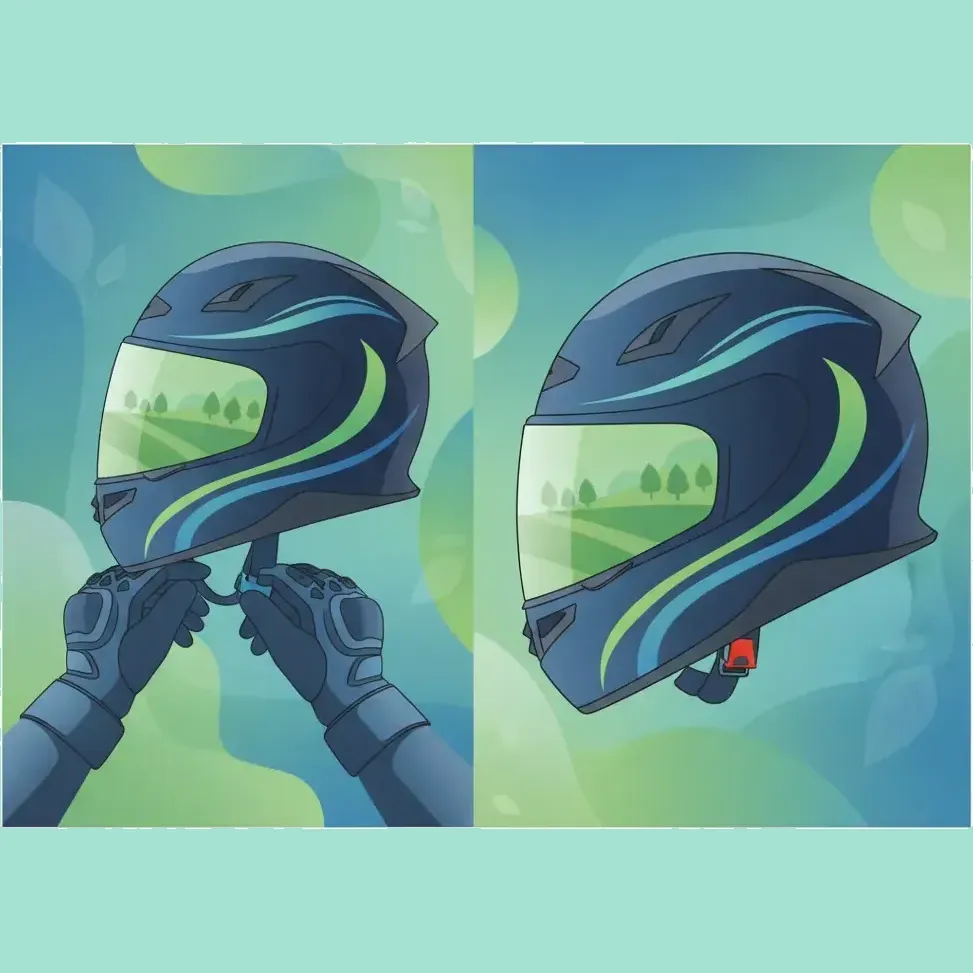
Learners will explore the legal mandate for wearing a helmet while operating an AM vehicle, focusing on the specific protective standards that helmets must meet in France. The lesson details how to correctly fit a helmet, secure straps, and verify certification markings such as the CE label. Understanding these requirements is essential for compliance with French law and for maximizing head injury protection in the event of an accident.

This lesson focuses on adapting your riding behavior to sudden environmental shifts, such as heavy fog or strong crosswinds on exposed bridges. You will learn specific technical adjustments, including leaning slightly into crosswinds and widening your safety margins during low-visibility fog. The lesson also highlights how seasonal temperature drops affect your tires' ability to warm up and achieve reliable, safe levels of road adhesion.
Find clear answers to common questions learners have about Helmet Types, Standards, and Proper Use. Learn how the lesson is structured, which driving theory objectives it supports, and how it fits into the overall learning path of units and curriculum progression in France. These explanations help you understand key concepts, lesson flow, and exam focused study goals.
Yes, French law requires that motorcycle helmets be equipped with retro-reflective stickers on the front, back, left, and right sides. These are essential for visibility at night and are a common topic in the theory exam.
The ECE mark (often seen as a label with a circle containing an E and a country code) indicates that the helmet has undergone rigorous testing and meets the current European safety standards for head protection.
While the law allows various types, full-face helmets are widely considered the safest as they provide protection for the chin and jaw area. The exam expects you to prioritize safety and recognize the limitations of open-face or jet helmets.
Yes, modular helmets are permitted, provided they carry the proper safety certification. Ensure the locking mechanism is secure and that you understand the safety implications of riding with the chin bar open versus closed.
Ready to focus your study? Use the practice search to find exactly the French driving theory questions you need for the Code de la route and permis de conduire ETG. Refine your knowledge on specific topics or challenging rules to boost your confidence and exam readiness.