
This lesson focuses on high-stakes emergency maneuvers essential for motorcycle safety on French roads. By mastering controlled swerving and independent braking, you will develop the reflexes needed to handle sudden obstacles and pass the hazard perception segments of your theory exam.

Lesson content overview
Every motorcycle rider will eventually face a split-second scenario where a collision seems imminent. Whether it is a car suddenly pulling out from a side street, an animal darting across a rural route, or debris dropping from a vehicle ahead, your survival depends on rapid, instinctive, and physically precise emergency maneuvers.
For candidates preparing for the French Motorcycle Theory Examination (Épreuve Théorique Moto - ETM) for Category A, A1, and A2 licenses, mastering the theory behind these maneuvers is not just a requirement to pass the exam; it is a fundamental pillar of active road safety. This lesson explores the critical decisions, physical laws, and psychological strategies required to safely execute emergency swerves (l'évitement) and recovery strategies on French roads.
When a hazard appears on the roadway, your brain must instantly select the safest course of action. This choice is primarily dictated by two variables: the nature of the obstacle and the available stopping distance.
Your distance from the hazard determines whether stopping is physically possible.
The Golden Rule of Evasive Action: Attempting to brake hard and swerve at the exact same time is one of the most common causes of single-vehicle motorcycle crashes. You must choose one action or separate them sequentially.
To understand why we must separate braking and steering inputs, we must look at the physical limits of motorcycle tires. This physical boundary is best explained by the Traction Circle (sometimes called the friction circle).
The traction circle is a graphical representation of the total friction force available between a motorcycle tire and the road surface. This total traction budget must be shared between longitudinal forces (braking and acceleration) and lateral forces (steering and cornering).
At any given moment, a tire has 100% of its available grip budget.
If you use 95% of your tire's traction for maximum emergency braking, you only have 5% left for steering. If you attempt to swerve sharply while maintaining that heavy braking pressure, the total force demanded from the tire exceeds the 100% boundary of the traction circle. The tire will instantly break traction, leading to:
To swerve safely, you must release the brakes to free up 100% of the tire's traction budget for lateral steering forces. Once the steering maneuver is complete and the motorcycle is stabilized, you can reapply the brakes to slow down.
A rapid controlled swerve, known in French as l'évitement, is a precise, high-speed lateral displacement designed to bypass an obstacle and return to your original line of travel.
Assess and Commit: Identify the hazard, locate the clear escape route, and completely release both the front and rear brakes to free up maximum traction.
Turn the Head: Turn your head and eyes decisively toward the clear escape path. Do not look at the obstacle.
Initiate Countersteering: Push firmly on the handlebar grip in the direction you want to go. To swerve right, push forward on the right handlebar. The bike will instantly lean and transition to the right.
Counter-Swerve to Re-stabilize: Once clear of the obstacle, you must bring the bike upright and parallel to the road. Push forward on the opposite handlebar (the left grip, in this case) to pull the motorcycle back into a straight line.
Stabilize and Recover: Smoothly roll on a fraction of throttle to stabilize the chassis, and check your mirrors to re-establish situational awareness.
The physical ability to swerve is useless if your eyes force you to ride directly into the hazard. This is due to a powerful cognitive phenomenon known as target fixation.
Target fixation is an involuntary human psychological response where an individual becomes so focused on an impending hazard that they steer directly toward it, despite wanting to avoid it.
When startled, our survival instinct is to lock our gaze onto the source of danger (e.g., the bumper of a car blocking the lane). Because a motorcycle naturally goes where the rider looks, this visual lock ensures a collision.
To break target fixation, you must train your visual habits.
[Hazard Appears] ──> [Conscious Head Turn] ──> [Eyes on Escape Route] ──> [Natural Countersteering Input] ──> [Safe Evasion]
By physically turning your head—not just shifting your eyes, but pointing your chin toward the open space—you accomplish three things:
In complex emergency scenarios, you may need to utilize advanced recovery techniques to maximize your tires' physical capabilities.
When entering an emergency turn or adjusting your path rapidly around a curve, you can use the pre-brake technique. By applying a very light, smooth application of the front brake before initiating the turn, you initiate a controlled forward weight transfer.
This weight transfer compresses the front suspension, shortening the motorcycle's wheelbase (making it steer faster) and widening the front tire's contact patch. This increases available front-end traction, preparing the tire for the upcoming steering input. However, this brake input must be completely released before the sharpest steering input begins.
During a high-speed emergency swerve, the rapid side-to-side transitions can cause the motorcycle's rear suspension to unload, causing a lateral wobble or loss of rear-wheel traction.
Applying a very slight, constant throttle input (tension de chaîne) once the bike is leaned into the swerve helps stabilize the chassis. This keeps the drive chain taut, prevents the rear suspension from squatting or extending violently, and keeps the rear tire firmly planted on the road surface.
Executing emergency maneuvers does not exempt a rider from traffic laws, but the Code de la route acknowledges the necessity of evasive actions under strict conditions.
Under Article R412-9 of the French Highway Code, every driver must remain master of their vehicle at all times. In the event of a crash resulting from an emergency maneuver, you may still be held partially or fully liable if it is determined that your speed was inappropriate for the conditions, preventing you from safely stopping or avoiding the obstacle within your field of vision.
Normally, changing lanes requires a pre-signal using your turn indicators (clignotants). During an immediate emergency swerve to avoid a collision, you are legally exempt from signaling beforehand if the delay would cause a crash. However, you must immediately return to your lane or signal your position as soon as the immediate threat has passed.
You are legally prohibited from executing an evasive maneuver that creates a more severe danger than the one you are trying to avoid.
If an emergency maneuver forces you to bring your motorcycle to a complete stop on the roadway or shoulder, you should immediately activate your hazard warning lights (feux de détresse) to warn oncoming and following traffic of your stationary, vulnerable position.
Emergency maneuvers cannot be performed identically in every situation. You must adapt your inputs based on road, weather, and vehicle variables.
| Variable | Physical Impact | Evasive Strategy Adjustment |
|---|---|---|
| Wet or Damp Roads | Reduced friction coefficient; smaller traction circle. | Reduce steering speed; use wider, smoother arcs; avoid aggressive lean angles; prioritize early, gentle braking over sharp swerving. |
| Potholes and Gravel | Instantaneous loss of local grip. | Never swerve directly onto gravel or paint markings; aim to keep the bike upright if rolling over unavoidable debris. |
| Night Riding | Reduced visibility; headlight beam does not bend into curves. | Reduce speed to match headlight range; rely heavily on peripheral vision; look for reflective road markings to identify escape routes. |
| Heavy Cargo / Passenger | Increased vehicle inertia; slower steering response; longer braking distance. | Requires significantly more physical effort on the handlebars to initiate a swerve; suspension will compress deeper, reducing ground clearance. |
| Worn Tires | Reduced contact patch; unpredictable slide characteristics. | The traction circle is significantly smaller. High-speed swerves should be avoided; defensive space management is the only safe countermeasure. |
When swerving to avoid pedestrians or cyclists, you must anticipate erratic human behavior. A pedestrian's natural reflex when startled by a motorcycle is to freeze or run backward. Always attempt to swerve behind the pedestrian's direction of travel rather than cutting across their forward path.
Understanding what not to do is just as important as knowing the correct steps. Avoid these common mistakes during emergency situations:
This lesson teaches critical emergency response techniques for motorcycle riders facing sudden road hazards. The core decision framework distinguishes between emergency braking (for sufficient distance) and controlled swerving (for imminent threats within 5 metres), with the fundamental rule that these inputs must never be simultaneous. The traction circle physics explains why: tires have a fixed grip budget shared between longitudinal and lateral forces, so braking hard leaves almost no traction for steering. The evitement procedure provides a five-step sequence—assess and release brakes, turn the head toward the escape route, countersteer to lean, counter-swerve to straighten, then stabilize—while target fixation techniques train riders to physically redirect their gaze to break the instinctive lock-onto-danger response. French legal articles confirm that emergency signaling exemptions exist but liability can still apply if speed was inappropriate for conditions.
A short set of high-value points that capture the most important learning from this lesson.
When facing an obstacle, choose between emergency braking or a controlled swerve based on obstacle type and available distance—never attempt both simultaneously.
The traction circle concept shows that braking and steering compete for the same tire grip; releasing brakes before swerving maximizes available traction for steering.
Target fixation causes riders to steer toward hazards they are looking at; physically turning your head toward the escape route breaks this psychological response.
Under French law (Article R412-6), you are exempt from signaling during an emergency swerve if signaling would cause a crash, but you must resume signaling immediately after.
Environmental factors like wet roads, worn tires, and heavy loads all reduce your traction circle and require gentler, wider evasive inputs.
Explore all units and lessons included in this driving theory course.
A rapid swerve requires releasing brakes first to free 100% of tire traction for lateral steering forces.
The evitement sequence is: assess and commit, turn your head toward the escape route, countersteer to lean, counter-swerve back to straighten, then stabilize with slight throttle.
Article R412-9 requires you to remain master of your vehicle; excessive speed for conditions may still result in liability even during emergency maneuvers.
Swerving into oncoming traffic or creating a greater hazard (R412-3) is illegal and prohibited regardless of the emergency.
Front-wheel lockup during braking combined with steering leads to a low-side crash; rear-wheel slide combined with regain of traction causes a high-side crash.
Applying maximum front brake while attempting to turn sharply, exceeding the traction circle and causing an immediate low-side crash.
Focusing eyes on the hazard instead of the escape route, allowing target fixation to pull the motorcycle directly into the obstacle.
Applying excessive throttle during a lean, causing rear-wheel spin-out and loss of stability during the swerve.
Panicking and swerving into oncoming traffic instead of staying within lane boundaries or using a safe shoulder.
Snapping the front brake lever abruptly before a turn, bottoming out the suspension and destabilizing the chassis before the steering input begins.
Lesson content overview
A short set of high-value points that capture the most important learning from this lesson.
When facing an obstacle, choose between emergency braking or a controlled swerve based on obstacle type and available distance—never attempt both simultaneously.
The traction circle concept shows that braking and steering compete for the same tire grip; releasing brakes before swerving maximizes available traction for steering.
Target fixation causes riders to steer toward hazards they are looking at; physically turning your head toward the escape route breaks this psychological response.
Under French law (Article R412-6), you are exempt from signaling during an emergency swerve if signaling would cause a crash, but you must resume signaling immediately after.
Environmental factors like wet roads, worn tires, and heavy loads all reduce your traction circle and require gentler, wider evasive inputs.
Explore all units and lessons included in this driving theory course.
A rapid swerve requires releasing brakes first to free 100% of tire traction for lateral steering forces.
The evitement sequence is: assess and commit, turn your head toward the escape route, countersteer to lean, counter-swerve back to straighten, then stabilize with slight throttle.
Article R412-9 requires you to remain master of your vehicle; excessive speed for conditions may still result in liability even during emergency maneuvers.
Swerving into oncoming traffic or creating a greater hazard (R412-3) is illegal and prohibited regardless of the emergency.
Front-wheel lockup during braking combined with steering leads to a low-side crash; rear-wheel slide combined with regain of traction causes a high-side crash.
Applying maximum front brake while attempting to turn sharply, exceeding the traction circle and causing an immediate low-side crash.
Focusing eyes on the hazard instead of the escape route, allowing target fixation to pull the motorcycle directly into the obstacle.
Applying excessive throttle during a lean, causing rear-wheel spin-out and loss of stability during the swerve.
Panicking and swerving into oncoming traffic instead of staying within lane boundaries or using a safe shoulder.
Snapping the front brake lever abruptly before a turn, bottoming out the suspension and destabilizing the chassis before the steering input begins.
Explore search topics learners often look for when studying Emergency Maneuvers and Recovery Strategies. These topics reflect common questions about road rules, driving situations, safety guidance, and lesson level theory preparation for learners in France.
Browse additional driving theory lessons that cover connected traffic rules, road signs, and common driving situations related to this topic. Improve your understanding of how different rules interact across everyday traffic scenarios.
Learn how to integrate continuous risk assessment and proactive hazard perception into your everyday riding. This lesson explores the defensive driving techniques required to maintain safety on French roads by anticipating other drivers' behaviors and positioning your motorcycle to stay visible and avoid dangerous traffic situations.
This final lesson integrates all course concepts into a single, cohesive approach to defensive riding and continuous risk assessment. You will study how to maintain a high-mileage visual lead, continuously scanning the road ahead for warning signs of conflict. By learning to assume that other motorists may not see you, you will build the proactive slowing habits and situational awareness needed to remain safe throughout your riding life.

Learners will develop the ability to anticipate potential hazards on the road, enhancing reaction times and defensive riding strategies. The lesson emphasizes constant scanning, early identification of threats such as sudden stops, pedestrian crossings, or unexpected lane changes, and appropriate response measures. By cultivating proactive risk assessment, AM riders can significantly reduce accident likelihood.

This lesson teaches you how to establish and preserve a dynamic cushion of safety on all sides of your motorcycle. You will study how to apply the 'two-second rule' to keep a safe following distance, extending it to three or more seconds in adverse weather. Additionally, you will discover how to manage tailgating motorists safely without resorting to dangerous speed increases, ensuring you always maintain a clear escape route.

This lesson provides global defensive driving strategies to minimize collision risks for all non-motorized and vulnerable road users. Drivers will learn to systematically lower vehicle speed in dense pedestrian zones, even when no active hazards are visible. By cultivating an anticipatory mindset and maintaining generous safety margins, professional drivers establish a protective safety envelope around their vehicle.

Proactive drivers scan the road constantly, detecting potential dangers before they turn into real-world emergency situations. This lesson teaches scanning techniques, the use of rear-view mirrors, and the interpretation of visual cues from other road users. You will learn to anticipate hazards like child play near roads, merging vehicles, and sudden lane changes, helping you drive defensively.

This lesson focuses on adapting your riding behavior to sudden environmental shifts, such as heavy fog or strong crosswinds on exposed bridges. You will learn specific technical adjustments, including leaning slightly into crosswinds and widening your safety margins during low-visibility fog. The lesson also highlights how seasonal temperature drops affect your tires' ability to warm up and achieve reliable, safe levels of road adhesion.
This lesson focuses on the legal requirement to yield to pedestrians on or about to step onto zebra crossings, a major focus of French road safety. You will learn how to approach school zones and pedestrian islands with heightened vigilance and reduced speed. Additionally, the lesson explores shared urban spaces, explaining how to maintain safe lateral distances when overtaking cyclists or personal electric scooters.

Certain groups of road users require heightened defensive attention from drivers due to physical limitations or unpredictable behaviors. This lesson covers how to recognize signs of visual impairment (white canes), mobility challenges, and the unpredictability of young children. You will learn to reduce your speed, extend yielding patience, and proactively secure extra space to protect these vulnerable users.

Learners will explore techniques for maintaining control and safety while riding in rain, focusing on reduced braking efficiency, hydroplaning prevention, and visibility challenges. The lesson emphasizes appropriate speed reduction, tire condition checks, and the use of rain gear to enhance rider comfort and protection. By mastering these adaptations, riders can navigate wet French conditions with confidence.
This lesson focuses on the skill of adjusting speed according to real-time road conditions, visibility, and traffic density. Learners will learn to assess factors such as weather, road surface quality, and pedestrian activity to determine a safe riding speed under French regulatory expectations. By mastering adaptive speed control, riders can enhance safety and reduce the likelihood of accidents caused by inappropriate speed.
Understand the mechanical limits of motorcycle grip through the traction circle model. This lesson explains how longitudinal and lateral forces affect tire stability, helping you grasp the theory behind why separating steering and braking is essential for maintaining control during emergency maneuvers on various road surfaces.
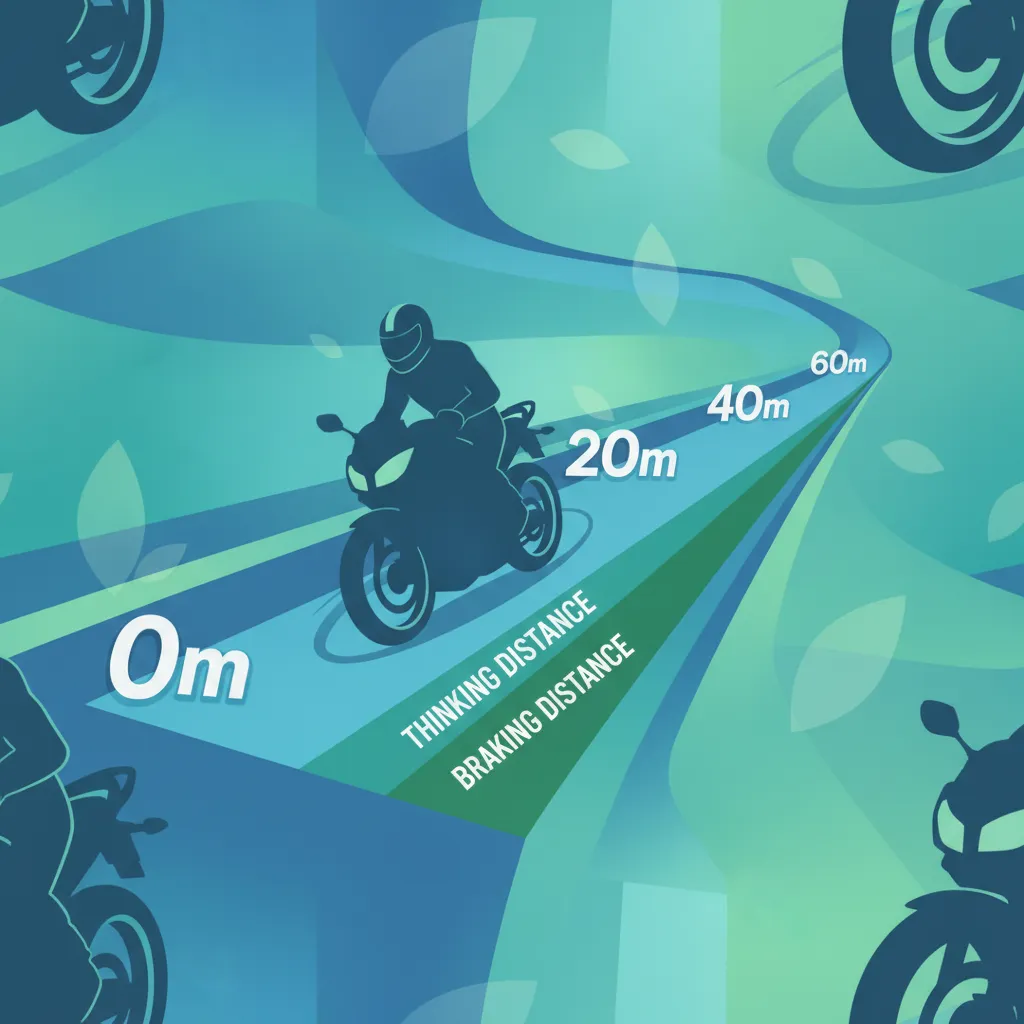
This lesson breaks down the physics of stopping a motorcycle, exploring how kinetic energy varies with the square of your speed. You will learn the mathematical components of total stopping distance, which includes both perception-reaction distance and physical braking distance. The lesson also explains how forward weight transfer during heavy braking increases traction on the front tire while reducing rear-wheel load.

This lesson explains how to coordinate your front and rear brake controls to achieve maximum stopping power without compromising your lateral stability. You will study how to progressively squeeze the front brake lever to prevent sudden wheel lockup, while using the rear brake for stabilization. The lesson also highlights the function of Anti-Lock Braking Systems (ABS) and how they help you maintain steering control during emergency stops.

This lesson focuses on identifying and managing the wide range of road surface grip levels encountered on French highways. You will learn to recognize hazardous low-traction situations, such as tar strips ('tar snakes'), wet manhole covers, gravel patches, and diesel spills at roundabouts. The lesson provides strategies for adjusting your throttle and lean angle in advance to prevent sudden, dangerous slides on compromised pavement.

Learners will be introduced to effective braking techniques tailored for AM vehicles, emphasizing progressive pressure application and the importance of maintaining grip. The lesson covers how to estimate stopping distances, execute emergency stops safely, and understand the limitations of light vehicle braking systems in France. Mastery of these techniques ensures riders can stop promptly and maintain control in various traffic scenarios.
Find clear answers to common questions learners have about Emergency Maneuvers and Recovery Strategies. Learn how the lesson is structured, which driving theory objectives it supports, and how it fits into the overall learning path of units and curriculum progression in France. These explanations help you understand key concepts, lesson flow, and exam focused study goals.
Applying heavy braking while simultaneously steering can overwhelm the front tire's grip, leading to a loss of traction or a low-side slide. In the French motorcycle theory exam, you are taught to release the brake or modulate it carefully before initiating a sharp steering input to ensure the tire has enough grip to turn.
Target fixation occurs when a rider focuses exclusively on an obstacle, causing them to subconsciously steer towards it. To overcome this, you must train yourself to identify a clear 'escape route' and keep your eyes and head pointed toward that exit path.
Yes, the ETG includes questions regarding hazard perception and how a rider should react to sudden obstacles, such as animals crossing or vehicles braking abruptly. Understanding the theory behind these maneuvers is crucial for answering correctly.
Whether you are pursuing an A1, A2, or full A license, the physics of emergency maneuvers remain the same. The theory learned here provides the foundation for the practical maneuvers you will eventually perform during your plateaus and open-road assessments.
Ready to focus your study? Use the practice search to find exactly the French driving theory questions you need for the Code de la route and permis de conduire ETG. Refine your knowledge on specific topics or challenging rules to boost your confidence and exam readiness.