
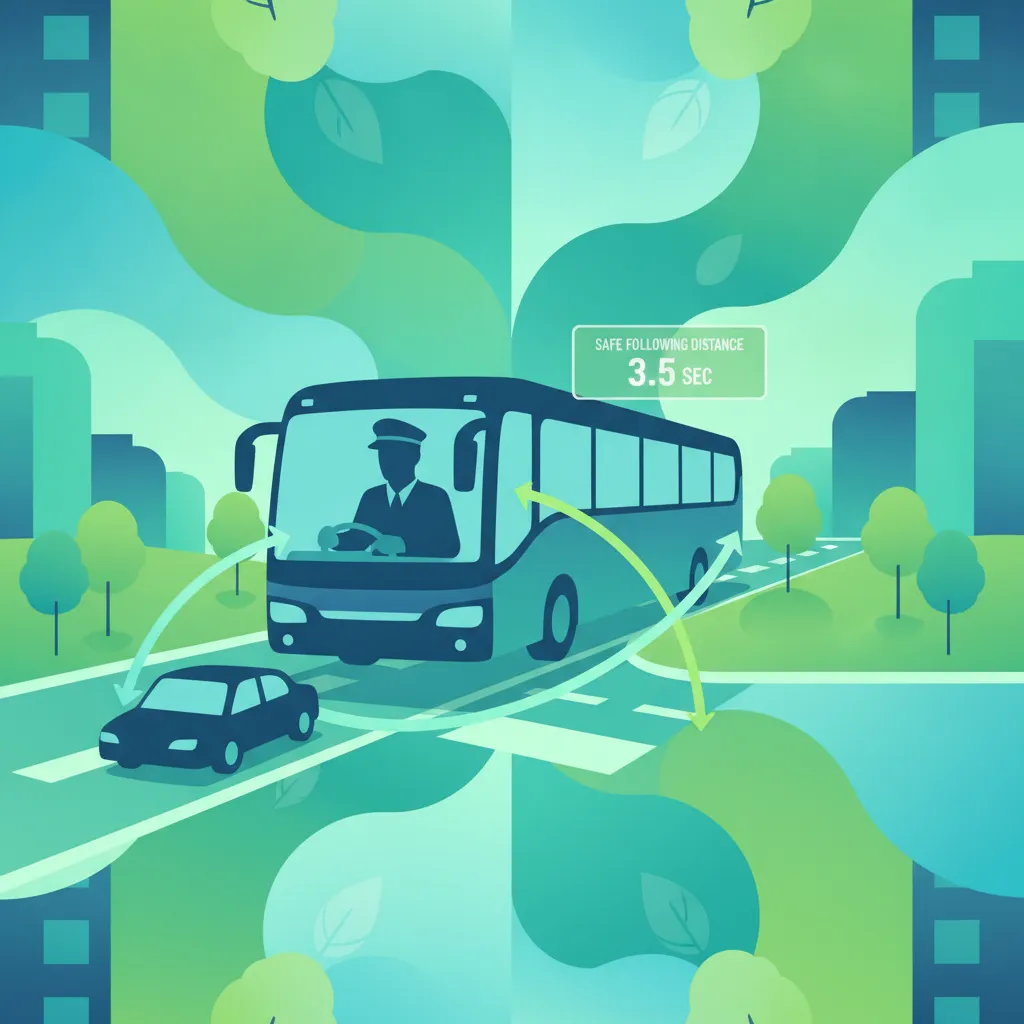
This unit focuses on the physical dynamics of operating large passenger vehicles such as buses and coaches on French roads. You will master critical skills including turning clearance calculations, safe following distances, and progressive vehicle control to ensure passenger safety and comfort. This knowledge is essential for both your theory exam and professional performance.
Browse all lessons that make up Vehicle Size, Smooth Control, Speed, Braking and Following Distance. Each lesson focuses on specific topics, learning objectives, and core concepts, helping you build essential knowledge and follow a clear, structured progression toward your study goals in France.
This lesson covers the physical dimensions of passenger vehicles and how their high profile, length, and width alter spatial awareness on the road. Learners will study tail-swing mechanics and track the path of the rear wheels during sharp turns to avoid hitting roadside obstacles. Accurate measurement of overhead structures, bridges, and underpass clearances is taught to prevent catastrophic structural collisions.
This lesson focuses on passenger comfort and safety by teaching drivers how to control load transfers during acceleration and gear shifts. Smooth throttle control and progressive gear engagement reduce sudden cabin shifts, preventing standing passengers from falling. Candidates will also explore eco-driving techniques that reduce fuel consumption and wear on mechanical parts without compromising route timetables.
This lesson details the specific legal speed limits for passenger transport vehicles on motorways, rural trunk roads, and urban streets under French law. Drivers will learn how speed limits shift depending on overall vehicle weight, towing arrangements, and poor weather conditions like heavy rain. Developing a proactive approach to speed management helps maintain stable vehicle control and ensures full regulatory compliance.
This lesson emphasizes the critical importance of maintaining a safe following distance when carrying dozens of passengers. Learners will study how vehicle weight and passenger load dynamically extend braking and total stopping distances compared to standard passenger cars. The lesson provides concrete spacing rules, such as adjusted safety gaps for highway driving and increased distances on slippery roads.
This lesson teaches advanced braking strategies, highlighting the correct application of progressive friction braking and auxiliary retardation systems like electric or hydraulic retarders. Drivers will learn to avoid abrupt braking inputs that could compromise passenger balance, particularly for standing passengers. It also covers emergency stop procedures, showing how to balance maximum deceleration with vehicle stability.
Explore high-intent keywords and long-tail search topics learners use when researching Vehicle Size, Smooth Control, Speed, Braking and Following Distance. These terms reflect how people search for reliable study materials, structured explanations, and unit-level theory preparation support in France.
Find clear answers to the most common questions learners ask about Vehicle Size, Smooth Control, Speed, Braking and Following Distance. Understand how the unit is organized, what learning goals it supports, and how it contributes to your study progression with structured explanations and practical guidance tailored for learners in France.
Increased weight significantly alters the vehicle's momentum and inertia. In the theory exam, you must recognize that a fully loaded bus requires a greater stopping distance compared to an empty vehicle, necessitating earlier and more progressive braking.
Smooth control involves avoiding sudden changes in throttle or brake pressure. Professional drivers must anticipate traffic conditions well in advance to execute gradual speed adjustments, which prevents passenger discomfort and reduces mechanical wear on the vehicle.
Large vehicles have a significant rear-swing and inner-wheel tracking. You must account for these by positioning the vehicle correctly before the turn and monitoring your mirrors constantly to ensure the rear of the bus clears obstacles safely.
Yes, French law imposes specific speed limits on vehicles over 3.5 tonnes, especially on motorways and rural roads. These limits vary depending on whether the vehicle is equipped with a speed limiter and the nature of the transport service.
All included lessons
Lessons in Vehicle Size, Smooth Control, Speed, Braking and Following Distance
See who benefits most from studying Vehicle Size, Smooth Control, Speed, Braking and Following Distance. This overview explains how the unit supports different learning needs, what level of knowledge is helpful before starting, and how it fits into the overall study path in France.
This unit is designed for candidates studying for the French D, D1, DE, or D1E passenger vehicle licences. It is perfect for those mastering the technical demands of professional driving who need to understand how vehicle physics influence road safety and exam questions.

Begin your structured journey towards passing the French ETG exam by exploring our comprehensive driving theory curriculum. Each course is designed to guide you through the Code de la route, ensuring you gain the knowledge and confidence for exam success. Find your ideal study path now.
Explore Theory CurriculumExplore all units and lessons included in this driving theory course.
Begin your structured journey towards passing the French ETG exam by exploring our comprehensive driving theory curriculum. Each course is designed to guide you through the Code de la route, ensuring you gain the knowledge and confidence for exam success. Find your ideal study path now.
Explore Theory Curriculum