
This lesson teaches essential vehicle dynamics for D1, D, D1E, and DE licence categories, focusing on the physics of load transfer and smooth control. By mastering precise acceleration and deceleration, you will ensure passenger safety and comfort while meeting the professional standards required for the French theory exam.

Lesson content overview
Operating a passenger transport vehicle, such as a bus or a coach, requires a level of driving precision far beyond that of a standard passenger car. As a professional driver preparing for the French Category D, D1, DE, or D1E license, your primary responsibilities are passenger safety, passenger comfort, and vehicle efficiency.
To achieve this, you must master vehicle dynamics—specifically how forces act upon a heavy vehicle during acceleration, deceleration, and cornering. This lesson provides an in-depth exploration of load transfer, axle load distribution, throttle management, progressive gear shifting, and eco-driving techniques within the framework of French road regulations (Code de la Route).
To control a heavy vehicle smoothly, you must first understand the physical forces at play when a bus or coach is in motion. Unlike cargo, human passengers are highly sensitive to sudden changes in speed and direction. Uncontrolled vehicle movements can lead to passenger discomfort, loss of balance, and severe falls inside the cabin.
Load transfer refers to the redistribution of a vehicle's mass between its axles and wheels caused by acceleration, deceleration, or cornering. This is a dynamic physical phenomenon governed by the laws of inertia.
The temporary shift of weight from one set of wheels to another due to longitudinal forces (accelerating or braking) or lateral forces (cornering).
For a heavy passenger vehicle, which often has a high center of gravity, uncontrolled load transfer causes extreme cabin pitch (forward-to-rear tilting) and roll (side-to-side tilting). Minimizing these shifts is crucial to maintaining tyre grip and preventing standing passengers (voyageurs debout) from losing their balance.
Axle load distribution is the proportion of the vehicle’s total weight supported by each individual axle at any given instant.
If you accelerate too abruptly, especially on an uphill gradient, the extreme rearward load transfer can overload the rear axle while severely unloading the front steering axle. This dynamic imbalance can cause a critical loss of front-wheel traction, rendering your steering inputs ineffective.
In France, heavy vehicle configurations must strictly adhere to the manufacturer's maximum authorized mass (Poids Maximal Autorisé) and axle weight limits to ensure mechanical integrity and safe handling.
The movement of passengers inside a bus is directly tied to the rate of change of acceleration, a physical metric known as "jerk." When a driver applies sudden throttle or harsh braking, the resulting high rate of jerk makes it incredibly difficult for passengers—particularly the elderly, disabled, or standing passengers—to adapt their posture.
During acceleration, the rearward shift of weight forces the cabin to pitch backward. Standing passengers, who may not yet be holding onto handrails or fully settled into their positions, are pushed toward the rear of the bus.
During braking, the forward shift of weight causes a forward cabin pitch. Passengers are thrown forward. Because human anatomy is less stable when resisting sudden forward or backward forces without warning, even a moderate longitudinal jerk can cause passengers to stumble, fall, and sustain injuries.
When a passenger vehicle negotiates a turn or a roundabout, lateral load transfer causes the body of the vehicle to roll outward. The taller the vehicle (such as a double-decker coach or a high-floor interurban bus), the more pronounced this roll becomes.
Excessive lateral roll not only causes passengers to slide in their seats or lose their grip on handrails, but it also increases the risk of rollover if the lateral force exceeds the stabilizing gravity vector.
The accelerator pedal should never be treated as an on-off switch. Professional drivers use progressive throttle management to ensure that speed transitions are imperceptible to passengers.
Initial Engagement: Ease off the brake pedal and allow the vehicle’s natural idle torque (or creep) to initiate the forward roll.
Gradual Pressure: Apply light, consistent pressure to the accelerator, allowing the engine to build power smoothly.
Sensing the Cabin: Monitor your mirrors to observe passenger stability as the vehicle gains momentum.
Stabilisation: Ease back on the accelerator slightly as you approach your target speed to transition smoothly into a cruise, avoiding a sudden forward pitch.
Just as acceleration must be progressive, deceleration requires early planning. By scanning the road far ahead, you can identify traffic lights, intersections, and bus stops early, allowing you to lift off the accelerator and let the vehicle's momentum dissipate naturally. This is known as coasting.
Using coasting and gentle deceleration minimizes the forward pitch of the vehicle, providing a comfortable environment where passengers do not feel forced to brace themselves against the seat in front of them.
Whether operating a manual, automated manual, or fully automatic gearbox, gear selection significantly influences vehicle dynamics and cabin stability.
When shifting gears in a manual or semi-automatic passenger vehicle, you must match the engine speed (RPM) with the transmission speed to prevent a drivetrain shock.
Modern automated transmissions are calibrated to shift smoothly, but a driver can still trigger abrupt shifts by applying erratic throttle pressure. Steady throttle inputs help the vehicle's transmission control unit select the optimal gear at the smoothest point in the power band.
Engine braking (frein moteur) is an excellent tool for controlling speed, especially on long descents. However, downshifting too early or dropping multiple gears at once creates an intense engine braking surge. This sudden drag on the drive wheels acts like a harsh brake application, causing an immediate, unexpected forward load transfer that can throw standing passengers off balance.
In the modern passenger transport industry, eco-driving is no longer optional. It is a highly valued professional skill that directly reduces fuel consumption, greenhouse gas emissions, and mechanical wear without compromising route timetables.
+-------------------------------------------------------------------------+
|                          ECO-DRIVING PRINCIPLES                         |
+-------------------------------------------------------------------------+
|  1. Anticipate traffic patterns to avoid unnecessary stops.              |
|  2. Maintain a steady speed and optimize engine RPM in the green zone.  |
|  3. Utilize vehicle inertia (coasting) whenever safe and practical.     |
|  4. Minimize aggressive braking by utilizing auxiliary retarders.       |
+-------------------------------------------------------------------------+
A common misconception is that eco-driving slows down operations. In reality, a driver who anticipates traffic flow avoids stopping completely at red lights or behind slow-moving traffic. Because it takes significantly less energy to accelerate a moving vehicle than to launch a stationary one, keeping the bus moving at a slow, continuous roll actually improves travel times and dramatically reduces fuel consumption.
In France, passenger safety is strictly regulated. The Code de la Route places a heavy legal responsibility on the driver to ensure the safety of all occupants.
According to the general safety obligations of the French Code de la Route, a driver must ensure that all passengers are safely accommodated before moving the vehicle.
The law requires drivers to maintain continuous control of their vehicles and drive in a manner that does not present a danger to occupants or other road users.
Exceeding the maximum authorized mass (Masse Maximale Autorisée) or individual axle load limits is a serious traffic violation in France. Overloaded vehicles exhibit highly unstable dynamics, increased braking distances, and unpredictable load transfers.
Vehicle dynamics are highly dependent on external environmental factors and the specific configuration of your vehicle.
Under wet or icy conditions, the coefficient of friction between the tyres and the road surface decreases dramatically.
| Driving Environment | Dynamic Challenges | Driver Action |
|---|---|---|
| Urban (City Centres) | Frequent stops, tight turns, standing passengers, vulnerable road users. | Prioritize low-speed smoothness, maximize coasting, check mirrors constantly before accelerating. |
| Motorway (Interurban) | High speeds, wind resistance, lane changes, passenger coaches with luggage. | Smooth steering inputs to prevent high-speed lateral roll; progressive deceleration when exiting. |
When driving a vehicle towing a heavy trailer (Category DE or D1E), you must account for the inertia of the trailer.
To maintain professional standards and ensure safety, avoid these common driving errors:
This lesson covers the essential vehicle dynamics for French Category D passenger transport, focusing on how load transfer affects heavy vehicles and passenger stability. Learners must master progressive throttle application, smooth gear engagement with rev-matching, and early deceleration planning to prevent cabin pitch that endangers standing passengers. The content also integrates eco-driving principles—coasting, green zone driving, and retarder use—that reduce fuel consumption while maintaining safety standards required by the French Code de la Route. Key legal obligations include ensuring passengers are secure before departure and avoiding driving behaviour that constitutes negligence under French road law.
A short set of high-value points that capture the most important learning from this lesson.
Load transfer redistributes vehicle weight between axles during acceleration, braking, and cornering, directly affecting passenger stability
Progressive throttle control minimizes cabin pitch and prevents standing passengers from losing balance
Coasting and early deceleration planning reduce fuel consumption and maintain passenger comfort without compromising safety
Smooth gear engagement and rev-matching prevent drivetrain shock that causes sudden forward passenger movement
The driver bears legal responsibility under the French Code de la Route to ensure passengers are safely seated or holding handrails before moving from a stop
Explore all units and lessons included in this driving theory course.
Jerk is the rate of change of acceleration—high jerk from sudden throttle or braking is the primary cause of passenger falls
On steep uphills, aggressive acceleration can overload the rear axle and cause critical loss of front-wheel steering traction
Coasting in neutral (roue libre) is illegal in France because it disconnects engine braking and reduces steering stability
Adverse weather dramatically reduces tyre-road friction, requiring gentler throttle inputs and longer following distances
When towing a trailer (Categories DE/D1E), deceleration in a straight line is essential to prevent jackknifing from trailer push
Accelerating from a bus stop before passengers have grasped a handrail or reached their seats
Rev downshifting without matching engine RPM, causing a sudden engine braking surge that throws passengers forward
Failing to anticipate stops and relying on last-minute hard braking, which creates dangerous forward pitch
Entering roundabouts at excessive speed, causing pronounced lateral roll and passenger sliding
Using engine braking surge on long descents by dropping multiple gears at once instead of using auxiliary retarders progressively
Lesson content overview
A short set of high-value points that capture the most important learning from this lesson.
Load transfer redistributes vehicle weight between axles during acceleration, braking, and cornering, directly affecting passenger stability
Progressive throttle control minimizes cabin pitch and prevents standing passengers from losing balance
Coasting and early deceleration planning reduce fuel consumption and maintain passenger comfort without compromising safety
Smooth gear engagement and rev-matching prevent drivetrain shock that causes sudden forward passenger movement
The driver bears legal responsibility under the French Code de la Route to ensure passengers are safely seated or holding handrails before moving from a stop
Explore all units and lessons included in this driving theory course.
Jerk is the rate of change of acceleration—high jerk from sudden throttle or braking is the primary cause of passenger falls
On steep uphills, aggressive acceleration can overload the rear axle and cause critical loss of front-wheel steering traction
Coasting in neutral (roue libre) is illegal in France because it disconnects engine braking and reduces steering stability
Adverse weather dramatically reduces tyre-road friction, requiring gentler throttle inputs and longer following distances
When towing a trailer (Categories DE/D1E), deceleration in a straight line is essential to prevent jackknifing from trailer push
Accelerating from a bus stop before passengers have grasped a handrail or reached their seats
Rev downshifting without matching engine RPM, causing a sudden engine braking surge that throws passengers forward
Failing to anticipate stops and relying on last-minute hard braking, which creates dangerous forward pitch
Entering roundabouts at excessive speed, causing pronounced lateral roll and passenger sliding
Using engine braking surge on long descents by dropping multiple gears at once instead of using auxiliary retarders progressively
Explore search topics learners often look for when studying Vehicle Dynamics and Smooth Acceleration/Deceleration. These topics reflect common questions about road rules, driving situations, safety guidance, and lesson level theory preparation for learners in France.
Browse additional driving theory lessons that cover connected traffic rules, road signs, and common driving situations related to this topic. Improve your understanding of how different rules interact across everyday traffic scenarios.
Learn how to manage large passenger vehicles in dense city centers. This lesson covers navigating narrow streets, handling bus stop positioning, and managing interactions with other road users in busy urban environments as required by French road transport regulations.
This lesson analyzes the various traffic challenges unique to operating large passenger vehicles in historic and modern French urban areas. Drivers will learn to manage narrow street layouts, double-parked delivery trucks, and high-density multi-lane roundabouts safely. The lesson emphasizes defensive driving strategies, route adjustments, and maintaining mental focus under severe schedule and time pressures.
This lesson focuses on maneuvering in extremely crowded areas, passenger terminals, or narrow streets blocked by parked vehicles and obstacles. Drivers will learn to assess clearance distances precisely before committing to narrow pathways. The content teaches steering techniques that maintain stability, optimize space usage, and prioritize public safety during slow-speed, high-difficulty maneuvers.

This lesson provides practical strategies for managing the physical demands of slow, heavily congested city traffic. You will learn how to maintain excellent low-speed balance through correct body posture, rear brake modulation, and smooth clutch control. It also emphasizes the importance of preserving an adequate safety buffer when stopping behind other vehicles, allowing an immediate escape route if you face a rear-end threat.
This lesson analyzes the technical path a long wheelbase vehicle must take when turning at intersections and navigating roundabouts. Drivers will learn to calculate tail swing and rear-wheel tracking, intentionally swinging wide to clear roadside curbs and poles safely. The lesson emphasizes yielding protocols for pedestrians and cyclists who may be crossing the target street during the turn.
Public transit vehicles like city buses and streetcars (trams) have clear legal priorities and dedicated infrastructure in urban areas. This lesson teaches you to recognize reserved transit lanes and your legal obligation to yield to buses exiting their designated stops. You will also learn safe driving strategies near tram tracks, ensuring you never block public transit lines or risk passenger boarding areas.

This lesson details how to manage high-risk interactions with pedestrians who may step off curbs or cross the road near bus stops. Learners will study French Code de la route laws regarding pedestrian priority at crosswalks and near stopping transit vehicles. Developing heightened spatial awareness around blind zones near the front of the bus is emphasized to prevent tragic pedestrian collisions.
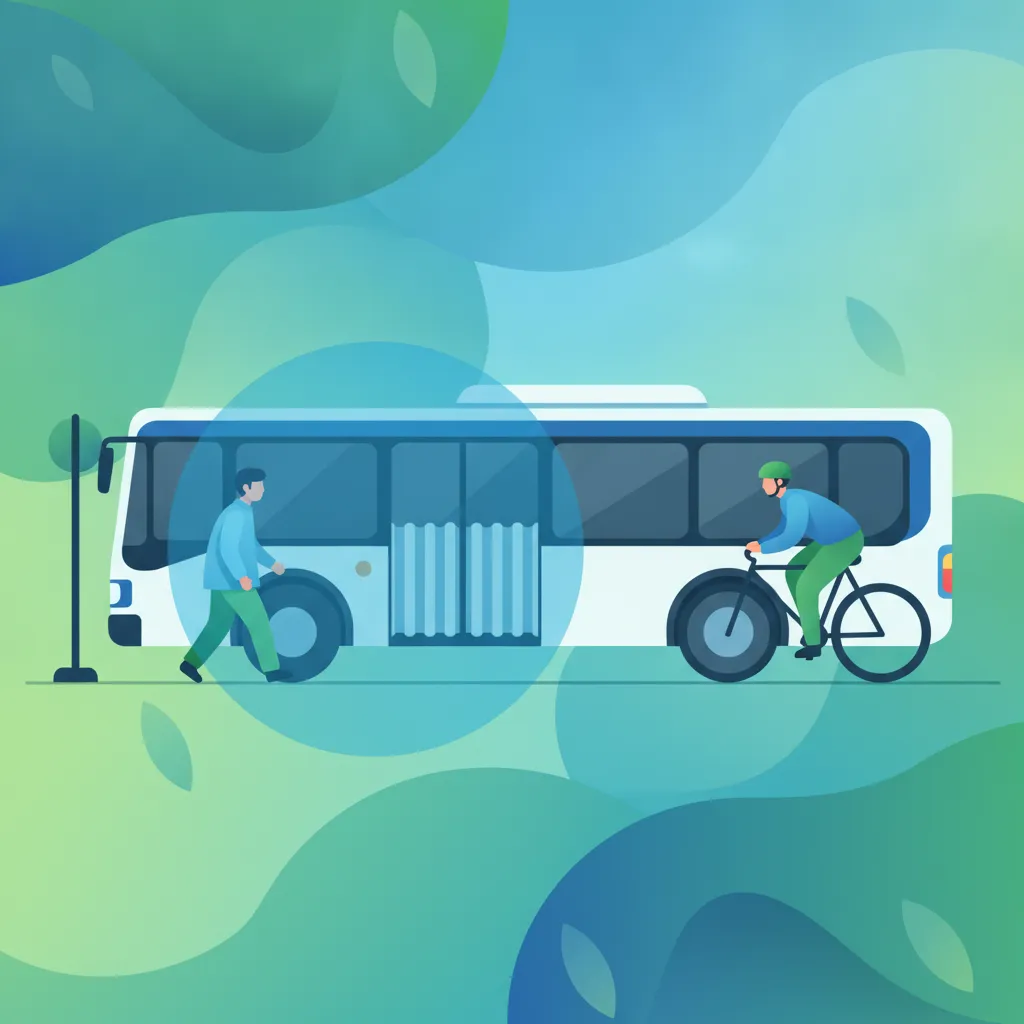
This lesson teaches specific visual scanning methods to detect vulnerable road users, such as children, elderly individuals, and cyclists near stops. Drivers will learn to anticipate sudden movements, like a passenger running to catch a bus or stepping off a sidewalk unexpectedly. Managing the massive blind spots around the front and right-hand sides of passenger vehicles is highlighted as a critical safety duty.
This lesson examines the regulatory limits and environmental controls applied to large passenger vehicles operating in dense French urban centers. Drivers will study the Crit'Air clean air sticker system and low-emission zones (ZFE) that restrict access for older, high-polluting vehicles. It also addresses navigating physical constraints, such as narrow streets, tight turning radii, and strict municipal weight limits.
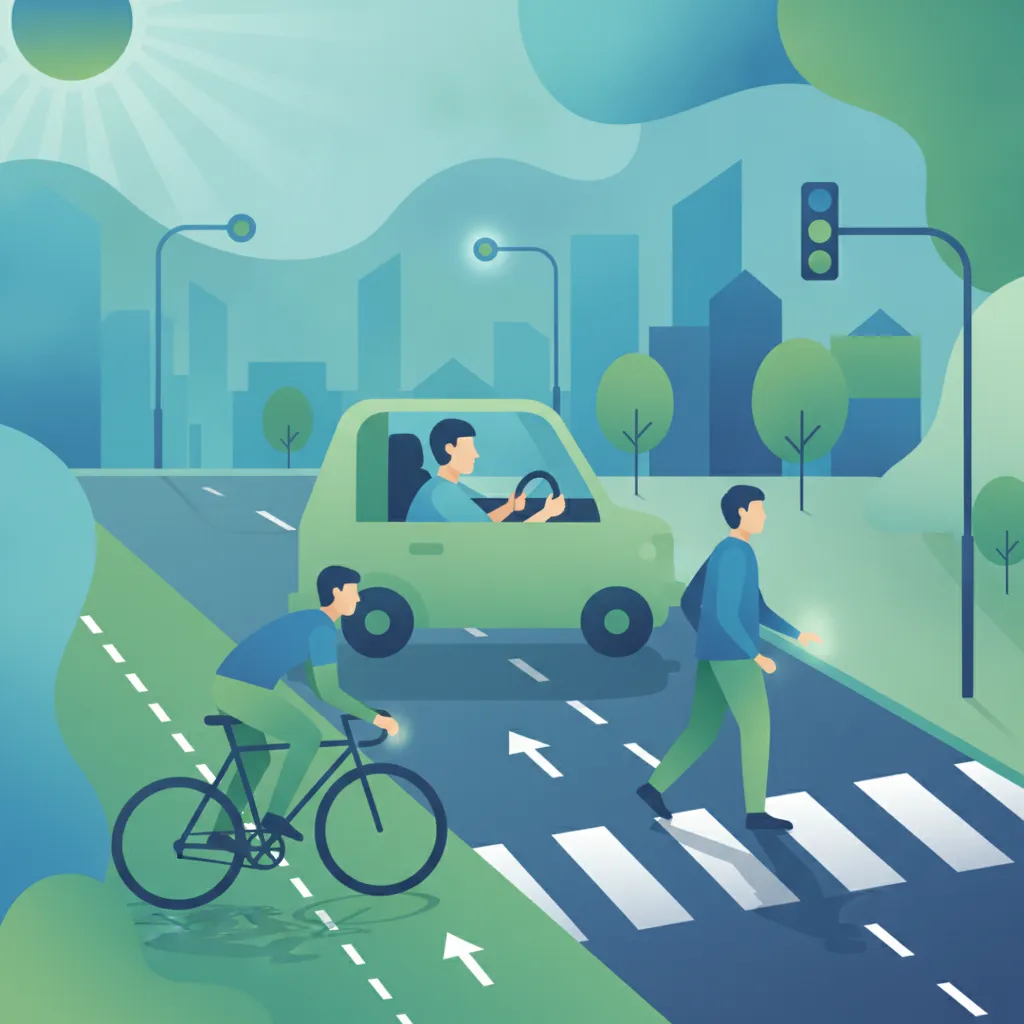
This lesson examines the specific challenges and responsibilities goods vehicle drivers face when interacting with pedestrians and cyclists in urban environments. Learners will understand right-of-way rules, the importance of yielding at pedestrian crossings, and safe turning practices that protect cyclists. The content emphasizes heightened driver vigilance, especially when navigating bike lanes and crowded sidewalks.
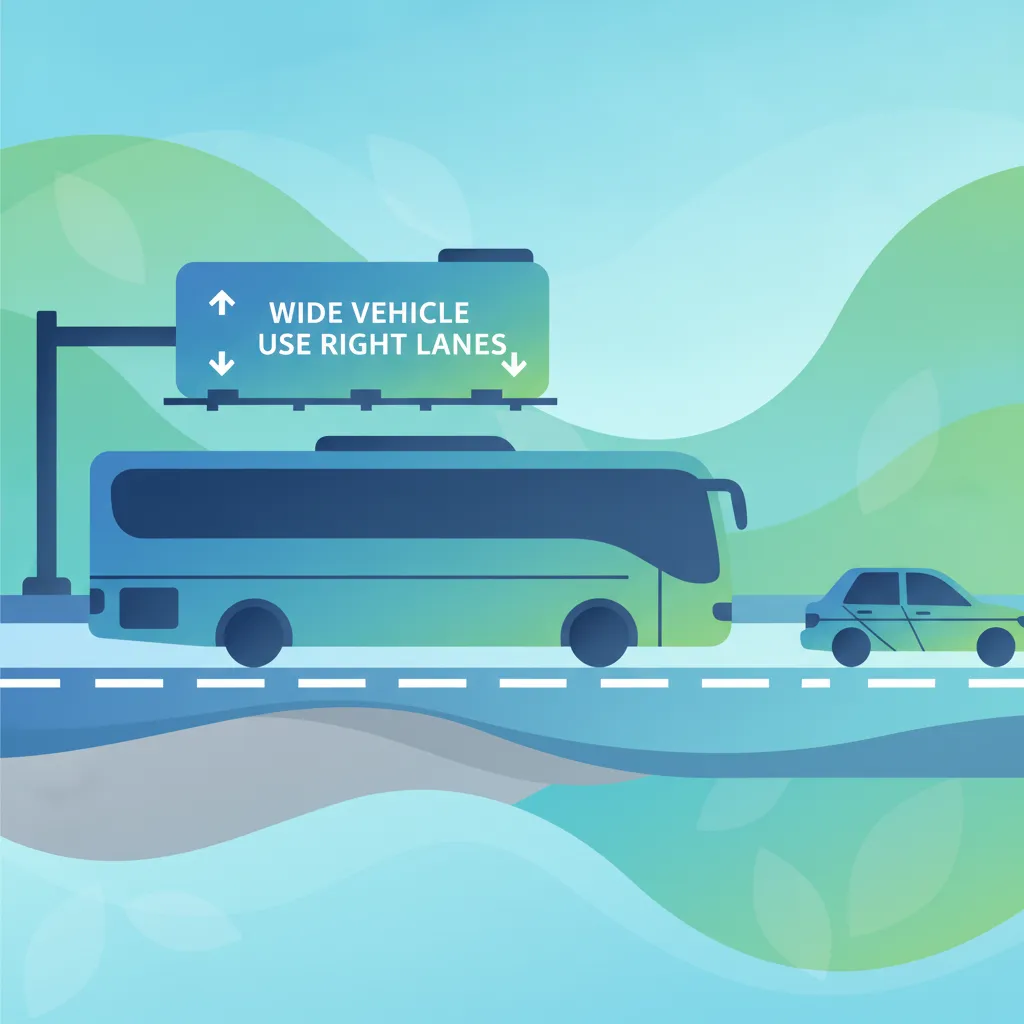
This lesson details the rules of lane discipline for operating wider and longer passenger transport vehicles on highway and city networks. Learners will explore proper lane positioning to prevent encroachment on adjacent lanes or sidewalks. It also covers the step-by-step visual and signaling sequence required to perform safe lane changes, avoiding sudden movements that could startle other drivers.
Understand how to adapt driving techniques for rain, snow, and ice when operating heavy passenger vehicles. This guide explains vehicle stability adjustments, speed management, and braking strategies for maintaining safety on rural routes and motorways under challenging environmental conditions.
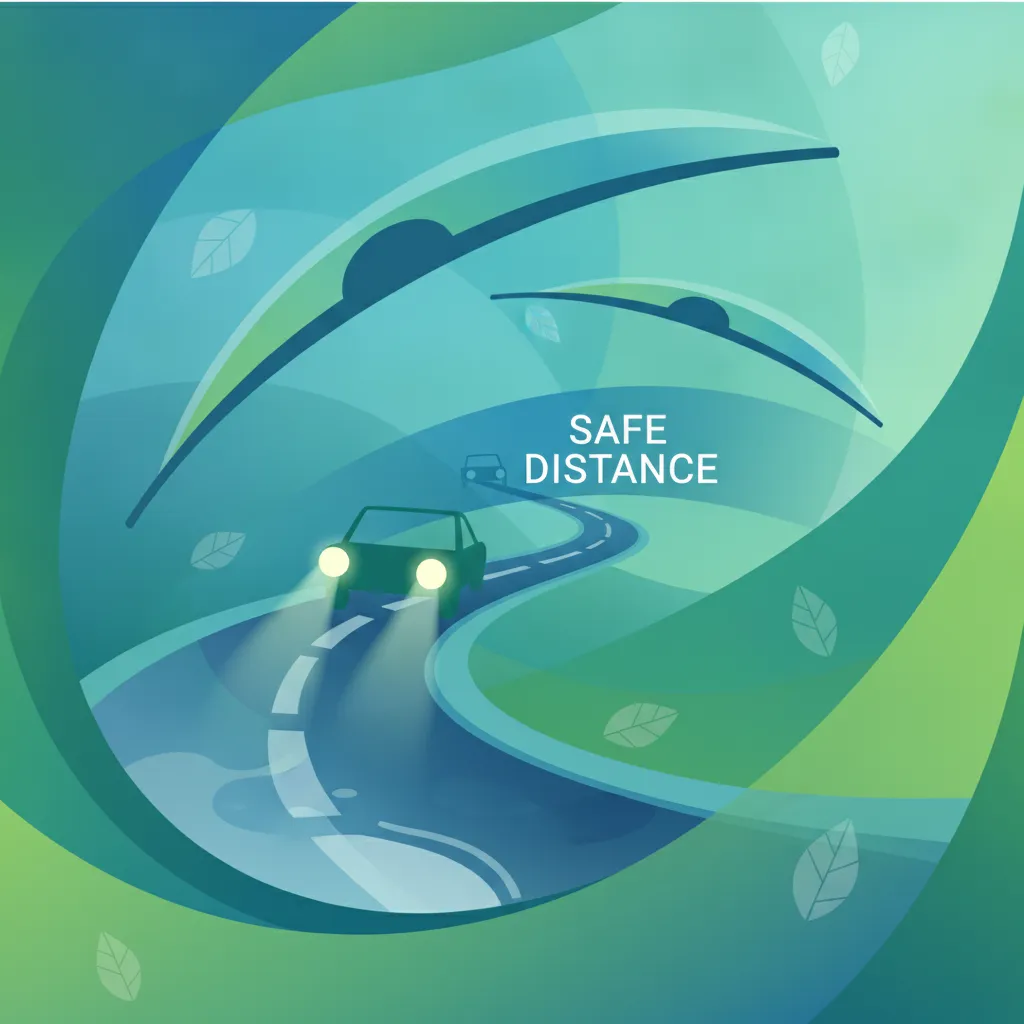
This lesson covers the mechanical and physical adaptations required to drive a passenger coach in rain, heavy fog, snow, and crosswinds. Drivers will learn to recognize signs of aquaplaning and understand the dramatic traction loss associated with wet or icy roads. It also details French winter equipment regulations (Loi Montagne) requiring snow tires or chains in designated mountainous regions.
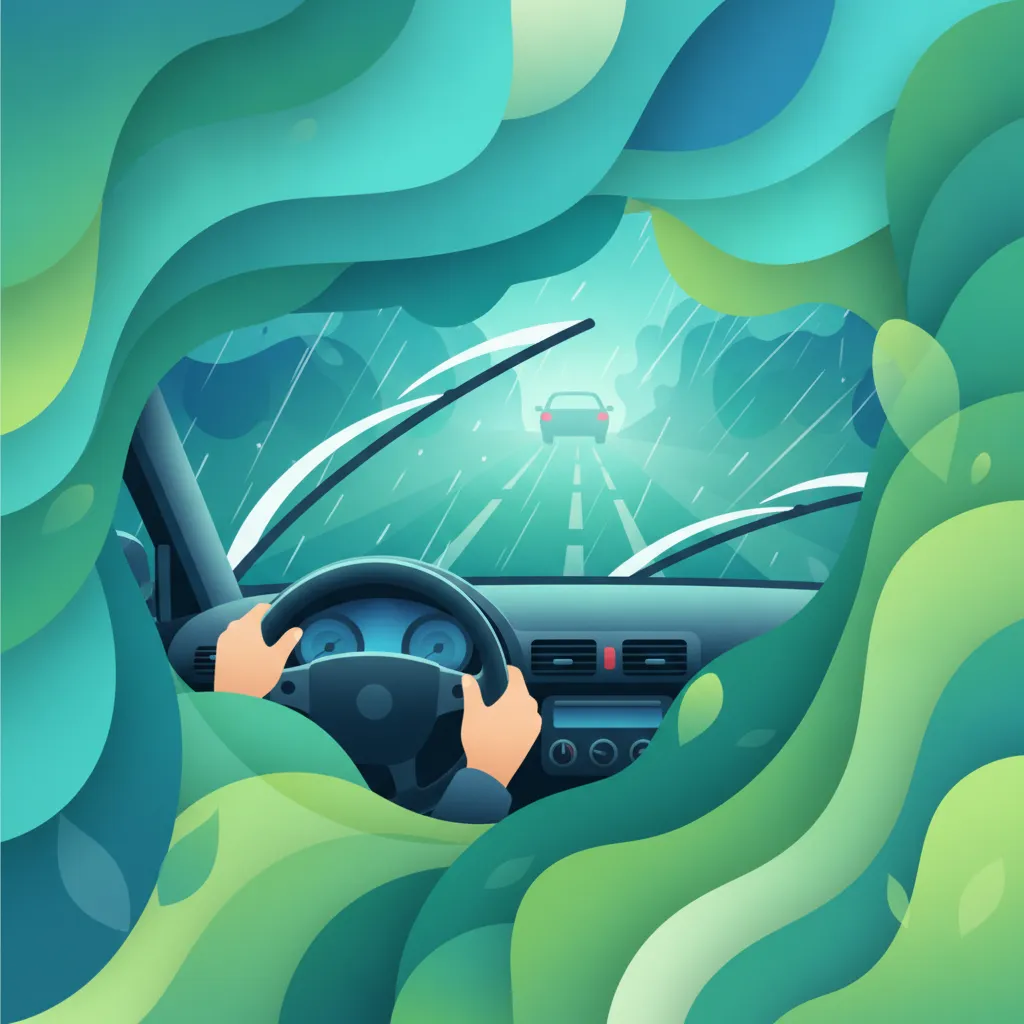
In this lesson, drivers will learn how to adjust their driving techniques in response to adverse weather conditions such as rain, fog, snow, ice, and strong winds. The content covers strategies for maintaining visibility, managing reduced traction on wet or icy surfaces, and adjusting speed and braking distances accordingly. Learners will also be introduced to the use of anti-skid and stability control systems under challenging weather.

Adverse weather reduces tyre traction and limits visibility, dramatically raising the risk of multi-car accidents on highways. This lesson details speed reductions required during rainfall, techniques for avoiding aquaplaning, and demisting windshields for visibility. You will learn how to maintain extra stopping distance on snow-covered roads and the correct headlight adjustments to make during fog.
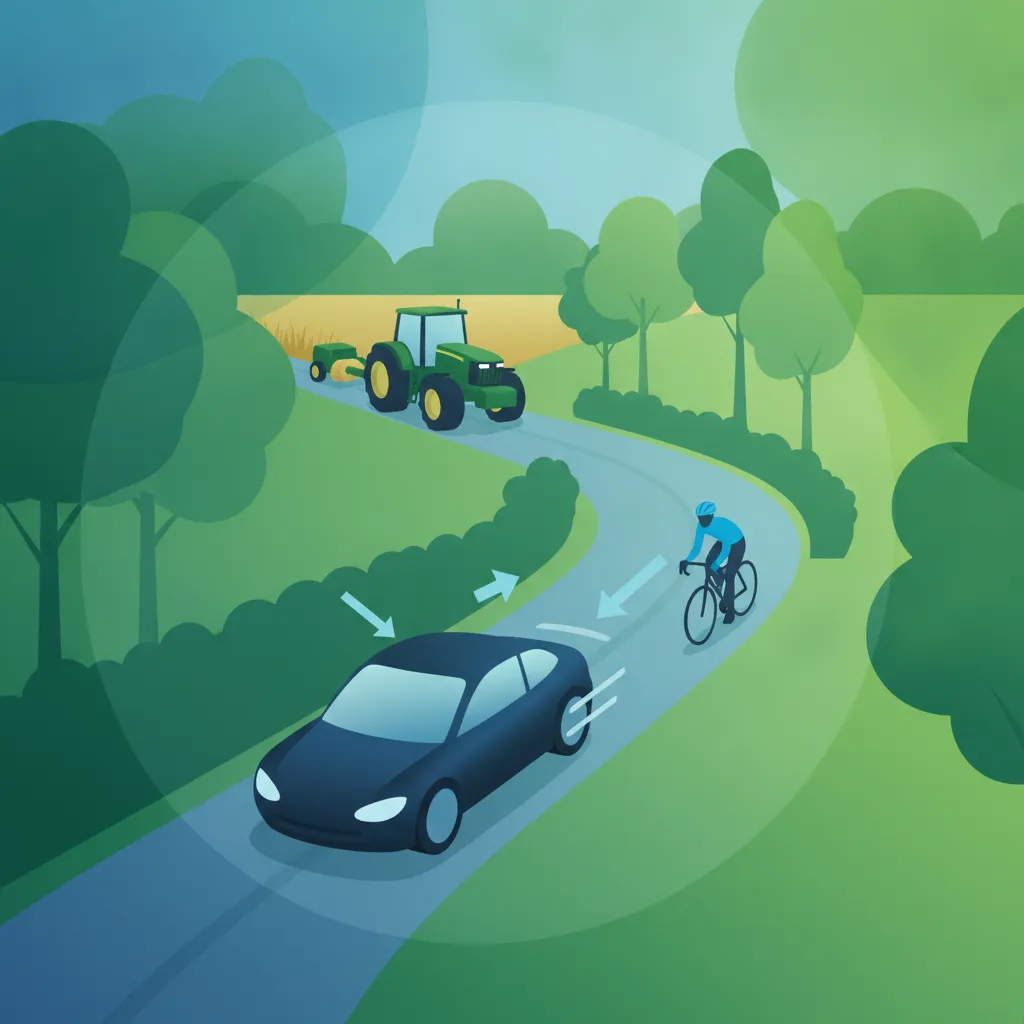
This lesson analyzes the complex driving conditions found on French secondary and rural road networks (routes départementales). Drivers will learn steering and braking techniques to descend steep gradients safely using engine retarding systems without overheating the service brakes. Anticipating agricultural machinery, domestic livestock, unlit intersections, and narrow bridges is also taught in depth.
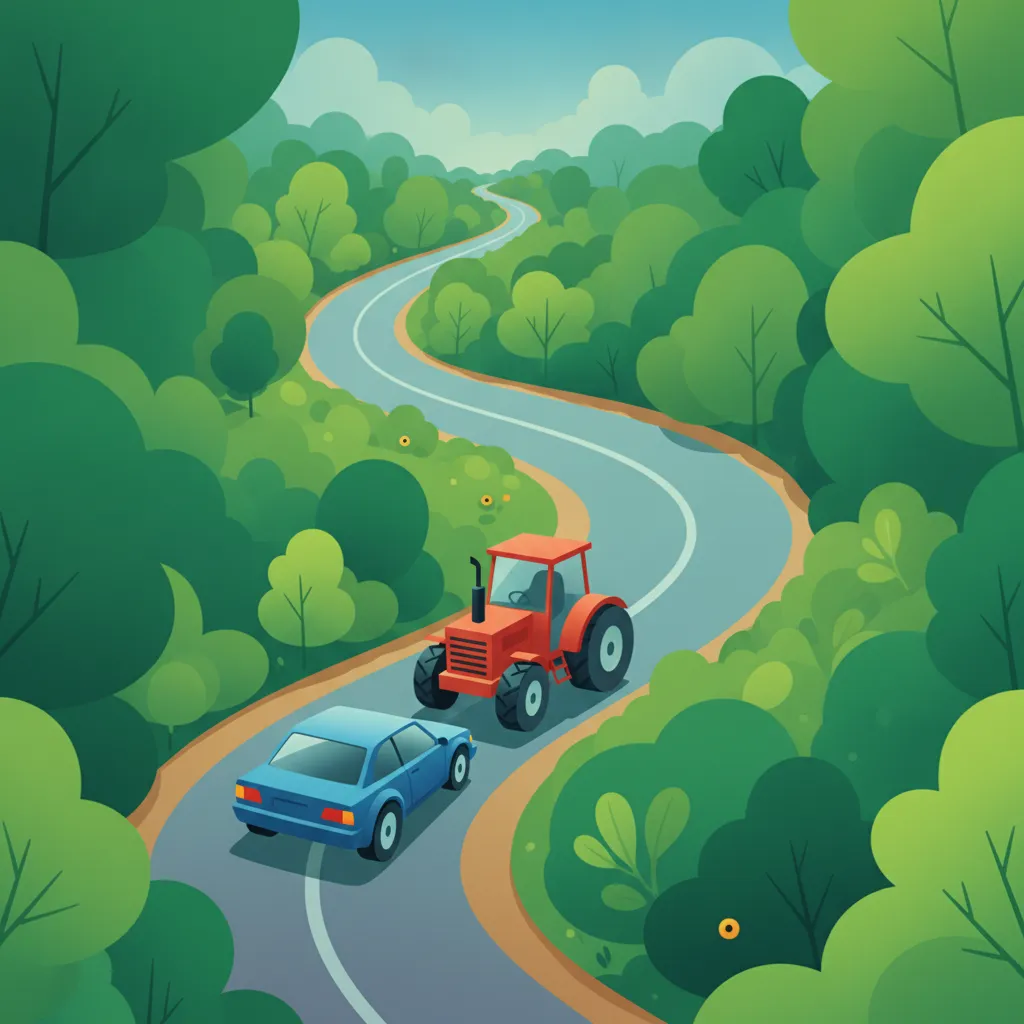
Rural roads account for a high percentage of severe accidents due to narrow widths, winding geometries, and sudden hazards. This lesson teaches strategies for negotiating sharp bends, handling agricultural machinery, and reacting to wildlife warning signs. You will learn to manage your vehicle's lane placement on roads with soft shoulders and understand speed limits on rural networks.

Learners will explore techniques for maintaining control and safety while riding in rain, focusing on reduced braking efficiency, hydroplaning prevention, and visibility challenges. The lesson emphasizes appropriate speed reduction, tire condition checks, and the use of rain gear to enhance rider comfort and protection. By mastering these adaptations, riders can navigate wet French conditions with confidence.

In this lesson, drivers will explore the specific challenges presented by rural road environments, including narrower lanes, shared space with agricultural vehicles, and frequent wildlife crossings. The content emphasizes adapting speed to road curvature, surface conditions, and visibility while navigating hills and bends. Learners will also learn to interpret rural road signage and understand the importance of maintaining vigilance.

This lesson focuses on adapting your riding behavior to sudden environmental shifts, such as heavy fog or strong crosswinds on exposed bridges. You will learn specific technical adjustments, including leaning slightly into crosswinds and widening your safety margins during low-visibility fog. The lesson also highlights how seasonal temperature drops affect your tires' ability to warm up and achieve reliable, safe levels of road adhesion.
Find clear answers to common questions learners have about Vehicle Dynamics and Smooth Acceleration/Deceleration. Learn how the lesson is structured, which driving theory objectives it supports, and how it fits into the overall learning path of units and curriculum progression in France. These explanations help you understand key concepts, lesson flow, and exam focused study goals.
Smooth acceleration prevents standing passengers from losing their balance, which is a key safety requirement in professional transport. It also reduces mechanical stress on the vehicle and improves fuel efficiency.
Incorrect or jerky gear shifts lead to abrupt changes in speed, causing discomfort. Mastering progressive gear engagement ensures that the transfer of power remains seamless and the cabin environment stays stable.
No, eco-driving is about efficiency and smoothness rather than just slow driving. By maintaining steady speeds and avoiding harsh braking, you actually keep to your timetable more reliably while reducing vehicle wear.
The exam often uses situational images or descriptions to test if you know how to adjust your driving style for a loaded vehicle. You may be asked about the correct braking distance or how to handle sudden stops.
Ready to focus your study? Use the practice search to find exactly the French driving theory questions you need for the Code de la route and permis de conduire ETG. Refine your knowledge on specific topics or challenging rules to boost your confidence and exam readiness.