
This lesson guides professional drivers through the vital rules of maintaining safe following distances while operating large passenger vehicles. You will learn how to adjust your spacing based on heavy passenger loads and varying road conditions, ensuring compliance with French traffic law.

Lesson content overview
When driving a high-capacity passenger vehicle—such as a city bus, a long-distance coach, or a minibus—your primary responsibility is the safety and physical well-being of your passengers. Unlike standard passenger cars, heavy passenger transport vehicles operate under drastically different physical constraints. Increased vehicle mass, pneumatic brake latency, and the presence of standing or unrestrained passengers require drivers to maintain significantly larger safety gaps.
This lesson covers the principles of safe following distances (distance de sécurité) for category D1, D, D1E, and DE vehicles. It explains how to adjust your spacing dynamically based on passenger load, speed, weather, and brake system characteristics while remaining fully compliant with the French traffic regulations (Code de la Route).
Every professional driver must master the physics of vehicle dynamics to anticipate hazards. Braking is the process of converting a vehicle’s kinetic energy into heat energy through friction. The kinetic energy of a moving vehicle is directly proportional to its mass and the square of its speed:
Where:
A standard coach can weigh between 13 and 19 tonnes when empty. Adding 50 passengers along with their luggage adds approximately 4 to 5 tonnes of dynamic, shifting mass. This additional weight significantly alters the vehicle's momentum:
To understand why a large following gap is necessary, we must break down the total stopping distance (distance d'arrêt) into its fundamental mechanical and human components.
The total distance traveled by a vehicle from the exact moment the driver perceives a hazard until the vehicle comes to a complete, physical stop. It is calculated as:
During the perception-reaction phase, the vehicle continues to travel at its initial speed. For a professional driver, a realistic average reaction time is approximately 1 to 1.5 seconds. This duration accounts for:
At higher speeds, the distance covered during this split second is considerable. For example, at , a vehicle covers . A reaction time translates to traveled before the brakes are even applied.
Unlike passenger cars that use hydraulic brake systems with near-instantaneous pressure transfer, heavy vehicles (categories D and DE) rely on compressed-air brake systems.
Once the brakes are fully engaged, the braking distance is determined by speed, total vehicle weight, tire condition, brake efficiency, and road surface friction.
Because kinetic energy increases with the square of your speed, doubling your speed from to does not double your braking distance—it quadruples it. When you add a full load of passengers to this equation, the braking distance increases even further.
The French Code de la Route establishes clear legal parameters to ensure heavy vehicles maintain safe buffers.
While standard passenger cars are required to maintain a safety gap of at least 2 seconds (Article R412-12 of the Code de la Route), professional driving standards and training modules for category D vehicles mandate a minimum safety gap of 3 seconds under dry, normal road conditions. This extra second compensates for:
To simplify safe gap management on the road, professional drivers use time-based gaps instead of trying to estimate physical distance in metres. Measuring distance in metres is notoriously difficult and changes constantly with speed. Time remains constant: a 3-second gap is always 3 seconds, whether you are traveling at or .
Establish the Base Gap: Start with a minimum of 3.0 seconds for any empty or lightly loaded Category D/D1 vehicle on a dry road.
Calculate the Passenger Load Surcharge: For every additional 10 passengers onboard beyond the first 20 passengers, add 0.5 seconds to your following time gap.
Apply Environmental Modifiers: If the road is wet, slick, or icy, increase your pre-calculated load-adjusted gap by at least 50%. If visibility is severely compromised (heavy rain, fog, or nighttime), add a further 20% to 50% safety margin.
Let's look at how these adjustments scale across different passenger volumes:
| Passenger Count | Dry Road Minimum Gap | Wet Road Minimum Gap (+50%) |
|---|---|---|
| 0 to 20 Passengers (Base) | 3.0 seconds | 4.5 seconds |
| 21 to 30 Passengers (+10) | 3.5 seconds | 5.25 seconds (Round to 5.5s) |
| 31 to 40 Passengers (+20) | 4.0 seconds | 6.0 seconds |
| 41 to 50 Passengers (+30) | 4.5 seconds | 6.75 seconds (Round to 7.0s) |
| 51 to 60+ Passengers (+40) | 5.0 seconds | 7.5 seconds |
Safety is not just about avoiding a collision; it is also about ensuring your passengers do not get injured inside your vehicle during braking.
In passenger transport, professional drivers must avoid deceleration forces exceeding (approximately ) under normal driving conditions.
By maintaining a large following distance, you create a buffer zone that allows for early, gradual braking. Instead of stomping on the brake pedal when the vehicle ahead stops suddenly, you can apply progressive, gentle brake pressure. This gradual deceleration keeps forces well below the threshold, preserving passenger comfort and preventing falls.
To apply these principles, let us analyze real-world driving scenarios where variables must be processed simultaneously.
Understanding common errors helps drivers build defensive habits on the road.
A common professional mistake is following too closely behind large trucks. While a truck’s brake lights might be visible, its massive body blocks your forward view of traffic. If the truck swerves to avoid a hazard, you will be left with zero reaction time.
Modern coaches are equipped with Adaptive Cruise Control (ACC) and Autonomous Emergency Braking (AEB). However, these systems do not always calculate safe margins based on your passenger load or interior passenger stability.
On long, downhill descents (such as mountain routes), continuous braking causes the brake pads and drums to overheat, a phenomenon known as brake fade. This drastically reduces braking efficiency and extends stopping distances.
In urban settings, passenger transport drivers often experience frustration from other motorists cutting into their safety gap. Cutting your gap to prevent others from merging is highly dangerous.
Maintaining a safe following distance is the single most effective way to prevent collisions, protect passengers from falls, and ensure a smooth, professional journey. By remembering to:
You will remain compliant with the French Code de la Route, keep your license clean, and—most importantly—ensure every passenger reaches their destination safely.
This lesson covers the critical skill of maintaining safe following distances when operating category D, D1, and DE passenger vehicles in France. Heavy buses and coaches require larger gaps than standard cars because of their greater mass, pneumatic brake systems with built-in latency, and the need to protect passengers from sudden deceleration forces. The baseline rule is a 3-second gap, which must be increased by 0.5 seconds for every 10 passengers beyond 20, and further adjusted upward for wet roads, night driving, or when carrying standing passengers. Understanding these calculations and applying defensive driving principles helps candidates pass the French theory exam and ensures passenger safety in real-world driving.
A short set of high-value points that capture the most important learning from this lesson.
Safe following distance for heavy passenger vehicles starts at a minimum of 3 seconds under dry conditions, compared to the 2-second rule for standard cars.
Adding passengers increases your required gap by 0.5 seconds for every 10 passengers beyond the first 20, accounting for increased kinetic energy and momentum.
Heavy vehicles using air brakes add 0.4 to 0.6 seconds of pneumatic latency beyond human reaction time, making total reaction-to-actuation time approximately 1.5 to 2.0 seconds.
Kinetic energy increases with the square of speed, meaning doubling your speed quadruples braking distance, not doubles it.
Standing passengers require deceleration under 0.2g to avoid falls, making following distance even more critical on urban routes.
Explore all units and lessons included in this driving theory course.
The 3-second base rule applies to all category D vehicles on dry roads; add 0.5 seconds per 10 passengers beyond 20.
Wet or slippery roads require increasing your pre-calculated gap by at least 50% to account for reduced tyre friction.
Maximum comfortable deceleration is 0.5g for seated passengers and only 0.2g for standing passengers on urban buses.
Pneumatic brake systems introduce 0.4 to 0.6 seconds of mechanical delay that must be factored into your reaction time calculation.
When driving behind vehicles that block your forward view, maintain a minimum 5-second gap to preserve reaction time for hidden hazards.
Assuming the 2-second rule for cars also applies to heavy passenger vehicles, when category D vehicles legally require 3 seconds minimum.
Relying solely on ADAS features like Adaptive Cruise Control without manually adjusting the gap for full passenger loads or adverse weather.
Underestimating brake fade on long downhill sections, which reduces braking efficiency and dramatically extends stopping distances.
Cutting your following gap when other vehicles merge into it, especially dangerous when standing passengers are present.
Treating all braking situations the same regardless of passenger load, forgetting that a fully loaded coach requires significantly more stopping distance than an empty one.
Lesson content overview
A short set of high-value points that capture the most important learning from this lesson.
Safe following distance for heavy passenger vehicles starts at a minimum of 3 seconds under dry conditions, compared to the 2-second rule for standard cars.
Adding passengers increases your required gap by 0.5 seconds for every 10 passengers beyond the first 20, accounting for increased kinetic energy and momentum.
Heavy vehicles using air brakes add 0.4 to 0.6 seconds of pneumatic latency beyond human reaction time, making total reaction-to-actuation time approximately 1.5 to 2.0 seconds.
Kinetic energy increases with the square of speed, meaning doubling your speed quadruples braking distance, not doubles it.
Standing passengers require deceleration under 0.2g to avoid falls, making following distance even more critical on urban routes.
Explore all units and lessons included in this driving theory course.
The 3-second base rule applies to all category D vehicles on dry roads; add 0.5 seconds per 10 passengers beyond 20.
Wet or slippery roads require increasing your pre-calculated gap by at least 50% to account for reduced tyre friction.
Maximum comfortable deceleration is 0.5g for seated passengers and only 0.2g for standing passengers on urban buses.
Pneumatic brake systems introduce 0.4 to 0.6 seconds of mechanical delay that must be factored into your reaction time calculation.
When driving behind vehicles that block your forward view, maintain a minimum 5-second gap to preserve reaction time for hidden hazards.
Assuming the 2-second rule for cars also applies to heavy passenger vehicles, when category D vehicles legally require 3 seconds minimum.
Relying solely on ADAS features like Adaptive Cruise Control without manually adjusting the gap for full passenger loads or adverse weather.
Underestimating brake fade on long downhill sections, which reduces braking efficiency and dramatically extends stopping distances.
Cutting your following gap when other vehicles merge into it, especially dangerous when standing passengers are present.
Treating all braking situations the same regardless of passenger load, forgetting that a fully loaded coach requires significantly more stopping distance than an empty one.
Explore search topics learners often look for when studying Safe Following Distance with Passengers Onboard. These topics reflect common questions about road rules, driving situations, safety guidance, and lesson level theory preparation for learners in France.
Browse additional driving theory lessons that cover connected traffic rules, road signs, and common driving situations related to this topic. Improve your understanding of how different rules interact across everyday traffic scenarios.
Understand how passenger load and total vehicle mass influence stopping distances and stability. This lesson explains the relationship between kinetic energy, air brake systems, and road safety when operating heavy passenger vehicles in compliance with the French driving theory curriculum.

This lesson focuses on passenger comfort and safety by teaching drivers how to control load transfers during acceleration and gear shifts. Smooth throttle control and progressive gear engagement reduce sudden cabin shifts, preventing standing passengers from falling. Candidates will also explore eco-driving techniques that reduce fuel consumption and wear on mechanical parts without compromising route timetables.

This lesson teaches advanced braking strategies, highlighting the correct application of progressive friction braking and auxiliary retardation systems like electric or hydraulic retarders. Drivers will learn to avoid abrupt braking inputs that could compromise passenger balance, particularly for standing passengers. It also covers emergency stop procedures, showing how to balance maximum deceleration with vehicle stability.

This lesson covers the secure loading, distribution, and stowage of passenger luggage inside designated holding areas and overhead storage bins. Candidates will analyze how physical load distribution directly influences vehicle stability, braking distances, and center of gravity during maneuvers. By learning to secure loose cargo effectively, drivers prevent unexpected load shifts that could endanger passengers or degrade vehicle control.

Carrying heavy loads or pulling trailers significantly alters a passenger vehicle's braking distances and stability characteristics. This lesson covers how to read weight limits (like gross vehicle weight ratings), distribute cargo weight evenly, and secure items inside the boot or on roof racks. You will learn to use specialized cargo straps and understand the risks of overloading your suspension and tyres.
Learn to identify and mitigate risks when navigating complex urban environments with large vehicles. This guide covers interaction with vulnerable road users, safe maneuvering around bus stops, and maintaining passenger safety in dense city traffic according to the French Code de la route.

This lesson details how to manage high-risk interactions with pedestrians who may step off curbs or cross the road near bus stops. Learners will study French Code de la route laws regarding pedestrian priority at crosswalks and near stopping transit vehicles. Developing heightened spatial awareness around blind zones near the front of the bus is emphasized to prevent tragic pedestrian collisions.

This lesson teaches specific visual scanning methods to detect vulnerable road users, such as children, elderly individuals, and cyclists near stops. Drivers will learn to anticipate sudden movements, like a passenger running to catch a bus or stepping off a sidewalk unexpectedly. Managing the massive blind spots around the front and right-hand sides of passenger vehicles is highlighted as a critical safety duty.

This lesson analyzes the various traffic challenges unique to operating large passenger vehicles in historic and modern French urban areas. Drivers will learn to manage narrow street layouts, double-parked delivery trucks, and high-density multi-lane roundabouts safely. The lesson emphasizes defensive driving strategies, route adjustments, and maintaining mental focus under severe schedule and time pressures.
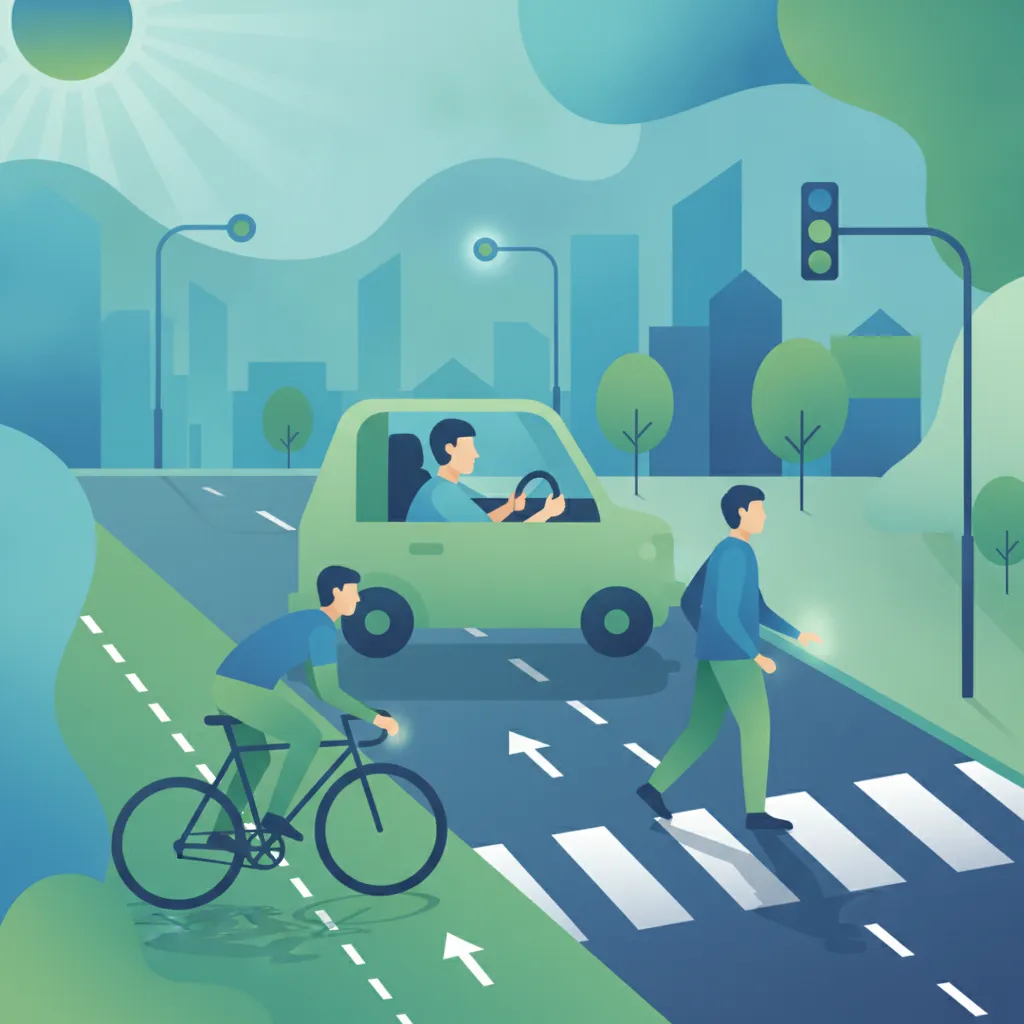
This lesson examines the specific challenges and responsibilities goods vehicle drivers face when interacting with pedestrians and cyclists in urban environments. Learners will understand right-of-way rules, the importance of yielding at pedestrian crossings, and safe turning practices that protect cyclists. The content emphasizes heightened driver vigilance, especially when navigating bike lanes and crowded sidewalks.

This lesson examines French Code de la route laws regarding pedestrian right-of-way, emphasizing the driver's legal duty to yield to any pedestrian engaged in crossing. It outlines proper approach speeds when approaching zebra crossings with obstructed views. Candidates will learn to maintain a safe physical buffer zone and verify that crosswalks are entirely clear of pedestrians before accelerating.

Public transit vehicles like city buses and streetcars (trams) have clear legal priorities and dedicated infrastructure in urban areas. This lesson teaches you to recognize reserved transit lanes and your legal obligation to yield to buses exiting their designated stops. You will also learn safe driving strategies near tram tracks, ensuring you never block public transit lines or risk passenger boarding areas.

This lesson focuses on the technical skills required to position a large bus or coach parallel to the boarding curb. Drivers will learn to minimize the gap between the vehicle steps and the sidewalk, preventing tripping hazards for boarding passengers. The lesson also covers safe approach angles, mirror alignment, and positioning rules that avoid contact with curbside objects or waiting pedestrians.
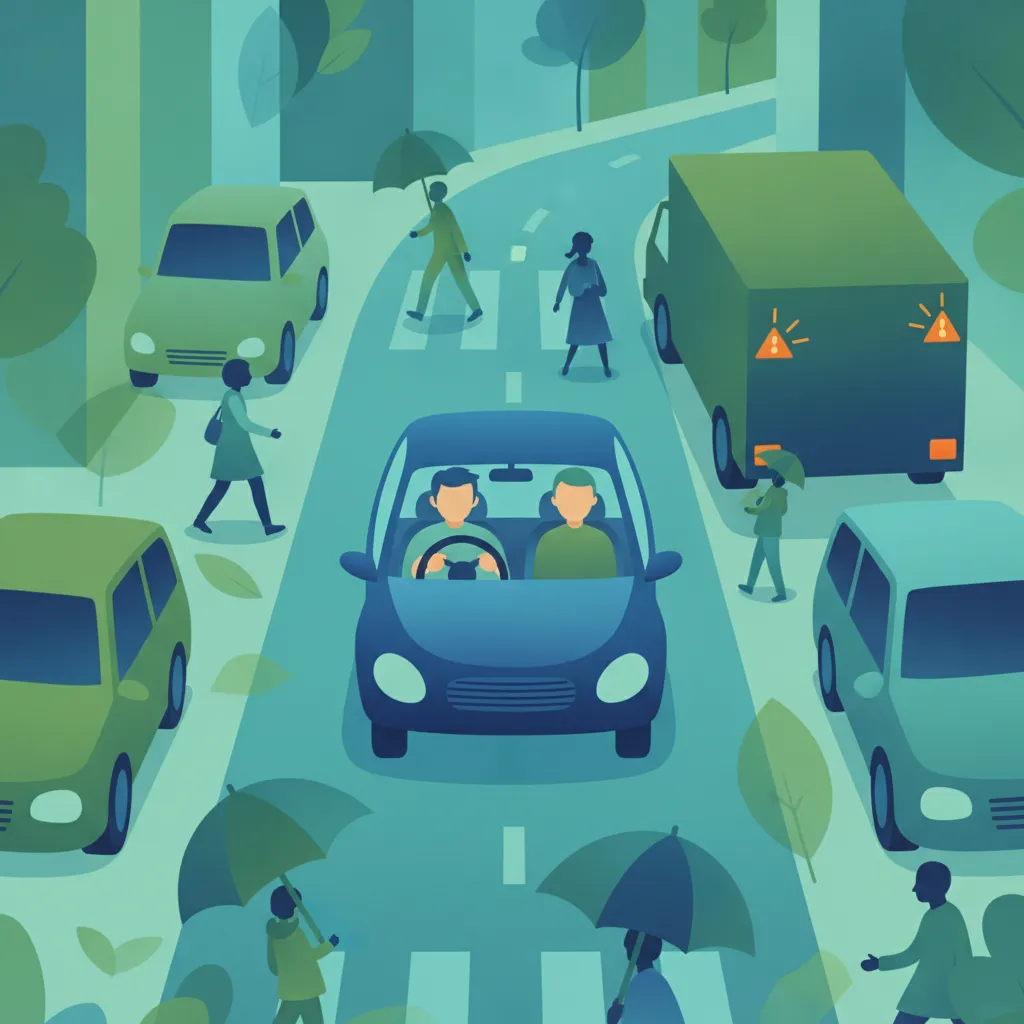
This lesson focuses on maneuvering in extremely crowded areas, passenger terminals, or narrow streets blocked by parked vehicles and obstacles. Drivers will learn to assess clearance distances precisely before committing to narrow pathways. The content teaches steering techniques that maintain stability, optimize space usage, and prioritize public safety during slow-speed, high-difficulty maneuvers.

In this lesson, drivers will learn strategies to avoid conflicts with smaller vehicles, such as cars and vans, which may not be as visible in large vehicle blind spots. The content emphasizes maintaining adequate spacing, using proper lane discipline, and being aware of small vehicles' behavior during lane changes and turns. Learners will also be introduced to communication techniques, such as signalling and eye contact.

This lesson provides global defensive driving strategies to minimize collision risks for all non-motorized and vulnerable road users. Drivers will learn to systematically lower vehicle speed in dense pedestrian zones, even when no active hazards are visible. By cultivating an anticipatory mindset and maintaining generous safety margins, professional drivers establish a protective safety envelope around their vehicle.
Find clear answers to common questions learners have about Safe Following Distance with Passengers Onboard. Learn how the lesson is structured, which driving theory objectives it supports, and how it fits into the overall learning path of units and curriculum progression in France. These explanations help you understand key concepts, lesson flow, and exam focused study goals.
A coach has significantly higher mass and different braking characteristics, especially when fully loaded. This increases the distance required to come to a complete stop, necessitating a larger safety gap to prevent collisions.
Increased weight from passengers and luggage significantly increases the vehicle's kinetic energy. You must increase your following distance proportionally to ensure that your braking system can safely dissipate this energy in an emergency.
Yes, on wet or slippery roads, stopping distances effectively double. You must increase the safety gap to at least twice the distance you would normally maintain, regardless of your vehicle size.
The theory exam focuses on your ability to apply safety principles. You will need to recognize that heavy vehicles require more time and space to react and stop compared to light vehicles, and apply this logic to traffic scenarios.
Ready to focus your study? Use the practice search to find exactly the French driving theory questions you need for the Code de la route and permis de conduire ETG. Refine your knowledge on specific topics or challenging rules to boost your confidence and exam readiness.