
This lesson teaches professional heavy goods vehicle drivers how to maintain correct following distances to ensure safety on French roads. Understanding these variables is critical for the C and CE theory exam, as it directly impacts your ability to manage a large vehicle's inertia and braking capabilities in diverse traffic environments.

Lesson content overview
Operating a heavy goods vehicle (HGV) in Category C (rigid trucks) or Category CE (articulated combinations) requires a profound understanding of vehicle physics and spatial awareness. Due to their immense mass, commercial vehicles cannot stop as quickly as passenger cars.
In this lesson, which forms an essential part of the French Goods Vehicle Licence Theory Course (Category C & CE), we will examine how to calculate and maintain safe following distances. We will cover the physical forces governing stopping distances, legal requirements under the French Code de la route, and how to dynamically adjust your driving in response to weather, vehicle load, and gradients.
To safely manage the space ahead of your truck, you must understand what happens from the moment you perceive a hazard to the moment your vehicle comes to a complete standstill. This entire sequence is known as the Total Stopping Distance (distance d'arrêt).
Total stopping distance is not a single, static measurement. It is a dynamic value that changes constantly based on your speed, your vehicle’s weight, the condition of your brakes, and the road surface. Physically, it is calculated as the sum of two distinct phases:
Understanding this equation is critical for passing your French truck theory exam and, more importantly, for preventing rear-end collisions on public roads.
To accurately calculate your stopping requirements, we must dissect the two components of total stopping distance.
Reaction distance is the space your vehicle covers from the moment you see a hazard (such as brake lights ahead) to the exact millisecond you begin pressing the brake pedal.
The physical distance a vehicle travels during the time it takes for the driver to perceive a hazard, process the information, and physically initiate braking.
A common misunderstanding among new drivers is assuming that reaction distance is negligible. At highway speeds, a heavily loaded truck will travel nearly 25 metres before the mechanical braking system is even activated. Fatigue, distraction (such as checking mirrors or looking at a GPS), or minor illness can easily double your reaction time to 2 seconds or more, doubling your reaction distance before the vehicle begins to slow down.
Braking distance is the physical space the vehicle travels after you apply the brakes until it comes to a complete halt.
Unlike reaction distance, which increases linearly with speed, braking distance increases quadratically (with the square of your speed). If you double your speed, your braking distance does not double—it increases by a factor of four ().
For heavy goods vehicles, braking distance is heavily dictated by:
The French Code de la route establishes clear, mandatory guidelines for minimum following distances, particularly for goods vehicles over 3.5 tonnes Gross Vehicle Weight (Poids Total Autorisé en Charge - PTAC).
For passenger cars, a general 2-second rule is recommended. However, because heavy vehicles require substantially longer to decelerate, the safety guidelines for goods vehicles demand a larger safety margin:
These temporal gaps are designed to guarantee that even if the vehicle in front performs an emergency stop, you have enough combined reaction and braking buffer to bring your multi-tonne vehicle to a safe halt.
On French motorways (autoroutes), the risk of high-speed, multi-vehicle pileups is elevated. Under Article R412-12 of the Code de la route, specific spacing regulations apply:
Let us look at how vehicle mass and speed interact in real-world scenarios. Heavy goods vehicles operate under varying load conditions, ranging from empty runs to carrying maximum capacity close to their legal Gross Vehicle Weight (GVW/PTAC).
A fully loaded truck requires significantly more stopping distance than an empty or lightly loaded truck.
Important Safety Rule: When your truck is fully loaded to its legal maximum capacity, you must add at least 1 additional second to your normal temporal following distance to account for the increased stopping distance.
According to French technical regulations (Arrêté du 15 novembre 2015), heavy goods vehicles must feature braking systems that meet stringent performance standards. A compliant HGV must be capable of stopping from 80 km/h within a maximum distance of 45 metres on a flat, dry asphalt road.
If we combine this with a standard 1-second reaction time (which covers 22.2 metres at 80 km/h), the absolute best-case total stopping distance for a compliant truck at 80 km/h is approximately 67.2 metres.
As a professional driver, you must constantly monitor the environment and adjust your following distance to compensate for external physical factors.
Road safety engineers use friction coefficients to calculate braking distances. For practical planning on the road, we apply multipliers to our dry-road braking distances:
| Road Condition | Grip Coefficient | Impact on Braking Distance | Recommended Temporal Gap |
|---|---|---|---|
| Dry Asphalt | Optimal (Coefficient = 1.0) | Standard distance (e.g., 40m at 80 km/h) | At least 3 seconds |
| Wet Road | Reduced (Coefficient ≈ 1.5) | Increases by roughly 50% (e.g., 60m at 80 km/h) | At least 4 seconds |
| Snow / Ice | Severely Compromised (Coefficient ≈ 2.0 to 3.0+) | Can double, triple, or increase tenfold | 5 to 6 seconds minimum |
When descending hills or mountain passes, gravity acts as an accelerating force.
Calculating precise physical distances in metres while driving is difficult. To simplify this, professional drivers use visual landmarks to measure temporal gaps.
Select a Fixed Landmark: Identify a stationary object ahead, such as a road sign, a bridge structure, a utility pole, or a tree.
Observe the Vehicle Ahead: Wait for the rear bumper of the vehicle in front of you to pass your chosen landmark.
Count the Seconds: Start counting slowly: "One thousand and one, one thousand and two, one thousand and three..." (or "un crocodile, deux crocodiles, trois crocodiles..." in French training).
Assess Your Gap: If your front bumper reaches the landmark before you finish counting to three (in dry conditions) or four (in wet conditions), you are tailgating. Softly ease off the accelerator to rebuild your safety margin.
Let us look at how these temporal gaps translate into physical distances at typical driving speeds:
Modern Category C and CE vehicles are equipped with active safety systems such as Anti-lock Braking Systems (ABS) and Electronic Stability Programmes (ESP). However, many drivers suffer from dangerous misconceptions regarding what these systems can actually do.
ABS prevents the vehicle's wheels from locking up during emergency braking.
ESP detects loss of steering control and automatically applies brakes to individual wheels to stabilize the truck.
Active safety technologies are designed to help you maintain control during an emergency. They are not a replacement for defensive driving or safe following distances.
Failing to maintain a safe following distance is a major cause of severe accidents involving heavy vehicles. Professional drivers must be vigilant in avoiding these common mistakes.
In dense traffic or urban environments, passenger cars will often merge into the safe space you have left in front of your truck.
When heavy trucks travel in groups or convoys on motorways, they sometimes follow each other closely to reduce wind resistance (drafting).
If you are operating a delivery truck, your vehicle's total mass changes as you offload cargo throughout the day.
This lesson covers the physics and regulations governing safe following distances for Category C and CE heavy goods vehicles in France, emphasizing that total stopping distance comprises reaction distance (typically 1 second) and braking distance (which grows with the square of speed). The French Code de la route mandates minimum temporal gaps of 3 seconds in dry conditions and 4 seconds in wet, icy, or low-visibility conditions for vehicles exceeding 3.5 tonnes PTAC. Heavy loads increase kinetic energy and stopping distance, requiring drivers to add at least 1 additional second when fully loaded, while road condition coefficients adjust braking calculations for reduced traction. While active safety systems like ABS and ESP help maintain steering stability during emergency braking, they do not reduce the physical space required to bring a multi-tonne vehicle to a halt, making correct following distances essential for professional drivers.
A short set of high-value points that capture the most important learning from this lesson.
Total stopping distance equals reaction distance plus braking distance, and both components must be accounted for when planning safe gaps.
Braking distance increases with the square of speed, meaning doubling your speed quadruples the distance needed to stop.
Under the French Code de la route, heavy goods vehicles must maintain at least 3 seconds in dry conditions and 4 seconds in wet or low-visibility conditions.
Vehicle load significantly affects stopping distance; a fully loaded truck approaching PTAC requires an additional 1-second margin.
Safety systems like ABS and ESP maintain steering control but do not shorten the physical braking distance required.
Explore all units and lessons included in this driving theory course.
The quick calculation rule: multiply the tens digit of your speed by 3 to get metres per second (e.g., 80 km/h = 8 × 3 = 24 m/s).
On open highways outside built-up areas, trucks over 3.5 tonnes must maintain a minimum physical distance of 50 metres from each other.
Road condition multipliers: wet surfaces increase braking distance by approximately 1.5×; snow or ice can multiply it by 2 to 3× or more.
When descending steep gradients, gravity accelerates the vehicle and overheats brakes, requiring proportionally larger following distances.
Use visual landmarks to count seconds ('one thousand and one...') to verify your temporal gap matches current conditions.
Assuming braking distance increases only linearly with speed rather than quadratically, leading to inadequate gaps at higher speeds.
Neglecting to adjust following distance as cargo is offloaded throughout the day, leaving excessive gaps when empty and insufficient gaps when reloaded.
Believing ABS or ESP can compensate for tailgating by providing shorter stopping distances, when these systems only improve steering control.
Failing to increase distance during the convoy effect on motorways, where multiple trucks follow closely to reduce wind resistance.
Using a fixed 2-second gap designed for passenger cars instead of the required 3 to 4 seconds for heavy goods vehicles.
Lesson content overview
A short set of high-value points that capture the most important learning from this lesson.
Total stopping distance equals reaction distance plus braking distance, and both components must be accounted for when planning safe gaps.
Braking distance increases with the square of speed, meaning doubling your speed quadruples the distance needed to stop.
Under the French Code de la route, heavy goods vehicles must maintain at least 3 seconds in dry conditions and 4 seconds in wet or low-visibility conditions.
Vehicle load significantly affects stopping distance; a fully loaded truck approaching PTAC requires an additional 1-second margin.
Safety systems like ABS and ESP maintain steering control but do not shorten the physical braking distance required.
Explore all units and lessons included in this driving theory course.
The quick calculation rule: multiply the tens digit of your speed by 3 to get metres per second (e.g., 80 km/h = 8 × 3 = 24 m/s).
On open highways outside built-up areas, trucks over 3.5 tonnes must maintain a minimum physical distance of 50 metres from each other.
Road condition multipliers: wet surfaces increase braking distance by approximately 1.5×; snow or ice can multiply it by 2 to 3× or more.
When descending steep gradients, gravity accelerates the vehicle and overheats brakes, requiring proportionally larger following distances.
Use visual landmarks to count seconds ('one thousand and one...') to verify your temporal gap matches current conditions.
Assuming braking distance increases only linearly with speed rather than quadratically, leading to inadequate gaps at higher speeds.
Neglecting to adjust following distance as cargo is offloaded throughout the day, leaving excessive gaps when empty and insufficient gaps when reloaded.
Believing ABS or ESP can compensate for tailgating by providing shorter stopping distances, when these systems only improve steering control.
Failing to increase distance during the convoy effect on motorways, where multiple trucks follow closely to reduce wind resistance.
Using a fixed 2-second gap designed for passenger cars instead of the required 3 to 4 seconds for heavy goods vehicles.
Explore search topics learners often look for when studying Calculating Safe Following Distances. These topics reflect common questions about road rules, driving situations, safety guidance, and lesson level theory preparation for learners in France.
Browse additional driving theory lessons that cover connected traffic rules, road signs, and common driving situations related to this topic. Improve your understanding of how different rules interact across everyday traffic scenarios.
Understand the mechanical components of air braking systems, the impact of vehicle load on inertia, and how heat accumulation causes brake fade during long descents. This guide explains the technical performance standards required for C and CE licence holders under French road safety regulations.
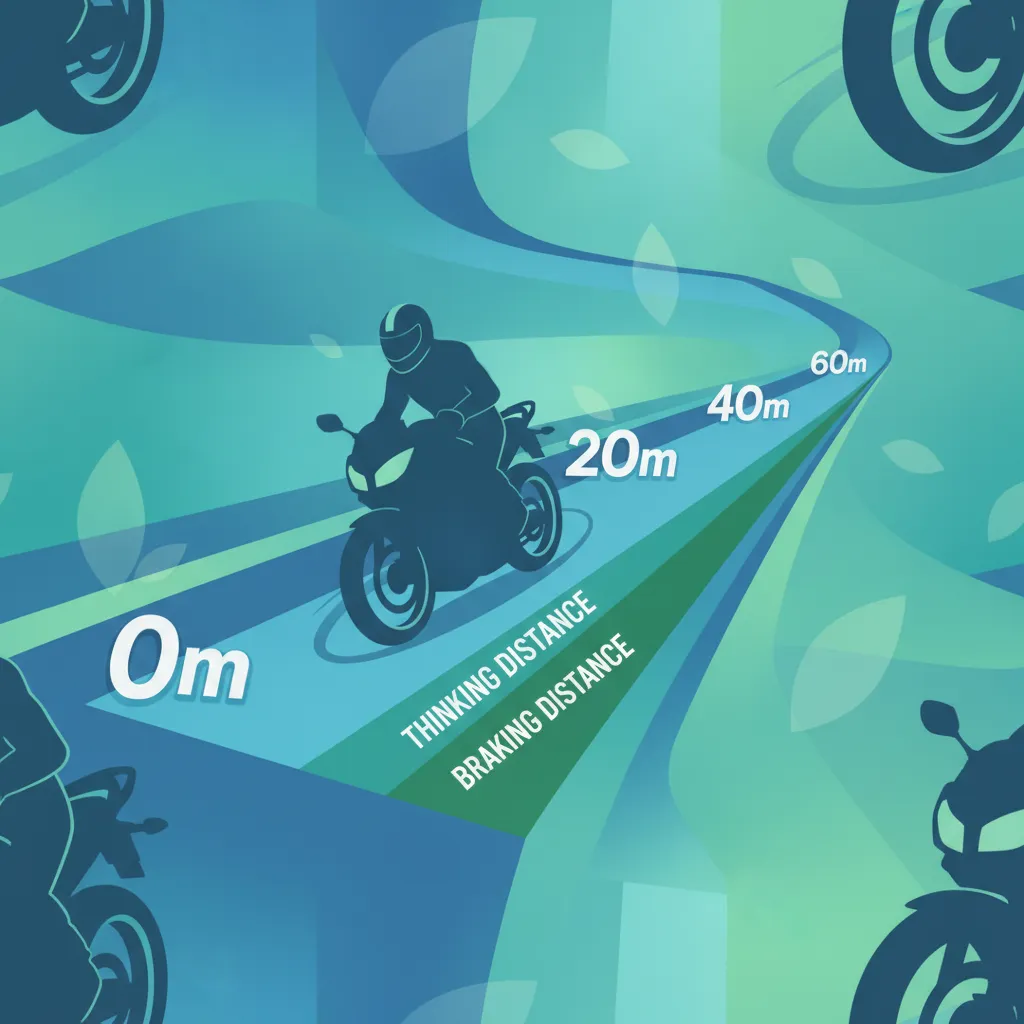
This lesson breaks down the physics of stopping a motorcycle, exploring how kinetic energy varies with the square of your speed. You will learn the mathematical components of total stopping distance, which includes both perception-reaction distance and physical braking distance. The lesson also explains how forward weight transfer during heavy braking increases traction on the front tire while reducing rear-wheel load.
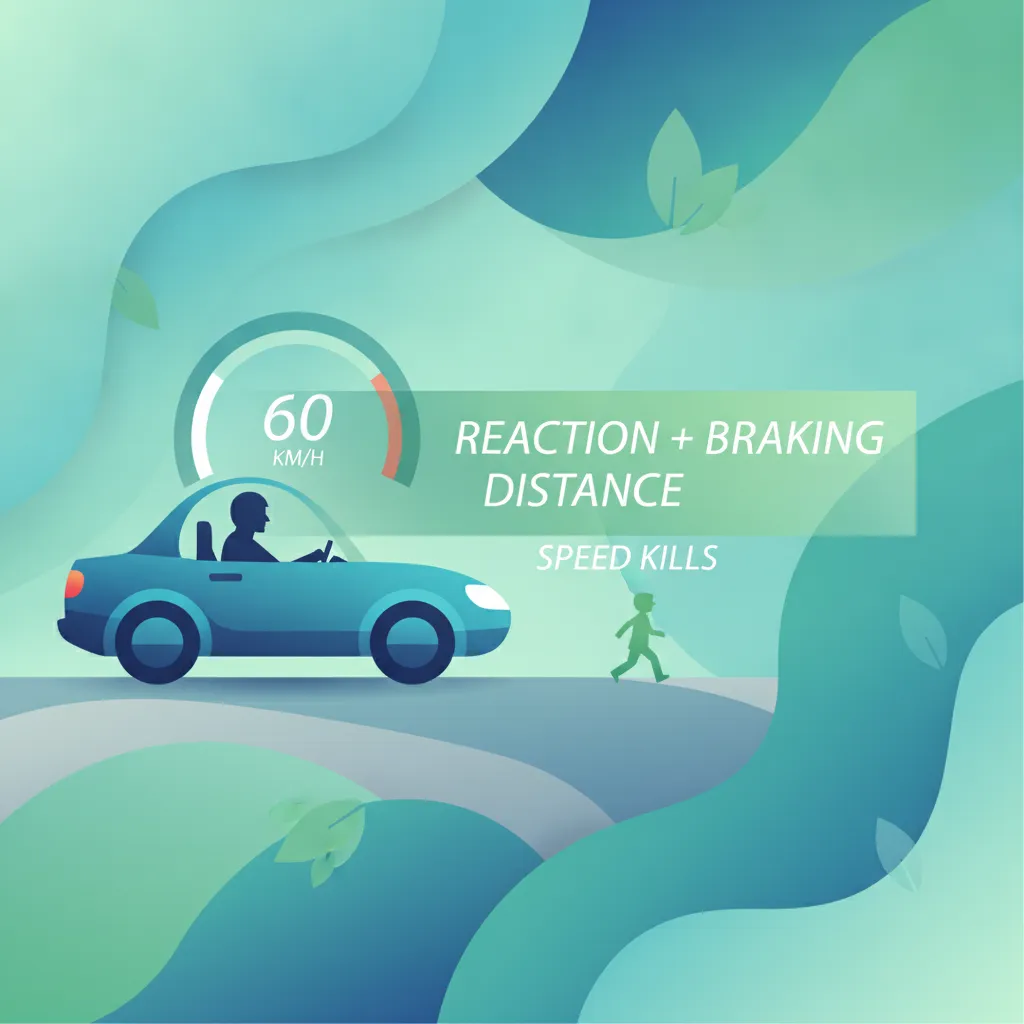
Total stopping distance is calculated as the sum of your reaction distance and the physical braking distance of the car. This lesson explains how reaction time is affected by driver focus and how speed exponentially increases the braking distance. You will learn how tire condition and slippery road surfaces degrade braking adhesion, requiring drivers to recognize and counteract these physical limits.

This lesson focuses on the various braking systems used in goods vehicles, including air brakes, hydraulic brakes, and advanced safety systems such as ABS and ESP. Learners will understand how these systems function, their impact on braking performance, and the importance of regular brake inspection and maintenance. The content also addresses brake wear, brake fade, and how these factors affect stopping distances, especially under heavy load conditions.

This lesson emphasizes the critical importance of maintaining a safe following distance when carrying dozens of passengers. Learners will study how vehicle weight and passenger load dynamically extend braking and total stopping distances compared to standard passenger cars. The lesson provides concrete spacing rules, such as adjusted safety gaps for highway driving and increased distances on slippery roads.
Explore the specific regulations for goods vehicles on high-speed motorways, including Article R412-12 regarding mandatory safety distances. Learn about correct lane discipline for articulated vehicles, managing visibility during high-speed traffic, and the specific conventions for navigating motorway roadworks and emergency stopping zones in France.
This lesson covers the rules of driving passenger vehicles on high-speed French motorways (autoroutes). Learners will study entry-ramp merging protocols, lane restrictions for vehicles over 3.5 tonnes, and motorway-specific speed limits. The lesson also highlights the correct use of toll booths (péages), emergency hard-shoulder safety procedures, and accessing dedicated coach rest areas.
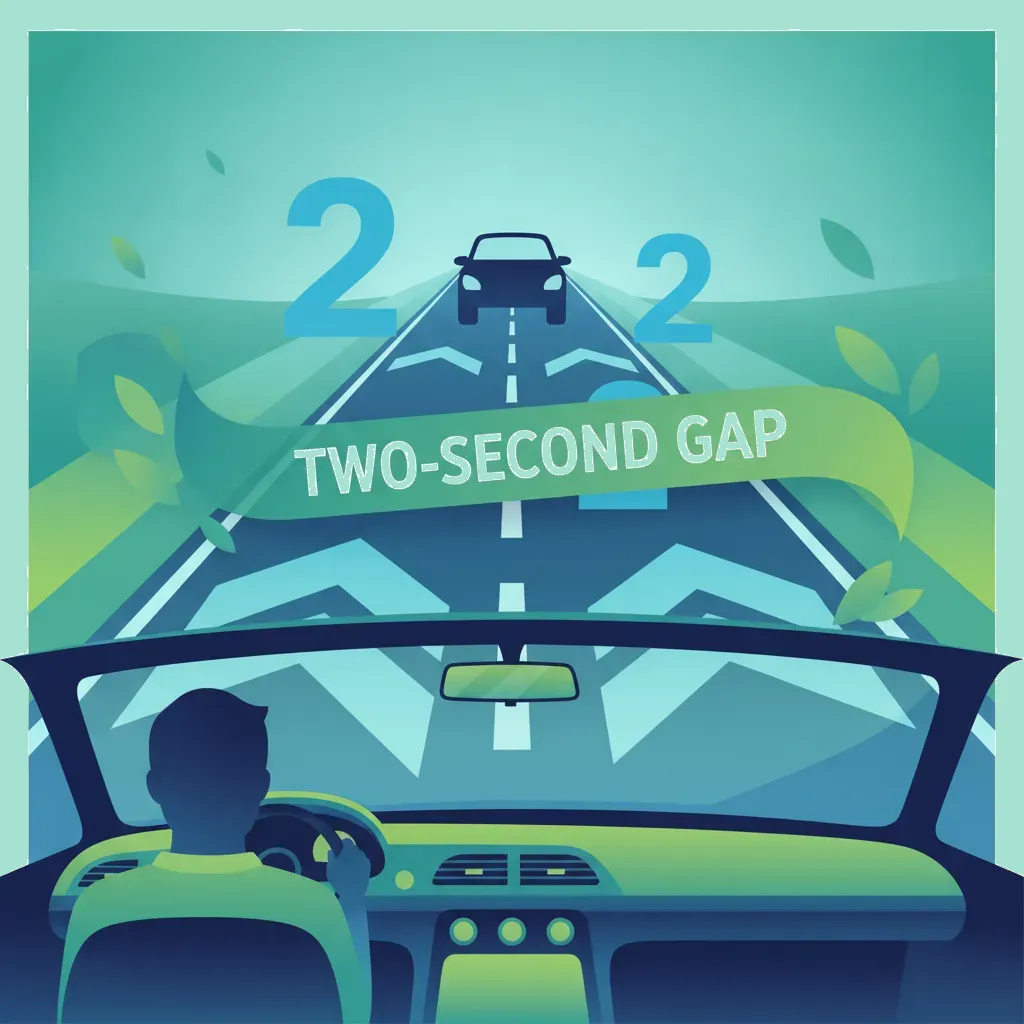
Maintaining a safe distance behind the lead vehicle is essential to prevent rear-end collisions during sudden braking maneuvers. This lesson teaches you the two-second safety rule and how to calculate this gap at different highway speeds. You will also study unique safety margin requirements, such as maintaining minimum distance intervals in road tunnels or doubling your following distance on wet roads.
This lesson focuses on the specific considerations for operating goods vehicles on French motorways, including lane selection, speed management, and proper merging techniques. Learners will understand the importance of maintaining lane discipline, using appropriate overtaking practices, and respecting motorway-specific speed limits for heavy vehicles. The content also covers the use of emergency lanes and the handling of traffic flow.
In this lesson, drivers will learn the specific speed limits that apply to goods vehicles across different road types in France, including urban areas, rural roads, and motorways. The content covers the differences between speed limit signs for heavy vehicles and standard passenger cars, the legal basis for these limits, and the importance of speed adaptation based on vehicle category and load. Learners will also be introduced to speed enforcement methods used in France, such as radar and speed cameras.
This lesson emphasizes the critical importance of maintaining a safe following distance when carrying dozens of passengers. Learners will study how vehicle weight and passenger load dynamically extend braking and total stopping distances compared to standard passenger cars. The lesson provides concrete spacing rules, such as adjusted safety gaps for highway driving and increased distances on slippery roads.
This lesson provides strategies for planning routes that accommodate oversized goods vehicles while complying with French road restrictions. Learners will learn how to identify prohibited routes, evaluate bridge and tunnel limitations, and obtain necessary access permits. The content also addresses the use of specialised GPS systems for heavy vehicle routing and the importance of contingency planning for detours, ensuring safe and efficient transport operations.
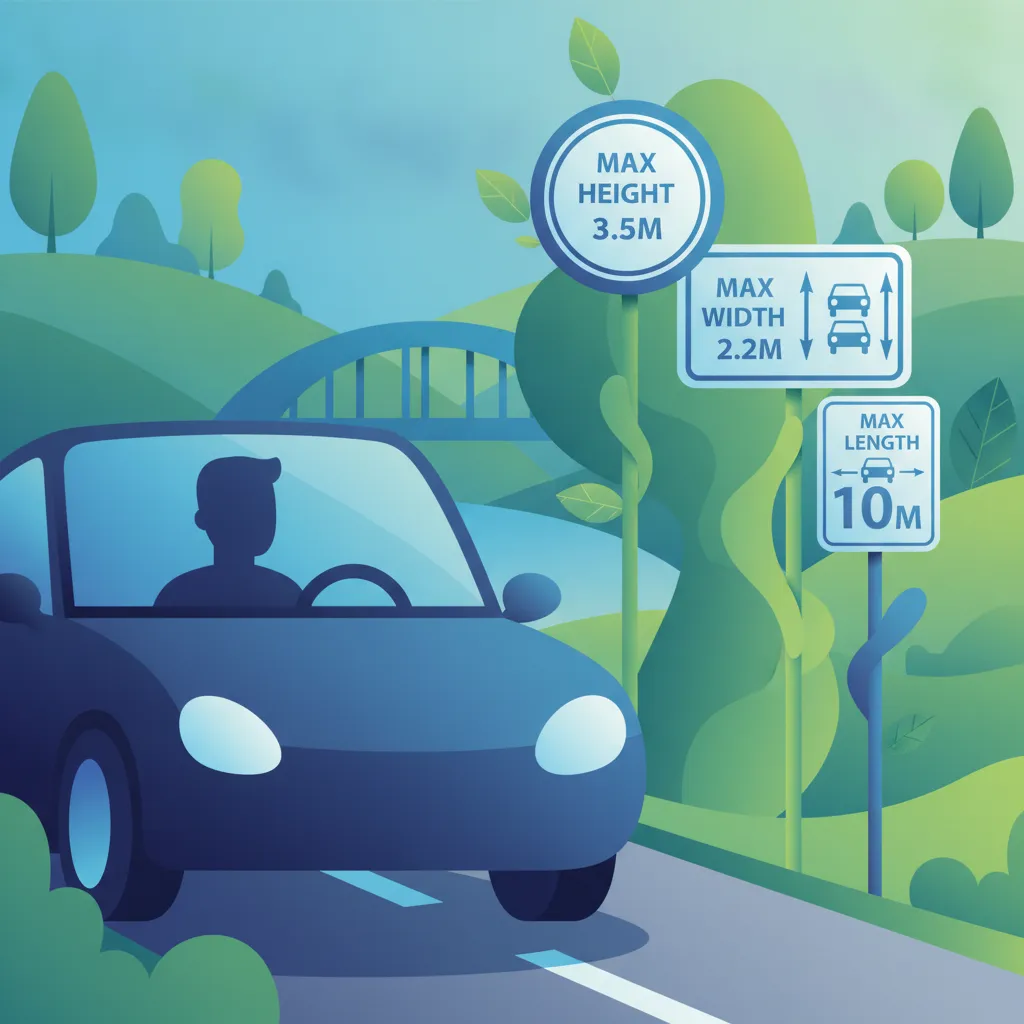
This lesson provides an in-depth analysis of how goods vehicles are classified according to their overall dimensions, such as length, width, height, and wheelbase. Learners will understand the legal limits imposed by French regulations for each vehicle class, and how these dimensions affect the vehicle’s classification and permissible routes. The material also explains the impact of cab size versus cargo space on maneuverability and route planning, highlighting the importance of accurate dimension assessment.
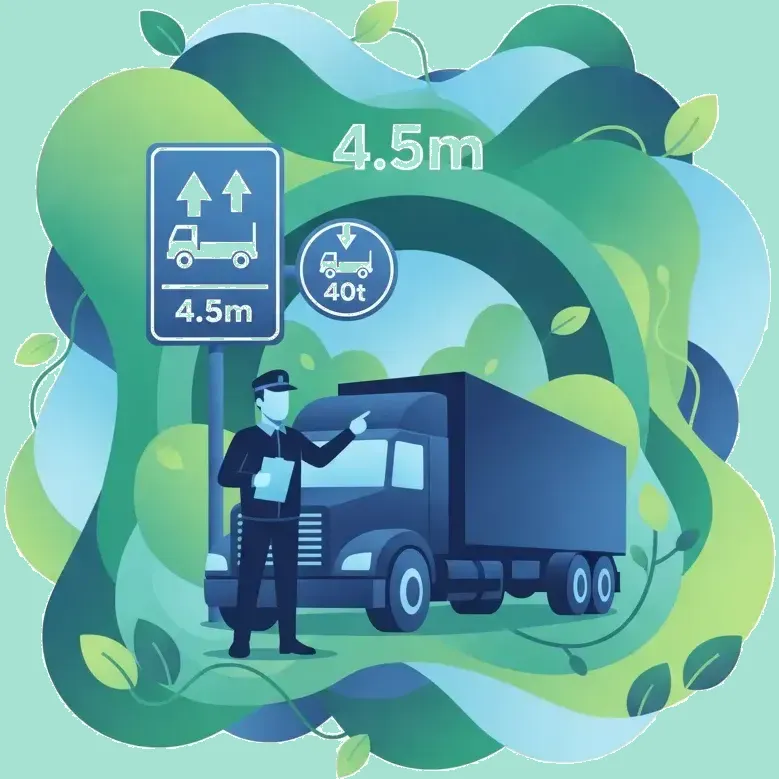
This lesson focuses on the weight and dimension restrictions that goods vehicles must adhere to while traveling on French roads. Learners will understand bridge caps, tunnel clearances, and other physical limitations imposed by infrastructure, and how these restrictions impact route planning and vehicle loading. The content also highlights legal load limits and the importance of compliance checks to avoid fines and roadblocks.

This lesson examines how goods vehicle drivers should approach and navigate roadworks zones and temporary traffic restrictions. Learners will be taught to recognize temporary speed limit signs, follow detour routes safely, and respect lane closures. The content also highlights the importance of maintaining safe distances from workers, adjusting for reduced lane width, and ensuring compliance with temporary regulations to avoid penalties.
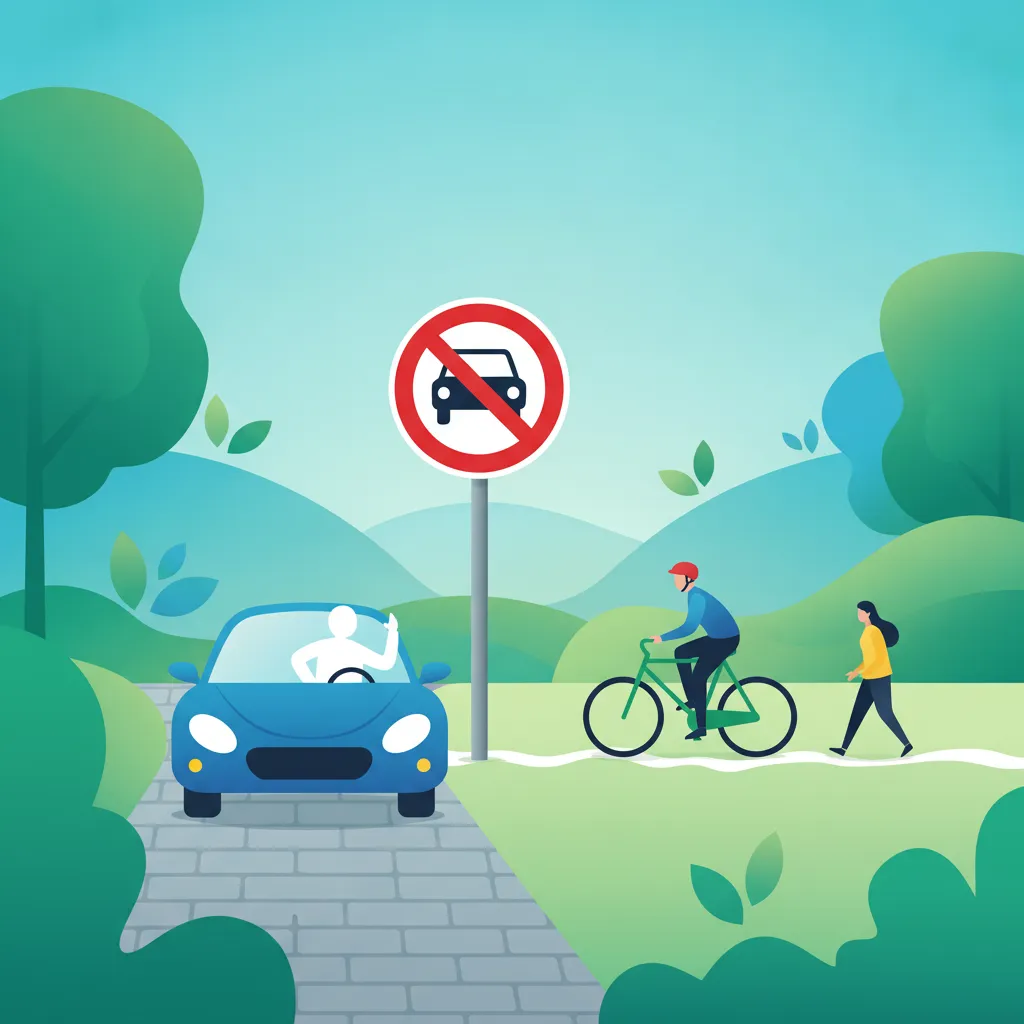
In this lesson, learners will explore the various access restrictions that apply to goods vehicles in France, such as low emission zones and weight-restricted areas. The focus is on understanding the process to obtain necessary access permits and authorisations, and how these restrictions influence route planning and operational decisions. Learners will also be introduced to specific regulations governing vehicle entry into city centres and environmentally sensitive zones.
Find clear answers to common questions learners have about Calculating Safe Following Distances. Learn how the lesson is structured, which driving theory objectives it supports, and how it fits into the overall learning path of units and curriculum progression in France. These explanations help you understand key concepts, lesson flow, and exam focused study goals.
Goods vehicles have significantly higher mass, which increases momentum and requires a much longer braking distance to come to a complete stop, even with modern ABS systems.
Yes. A fully loaded goods vehicle has a higher centre of gravity and increased kinetic energy, meaning braking takes longer and stability is reduced, requiring you to increase your following gap.
In France, a professional driver should maintain a gap of at least 2 seconds behind the vehicle ahead under ideal conditions, doubling this to 4 seconds or more in poor weather or at higher speeds.
Absolutely. Downhill gradients increase the braking distance significantly because gravity assists the vehicle's forward momentum, requiring you to proactively increase your following distance.
Ready to focus your study? Use the practice search to find exactly the French driving theory questions you need for the Code de la route and permis de conduire ETG. Refine your knowledge on specific topics or challenging rules to boost your confidence and exam readiness.