
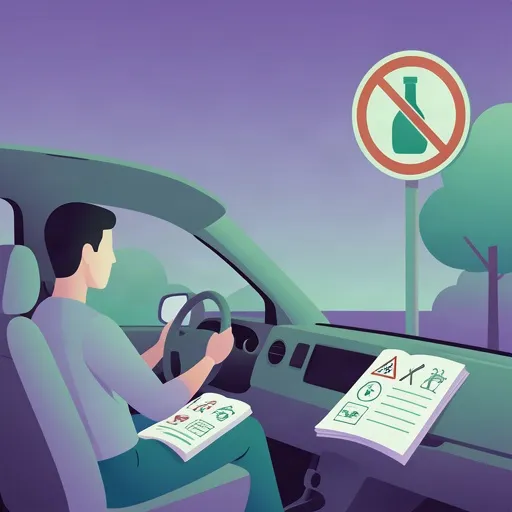
Drivers in Germany must adhere to strict legal alcohol limits that carry significant consequences for safety and legal status. This guide clarifies the differences between general limits, the 0.0 promille requirement for new drivers, and the severe legal penalties associated with relative and absolute incapacitation. Mastery of these rules is vital for passing your theory exam and avoiding long-term complications with your driving license.
Article content overview
In Germany, road safety is underpinned by strict traffic legislation aimed at minimizing the risk of accidents caused by intoxication. Whether you are a student preparing for your theory exam or an experienced driver, understanding the legal alcohol thresholds is essential. The German legal system distinguishes between various levels of intoxication, each carrying different penalties that range from administrative fines to severe criminal prosecution under the Strafgesetzbuch (StGB).
The safest and most responsible approach is "Don't drink and drive." Alcohol impairs your reaction time, vision, and decision-making capabilities, which are critical for safe driving in complex German traffic conditions.
German law operates on a tiered system to assess a driver's ability to operate a vehicle safely. It is a common misconception that there is only one "legal limit." Instead, the law accounts for both the physical concentration of alcohol in the bloodstream and the actual ability of the driver to navigate traffic safely.
A zero-tolerance policy applies to specific groups of drivers. If you are in your Probezeit (probationary period) or are under the age of 21, you must maintain a 0.0 promille blood alcohol level. This strict rule also applies to professional drivers operating public transport or heavy goods vehicles while on duty. Violating this rule results in immediate penalties, including fines and potential extensions of your probationary period.
For the general driving population, 0.5 promille is the primary threshold defined in § 24a of the Straßenverkehrsgesetz (StVG). If a driver is found with 0.5 promille or more of alcohol in their blood—or an equivalent amount in their breath—they are committing an administrative offense. Even without causing an accident, a first-time offense typically results in a €500 fine, two points in the Flensburg register, and a one-month driving ban.
The law becomes significantly stricter when alcohol levels rise or when driving performance is visibly impaired.
Occurs at 0.3 promille or above if the driver exhibits signs of impaired driving (e.g., erratic lane keeping, delayed reaction). Even at this lower level, you can be charged with a criminal offense under § 316 StGB if an accident occurs or traffic is endangered.
Legally presumed at 1.1 promille. At this level, the law assumes that any driver is incapable of operating a vehicle safely, regardless of whether they appear sober. This is always a criminal offense under the StGB.
The consequences for driving under the influence in Germany are designed to act as a serious deterrent. As offenses increase or thresholds are crossed, the penalties escalate from simple fines to the potential for prison sentences and the permanent loss of your driving license.
| Alcohol Level | Legal Status | Typical Consequences |
|---|---|---|
| 0.0 Promille | Mandatory for Under 21 / Probation | Fines, points, probation extension |
| 0.3 Promille+ | Relative Incapacitation | Criminal charges if impaired/accident |
| 0.5 Promille | Administrative Limit | €500 fine, 2 points, 1 month ban |
| 1.1 Promille | Absolute Incapacitation | Criminal offense, license revocation, MPU |
Beyond fines and bans, repeat offenders or those involved in serious incidents may be required to undergo a Medizinisch-Psychologische Untersuchung (MPU), often colloquially known as the "idiot test." This rigorous evaluation assesses whether a person is fit to regain their license, and failing it can result in an indefinite loss of driving privileges.
To master your theory exam, you must familiarize yourself with the core terminology used in German road law. These concepts appear frequently in exam questions regarding driver responsibility and the Bußgeldkatalog.
Article content overview
Explore related topics, search based questions, and concepts that learners often look up when studying Germany Alcohol Driving Limits. These themes reflect real search intent and help you understand how this topic connects to wider driving theory knowledge in Germany.
Find clear and practical answers to common questions learners often have about Germany Alcohol Driving Limits. This section helps explain difficult points, remove confusion, and reinforce the key driving theory concepts that matter for learners in Germany.
Drivers in their probation period or those under 21 years of age are subject to a 0.0 promille limit, meaning they must not drive after consuming any alcohol.
Relative Fahruntüchtigkeit (incapacitation) starts at 0.3 promille if any driving errors or accidents occur. Absolute Fahruntüchtigkeit is legally defined at 1.1 promille, where the driver is considered incapable of driving safely regardless of their observable behavior.
A first-time offense generally results in a 500 Euro fine, two points in the Flensburg register, and a one-month driving ban.
Yes. Beyond fines and points, reaching higher promille levels—or causing accidents while under the influence—can lead to severe criminal charges, permanent license revocation, and the mandatory requirement to undergo a medical-psychological assessment (MPU).
Didn't find what you were looking for? Continue your German driving theory preparation by exploring related articles, specific road sign categories, or in-depth guides on complex traffic situations. Deepen your understanding before the official test.