
Navigating a Baustelle requires more than just careful driving; it demands a thorough understanding of the specific traffic laws enforced under the StVO. In this guide, you will learn why speed limits remain mandatory even when no workers are visible, how to correctly apply the zipper merge to reduce congestion, and how to anticipate hazards like lane narrowing and emergency vehicle presence. This knowledge is crucial for both practical driving safety and correctly answering hazard perception questions on the German theory test.
Article content overview
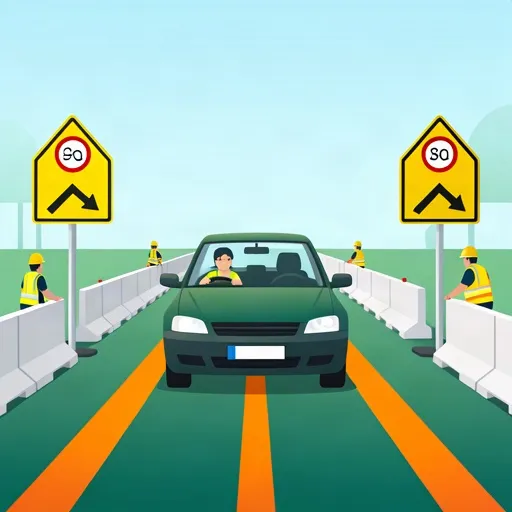
Navigating a Baustelle (construction zone) on the German Autobahn is one of the most demanding tasks for any driver. While the network is famous for its speed potential, these areas introduce significant physical limitations, including narrowed lanes, reduced side clearances, and the constant presence of workers. For those preparing for the German theory exam, understanding these zones is not just about safety—it is a critical requirement for answering hazard perception questions correctly.
A common misconception among new drivers is that speed limits in a Baustelle are merely suggestions or only apply when road workers are physically present. In reality, speed limits posted in construction zones are strictly legally binding at all times, including at night, on weekends, and on public holidays. These restrictions are enacted to ensure traffic flow and protect both motorists and workers from the hazards of high-speed maneuvers in restricted spaces.
Failing to adhere to the posted speed limit in a construction zone can lead to severe penalties, including points in Flensburg, heavy fines, and, in cases of severe speeding, a driving ban. Furthermore, authorities often double the standard fines for speeding violations committed within active roadworks.
When you see a speed limit sign combined with the warning sign for roadworks, the limit remains in effect until you reach a sign that explicitly cancels the restriction. Do not assume that the absence of orange traffic cones or workers means the limit no longer applies; the legal restriction stands until the corresponding end-of-restriction sign is passed.
When a lane ends due to a Baustelle or a traffic accident, the German Straßenverkehrs-Ordnung (StVO) mandates the use of the Reißverschlussverfahren, or zipper merge. This rule requires drivers in the lane that is coming to an end to continue driving until the very point where the lane disappears. Drivers in the continuing lane must allow one vehicle from the ending lane to merge in front of them, alternating like the teeth of a zipper.
Many drivers cause unnecessary congestion by merging far too early. By merging early, you effectively shorten the available road space and increase the length of the tailback, which in turn elevates the risk of rear-end collisions—the most common type of accident in German motorway construction zones.
Construction zones create unique environmental hazards that require defensive driving techniques. Because lanes are narrowed, often with only plastic barriers separating you from oncoming traffic or heavy machinery, your margin for error is minimal. You must pay close attention to your speedometer and increase your following distance, as sudden braking by the vehicle in front can lead to a dangerous chain reaction.
If you see traffic ahead starting to slow down, warn those behind you by briefly switching on your hazard lights. This simple action can be the difference between a controlled stop and a serious collision. Additionally, always scan your rearview mirror when approaching the end of a queue to ensure that you have an escape route if the driver behind you fails to stop in time.
Familiarizing yourself with the specific terminology used in the StVO will help you navigate both the road and the exam questions.
It is vital to understand that Baustellen are not just about the workers; they are about the road geometry itself. Even without workers present, the road design often features sharp curves, uneven surfaces, or restricted lane widths that make standard highway speeds dangerous. Furthermore, specialized heavy vehicles may need to enter or exit the site at any moment, and overhead gantry restrictions remain in place to protect the structural integrity of the work zone.
This article covers the essential rules for navigating German Autobahn construction zones (Baustellen), emphasizing that posted speed limits are legally binding at all times regardless of worker visibility. It explains the mandatory zipper merge procedure (Reißverschlussverfahren) where drivers in the ending lane continue to the merge point while the continuing lane alternates allowing vehicles in. Construction zones create unique hazards through narrowed lanes, reduced clearances, and heavy machinery, requiring increased following distances and defensive driving techniques. The content also highlights that penalties for violations are doubled and provides key terminology including StVO, Bußgeldkatalog, and Standspur for theory test preparation.
A short set of high-value points that capture the most important ideas from this article.
Speed limits in construction zones are legally binding at all times, regardless of worker presence, time of day, or day of week.
The zipper merge (Reißverschlussverfahren) requires drivers in the ending lane to continue until the merge point, while drivers in the continuing lane must allow one vehicle to merge alternately.
Construction zone speed limits remain in effect until an official end-of-restriction sign is passed, not when cones or workers become absent.
Lane narrowing and physical barriers in Baustellen create minimal margins for error, requiring increased following distances and constant speed awareness.
Hazard lights should be used to warn following traffic when approaching a slowdown in a construction zone.
Posted speed limits in construction zones are mandatory under StVO, not optional recommendations.
Reißverschlussverfahren means continuing in your lane until the merge point, then alternating one-for-one with adjacent lane traffic.
Fines for speeding in construction zones are typically doubled compared to standard violations.
The hard shoulder (Standspur) is strictly reserved for emergencies and must never be used as a driving lane.
Mobile traffic control boards (road sign 616) carry the same legal authority as posted signs and must be obeyed immediately.
Assuming speed limits no longer apply once construction workers are no longer visible on site.
Merging into the continuing lane too early, which shortens available road space and increases congestion.
Treating construction zone speed limits as suggestions rather than legally enforceable restrictions.
Failing to maintain adequate following distance when lanes are narrowed and escape routes are limited.
Using the hard shoulder (Standspur) as an extended driving lane to bypass congestion.
Article content overview
A short set of high-value points that capture the most important ideas from this article.
Speed limits in construction zones are legally binding at all times, regardless of worker presence, time of day, or day of week.
The zipper merge (Reißverschlussverfahren) requires drivers in the ending lane to continue until the merge point, while drivers in the continuing lane must allow one vehicle to merge alternately.
Construction zone speed limits remain in effect until an official end-of-restriction sign is passed, not when cones or workers become absent.
Lane narrowing and physical barriers in Baustellen create minimal margins for error, requiring increased following distances and constant speed awareness.
Hazard lights should be used to warn following traffic when approaching a slowdown in a construction zone.
Posted speed limits in construction zones are mandatory under StVO, not optional recommendations.
Reißverschlussverfahren means continuing in your lane until the merge point, then alternating one-for-one with adjacent lane traffic.
Fines for speeding in construction zones are typically doubled compared to standard violations.
The hard shoulder (Standspur) is strictly reserved for emergencies and must never be used as a driving lane.
Mobile traffic control boards (road sign 616) carry the same legal authority as posted signs and must be obeyed immediately.
Assuming speed limits no longer apply once construction workers are no longer visible on site.
Merging into the continuing lane too early, which shortens available road space and increases congestion.
Treating construction zone speed limits as suggestions rather than legally enforceable restrictions.
Failing to maintain adequate following distance when lanes are narrowed and escape routes are limited.
Using the hard shoulder (Standspur) as an extended driving lane to bypass congestion.
Explore related topics, search based questions, and concepts that learners often look up when studying Autobahn Construction Zone Rules. These themes reflect real search intent and help you understand how this topic connects to wider driving theory knowledge in Germany.
Find clear and practical answers to common questions learners often have about Autobahn Construction Zone Rules. This section helps explain difficult points, remove confusion, and reinforce the key driving theory concepts that matter for learners in Germany.
Yes. Speed limits in construction zones are legally binding traffic regulations under the StVO and remain in full effect until the end-of-restriction sign is passed, regardless of whether workers or machinery are currently visible.
The Reißverschlussverfahren, or zipper merge, is the required method for merging lanes when one lane ends, such as before a construction zone. Drivers should stay in their lane until the narrowing begins and then merge alternately with vehicles from the ending lane.
Speeding in a construction zone significantly increases the risk of accidents involving workers and other road users in narrow lanes. Because of the heightened danger and the necessity of protecting personnel, many German jurisdictions impose stricter penalties for violations in these areas.
Immediately reduce your speed, increase your following distance, and keep an eye on your rearview mirror. If you encounter a sudden traffic jam, switch on your hazard warning lights to alert vehicles behind you.
Didn't find what you were looking for? Continue your German driving theory preparation by exploring related articles, specific road sign categories, or in-depth guides on complex traffic situations. Deepen your understanding before the official test.