
Parking a trailer on public streets is more strictly regulated than most drivers realize, particularly when the trailer is disconnected from the towing vehicle. This guide breaks down the essential legal restrictions, including the two-week rule and dimensions-based limitations, to help you understand how to store your caravan or trailer lawfully. Mastering these rules is vital not only for compliance with local ordinances but also for demonstrating your knowledge of standing vehicle regulations in the German theory exam.
Article content overview
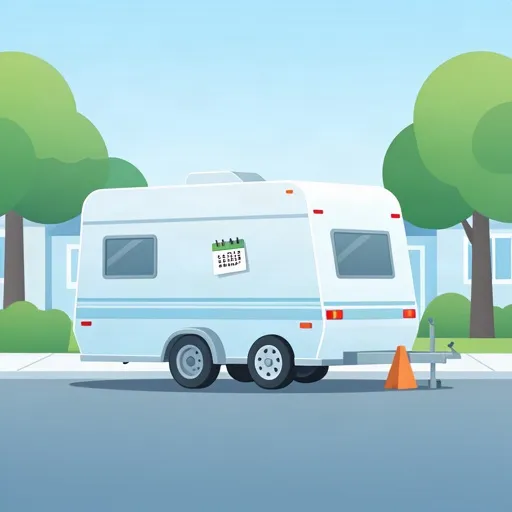
Parking a trailer on public roads in Germany is a common scenario for many drivers, yet it is governed by specific regulations that often catch motorists off guard. Whether you are towing a caravan, a horse trailer, or a simple utility trailer, understanding the legal requirements defined in the Straßenverkehrs-Ordnung (StVO) is essential to avoid fines and ensure you are not creating a hazard. When a trailer is disconnected from its towing vehicle, it is legally considered a parked vehicle, and it must comply with strict criteria regarding duration, location, and visibility.
According to §12 of the StVO, the act of parking occurs whenever you leave your vehicle or remain stationary for longer than three minutes. For trailer owners, it is critical to recognize that once a trailer is uncoupled from the towing vehicle, it is subject to the same – and often more restrictive – parking regulations as a standalone car. Simply uncoupling your caravan on a public street does not grant you the right to leave it there indefinitely.
One of the most important regulations for trailer owners is the limit on how long a disconnected trailer may occupy a public parking space within built-up areas. Under §12 Abs. 3b StVO, a trailer with a maximum authorized mass exceeding 750 kg must not be parked in the same location for more than two consecutive weeks.
It is a common misconception that moving the trailer a few meters down the street resets this two-week clock. Authorities consider the intent of the parking; if the trailer remains on the same street or in the immediate vicinity, it is often viewed as a single, continuous parking period. Furthermore, trailers exceeding 7 meters in length are generally prohibited from being parked in built-up areas except in designated, marked parking zones.
Visibility is a paramount safety concern when leaving a trailer on a public road. If you park your trailer on a street that is not adequately illuminated by public lighting, you are legally required to ensure the trailer is visible to other road users. This is typically achieved by using proper parking lights or, at a minimum, ensuring that the trailer’s mandatory rear retroreflectors are clean and functioning.
Violating parking regulations for trailers can lead to immediate financial penalties. For instance, parking a trailer in a way that obstructs traffic, or failing to move a trailer after the two-week threshold, frequently results in fines issued by the local Ordnungsamt. In more severe cases, or where the trailer poses an active safety risk to cyclists and pedestrians, the authorities may order the trailer to be towed away at the owner’s expense.
| Scenario | Rule / Regulation |
|---|---|
| Trailer > 750 kg in built-up area | Maximum 2 weeks parking limit. |
| Trailer > 7 m length | Prohibited on public streets, except in designated zones. |
| Parking on unlit roads | Mandatory rear lighting or reflective visibility required. |
| Moving trailer slightly | Does not reset the 2-week timer in most jurisdictions. |
Under §12 StVO, a disconnected trailer is treated as a standing vehicle subject to strict parking regulations. In built-up areas, trailers over 750 kg maximum authorized mass cannot remain parked in the same location for more than two consecutive weeks, and trailers exceeding 7 meters in length are generally prohibited from public streets except in designated zones. Parking on unlit roads requires proper rear reflectors or parking lights for visibility. Local authorities (Ordnungsamt) enforce these rules, and many cities impose additional restrictions beyond the federal baseline, making it essential to check municipal bylaws before leaving a trailer on public land.
A short set of high-value points that capture the most important ideas from this article.
A disconnected trailer is legally classified as a standing vehicle and must comply with §12 StVO parking rules
Trailers exceeding 750 kg maximum authorized mass may only be parked in built-up areas for a maximum of two consecutive weeks
Trailers longer than 7 meters are generally prohibited on public streets except in designated marked parking zones
Shifting a trailer a few meters down the street does not reset the two-week parking timer
Unlit street parking requires functioning rear retroreflectors or parking lights to ensure visibility
§12 Abs. 3b StVO is the specific legal basis for disconnected trailer parking duration limits
Two critical thresholds: 750 kg for time restrictions and 7 meters for street parking prohibition
The Ordnungsamt is the local authority responsible for monitoring and enforcing trailer parking violations
City limit signs define the boundary of built-up areas where stricter rules apply
Local municipalities can impose supplementary bylaws that are stricter than federal StVO rules
Assuming that moving a trailer a short distance resets the two-week parking clock
Neglecting to check local city bylaws in high-pressure parking areas like Munich or Berlin
Parking a trailer on unlit roads without ensuring proper rear lighting or reflector visibility
Forgetting that the two-week limit applies to the same location or immediate vicinity, not just exact spots
Assuming trailers under 750 kg have no restrictions when other rules like length limits may still apply
Article content overview
A short set of high-value points that capture the most important ideas from this article.
A disconnected trailer is legally classified as a standing vehicle and must comply with §12 StVO parking rules
Trailers exceeding 750 kg maximum authorized mass may only be parked in built-up areas for a maximum of two consecutive weeks
Trailers longer than 7 meters are generally prohibited on public streets except in designated marked parking zones
Shifting a trailer a few meters down the street does not reset the two-week parking timer
Unlit street parking requires functioning rear retroreflectors or parking lights to ensure visibility
§12 Abs. 3b StVO is the specific legal basis for disconnected trailer parking duration limits
Two critical thresholds: 750 kg for time restrictions and 7 meters for street parking prohibition
The Ordnungsamt is the local authority responsible for monitoring and enforcing trailer parking violations
City limit signs define the boundary of built-up areas where stricter rules apply
Local municipalities can impose supplementary bylaws that are stricter than federal StVO rules
Assuming that moving a trailer a short distance resets the two-week parking clock
Neglecting to check local city bylaws in high-pressure parking areas like Munich or Berlin
Parking a trailer on unlit roads without ensuring proper rear lighting or reflector visibility
Forgetting that the two-week limit applies to the same location or immediate vicinity, not just exact spots
Assuming trailers under 750 kg have no restrictions when other rules like length limits may still apply
Explore related topics, search based questions, and concepts that learners often look up when studying Germany Trailer Parking Rules. These themes reflect real search intent and help you understand how this topic connects to wider driving theory knowledge in Germany.
Find clear and practical answers to common questions learners often have about Germany Trailer Parking Rules. This section helps explain difficult points, remove confusion, and reinforce the key driving theory concepts that matter for learners in Germany.
Under §12 StVO, a vehicle or trailer is considered parked as soon as it is disconnected from the towing vehicle, regardless of whether it stays there for a few minutes or several days.
In built-up areas, trailers exceeding a maximum authorized mass of 750 kg may not be parked on public roads for more than two consecutive weeks.
No, simply moving the trailer a short distance within the same street does not reset the two-week time limit; the intent is to prevent the permanent storage of trailers on public thoroughfares.
On unlit roads, a parked trailer must display at least the rear reflectors. If the road is not sufficiently illuminated, additional lighting may be required to ensure the trailer is visible to other road users.
Didn't find what you were looking for? Continue your German driving theory preparation by exploring related articles, specific road sign categories, or in-depth guides on complex traffic situations. Deepen your understanding before the official test.