The 'rechts vor links' rule is a core component of German traffic law that often catches learners off guard during theory exams and practical driving. By understanding when this rule applies and identifying the critical scenarios where it does not, you will significantly improve your hazard perception and decision-making skills at unmarked intersections.
Article content overview
In the German road system, navigating intersections efficiently requires a deep understanding of the fundamental priority rules established by the Straßenverkehrs-Ordnung (StVO). The most essential of these is the "rechts vor links" principle—translated as "right before left." This rule serves as the default traffic logic for every intersection or junction in Germany where no specific traffic signs or signals indicate otherwise. For learner drivers preparing for their theory exam, grasping this concept is not just a regulatory necessity; it is a critical skill for avoiding collisions in residential and urban areas.
The core of the "rechts vor links" rule is simplicity: at a crossing where no traffic signs regulate priority, the driver approaching from your right-hand side has the right of way. This applies regardless of the size of the road, the quality of the pavement, or whether the street looks like a "main road" compared to a smaller side street. Relying on the visual appearance of a road rather than the legal signage is a common mistake that leads to many avoidable accidents in German cities.
It is important to remember that this rule is designed to ensure safety at intersections that lack advanced traffic control systems. However, because it relies on drivers correctly identifying that no other signs exist, it requires constant vigilance. If you approach an intersection and see no signs, you must assume that a vehicle appearing from your right has the right to cross before you.
While "rechts vor links" is the foundation, it is vital to recognize the scenarios where it is superseded by other regulations. The StVO explicitly dictates that specific signage or road markings override the default rule. If you encounter the following signs, the "right before left" rule is no longer in effect, and you must act according to the instructions provided by the traffic control devices.
Additionally, traffic lights (Lichtzeichenanlagen) always take precedence over the default rule. If an intersection is controlled by a traffic light, you follow the color of the signal, and "rechts vor links" is completely suspended.
There are specific situations where the "rechts vor links" rule does not apply even if there are no signs present. Drivers often overlook these exceptions, leading to errors in both practical driving and the theory exam. The most notable exceptions include exiting a private driveway, a forest or field path, or a traffic-calmed area (often marked by a blue rectangular sign featuring symbols of a person and a house).
Always remember that you must yield to vehicles coming out of a traffic-calmed area (Verkehrsberuhigter Bereich), even if they appear on your left. This is a common trap in the German theory exam!
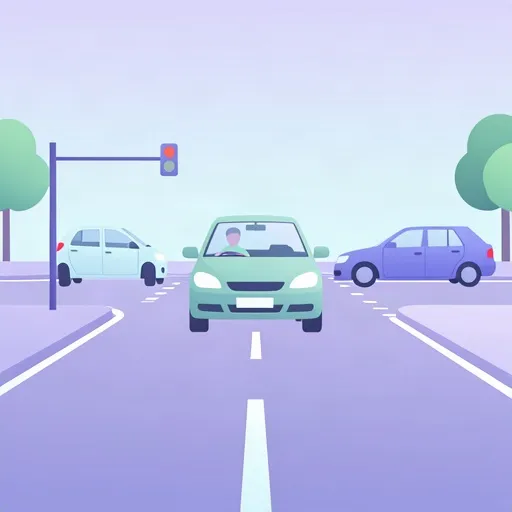
During your German driving theory test, you will encounter numerous visual scenarios depicting intersections. The examiners test your ability to correctly identify the priority status of each vehicle involved. You might see a situation where three or four cars arrive at an unmarked junction simultaneously. In such cases, the rule of "mutual agreement" comes into play: one driver may waive their right of way to allow the flow of traffic to continue, a courtesy that is legally recognized but should be performed with caution.
Article content overview
Explore related topics, search based questions, and concepts that learners often look up when studying Right Before Left Rule (Rechts vor Links). These themes reflect real search intent and help you understand how this topic connects to wider driving theory knowledge in Germany.
Find clear and practical answers to common questions learners often have about Right Before Left Rule (Rechts vor Links). This section helps explain difficult points, remove confusion, and reinforce the key driving theory concepts that matter for learners in Germany.
No, it is the default rule only when no other priority signage, road markings, or traffic lights are present.
The rule does not apply if you are entering from a path, such as a field or forest road, an lowered curb, or a traffic-calmed area (verkehrsberuhigter Bereich), as well as at intersections controlled by signs or lights.
No. In Germany, even if one road looks like a main road or is wider, the 'rechts vor links' rule still applies unless formal priority signs or road markings dictate otherwise.
If 'rechts vor links' creates a stalemate, drivers should use defensive driving, eye contact, and hand signals to coordinate who proceeds first through mutual agreement.
Didn't find what you were looking for? Continue your German driving theory preparation by exploring related articles, specific road sign categories, or in-depth guides on complex traffic situations. Deepen your understanding before the official test.