
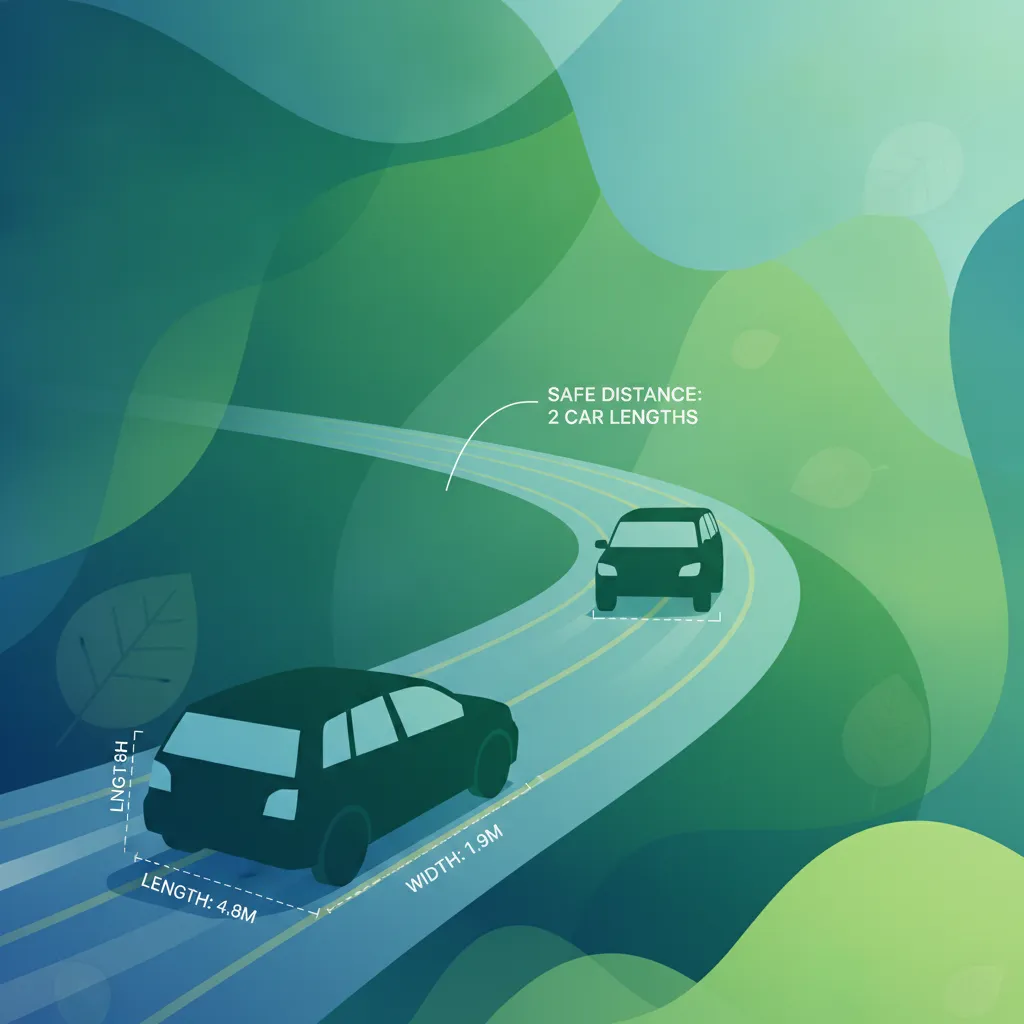
This unit focuses on the critical interplay between your passenger vehicle's physical characteristics and safe driving control. You'll learn how dimensions, weight, and load impact handling, and develop essential skills in smooth acceleration, progressive braking, speed adaptation, and maintaining safe following distances. Mastering these aspects is key to ensuring passenger comfort, preventing accidents, and passing your German professional driver theory exam.
Browse all lessons that make up Vehicle Dimensions, Smooth Control, Speed, Braking and Following Distance. Each lesson focuses on specific topics, learning objectives, and core concepts, helping you build essential knowledge and follow a clear, structured progression toward your study goals in Germany.
This lesson examines the direct impact of a passenger vehicle's dimensions on its operation. It explains key concepts such as turning radius, swept path, and rear overhang, which are crucial for safe maneuvering in confined areas. Learners will understand how to account for these characteristics when positioning the vehicle in a lane, making turns, and navigating challenging urban environments to avoid collisions.
This lesson focuses on the critical relationship between load distribution, the center of gravity, and vehicle stability. It explains how the placement of passengers and luggage can raise the center of gravity, increasing the risk of rollover during turns or sudden maneuvers. Learners will understand how to manage loading within legal weight limits to maintain optimal handling, braking performance, and overall safety.
This lesson teaches the driving techniques required for smooth operation, which is essential for passenger comfort and vehicle stability. It covers progressive application of the accelerator and brakes to avoid jolts and abrupt movements. The principles of anticipatory driving are also explored, showing how looking ahead and planning maneuvers contributes to a smoother ride, better fuel efficiency, and increased safety.
This lesson covers the crucial skills of managing speed and maintaining a safe buffer from other vehicles. It teaches methods for calculating an appropriate following distance, such as the time-gap method, which adapts to different speeds and conditions. Learners will understand how to adjust their speed based on traffic flow, road surface, and weather to ensure they always have enough time and space to stop safely.
Explore high-intent keywords and long-tail search topics learners use when researching Vehicle Dimensions, Smooth Control, Speed, Braking and Following Distance. These terms reflect how people search for reliable study materials, structured explanations, and unit-level theory preparation support in Germany.
Find clear answers to the most common questions learners ask about Vehicle Dimensions, Smooth Control, Speed, Braking and Following Distance. Understand how the unit is organized, what learning goals it supports, and how it contributes to your study progression with structured explanations and practical guidance tailored for learners in Germany.
In Germany, understanding your vehicle's length, width, and height is critical for navigating narrow streets, avoiding obstacles, and correctly positioning yourself at junctions and bus stops. For larger passenger vehicles covered in categories D1-DE, awareness of the turning radius is especially important to prevent collisions with curbs or other vehicles when turning.
Smooth control refers to gentle and progressive application of acceleration and braking. This ensures passenger comfort by minimizing jolts and sudden movements, which is a key aspect of the professional duty of care for passenger transport drivers in Germany. It also contributes to better vehicle stability and fuel efficiency.
Safe following distance is paramount in Germany, especially for passenger vehicles, to allow ample time to react to sudden stops by the vehicle ahead. Factors like increased braking distances for heavier vehicles and the need to protect passengers mean drivers must maintain a greater margin than for a standard car. It’s a frequent topic in theory exams.
Incorrect load distribution can shift a vehicle's center of gravity, making it less stable, particularly during cornering or emergency maneuvers. For professional drivers in Germany, ensuring passengers and luggage are loaded correctly according to regulations is vital for maintaining control and preventing accidents.
Drivers must always adapt speed to road conditions, visibility, traffic density, and the specific vehicle's capabilities. While general speed limits apply, professional drivers must also consider passenger comfort and safety, meaning lower speeds may be necessary even within legal limits, especially on rural routes or in adverse weather.
Yes, progressive and controlled braking is essential. Professional drivers must anticipate traffic flow and brake smoothly to avoid unsettling passengers. Theory exams often test the understanding of how a fully loaded vehicle requires more stopping distance and a gentler braking approach than an empty one.
All included lessons
Lessons in Vehicle Dimensions, Smooth Control, Speed, Braking and Following Distance
See who benefits most from studying Vehicle Dimensions, Smooth Control, Speed, Braking and Following Distance. This overview explains how the unit supports different learning needs, what level of knowledge is helpful before starting, and how it fits into the overall study path in Germany.
This unit is essential for aspiring professional drivers preparing for the German D1, D1E, D, or DE licence theory exams. It is particularly beneficial for those needing to understand how vehicle dynamics impact safe operation when carrying passengers and who want to build a solid foundation for safe driving practices.

Ready to prepare for your German driving licence theory exam? Dive into our carefully structured courses to build your knowledge effectively. Select a course that matches your licence category and begin your systematic study path today for confident exam success.
Browse Driving Theory CoursesExplore all units and lessons included in this driving theory course.
Ready to prepare for your German driving licence theory exam? Dive into our carefully structured courses to build your knowledge effectively. Select a course that matches your licence category and begin your systematic study path today for confident exam success.
Browse Driving Theory Courses