
This lesson focuses on the physical dimensions of D1, D1E, D, and DE vehicles and their critical role in safe operation. You will learn how to account for length, width, height, and turning radius to navigate urban environments, manage swept paths, and prevent collisions. Understanding these technical characteristics is essential for professional driving and success in your theory exam.
Lesson content overview
Professional passenger vehicle operators, holding licence categories D1, D1E, D, or DE, are entrusted with the safe transport of passengers. A fundamental aspect of this responsibility is a deep understanding of vehicle dimensions and their direct impact on operation and maneuverability. This lesson provides a comprehensive overview of how vehicle length, width, height, and crucial turning dynamics like turning radius, swept path, and rear overhang influence safe driving practices.
Mastering these concepts is not merely about adhering to regulations; it is about developing an intuitive sense of your vehicle's spatial footprint. This awareness prevents collisions, ensures efficient lane positioning, supports correct parking, and facilitates safe turning maneuvers, especially in demanding urban environments or confined spaces.
The physical attributes of a passenger vehicle dictate its spatial requirements and operational challenges. Understanding these core dimensions is the first step towards safe and proficient driving.
The overall length of a passenger vehicle, from its frontmost to its rearmost point, significantly affects how it interacts with the road environment. Longer vehicles, such as coaches or articulated buses, require substantially more planning for maneuvers.
When operating a long vehicle, drivers must constantly consider its extensive footprint. This impacts decisions like selecting appropriate lanes, judging safe overtaking distances, and navigating roundabouts or tight intersections. The longer a vehicle, the more space it needs to complete any change in direction without infringing on other lanes or obstructing traffic.
For professional drivers, maintaining precise lane positioning is critical. A long vehicle can easily drift or swing out if not carefully steered, potentially causing dangerous situations for adjacent traffic or vulnerable road users. During overtaking, the extended length means a longer period spent alongside the overtaken vehicle, necessitating a greater clear road ahead.
Vehicle width refers to the maximum horizontal distance of the vehicle, including mirrors. This dimension is crucial for determining lane occupancy, ensuring adequate clearance from obstacles, and safely passing other vehicles.
Passenger vehicles, especially buses and coaches, are significantly wider than standard cars. This means they often occupy most, if not all, of a standard lane. Drivers must be acutely aware of their vehicle's width to avoid encroaching on adjacent lanes, hitting parked vehicles, or brushing against curbs, street furniture, or roadside vegetation.
Maintaining sufficient lateral clearance is paramount. When passing cyclists, pedestrians, or stationary vehicles, the driver must judge the available space accurately. Mirrors extend the effective width of the vehicle and are often the first point of contact with an obstacle. Regular checks of side mirrors are essential to monitor the vehicle's position relative to its surroundings. Misjudging vehicle width, particularly in narrow city streets or construction zones, can lead to side-swipe collisions, which can be severe.
Vehicle height is the vertical distance from the ground to the highest point of the vehicle, including any roof-mounted equipment. This dimension is critical for safely passing under bridges, tunnels, overhead wires, and other infrastructure.
Professional passenger vehicles, particularly double-decker buses or coaches with air conditioning units or luggage racks on the roof, can have substantial heights. Drivers must always be aware of their vehicle's exact height and diligently observe all height clearance signs. Ignoring these warnings can lead to catastrophic accidents, causing severe damage to the vehicle, infrastructure, and potentially endangering passengers.
Route planning for tall vehicles requires careful attention to height restrictions. It is often necessary to select specific routes that accommodate the vehicle's height, especially when entering urban areas, parking garages, or industrial estates. A low bridge or tunnel can become an impassable barrier, or worse, a collision site, if not accounted for during route assessment.
Turning dynamics are perhaps the most complex aspect of maneuvering large passenger vehicles. They encompass not just the physical turn of the wheels but the entire spatial envelope the vehicle occupies.
The turning radius is a fundamental concept for any driver of a large vehicle.
There are generally two types of turning radius to consider. The minimum turning radius represents the absolute tightest turn a vehicle can achieve, often measured from the center of the vehicle. However, from a practical driving perspective, it's more useful to think about the practical turning radius, which considers the outermost point of the vehicle (usually the front or rear corner, or even a mirror) during a turn. This provides a realistic measure of the space needed.
For professional drivers, understanding the turning radius is crucial for planning turns, navigating roundabouts, and executing U-turns. A large passenger vehicle's turning radius can be significant, often requiring multiple lanes or a wide arc to complete a turn safely. Drivers must initiate turns at the correct position and speed, allowing ample space for the vehicle to complete its path without encroaching on curbs, medians, or other traffic. Misjudging the turning radius can lead to mounting curbs, striking obstacles, or causing congestion and delays.
While turning radius defines the path of the wheels, the swept path describes the entire area occupied by the vehicle during a turning maneuver.
The swept path is a three-dimensional concept that includes the vehicle's width, length, turning radius, and crucially, its front and rear overhangs. When a large vehicle turns, its front and rear corners, particularly those beyond the axles, do not follow the same path as the wheels. The front of the vehicle may swing out (front overhang), and the rear may swing in (rear overhang), especially in tighter turns.
Visualizing the swept path is essential for preventing side collisions. Drivers must anticipate how the entire body of the vehicle will move and ensure there is adequate clearance from parked cars, street furniture, traffic islands, and other vehicles. Failing to account for the swept path can lead to the rear of the vehicle clipping an object, even if the front cleared it successfully. This is especially true for long vehicles and those with significant rear overhangs.
The rear overhang is a particularly important dimension for professional passenger vehicles, especially when maneuvering in confined spaces.
The rear overhang has a direct and significant impact on the vehicle's turning behavior, particularly in reverse maneuvers and tight forward turns. When a vehicle with a substantial rear overhang turns, the rear-most section of the vehicle swings in towards the center of the turn. This phenomenon, often called "tail swing" or "cut-in," means that while the front of the vehicle may successfully clear an obstacle, the rear can collide with it.
Drivers must account for rear overhang when performing a variety of maneuvers:
Misunderstandings about rear overhang are a common cause of minor and sometimes significant damage. Many drivers fail to appreciate the extent to which the rear of a long vehicle can swing, leading to insufficient clearance and collisions.
While not a physical dimension itself, the distribution of weight within a passenger vehicle profoundly affects its effective dimensions and handling characteristics, especially during turns.
The center of gravity (CoG) is the point where the entire weight of the vehicle appears to act. When passengers board, luggage is stored, or fuel levels change, the CoG shifts. Improper load distribution can raise the CoG, making the vehicle less stable and more prone to rolling over, especially during cornering. It can also shift the CoG towards one end of the vehicle.
A vehicle's turning radius and stability are directly influenced by its load distribution. For instance, if a bus is heavily loaded at the rear, the weight distribution shifts, potentially increasing the effective rear overhang effect during turns. This can cause the rear to swing wider or cut in more sharply than expected.
Similarly, an unevenly distributed load can cause a vehicle to lean more heavily on one side during a turn, affecting tire grip and making the vehicle feel less predictable. Professional drivers must understand that the vehicle's dynamic behavior changes significantly between an empty and a fully loaded state. An empty school bus, for example, will handle very differently from one full of children and their school bags.
In Germany, as in other countries, strict regulations govern permissible axle loads and overall vehicle weight. Professional drivers are responsible for ensuring that their vehicle is loaded correctly, that weight is evenly distributed, and that no axle exceeds its maximum permissible load. Overloading, particularly on the rear axle, can compromise braking performance, increase tire wear, and critically, alter the vehicle's handling characteristics during turns, making it more challenging to control. Securely stowing luggage and ensuring passengers are seated appropriately also contribute to stable load distribution.
Operating professional passenger vehicles requires strict adherence to traffic laws and a proactive approach to safety, especially concerning vehicle dimensions.
German road traffic law (Straßenverkehrs-Ordnung – StVO) and other relevant regulations (e.g., Straßenverkehrs-Zulassungs-Ordnung – StVZO) outline specific requirements for vehicle dimensions, weights, and safe operation. While exact figures can vary by vehicle type and configuration, the underlying principles are consistent:
Misjudging vehicle dimensions is a common cause of incidents, ranging from minor scrapes to serious accidents:
Driving conditions significantly influence how vehicle dimensions should be managed:
Pedestrians, cyclists, and motorcyclists are particularly vulnerable around large passenger vehicles, especially during turns. The wide swept path and potential for significant rear overhang mean that these users can easily be caught in a vehicle's path if drivers are not exceptionally careful.
Always scan the area around your vehicle thoroughly before and during a turn. Pay extra attention to blind spots, where vulnerable road users might be obscured. Give ample space and consider their likely movements. A professional driver's duty of care extends to all road users, but especially those most at risk from the unique dimensions of passenger vehicles.
Operating a professional passenger vehicle demands a holistic understanding of its physical dimensions and dynamic behavior. This knowledge is not just theoretical; it translates directly into safer driving practices, smoother maneuvers, and enhanced passenger comfort and safety.
Always be aware of your vehicle's length, width, and height, especially when planning routes and assessing clearances. Visualize the swept path of your vehicle during every turn, consciously accounting for the crucial effects of rear overhang. Remember that load distribution changes your vehicle's handling, affecting its stability and turning dynamics. By consistently applying these principles, you will navigate complex traffic scenarios with confidence, efficiency, and above all, safety.
This lesson covers how the physical dimensions of professional passenger vehicles—length, width, and height—dictate their spatial requirements and handling characteristics. It explains critical turning dynamics including turning radius, swept path, and rear overhang, emphasizing that the entire vehicle body must be accounted for during maneuvers, not just the wheels. Load distribution affects the center of gravity and can significantly change a vehicle's behavior when turning, especially between empty and loaded states. Drivers must observe German traffic regulations under StVO and StVZO, respecting height clearances and ensuring adequate space for their vehicle's complete swept path. Understanding these principles prevents collisions, protects vulnerable road users, and ensures safe maneuvering in urban environments.
A short set of high-value points that capture the most important learning from this lesson.
Vehicle length, width, and height each impose distinct spatial constraints that must be assessed before every maneuver.
The swept path describes the entire area your vehicle occupies during a turn, not just the wheel track, and must be visualized to prevent side collisions.
Rear overhang causes the rear of a long vehicle to swing inward during turns, requiring extra clearance on the outside of turns.
Load distribution changes a vehicle's center of gravity and can alter turning behavior, making an empty bus handle differently from a fully loaded one.
Height clearance must be verified before every journey as bridge or tunnel strikes can cause catastrophic damage.
Explore all units and lessons included in this driving theory course.
Turning radius is the smallest circular path the vehicle can navigate; swept path includes the entire vehicle footprint including overhangs.
Rear overhang cuts inward during turns (tail swing), meaning the rear follows a tighter arc than the front wheels.
Lateral clearance must account for mirrors, which extend the effective width of the vehicle.
In Germany, StVO and StVZO govern vehicle dimension requirements and drivers must ensure maneuvers respect turning radius, swept path, and height clearances.
Weather conditions increase the space needed for turning as reduced grip affects braking and cornering control.
Assuming the rear will clear an obstacle simply because the front cleared it, ignoring rear overhang cut-in behavior.
Failing to check height clearance signs before entering tunnels, parking garages, or low bridges.
Initiating turns too sharply or from the wrong position, causing the rear overhang to mount curbs or strike street furniture.
Not adjusting driving technique when the vehicle is fully loaded versus empty, leading to unexpected handling differences.
Neglecting to monitor mirrors throughout a turn, losing awareness of the vehicle's full swept path and rear position.
Lesson content overview
A short set of high-value points that capture the most important learning from this lesson.
Vehicle length, width, and height each impose distinct spatial constraints that must be assessed before every maneuver.
The swept path describes the entire area your vehicle occupies during a turn, not just the wheel track, and must be visualized to prevent side collisions.
Rear overhang causes the rear of a long vehicle to swing inward during turns, requiring extra clearance on the outside of turns.
Load distribution changes a vehicle's center of gravity and can alter turning behavior, making an empty bus handle differently from a fully loaded one.
Height clearance must be verified before every journey as bridge or tunnel strikes can cause catastrophic damage.
Explore all units and lessons included in this driving theory course.
Turning radius is the smallest circular path the vehicle can navigate; swept path includes the entire vehicle footprint including overhangs.
Rear overhang cuts inward during turns (tail swing), meaning the rear follows a tighter arc than the front wheels.
Lateral clearance must account for mirrors, which extend the effective width of the vehicle.
In Germany, StVO and StVZO govern vehicle dimension requirements and drivers must ensure maneuvers respect turning radius, swept path, and height clearances.
Weather conditions increase the space needed for turning as reduced grip affects braking and cornering control.
Assuming the rear will clear an obstacle simply because the front cleared it, ignoring rear overhang cut-in behavior.
Failing to check height clearance signs before entering tunnels, parking garages, or low bridges.
Initiating turns too sharply or from the wrong position, causing the rear overhang to mount curbs or strike street furniture.
Not adjusting driving technique when the vehicle is fully loaded versus empty, leading to unexpected handling differences.
Neglecting to monitor mirrors throughout a turn, losing awareness of the vehicle's full swept path and rear position.
Explore search topics learners often look for when studying Vehicle Length, Width, Height, and Turning Radius. These topics reflect common questions about road rules, driving situations, safety guidance, and lesson level theory preparation for learners in Germany.
Browse additional driving theory lessons that cover connected traffic rules, road signs, and common driving situations related to this topic. Improve your understanding of how different rules interact across everyday traffic scenarios.
Explore how vehicle dimensions like length, width, and height, alongside turning radius and swept path, impact safe maneuvering for D category vehicles in Germany. Understand essential concepts for navigating tight spaces and complex urban environments according to German road rules.

This lesson teaches the fundamental techniques for safely turning a large passenger vehicle. It explains the concepts of turning radius, swept path, and off-tracking, where the rear wheels follow a tighter path than the front wheels. Learners will understand how to position the vehicle correctly before a turn and manage their speed to navigate corners without encroaching on other lanes or hitting curbs.

This lesson examines the concepts of turning radius and swept path, explaining how a heavy vehicle's size influences the space required for a turn. It highlights the importance of maintaining proper lane positioning to accommodate the vehicle's dimensions. The content provides guidance on planning maneuvers and accounting for off-tracking during cornering.

This lesson covers the dimensional limits for heavy vehicles, focusing on height, width, and length restrictions. It explains how to interpret clearance signage for bridges, tunnels, and overhead obstacles, and discusses the implications for route planning. The content also addresses the importance of understanding turning radii and swept paths to avoid collisions.

This lesson provides instruction on the rules and best practices for operating a large passenger vehicle on the Autobahn. It covers the principles of strict lane discipline, regulations for minimum speed, and correct procedures for overtaking and merging. The importance of maintaining significantly increased following distances at high speeds and planning for exits well in advance is a key focus.

This lesson covers the high-risk maneuver of reversing a large passenger vehicle. It details a systematic approach that includes using all available aids like mirrors, cameras, and audible alarms. The lesson stresses the need for slow, controlled movements, constant scanning of the surroundings, and conducting thorough clearance checks to prevent collisions with objects or people behind the vehicle, advocating for a spotter whenever possible.
This lesson covers the principles of effective route planning and the practical skills for navigating different types of junctions. It provides guidance on using navigation aids and understanding the specific challenges large vehicles face at roundabouts and complex intersections. Emphasis is placed on correct lane selection and positioning well in advance of a turn to execute the maneuver safely and without impeding other traffic.

This lesson addresses the challenges of maneuvering heavy vehicles in confined spaces such as loading bays and narrow streets. It provides strategies for planning the maneuver, accounting for vehicle dimensions, turning radius, and blind spots. The content emphasizes slow, controlled movements and the need for high situational awareness.

This lesson covers the crucial skills of managing speed and maintaining a safe buffer from other vehicles. It teaches methods for calculating an appropriate following distance, such as the time-gap method, which adapts to different speeds and conditions. Learners will understand how to adjust their speed based on traffic flow, road surface, and weather to ensure they always have enough time and space to stop safely.

This lesson focuses on the critical relationship between load distribution, the center of gravity, and vehicle stability. It explains how the placement of passengers and luggage can raise the center of gravity, increasing the risk of rollover during turns or sudden maneuvers. Learners will understand how to manage loading within legal weight limits to maintain optimal handling, braking performance, and overall safety.
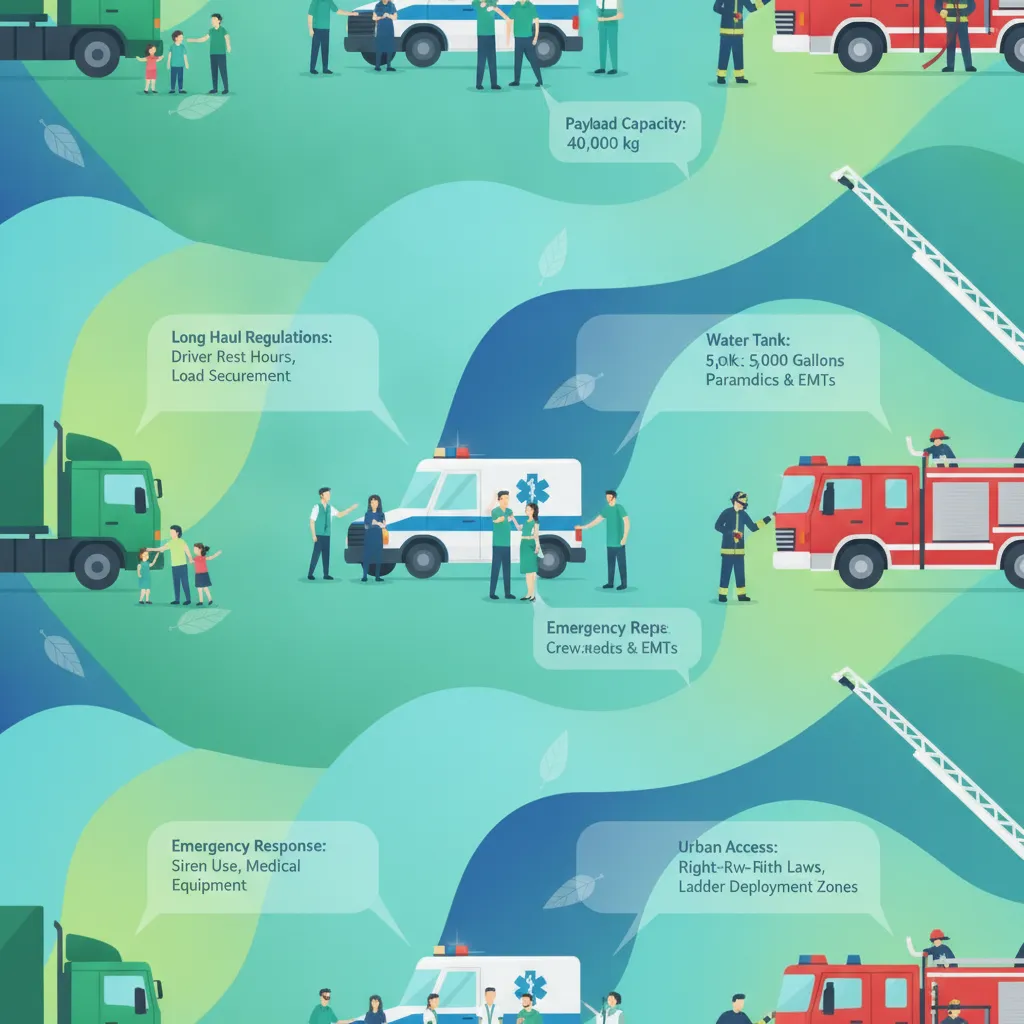
This lesson covers safe interaction with special vehicles. It details the challenges of driving near large trucks (LKW), including their extensive blind spots, longer stopping distances, and the effects of wind turbulence when overtaking them. A critical part of the lesson is explaining the correct procedure for reacting to emergency vehicles by creating an emergency corridor ('Rettungsgasse') on multi-lane roads.
Understand the critical importance of vehicle dimensions, including rear overhang and turning radius, for safely navigating narrow streets, junctions, and parking areas. This lesson focuses on the practical application of these concepts for professional drivers to prevent accidents and ensure smooth operation in challenging urban settings.

This lesson provides a comprehensive guide to identifying and managing the significant blind spots around a large passenger vehicle. It covers the correct adjustment and use of all mirrors, supplemented by camera systems, to gain maximum visibility. The importance of performing physical checks ('shoulder checks') before turning or changing lanes is emphasized to detect smaller road users like cyclists and pedestrians who may be hidden from view.

This lesson focuses on the high-risk maneuver of reversing, emphasizing the importance of all-around observation due to limited visibility. It teaches techniques for controlling the vehicle at very low speeds and using mirrors and direct observation to manage large blind spots behind the car. The priority is to ensure the path is clear of pedestrians and obstacles at all times.
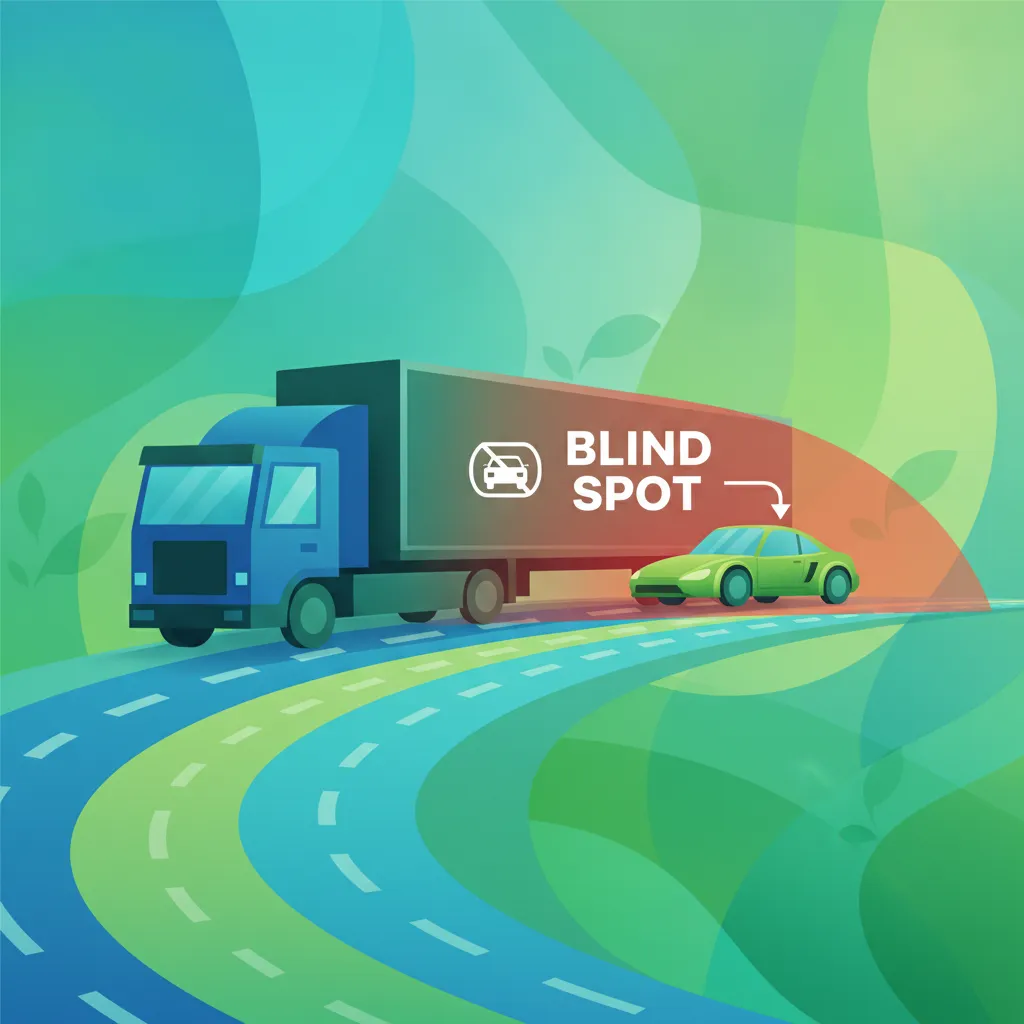
This lesson focuses on the blind spot zones specific to trucks and vehicle combinations, explaining where these zones are located. It covers the use of blind spot mirrors and other aids to enhance driver awareness during lane changes and turns. The content stresses the importance of maintaining safe distances from vulnerable road users.
This lesson covers the high-risk maneuver of reversing a large passenger vehicle. It details a systematic approach that includes using all available aids like mirrors, cameras, and audible alarms. The lesson stresses the need for slow, controlled movements, constant scanning of the surroundings, and conducting thorough clearance checks to prevent collisions with objects or people behind the vehicle, advocating for a spotter whenever possible.

This lesson teaches the proper adjustment of all required mirrors to maximize the field of vision and minimize blind spots. It discusses the limitations of indirect vision and the importance of aligning mirrors based on the driver's seating position. The content also outlines the typical blind zones for heavy vehicles and strategies to mitigate them.
This lesson addresses the challenges of maneuvering heavy vehicles in confined spaces such as loading bays and narrow streets. It provides strategies for planning the maneuver, accounting for vehicle dimensions, turning radius, and blind spots. The content emphasizes slow, controlled movements and the need for high situational awareness.

This lesson explores the critical role of visibility in safe driving, covering topics such as sight distance, managing blind spots, and the correct use of mirrors. It provides guidance on how to adjust your driving in conditions of reduced visibility, such as at night, in fog, or during heavy rain, including the proper use of headlights. The importance of the over-the-shoulder check ('Schulterblick') is also a key focus.
This lesson teaches riders how to develop strong visual perception skills for the road. It covers systematic scanning patterns, the correct use of mirrors, and the critical importance of performing a head check to cover blind spots. Understanding the larger blind spots of trucks and buses is also a key safety component.
This lesson focuses on the interaction between heavy vehicles and vulnerable road users at crossings, particularly when turning right. It covers the need for heightened vigilance, the importance of properly using mirrors, and correct signaling to alert others. The content highlights legal responsibilities and safe distance requirements to prevent accidents.

This lesson focuses on the critical moments of interaction with pedestrians and cyclists near bus stops, a common location for accidents. It reinforces the importance of reducing speed, yielding right-of-way, and constantly monitoring blind spots during the stopping process. Learners will practice techniques like making eye contact and using signals to communicate intentions, creating a safer environment for everyone around the vehicle.
Find clear answers to common questions learners have about Vehicle Length, Width, Height, and Turning Radius. Learn how the lesson is structured, which driving theory objectives it supports, and how it fits into the overall learning path of units and curriculum progression in Germany. These explanations help you understand key concepts, lesson flow, and exam focused study goals.
Larger vehicles have a longer wheelbase and a wider stance, creating a 'swept path' effect. This means the rear wheels follow a tighter arc than the front wheels, which requires you to position the vehicle further away from the inside of a turn to avoid hitting curbs or obstacles.
The rear overhang is the section of the vehicle extending behind the rear wheels. When you turn, this section swings out in the opposite direction of the turn, potentially striking pedestrians, street furniture, or other vehicles if not accounted for by the driver.
Drivers must be aware of height restrictions on signs, such as underpasses or low bridges. Always know your vehicle's exact height including equipment, and monitor clearance signs constantly to prevent hazardous collisions.
Yes, the theory exam often features images of intersection scenarios requiring you to identify the correct turning path or determine if a vehicle can safely clear a specific space based on its dimensions.
Begin your targeted revision now. Use our practice search to quickly find specific German driving theory questions. Filter by StVO rules, road signs, or hazard perception to create your focused study plan. Master challenging areas and prepare confidently for your theoretical driving test.