
This lesson explores the essential relationship between load distribution, the center of gravity, and the stability of passenger vehicles. You will learn how to properly manage passenger and luggage placement to maintain safety, handling, and braking performance while adhering to German legal requirements for categories D1, D1E, D, and DE.

Lesson content overview
For professional drivers operating passenger vehicles in categories D1, D1E, D, and DE, a profound understanding of the vehicle's center of gravity (CoG) and proper load distribution is not merely a technical detail; it is a fundamental aspect of passenger safety and operational integrity. This lesson delves into these critical concepts, explaining how they influence vehicle stability, handling, braking performance, and the crucial prevention of rollovers. Mastering these principles is essential for managing loading within legal weight limits and ensuring the optimal safety of all occupants.
The Center of Gravity (CoG) is defined as the theoretical point where the entire mass of an object, in this case, a passenger vehicle and its contents, is considered to be concentrated. Imagine balancing the vehicle on a single point; that point would be its CoG. This single point determines the vehicle's inherent stability and its tendency to tip over, especially during dynamic maneuvers.
Every object has a CoG. For a vehicle, this point is not fixed; it shifts dynamically based on its design, the presence of fuel, and most significantly, the placement and weight of passengers and luggage. Understanding its location is paramount because it dictates how a vehicle will react to forces acting upon it, such as acceleration, braking, and cornering.
The CoG can be described in three dimensions, each with distinct implications for vehicle dynamics:
The principle behind rollover risk is straightforward physics. When a vehicle turns, centrifugal force pushes its mass outwards. If the vertical CoG is high, this outward force creates a larger turning moment (torque) around the contact points of the outer wheels, making it easier for the vehicle to tip over. Conversely, a lower CoG means the vehicle's weight provides a greater restoring moment, resisting the outward force and keeping the wheels firmly on the ground. Professional passenger vehicles, by their nature of carrying many people, often have a higher CoG than a typical car, making this aspect exceptionally critical.
Load distribution refers to the way cargo, passengers, and equipment are arranged and allocated within a vehicle's compartments. It is not enough to simply ensure that the total weight of the vehicle is within legal limits; how that weight is distributed is equally, if not more, important for safe operation. Proper load distribution ensures that the vehicle's handling characteristics remain predictable, braking performance is optimal, and the structural integrity of the vehicle is maintained.
Balanced loading means distributing the total weight as evenly as possible across the vehicle's structure and axles. In the context of passenger transport, this involves strategic passenger seating and careful luggage stowage. An uneven distribution of weight can lead to a multitude of safety issues, ranging from compromised handling and increased stopping distances to severe mechanical stress and heightened rollover risk.
Understanding the different facets of load distribution is key to practical application:
Neglecting proper load distribution can lead to severe consequences, impacting safety, vehicle longevity, and operational costs:
Compliance with legal load limits is not merely a recommendation but a strict mandatory requirement under German road traffic law, primarily governed by the Straßenverkehrs-Zulassungs-Ordnung (StVZO). These regulations are designed to prevent overloading, protect road infrastructure, and ensure the safety of all road users. Professional drivers of passenger vehicles must be intimately familiar with these limits.
Every passenger vehicle has a specified Gross Vehicle Weight (GVW), which is the maximum permissible total weight of the vehicle including its own unladen weight, all passengers, their luggage, and fuel. Exceeding the GVW is a serious offense that compromises the vehicle's design limits and safety margins.
Equally important are the permissible axle loads, which specify the maximum weight that each individual axle can carry. Even if the total GVW is within limits, concentrating too much weight over a single axle (e.g., all luggage in the very rear compartment) can lead to an axle overload. This can cause structural damage, reduce braking efficiency for that axle, and significantly increase tyre failure risk.
Exceeding legal load limits can result in substantial fines, points on your driving license, and potential prohibitions from continuing your journey until the load is adjusted. In the event of an accident, severe liability issues may arise if overloading is a contributing factor.
Passenger vehicles are designed and certified for a specific maximum number of passengers. This number is determined by the vehicle's structural capacity, available seating, and the expected average weight of a passenger. While an average weight per passenger is used in calculations for certification, drivers must be mindful that groups of heavier individuals or excessive hand luggage can quickly approach or exceed limits, even with the "correct" number of passengers. Drivers must adhere strictly to the maximum passenger capacity indicated in the vehicle's registration documents.
Each tyre fitted to a professional passenger vehicle has a tyre load limit, indicated by a load index on its sidewall. This rating specifies the maximum weight that a single tyre can safely support when inflated to the correct pressure. Operating tyres beyond their specified load limit causes excessive flexion, heat build-up, premature wear, and a high risk of catastrophic failure (blowout).
Similarly, the suspension system (springs, shock absorbers, anti-roll bars) is designed to support the vehicle's weight and absorb road shocks within a specific range. Overloading the suspension leads to reduced effectiveness, impaired handling, a harsher ride, and accelerated wear of components, potentially compromising the vehicle's structural integrity. Regular checks of tyre pressure, especially when heavily loaded, are crucial for maintaining tyre integrity and performance.
The risk of a vehicle rolling over is a paramount concern, particularly for professional passenger vehicle drivers due to the vehicle types and the precious cargo they carry. A rollover occurs when the forces acting on a vehicle cause it to tip over onto its side or roof.
Rollover events are typically triggered by a combination of factors:
When the lateral force generated exceeds the vehicle's static stability threshold – essentially, the point at which the restoring moment from the vehicle's weight is overcome – a rollover occurs.
The danger of a high CoG cannot be overstated for passenger vehicles. Imagine a tall, narrow object compared to a short, wide one. The taller object is far easier to tip over. In a bus, especially a double-decker, a significant portion of the vehicle's mass (passengers) can be high off the ground.
Professional drivers have direct control over several critical aspects to mitigate rollover risk:
Effective management of center of gravity and load distribution requires a combination of disciplined loading practices and adaptive driving techniques. These are crucial skills for any professional driver of categories D1, D1E, D, and DE.
The primary load in a passenger vehicle is the passengers themselves. Their distribution significantly impacts the CoG:
Properly stowing luggage and other equipment is vital for maintaining vehicle stability:
The presence of passengers and luggage fundamentally changes a vehicle's dynamics, requiring a responsive adjustment in driving style:
The impact of center of gravity and load distribution is not static; it is heavily influenced by external factors such as weather conditions, road type, and whether the vehicle is operating with a trailer. Professional drivers must understand these conditional variations to make appropriate adjustments.
Reduced tyre grip on wet or icy surfaces significantly amplifies the risks associated with a high or poorly distributed CoG.
The topography of the road directly impacts how a vehicle's CoG behaves.
When a passenger vehicle (like a bus for categories D1E or DE) is coupled with a trailer, the complexity of CoG management increases significantly.
Understanding common mistakes related to center of gravity and load distribution is crucial for preventing dangerous situations. Professional drivers must recognize these scenarios and actively avoid them.
Always perform a mental or physical check of your load distribution before starting a journey, especially if you have many passengers or significant luggage. Think: "Is the weight low, central, and evenly spread?"
Understanding the precise terminology associated with vehicle stability and loading is vital for professional drivers.
The effective management of a vehicle's Center of Gravity (CoG) and load distribution is a cornerstone of safe and responsible professional passenger transport. As a driver operating vehicles in categories D1, D1E, D, and DE, your vigilance in these areas directly impacts the safety and comfort of your passengers.
Remember these key principles:
By consistently applying these principles, professional passenger vehicle drivers can ensure optimal vehicle handling, reliable braking performance, and, most importantly, the maximum possible safety for all occupants on every journey.
This lesson covers the critical relationship between Center of Gravity and vehicle stability for professional passenger drivers. The CoG shifts dynamically with passenger and luggage placement across three dimensions—vertical, longitudinal, and lateral—with vertical CoG being most critical for rollover risk. Proper load distribution requires balancing weight across axles while keeping the CoG low and central, with heavy items stowed as low as possible. Professional drivers must comply with German StVZO legal limits for GVW and axle loads, adapt driving style by reducing speed and increasing following distances when fully loaded, and apply smooth control inputs to minimize lateral forces that could destabilize the vehicle.
A short set of high-value points that capture the most important learning from this lesson.
The Center of Gravity is not fixed; it shifts dynamically with every passenger, piece of luggage, and change in fuel level
A higher vertical CoG critically increases rollover risk during turns and sudden maneuvers due to greater turning moment
Load distribution matters as much as total weight—how weight is spread across axles and sides determines stability
Gross Vehicle Weight and axle load limits are mandatory legal requirements under German StVZO that must never be exceeded
Heavy items and passengers should always be positioned as low and as centrally as possible within the vehicle
Explore all units and lessons included in this driving theory course.
CoG has three critical dimensions: vertical (most dangerous when high), longitudinal (affects steering/braking), and lateral (causes uneven tyre wear)
Lateral forces during cornering increase with the square of speed—small speed increases create disproportionately larger forces
Tyre load limits are marked on sidewalls and must never be exceeded; under-inflation causes overheating and blowout risk
On double-decker buses, passengers on the upper deck significantly raise the vertical CoG and rollover vulnerability
Smooth, anticipatory driving with gentle control inputs is essential for loaded vehicles to minimize weight transfer
Assuming total weight compliance means safe loading—uneven distribution can overload single axles even when GVW is within limits
Allowing passengers to congregate on one side or at one end of the bus, creating dangerous lateral or longitudinal CoG shifts
Placing heavy luggage on roof racks or upper storage compartments, dramatically raising the vertical CoG and rollover risk
Failing to adjust driving style for loaded conditions by maintaining empty-vehicle speeds in curves and following distances
Ignoring reduced traction conditions—wet or icy roads amplify CoG effects and require significant additional speed reduction
Lesson content overview
A short set of high-value points that capture the most important learning from this lesson.
The Center of Gravity is not fixed; it shifts dynamically with every passenger, piece of luggage, and change in fuel level
A higher vertical CoG critically increases rollover risk during turns and sudden maneuvers due to greater turning moment
Load distribution matters as much as total weight—how weight is spread across axles and sides determines stability
Gross Vehicle Weight and axle load limits are mandatory legal requirements under German StVZO that must never be exceeded
Heavy items and passengers should always be positioned as low and as centrally as possible within the vehicle
Explore all units and lessons included in this driving theory course.
CoG has three critical dimensions: vertical (most dangerous when high), longitudinal (affects steering/braking), and lateral (causes uneven tyre wear)
Lateral forces during cornering increase with the square of speed—small speed increases create disproportionately larger forces
Tyre load limits are marked on sidewalls and must never be exceeded; under-inflation causes overheating and blowout risk
On double-decker buses, passengers on the upper deck significantly raise the vertical CoG and rollover vulnerability
Smooth, anticipatory driving with gentle control inputs is essential for loaded vehicles to minimize weight transfer
Assuming total weight compliance means safe loading—uneven distribution can overload single axles even when GVW is within limits
Allowing passengers to congregate on one side or at one end of the bus, creating dangerous lateral or longitudinal CoG shifts
Placing heavy luggage on roof racks or upper storage compartments, dramatically raising the vertical CoG and rollover risk
Failing to adjust driving style for loaded conditions by maintaining empty-vehicle speeds in curves and following distances
Ignoring reduced traction conditions—wet or icy roads amplify CoG effects and require significant additional speed reduction
Explore search topics learners often look for when studying Center of Gravity and Load Distribution. These topics reflect common questions about road rules, driving situations, safety guidance, and lesson level theory preparation for learners in Germany.
Browse additional driving theory lessons that cover connected traffic rules, road signs, and common driving situations related to this topic. Improve your understanding of how different rules interact across everyday traffic scenarios.
Explore how vehicle dynamics, load distribution, and center of gravity impact stability and rollover risk for D category vehicles in Germany. Understand key safety principles for passenger transport.

This lesson focuses on vehicle stability and the risks of rollover, particularly for vehicles with a high centre of gravity. It discusses how load placement, speed, and cornering affect rollover risk. The content outlines countermeasures such as speed reduction, load lowering, and the use of anti-roll devices.
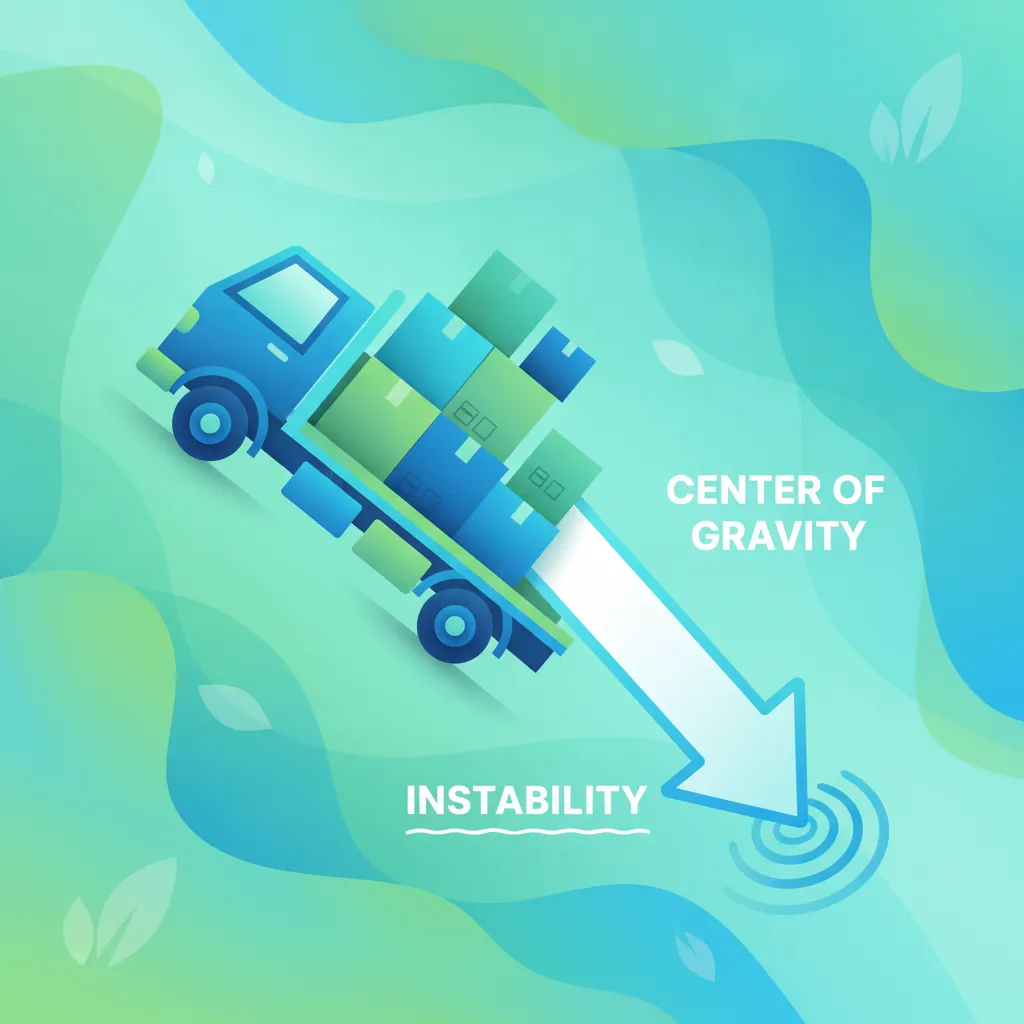
This lesson introduces the principles of load distribution and the impact of the centre of gravity on vehicle stability. It explains how cargo placement influences axle loads and the overall balance of the vehicle. The content emphasizes the importance of maintaining a low centre of gravity to reduce rollover risk.

This lesson examines the direct impact of a passenger vehicle's dimensions on its operation. It explains key concepts such as turning radius, swept path, and rear overhang, which are crucial for safe maneuvering in confined areas. Learners will understand how to account for these characteristics when positioning the vehicle in a lane, making turns, and navigating challenging urban environments to avoid collisions.

This lesson examines the risks associated with load shifting during braking and cornering maneuvers. It explains how inertia and weight transfer can cause cargo to move, potentially leading to instability or loss of control. The content emphasizes the importance of proper load securing to mitigate these risks and maintain vehicle stability.

This lesson focuses on the risks of jackknifing and trailer swing, particularly during braking and on downhill descents. It provides recommendations for safe speed management, proper braking techniques, and maintaining vehicle stability. The content also addresses safe reversing practices and the importance of monitoring blind spots during maneuvers.

This lesson teaches the fundamental techniques for safely turning a large passenger vehicle. It explains the concepts of turning radius, swept path, and off-tracking, where the rear wheels follow a tighter path than the front wheels. Learners will understand how to position the vehicle correctly before a turn and manage their speed to navigate corners without encroaching on other lanes or hitting curbs.

This lesson teaches the driving techniques required for smooth operation, which is essential for passenger comfort and vehicle stability. It covers progressive application of the accelerator and brakes to avoid jolts and abrupt movements. The principles of anticipatory driving are also explored, showing how looking ahead and planning maneuvers contributes to a smoother ride, better fuel efficiency, and increased safety.

This lesson offers a foundational overview of passenger vehicle construction, focusing on the chassis, engine, and transmission systems. It explains the function of essential components like brakes and steering, which are critical for safe operation. Learners will also understand how vehicle dimensions, weight distribution, and passenger capacity fundamentally influence handling, stability, and overall performance on the road.

This lesson introduces the concept of defensive driving ('vorausschauendes Fahren'), a proactive approach focused on anticipating and mitigating potential risks. It teaches techniques for scanning the road ahead, identifying potential hazards early, and managing the space around your vehicle to create a safety buffer. The goal is to develop a mindset that prioritizes safety and collision avoidance above all else.

This lesson details the driver's legal responsibility for the safety of all passengers. It reinforces the mandatory use of seat belts for everyone in the vehicle. A significant focus is placed on the strict regulations for child safety, explaining the types of child restraint systems required based on a child's age, height, and weight, and how to install them correctly.
Learn the essential rules for load distribution and its effect on vehicle handling and braking. This lesson covers maintaining stability and safety within legal weight limits for passenger vehicles.

This lesson focuses on the distribution of loads across axle groups and the legal limits for axle loads. It explains the importance of correct weight distribution to avoid axle overloading, which can lead to road damage and safety hazards. The content also covers methods for measuring axle loads and the legal requirements for maintaining proper axle load limits.

This lesson explains the legal and safety requirements for transporting goods and cargo. It covers the importance of proper load distribution to maintain vehicle stability and the methods for securely fastening items to prevent them from shifting or falling. The regulations concerning maximum vehicle weight, roof loads, and the correct marking of loads that overhang the vehicle are also detailed.
This lesson details the driver's legal responsibility for the safety of all passengers. It reinforces the mandatory use of seat belts for everyone in the vehicle. A significant focus is placed on the strict regulations for child safety, explaining the types of child restraint systems required based on a child's age, height, and weight, and how to install them correctly.

This lesson covers the critical considerations for safely carrying a passenger. It explains how the additional weight affects the motorcycle's handling, braking, and acceleration characteristics by altering the center of gravity. The content emphasizes the importance of briefing the passenger on how to behave on the motorcycle and adjusting tyre pressures and suspension settings accordingly.

This lesson covers the proper management of items brought on board by passengers, including luggage, prams, and mobility aids. It teaches how to use designated storage areas and racks correctly to prevent items from becoming hazards. The procedures for securing wheelchairs and other mobility devices are detailed to ensure they are stable and do not move during transit, complying with safety and accessibility standards.

This lesson details the specific legal obligations and safety protocols required for transporting schoolchildren. It covers the correct procedures for pick-up and drop-off, the use of warning lights, and the importance of supervised boarding and alighting. The lesson also explains how to interact with school crossing guards and navigate school zones safely to ensure the highest level of protection for children.

This lesson focuses on the particular care required when driving near pedestrians, with a special emphasis on children and the elderly, whose behavior can be unpredictable. It covers the rules for yielding at zebra crossings and the importance of reducing speed near schools, playgrounds, and residential areas. The goal is to instill a habit of constant vigilance and readiness to stop.

This lesson explores the principles of carrying luggage safely without compromising the motorcycle's handling. It emphasizes the importance of securing the load properly and distributing the weight evenly and low to maintain a stable center of gravity. The content explains how improperly loaded luggage can negatively impact steering, braking, and overall stability, particularly at speed.

This lesson outlines the legal requirements for load securing according to German traffic law (StVO) and other relevant regulations. It details the obligations for cargo safety, inspection, and documentation. The content also explains the penalties for non-compliance, emphasizing adherence to legal standards to ensure safety.
This lesson introduces the principles of load distribution and the impact of the centre of gravity on vehicle stability. It explains how cargo placement influences axle loads and the overall balance of the vehicle. The content emphasizes the importance of maintaining a low centre of gravity to reduce rollover risk.
Find clear answers to common questions learners have about Center of Gravity and Load Distribution. Learn how the lesson is structured, which driving theory objectives it supports, and how it fits into the overall learning path of units and curriculum progression in Germany. These explanations help you understand key concepts, lesson flow, and exam focused study goals.
Large passenger vehicles have a higher construction and larger side surface area. As the center of gravity rises due to passengers or overhead luggage, the vehicle becomes significantly more prone to tipping or rolling over during sharp turns or sudden evasive maneuvers.
Improper weight distribution can lead to an uneven load on the braking system, potentially causing reduced braking efficiency or loss of steering control. It is vital to distribute weight evenly according to manufacturer specifications to ensure the vehicle remains stable during heavy braking.
Yes, standing passengers contribute to a higher center of gravity compared to seated ones, especially if they are clustered in one area. Professional drivers must manage passenger flow to ensure the vehicle remains balanced, particularly in urban environments with frequent stops.
Always look for answers that prioritize keeping the center of gravity as low as possible. If a question suggests storing luggage on the roof versus in the hold, the hold is almost always the correct answer for maintaining vehicle stability.
Begin your targeted revision now. Use our practice search to quickly find specific German driving theory questions. Filter by StVO rules, road signs, or hazard perception to create your focused study plan. Master challenging areas and prepare confidently for your theoretical driving test.