
Understanding the complex landscape of winter road ordinances in Italy is critical for both the theory exam and real-world safety. This guide explains the legal necessity of carrying snow chains or fitting winter tyres when travelling through alpine regions, and provides practical advice on safe handling during icy conditions. Learners will gain insight into official vehicle equipment standards and the importance of complying with local ordinances to ensure a safe journey on Italian roads.
Article content overview
Navigating Italy during the winter months requires a solid understanding of both national road regulations and local ordinances. While there is no single, unified national law that mandates winter tyres for the entire country, thousands of municipalities and road management authorities issue specific decrees that make winter equipment mandatory on a large portion of the road network. Failing to comply with these rules can result in significant fines and, more importantly, poses a serious risk to your safety and that of other road users.
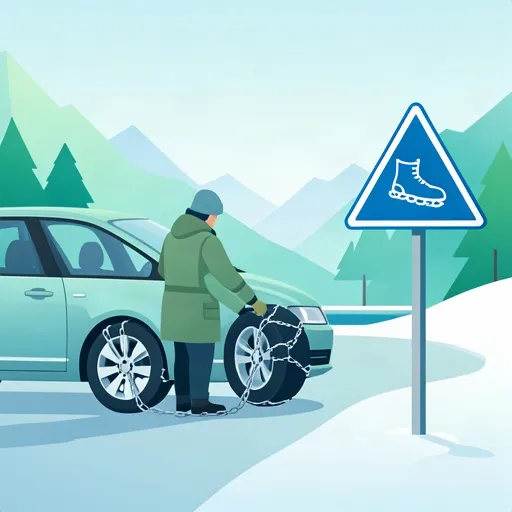
In Italy, the obligation to carry winter equipment generally runs from 15 November to 15 April. During this window, you must either have your vehicle equipped with winter tyres or carry suitable anti-skid devices, such as snow chains, on board. It is crucial to remember that these obligations are dictated by local road authorities (such as the ANAS or regional administrations) and are communicated through specific road signs. Once you encounter a sign indicating the obligation, you are legally required to comply immediately.
The presence of these signs means that if you are stopped by law enforcement within the marked zone and lack the appropriate equipment, you face administrative fines. Furthermore, during snowfall, traffic police may prohibit vehicles not equipped with winter tyres or chains from proceeding, forcing you to turn back or wait for conditions to improve.
When preparing for winter driving, it is vital to distinguish between the different types of tyres available. Many drivers rely on "M+S" (Mud and Snow) marked tyres, which satisfy the minimum legal requirement for many local ordinances. However, for those frequently driving in the Alps or the Apennines, these do not offer the same level of safety as tyres marked with the 3PMSF (Three Peak Mountain Snowflake) symbol.
While an M+S tyre meets the letter of the law in most jurisdictions, the 3PMSF-certified winter tyre is the gold standard for mountain driving. These tyres are specifically designed to remain flexible and provide grip at temperatures below 7°C, significantly reducing braking distances on icy surfaces.
If you choose not to fit winter tyres, you must carry snow chains in your vehicle at all times during the winter period on roads where the obligation is in force. You should never wait until you are stuck in deep snow to learn how to fit them. Practice installing your chains in a dry, safe location before your journey begins.
Driving on snow-covered roads in Italy, especially on steep mountain passes, requires a shift in your driving style. The Italian theory exam emphasizes the importance of avoiding sudden inputs, which can cause the vehicle to lose traction instantly. You should aim for smooth, gentle steering, braking, and acceleration to keep the vehicle stable.
Increase your safety distance significantly, as braking distances on snow can be several times longer than on dry asphalt. Avoid the common mistake of braking hard in a turn; instead, reduce your speed well before entering a curve. If your vehicle begins to slide, avoid panic braking; keep your steering input steady and focus on the direction you wish to travel.
Winter driving in Italy operates under a regional ordinance system where local authorities mandate snow chains or winter tyres on specific road sections between 15 November and 15 April. The key distinction learners must grasp is between M+S tyres, which satisfy minimum legal requirements, and 3PMSF-certified tyres, which provide superior performance in severe alpine conditions. Safe winter driving requires fitting chains to the driven axle in a safe location and practicing the procedure beforehand, while on the road drivers must use smooth inputs and significantly increased following distances to avoid losing traction on snow and ice.
A short set of high-value points that capture the most important ideas from this article.
Winter equipment obligations in Italy are imposed by local road authorities through specific ordinances, not a single national law
During the 15 November to 15 April period, you must either carry snow chains or have winter tyres fitted on roads marked with the obligation sign
M+S (Mud and Snow) tyres meet minimum legal requirements, but 3PMSF-certified tyres offer superior grip and are the gold standard for alpine driving
Snow chains must be fitted to the driven axle only, and you should practice installation before your journey
On snow and ice, avoid sudden inputs—use smooth steering, braking, and acceleration to maintain vehicle stability
The mandatory winter equipment period runs from 15 November to 15 April, but obligations only apply when signed road sections are entered
Road sign II.87 indicates mandatory snow chains or winter tyres for vehicles within that marked zone
3PMSF (Three Peak Mountain Snow Flake) tyres are specifically designed to remain flexible and grip at temperatures below 7°C
Chains must be mounted on the driven wheels (front for FWD, rear for RWD) and re-tightened after driving a few hundred metres
Italian terms: Catene da neve (snow chains), Pneumatici invernali (winter tyres), Ordinanza (local decree), Mezzi antisdrucciolevoli (anti-skid devices)
Assuming M+S tyres are equivalent to proper winter tyres; 3PMSF certification provides significantly better snow performance
Attempting to install chains in live traffic or on dangerous inclines instead of finding a safe, flat area first
Fitting chains to the wrong axle—chains must go on the driven wheels, not just any wheel
Braking hard when entering a curve on snow, which causes immediate loss of traction
Not re-tightening chains after the initial fitting, leading to loose chains that can damage the vehicle
Article content overview
A short set of high-value points that capture the most important ideas from this article.
Winter equipment obligations in Italy are imposed by local road authorities through specific ordinances, not a single national law
During the 15 November to 15 April period, you must either carry snow chains or have winter tyres fitted on roads marked with the obligation sign
M+S (Mud and Snow) tyres meet minimum legal requirements, but 3PMSF-certified tyres offer superior grip and are the gold standard for alpine driving
Snow chains must be fitted to the driven axle only, and you should practice installation before your journey
On snow and ice, avoid sudden inputs—use smooth steering, braking, and acceleration to maintain vehicle stability
The mandatory winter equipment period runs from 15 November to 15 April, but obligations only apply when signed road sections are entered
Road sign II.87 indicates mandatory snow chains or winter tyres for vehicles within that marked zone
3PMSF (Three Peak Mountain Snow Flake) tyres are specifically designed to remain flexible and grip at temperatures below 7°C
Chains must be mounted on the driven wheels (front for FWD, rear for RWD) and re-tightened after driving a few hundred metres
Italian terms: Catene da neve (snow chains), Pneumatici invernali (winter tyres), Ordinanza (local decree), Mezzi antisdrucciolevoli (anti-skid devices)
Assuming M+S tyres are equivalent to proper winter tyres; 3PMSF certification provides significantly better snow performance
Attempting to install chains in live traffic or on dangerous inclines instead of finding a safe, flat area first
Fitting chains to the wrong axle—chains must go on the driven wheels, not just any wheel
Braking hard when entering a curve on snow, which causes immediate loss of traction
Not re-tightening chains after the initial fitting, leading to loose chains that can damage the vehicle
Explore related topics, search based questions, and concepts that learners often look up when studying Italy Winter Driving Rules. These themes reflect real search intent and help you understand how this topic connects to wider driving theory knowledge in Italy.
Find clear and practical answers to common questions learners often have about Italy Winter Driving Rules. This section helps explain difficult points, remove confusion, and reinforce the key driving theory concepts that matter for learners in Italy.
Most regional ordinances require vehicles to be equipped with snow chains or winter tyres between 15 November and 15 April, though local signs can impose these rules at any time during snowy or icy conditions.
M+S (Mud and Snow) marked tyres meet the basic legal requirement in Italy, whereas the 3PMSF (Three Peak Mountain Snowflake) symbol denotes a tyre specifically tested for high performance in severe snowy conditions, offering superior safety.
Chains must be fitted on the driving wheels of the vehicle. For front-wheel drive cars, they go on the front; for rear-wheel drive, on the rear; and for 4WD vehicles, typically on the front, though you should follow your specific manufacturer's instructions.
Failing to carry or use required snow chains or winter tyres in zones marked by specific road signs can result in administrative fines and may lead to being prohibited from continuing your journey until the equipment is provided.
Refine your search or explore related Italian driving theory articles to build a stronger foundation for your exam. Dive deeper into specific traffic regulations, road signs, and practical driving scenarios that are essential for passing your official licence test.