This lesson provides an essential deep-dive into the priority rules governing French roads as part of your motorcycle theory training. You will learn to navigate complex intersections by correctly identifying and responding to the priority à droite rule and various yield indicators, building the situational awareness needed for your A, A1, or A2 licence.
Lesson content overview
Navigating the road network in France requires an absolute and instinctive understanding of right-of-way rules. Governed strictly by the French Code de la route, priority rules establish clear protocols for who may proceed and who must yield at intersections.
For motorcyclists, mastering these rules is not merely a requirement for passing the theoretical examination (Categories A, A1, and A2); it is a critical survival skill. Because of a motorcycle's smaller profile, other road users may fail to spot you. Misinterpreting a priority sign or failing to anticipate another driver's mistake can have severe consequences.
This guide details the core principles of French priority law, from the default rule of priorité à droite to the specific demands of stop signs, yield signs, and defensive motorcycle riding strategies.
In France, priority at intersections is hierarchical. It is determined by traffic lights, explicit road signs, road markings, and, in their absence, default statutory rules. The foundational purpose of these regulations is to maintain a predictable flow of traffic, eliminate hesitation, and minimize conflict points where collisions are most likely to occur.
Understanding the hierarchy of control is essential. At any given intersection, priority is determined in the following descending order of authority:
The most famous—and frequently misunderstood—aspect of French traffic law is the default rule of priorité à droite (priority to the right). Under Article R415-10 of the Code de la route, when two vehicles approach an intersection from different roads and there are no signs, signals, or markings to regulate the right-of-way, the driver coming from the left must yield to the driver approaching from the right.
The default statutory rule in France stating that at any uncontrolled intersection, drivers must yield the right-of-way to any vehicle approaching from their right-hand side.
Many foreign drivers and new riders assume that major, wide, or faster roads automatically have priority over smaller side streets. This is a highly dangerous misconception. In France, priorité à droite applies in the following scenarios unless explicit signage says otherwise:
To warn drivers of an upcoming intersection where they must yield to the right, French authorities place a specific warning sign.
While the rule is the default, there are critical exceptions where vehicles coming from the right do not have priority:
For motorcyclists, priorité à droite represents a high-risk scenario. Drivers emerging from the right may pull out blindly, assuming you have seen them or that your motorcycle is traveling slower than it actually is. Conversely, drivers behind you may not expect you to slow down for an unmarked side street on your right.
Rider Safety Tip: When riding through urban areas with frequent side streets, look for clues of a priorité à droite intersection. Watch for breaks in the curb line, gaps in parallel-parked cars, and look for the rear of stop or yield signs facing the intersecting street. If there are no signs facing them, they have the right-of-way, and you must be prepared to stop.
To safely manage these intersections, follow this scan-and-prepare sequence:
Scan early: Look ahead for signs (like the AB1 warning sign) or road markings that indicate an upcoming intersection.
Position defensively: Move toward the center of your lane to increase your visibility to drivers waiting in side streets on the right, and to create a buffer space.
Cover your brakes: Lightly place two fingers over the front brake lever and rest your foot on the rear brake pedal. This eliminates your physical reaction time if a vehicle pulls out.
Check your mirrors: Assess the traffic behind you. If you need to slow down to yield to a vehicle on your right, make sure the driver behind you is aware of your speed reduction.
Yield or proceed with caution: If a vehicle is approaching from the right, bring your motorcycle to a smooth stop. If the way is clear, proceed while continuing to scan.
To prevent major transit routes from being constantly interrupted by vehicles pulling out from the right, the Code de la route utilizes priority roads (routes à priorité). These roads are designated by specific signage, indicating that vehicles traveling on them have priority over all intersecting side roads under Article R410-5.
When you pass the yellow diamond sign (AB3), you are entering a continuous priority road. Traffic merging or crossing from side roads will face either a stop sign or a yield sign. This priority remains in effect through subsequent intersections until it is explicitly revoked.
In some urban areas, you may also see supplementary indicators or blue square signs with white borders (carré bleu à bordure blanche) indicating specific traffic configurations, such as designated one-way streets with priority layouts. However, the yellow diamond (AB3) remains the primary nationwide indicator for continuous priority.
Often, you do not need continuous priority along an entire route, but rather a guarantee of right-of-way at a single, highly active upcoming intersection. For this, French authorities use the sectional priority sign (AB4).
This sign is extremely common on secondary rural roads. It warns you of an upcoming junction while reassuring you that crossing traffic has a mandatory requirement to yield to you.
At complex intersections where the main priority road bends rather than continuing straight, a supplementary square sign containing a schematic diagram is mounted beneath the priority sign.
On these schematic diagrams:
If you are traveling along the path represented by the thick line, you retain your right-of-way, even if you are technically turning. If you are entering from one of the thin lines, you must yield to any vehicle traveling on the thick line path.
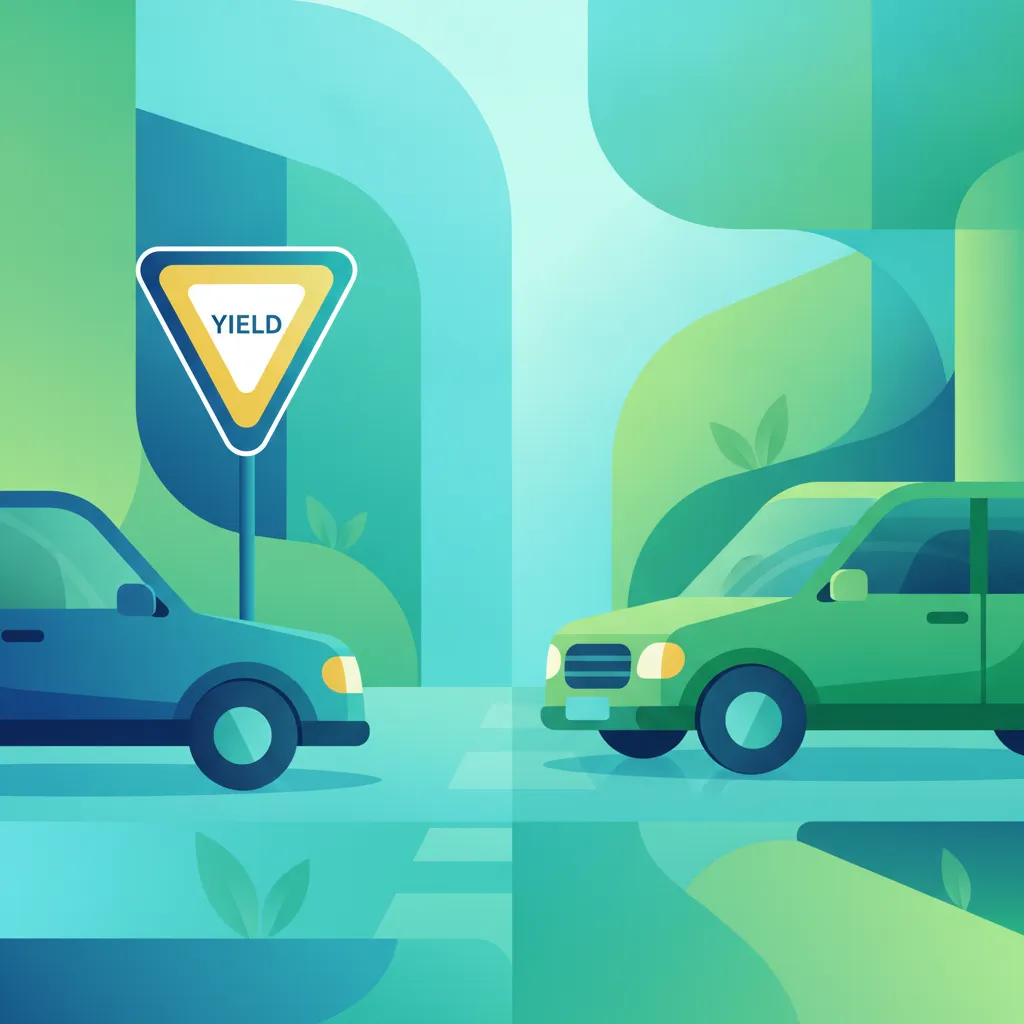
A yield sign (cédez le passage) indicates that you must give way to all traffic on the intersecting road under Article R415-8 of the Code de la route. Unlike a stop sign, a yield sign does not require you to make a mandatory, complete stop if the intersecting road is completely clear.
To reinforce the vertical sign, a distinct road marking is painted across the entrance of the intersection. This is a thick, dashed white line spanning the width of the yielding lane.
When approaching a yield sign on a motorcycle:
Under Article R415-6 of the Code de la route, a stop sign represents an absolute, non-negotiable legal obligation to bring your vehicle to a complete halt before entering the intersection.
To satisfy the legal definition of a stop in France, your motorcycle's wheels must completely cease all forward motion. The stop must be performed at the solid white stop line painted on the road surface.
If your view of the intersecting traffic is blocked by parked cars, buildings, or vegetation, you must follow a two-stage procedure:
First Stop: Bring your motorcycle to a complete stop behind the solid white stop line. Put at least one foot down on the pavement to demonstrate a clear halt.
Inching Forward: Slowly creep forward (using "clutch zone" control on your motorcycle) until you can see clearly down the intersecting road.
Second Stop: If traffic is approaching, stop a second time to yield. If the road is clear, accelerate smoothly into the intersection.
A very common traffic violation in France is the rolling stop (stop glissé), where a rider merely slows down to a walking pace without bringing the motorcycle to a full, balanced halt.
This is highly illegal. French law enforcement heavily penalizes rolling stops.
Legal Penalties for a Rolling Stop:
Traffic flow in France is heavily integrated with vulnerable road users and unique geometric layouts, both of which alter how priority rules are applied.
In France, there is a technical distinction between two types of circular intersections, though almost all modern ones follow the same rule:
Under Article R415-11 of the Code de la route, pedestrians have absolute, overriding priority at all marked crosswalks.
This rule applies irrespective of your priority status. Even if you are riding on a designated priority road with a yellow diamond sign (AB3), if a pedestrian is crossing or clearly indicating their intention to cross at a zebra crossing, you must slow down and stop to let them pass.
Failing to yield to a pedestrian carries a severe penalty of 6 points off your license and a heavy fine.
You must always yield to priority emergency vehicles (police, fire, ambulance) when their sirens and blue beacon lights are active. When approaching an intersection, even if you have a green light or are on a priority road, you must safely stop or pull over to allow them to clear the junction.
Furthermore, pay close attention to cyclists. Many urban areas in France feature two-way cycle lanes on otherwise one-way streets (double-sens cyclable). When approaching an intersection or turning, always check both directions for oncoming bicycles, even if the vehicular traffic is only one-way.
Having the legal right-of-way does not create a protective physical shield around your motorcycle. In a collision between a car and a motorcycle, the rider always suffers the worst consequences. Therefore, you must practice defensive priority management.
Never assume a driver at a stop or yield sign has seen you simply because you have the right-of-way. Always look for visual confirmation:
As you approach an intersection where a car is waiting to pull out from a side road, perform a subtle, controlled lane adjustment (lateral shift) within your lane. This lateral movement makes you much more visible against the background environment, breaking the "motion camouflage" that often causes drivers to overlook oncoming motorcycles.
Failing to respect priority rules is one of the leading causes of fatal motorcycle accidents in France. Consequently, the legal penalties are designed to be highly deterrent.
| Violation | Legal Consequence (Standard) | Operational/Safety Risk |
|---|---|---|
| Failing to yield to the right (Priorité à Droite) | €135 fine, 4 points deducted, potential license suspension. | High risk of side-impact (T-bone) collisions. |
| Rolling stop (Stop Glissé) | €135 fine, 4 points deducted, potential license suspension. | Insufficient time to detect pedestrians or fast-moving cyclists. |
| Failing to yield at a Cédez le Passage | €135 fine, 4 points deducted. | Pulling out in front of faster vehicles, causing rear-end crashes. |
| Failing to yield to a pedestrian | €135 fine, 6 points deducted, potential license suspension. | High risk of severe injury or fatality to vulnerable road users. |
| Failing to yield to emergency vehicles | €135 fine, 4 points deducted. | Blocking critical emergency services and risking multi-vehicle pileups. |
To consolidate your understanding, let's analyze five common real-world scenarios you will encounter on French roads.
To build a complete mental model of safe road operation, this lesson should be integrated with your broader driving theory studies.
Explore all units and lessons included in this driving theory course.
Lesson content overview
Explore all units and lessons included in this driving theory course.
Explore search topics learners often look for when studying Priority Rules: Right-of-Way, Priorité à Droite, and Yield Signs. These topics reflect common questions about road rules, driving situations, safety guidance, and lesson level theory preparation for learners in France.
Browse additional driving theory lessons that cover connected traffic rules, road signs, and common driving situations related to this topic. Improve your understanding of how different rules interact across everyday traffic scenarios.
Understand the specific priority protocols for modern roundabouts and complex multi-lane junctions in French driving theory. This guide explains how to manage right-of-way when navigating circular intersections and clarifies the distinction between different roundabout configurations to ensure safe and compliant maneuvers on the road.

France features a vast network of roundabouts (carrefours a sens giratoire) governed by specific entry and lane-use regulations. This lesson explains that vehicles entering a roundabout must yield to traffic already circulating inside. You will learn how to select the correct lane depending on your exit, use direction indicators properly, and yield to pedestrians and cyclists near roundabout exits.

Some crossroads feature complex layouts or specific signs that modify standard priority rules, such as schematic diagrams (panonceaux schematiques). This lesson teaches you how to read these auxiliary signs, which depict the thick line of the priority road and thin lines of secondary roads. You will learn how to maintain priority when the main road curves and how to navigate non-standard intersection layouts.
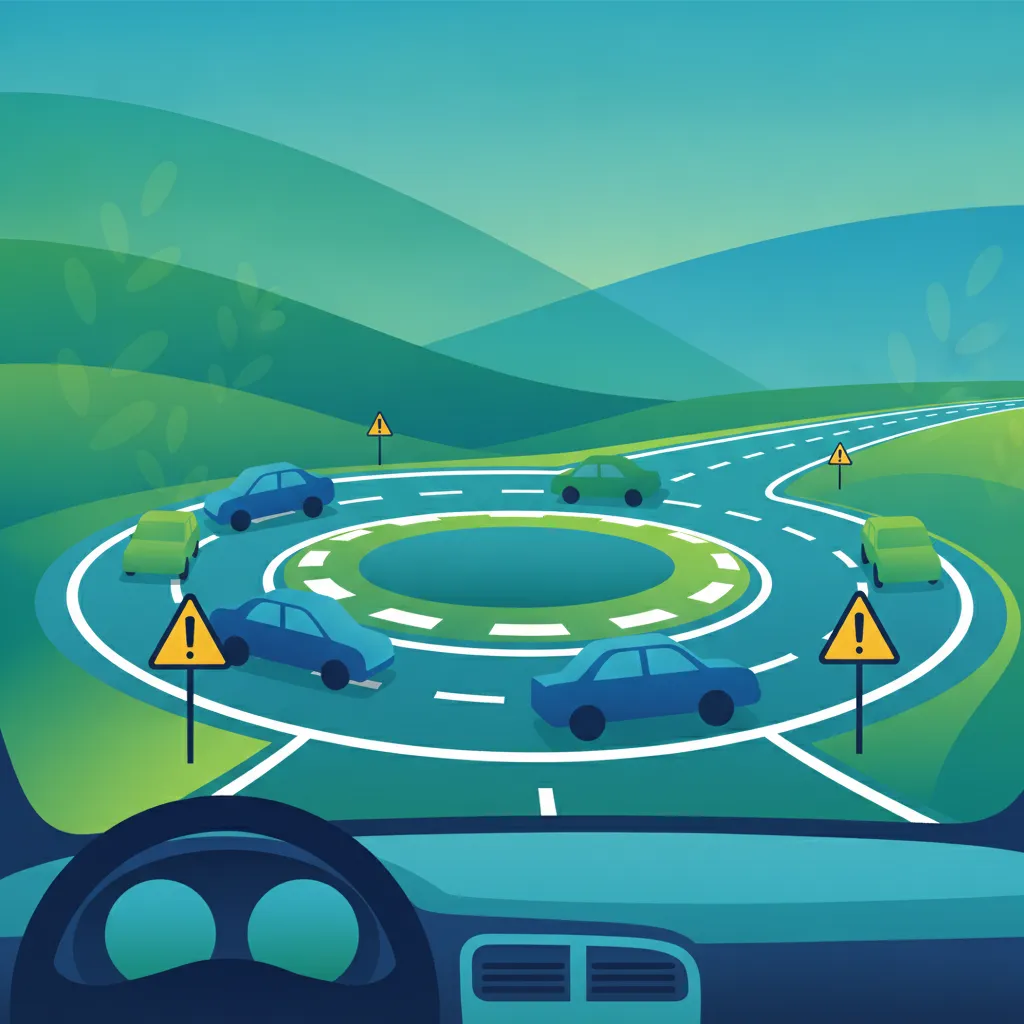
This lesson focuses on the skills required to safely enter, navigate, and exit roundabouts, a common feature in French urban environments. Learners will understand the need to yield to circulating traffic, select the appropriate lane upon entry, and signal intentions when exiting. By mastering these techniques, AM riders can safely integrate into roundabout traffic flow and reduce conflicts with other road users.

This lesson explains the correct procedures for entering, circulating, and exiting roundabouts, which are highly prevalent throughout France. You will learn the exact lane choice strategies based on your intended exit, and how to use your turn indicators at each stage of the maneuver. The content also addresses the critical task of performing over-the-shoulder blind spot checks to avoid conflicts with overtaking vehicles when exiting.

Negotiating crossroads that lack active traffic light signals requires a clear reading of signs and painted stop or yield lines. This lesson details the obligations of stopping completely at stop signs and slowing down to yield at 'cedez le passage' markings. You will learn to assess cross-traffic speeds, determine priorities when multiple vehicles arrive, and execute turns safely.

This lesson analyzes the technical path a long wheelbase vehicle must take when turning at intersections and navigating roundabouts. Drivers will learn to calculate tail swing and rear-wheel tracking, intentionally swinging wide to clear roadside curbs and poles safely. The lesson emphasizes yielding protocols for pedestrians and cyclists who may be crossing the target street during the turn.

Learners will learn the critical steps for safely approaching and traversing intersections, emphasizing speed reduction, priority assessment, and adherence to right-of-way rules, including priorité à droite. The lesson covers recognizing stop lines, interpreting road markings, and maintaining a safe distance from other vehicles. By mastering these practices, AM riders can confidently navigate intersections while minimizing collision risk.

Learners will study the fundamental priority rules that dictate right-of-way at intersections, focusing on the 'priorité à droite' principle prevalent in French road design. The lesson explains how to identify priority roads, interpret yield signs, and apply these rules safely when operating an AM vehicle. Understanding priority ensures orderly movement and reduces conflict points in mixed traffic scenarios.
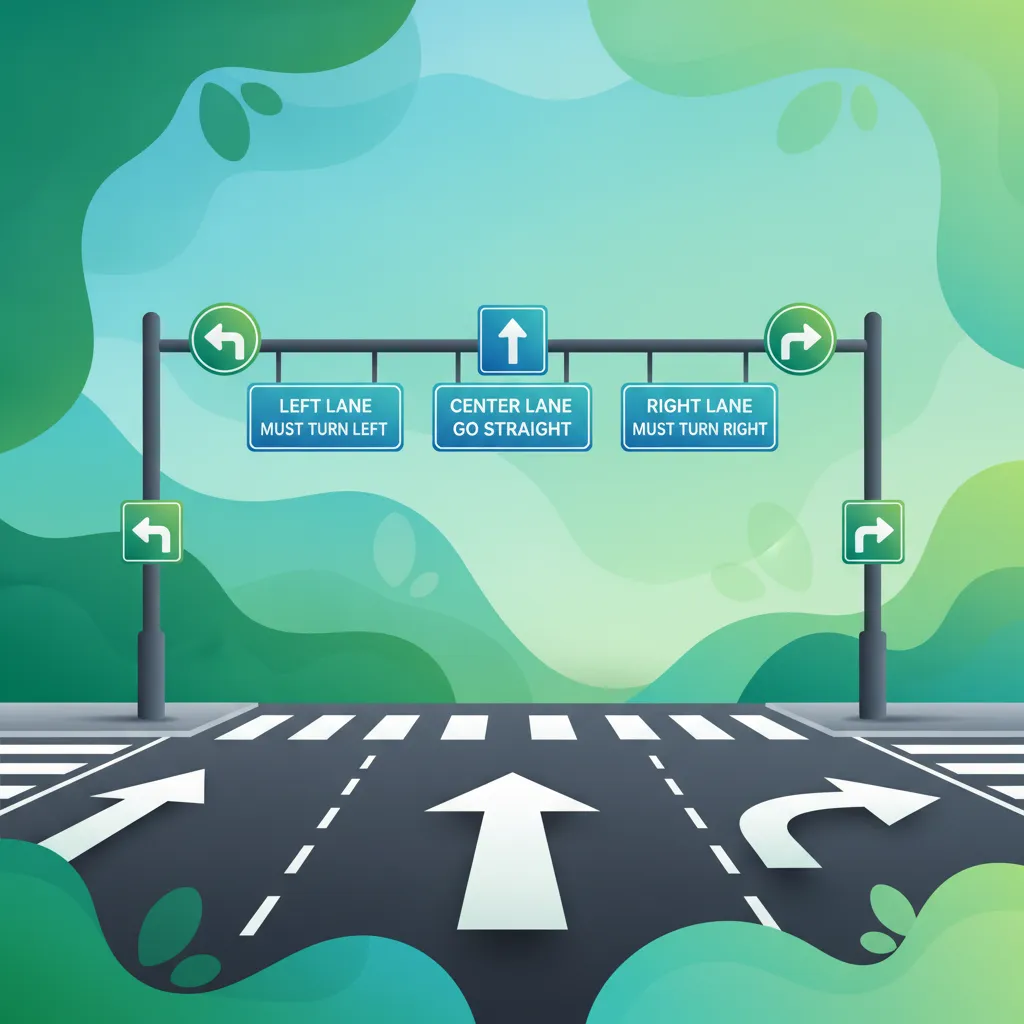
Preselection and direction arrows painted on the road surface instruct drivers on lane-specific movements at upcoming intersections or merges. This lesson teaches you how to interpret these arrows so you can position your vehicle correctly well in advance of a turn. You will learn the rules for lane merging, following curved guidance lines, and avoiding sudden, dangerous lane adjustments.

Controlled intersections use traffic lights and accompanying signs to manage busy crossings systematically. This lesson covers how to safely proceed on a green light, negotiate left turns when yielding to oncoming traffic, and obey flashing amber lights. You will also learn the hierarchy of traffic control, where police officer gestures overrule both traffic lights and priority signs.
Learn how to apply defensive riding techniques to manage right-of-way effectively in high-risk environments. This lesson focuses on scanning for hazards at unmarked intersections, identifying early cues from other drivers, and maintaining optimal road positioning to ensure you are seen by other road users when priority rules apply.

In France, the default rule at any intersection without clear priority signage is priority-to-the-right (priorite a droite). This lesson explains how to identify unsignaled junctions in urban and rural environments and when you must yield to incoming vehicles. You will learn to spot the standard yellow diamond priority signs and triangular warning signs that indicate whether you hold the priority.
Learners will study the fundamental priority rules that dictate right-of-way at intersections, focusing on the 'priorité à droite' principle prevalent in French road design. The lesson explains how to identify priority roads, interpret yield signs, and apply these rules safely when operating an AM vehicle. Understanding priority ensures orderly movement and reduces conflict points in mixed traffic scenarios.
Find clear answers to common questions learners have about Priority Rules: Right-of-Way, Priorité à Droite, and Yield Signs. Learn how the lesson is structured, which driving theory objectives it supports, and how it fits into the overall learning path of units and curriculum progression in France. These explanations help you understand key concepts, lesson flow, and exam focused study goals.
Yes, in the absence of any road signs or markings, the rule of priority à droite applies, meaning you must yield to vehicles coming from your right. This is a fundamental concept in the French Code de la route and a frequent topic in the motorcycle theory exam.
You are on a priority road if you see the yellow diamond-shaped sign with a white border. This sign indicates that you have priority at all upcoming intersections until you see the crossed-out yellow diamond sign indicating the end of priority.
No, the priority rules defined in the Code de la route apply to all road users, including motorcycles (A, A1, A2). However, due to the vulnerability of riders, it is critical to ride defensively and never assume others will correctly respect your right-of-way.
A Yield sign (triangle pointing down) requires you to slow down and give way only if there is traffic. A Stop sign (octagonal) mandates that you come to a complete standstill, with wheels fully stopped, before proceeding once the intersection is clear.
Ready to focus your study? Use the practice search to find exactly the French driving theory questions you need for the Code de la route and permis de conduire ETG. Refine your knowledge on specific topics or challenging rules to boost your confidence and exam readiness.