
This lesson focuses on the critical skills required to maintain motorcycle control when riding in rainy weather or on slippery surfaces. You will learn how to identify potential hazards like aquaplaning and understand the technical adjustments needed to safely navigate French roads in poor conditions.

Lesson content overview
Operating a motorcycle in wet conditions is one of the most critical safety challenges you will face as a rider. Unlike driving a car, where four wide contact patches provide stability, a motorcycle relies on two small, rounded footprints—each barely larger than a credit card—to maintain balance, steering, and braking. When rain falls on French roads, the physical dynamics of your motorcycle change instantly.
This lesson covers the crucial concepts of wet-weather riding required for the French motorcycle theory exam (Épreuve Théorique Moto - ETM) for Category A, A1, and A2 licenses. You will learn the physics behind tire grip, the mechanisms of traction loss, and how to adapt your riding style, vehicle maintenance, and safety margins to navigate wet roads securely.
To understand why wet roads are dangerous, you must understand the concept of adhesion (l'adhérence). Grip is the frictional force generated between your tire's rubber compound and the micro-roughness of the road surface.
Under dry conditions, the coefficient of friction () between rubber and high-quality asphalt is typically around 0.8 to 0.9, allowing for responsive braking, stable cornering, and rapid acceleration. However, when water covers the road, it acts as a lubricant. The water fills the microscopic gaps in the asphalt, creating a physical barrier that prevents the tire's rubber from directly conforming to the road's texture. In heavy rain, this coefficient of friction can plunge to 0.4 or lower.
The frictional force resulting from the contact between the tire tread and the road surface. It is calculated as the product of the normal force (the weight of the motorcycle and rider pushing down) and the coefficient of friction of the tire-road interface.
This reduction in friction has direct consequences:
Aquaplaning (or hydroplaning) represents the complete loss of contact between the motorcycle's tire and the road surface, caused by a buildup of water pressure. Instead of cutting through the water to grip the asphalt, the tire climbs up on a microscopic wedge of water and begins to float.
Aquaplaning is categorized into two distinct physical phenomena:
In France, the transition from dry to wet weather is particularly hazardous due to a phenomenon known as verglas d'été (summer ice).
During prolonged dry spells, motor oil, fuel drippings, tire rubber particles, and dust accumulate in the micro-grooves of the asphalt. When it first begins to drizzle, this mixture of water and greasy residue creates a highly slick emulsion. Before a heavy downpour can wash this mixture away, the road surface is as slippery as sheet ice.
The First 15 Minutes: The most dangerous time to ride is during the first fifteen minutes of a light rainfall. The grease and oil on the road surface emulsify with the water, creating a highly unstable layer. Always reduce your speed immediately at the first sign of raindrops.
Your tires are your primary defense against aquaplaning. The tread pattern is engineered to act as a hydraulic pump, channeling water away from the center of the tire and expelling it out to the sides.
The geometric grooves on a motorcycle tire are specifically designed to handle water displacement.
Tire pressure (measured in bar or psi) directly dictates the shape and size of your tire's contact patch.
Riding safely on wet roads requires a conscious shift in how you operate the physical controls of your motorcycle. Every input—throttle, brakes, steering—must be executed with absolute smoothness and progressive moderation.
Your speed is the single most controllable factor influencing aquaplaning. The higher your velocity, the less time the tire tread has to sweep water away.
Under French traffic laws, speed limits are legally reduced during precipitation to compensate for this physical hazard:
Regardless of the posted limits, you must adjust your speed down further if you encounter standing water, heavy spray, or reduced visibility.
In dry conditions, a rider typically applies approximately 70% of their braking force to the front wheel and 30% to the rear wheel. In wet conditions, this balance must shift to avoid locking up the front tire, which almost always results in an immediate low-side crash.
To change direction, a motorcycle must lean. Lean angle requires lateral grip. On wet roads, you must minimize the maximum lean angle of your bike to preserve safety margins.
If you enter a patch of standing water at high speed and your motorcycle begins to hydroplane, you will experience a distinct, alarming "floating" sensation. The steering will feel extremely light and unresponsive, and the engine RPM may rise suddenly as the rear tire loses resistance.
Your instinctive human reaction will be to slam on the brakes or steer away from the hazard. This is highly dangerous. You must manage this situation through calculated, disciplined physics.
Do Not Brake: Do not touch either the front or rear brake levers. Applying the brakes while the tire is floating will cause the wheels to stop spinning immediately. When the tire eventually drops back down and regains contact with the asphalt, a locked wheel will cause an instant high-side or low-side crash.
Ease Off the Throttle Gradually: Slowly roll off the throttle. Do not chop it shut abruptly, as sudden engine braking can upset the chassis balance. Lowering the throttle reduces forward momentum, allowing the tires to naturally slow down and sink back through the water film to find the asphalt.
Maintain a Straight steering Line: Keep the handlebars pointed straight ahead. Do not attempt to steer, turn, or make course corrections while floating. Keep your eyes focused on your intended exit path down the road.
Keep Your Body Relaxed: Avoid tensing up. Keep your weight centered over the middle of the motorcycle to maximize downward pressure on both tires. Once the tires cut back through the water, you will feel grip return smoothly.
A rainstorm reveals hidden traps on the road surface that are virtually harmless when dry. A defensive rider must scan the road ahead to identify and avoid these specific micro-hazards:
To prepare for your theoretical examination, memorize these essential, non-negotiable legal and physical parameters:
| Variable / Parameter | Standard Dry Condition | Wet Condition Requirement | Legal / Safety Rationale |
|---|---|---|---|
| Motorway Speed Limit | 130 km/h | 110 km/h | Lower speed limits prevent dynamic aquaplaning on fast roads. |
| Dual Carriageway Speed Limit | 110 km/h | 100 km/h | Ensures adequate reaction and stopping distances. |
| Secondary Road Speed Limit | 80 km/h | 70 km/h | Protects against traction loss on rural or winding routes. |
| Minimum Tire Tread Depth | 1.6 mm | 1.6 mm (Legal Minimum) | Code de la route requirement; safety experts recommend >2.0 mm. |
| Braking Distance | Baseline distance | Approx. Double (2x) | Reduced friction coefficient () on wet asphalt. |
| Braking Distribution | 70% Front / 30% Rear | 50% Front / 50% Rear | Prevents front wheel lock-ups and sliding hazards. |
Explore all units and lessons included in this driving theory course.
Lesson content overview
Explore all units and lessons included in this driving theory course.
Explore search topics learners often look for when studying Riding in Wet Conditions: Hydroplaning and Traction Loss. These topics reflect common questions about road rules, driving situations, safety guidance, and lesson level theory preparation for learners in France.
Browse additional driving theory lessons that cover connected traffic rules, road signs, and common driving situations related to this topic. Improve your understanding of how different rules interact across everyday traffic scenarios.
Learn the mechanical principles behind effective braking and stable cornering on a motorcycle. Understand how weight distribution and tire traction affect your ability to control the bike during maneuvers, ensuring safety and compliance with the French driving theory curriculum requirements for motorcycle riders.

This lesson covers the physical mechanics of cornering, highlighting the technique of countersteering to initiate and control lean angles. You will learn to divide bends into distinct entry, apex, and exit phases, choosing the safest path that maximizes your visibility and grip reserves. Finally, the lesson explains the concept of the traction circle, helping you manage the division of tire grip between lateral cornering forces and acceleration.

This lesson explains how to coordinate your front and rear brake controls to achieve maximum stopping power without compromising your lateral stability. You will study how to progressively squeeze the front brake lever to prevent sudden wheel lockup, while using the rear brake for stabilization. The lesson also highlights the function of Anti-Lock Braking Systems (ABS) and how they help you maintain steering control during emergency stops.
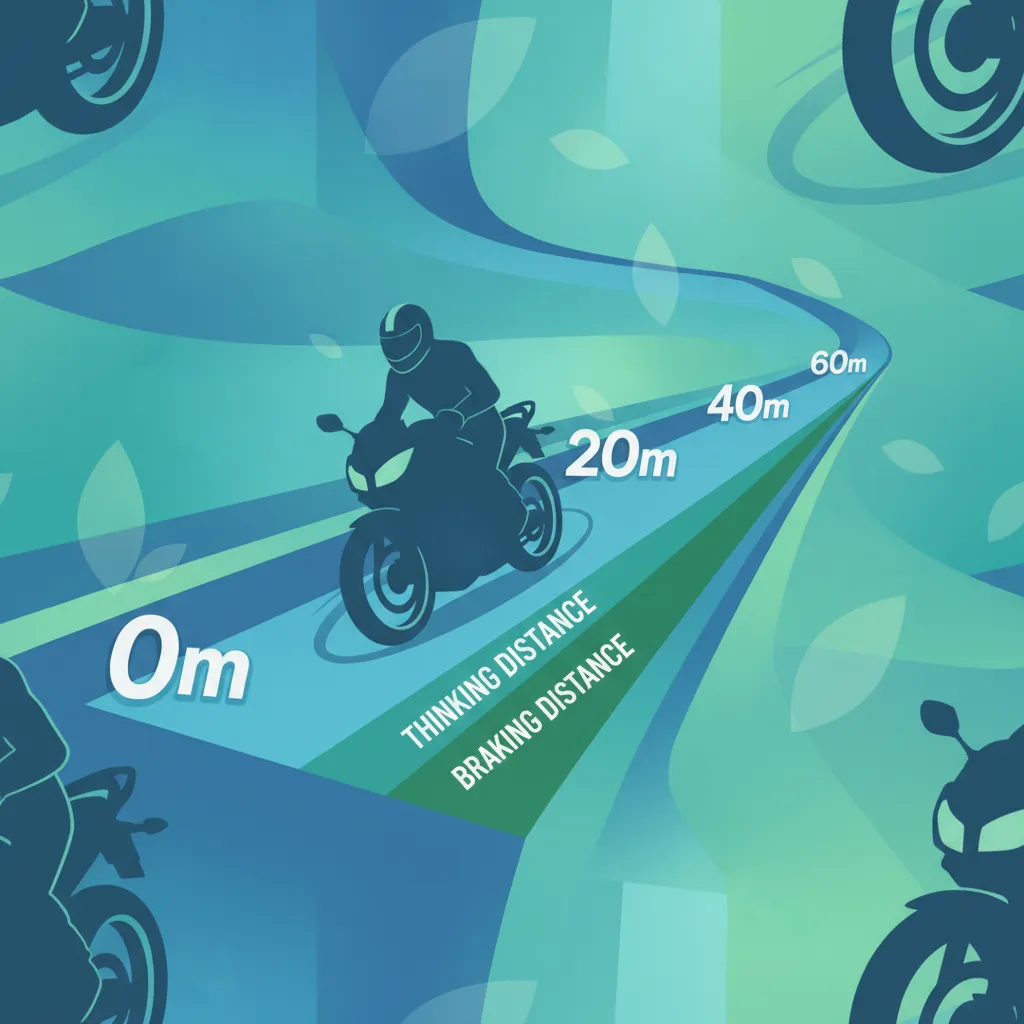
This lesson breaks down the physics of stopping a motorcycle, exploring how kinetic energy varies with the square of your speed. You will learn the mathematical components of total stopping distance, which includes both perception-reaction distance and physical braking distance. The lesson also explains how forward weight transfer during heavy braking increases traction on the front tire while reducing rear-wheel load.

Learners will be introduced to effective braking techniques tailored for AM vehicles, emphasizing progressive pressure application and the importance of maintaining grip. The lesson covers how to estimate stopping distances, execute emergency stops safely, and understand the limitations of light vehicle braking systems in France. Mastery of these techniques ensures riders can stop promptly and maintain control in various traffic scenarios.

This lesson teaches critical emergency response maneuvers to help you avoid sudden, unexpected obstacles on the roadway. You will learn the exact step-by-step process of executing a rapid, controlled swerve, keeping braking forces separate from steering inputs to prevent a slide. Additionally, the lesson addresses the psychological challenge of 'target fixation' and provides techniques to keep your eyes focused on your clear escape route.

This lesson provides practical strategies for managing the physical demands of slow, heavily congested city traffic. You will learn how to maintain excellent low-speed balance through correct body posture, rear brake modulation, and smooth clutch control. It also emphasizes the importance of preserving an adequate safety buffer when stopping behind other vehicles, allowing an immediate escape route if you face a rear-end threat.

This lesson teaches you how to establish and preserve a dynamic cushion of safety on all sides of your motorcycle. You will study how to apply the 'two-second rule' to keep a safe following distance, extending it to three or more seconds in adverse weather. Additionally, you will discover how to manage tailgating motorists safely without resorting to dangerous speed increases, ensuring you always maintain a clear escape route.

This lesson teaches riders how to negotiate loose surfaces such as gravel, sand, and poorly maintained urban asphalt without dropping the motorcycle. You will study correct body positioning, focusing on keeping your weight centered and your grip relaxed on the handlebars. The lesson also highlights why smooth, constant throttle delivery and avoiding abrupt front braking are essential to prevent the front wheel from washing out.
Explore essential defensive riding strategies to identify and mitigate environmental road hazards. This guide covers how to manage visibility, road surfaces, and traffic flow in urban and rural environments to maintain safety and uphold the principles of the French Code de la route for all motorcyclists.

Learners will develop the ability to anticipate potential hazards on the road, enhancing reaction times and defensive riding strategies. The lesson emphasizes constant scanning, early identification of threats such as sudden stops, pedestrian crossings, or unexpected lane changes, and appropriate response measures. By cultivating proactive risk assessment, AM riders can significantly reduce accident likelihood.

This final lesson integrates all course concepts into a single, cohesive approach to defensive riding and continuous risk assessment. You will study how to maintain a high-mileage visual lead, continuously scanning the road ahead for warning signs of conflict. By learning to assume that other motorists may not see you, you will build the proactive slowing habits and situational awareness needed to remain safe throughout your riding life.
This lesson breaks down triangular warning signs, which warn of upcoming safety hazards like reverse curves, narrowing lanes, or loose gravel. You will learn to translate these visual markers into proactive riding techniques, such as adjusting your entry speed or choosing an alternative lean angle. Special attention is given to signs indicating temporary roadworks or variable grip conditions, which pose elevated dangers to motorcycles.
This lesson teaches you how to establish and preserve a dynamic cushion of safety on all sides of your motorcycle. You will study how to apply the 'two-second rule' to keep a safe following distance, extending it to three or more seconds in adverse weather. Additionally, you will discover how to manage tailgating motorists safely without resorting to dangerous speed increases, ensuring you always maintain a clear escape route.

This lesson teaches riders how to approach and cross both controlled and uncontrolled intersections in urban settings. You will practice the 'scanning cycle' technique to identify cross-traffic hazards and manage your defensive line of sight around physical obstructions. The lesson also highlights the critical importance of early signaling and positioning to ensure that turning passenger cars do not violate your safety zone.
This lesson teaches critical emergency response maneuvers to help you avoid sudden, unexpected obstacles on the roadway. You will learn the exact step-by-step process of executing a rapid, controlled swerve, keeping braking forces separate from steering inputs to prevent a slide. Additionally, the lesson addresses the psychological challenge of 'target fixation' and provides techniques to keep your eyes focused on your clear escape route.

In this lesson, drivers will learn how to safely share the road with motorcycles and scooters, focusing on the specific blind spots and speed differentials that create risk. The content highlights proper lane positioning, caution when overtaking, and strategies for predicting motorcycle trajectories. Learners will also be introduced to the importance of being aware of scooter movements, especially in narrow streets.
This lesson explores how dividing your travel lane into three distinct vertical zones allows you to adjust your positioning for optimal safety. You will learn to shift your line to avoid oil slicks in the lane center, road debris at the edges, and wind blasts from passing trucks. Crucially, the lesson covers how to adapt your lane position on blind bends to widen your field of vision and stay clear of oncoming traffic.

This lesson focuses on French warning signs that alert drivers to potential hazards ahead, such as curves, animal crossings, or slippery surfaces, with particular attention to signs relevant to AM riders. Learners will examine how to interpret these signs, understand the associated risks, and adapt riding behavior accordingly. By mastering warning sign recognition, riders can proactively manage safety risks in diverse road conditions.

This lesson addresses the critical psychological elements that often lead to hazardous riding decisions, especially among newer motorcyclists. You will examine the dangers of overestimating your personal control limits and downplaying common road risks during group rides. The lesson provides practical strategies to resist peer pressure, maintain your own safe pace, and prioritize professional defensive habits over showing off.
Find clear answers to common questions learners have about Riding in Wet Conditions: Hydroplaning and Traction Loss. Learn how the lesson is structured, which driving theory objectives it supports, and how it fits into the overall learning path of units and curriculum progression in France. These explanations help you understand key concepts, lesson flow, and exam focused study goals.
The primary danger is aquaplaning, where a layer of water forms between the tire and the road surface. This causes the tire to lose contact with the asphalt, leading to a complete loss of steering and braking control.
Sudden or aggressive use of the throttle or brakes can easily exceed the limited grip available on a wet surface, causing the wheels to lock or slide. Smooth, gradual inputs help maintain the balance of the motorcycle and allow the tires to keep gripping the road.
Yes, adequate tread depth is vital because it provides channels for water to be pushed away from under the tire contact patch. If the tread is too shallow, water cannot be displaced, which significantly increases the risk of hydroplaning.
According to the Code de la route, you must reduce your speed significantly when road conditions deteriorate. Lowering your speed allows more time to react to hazards and reduces the speed at which aquaplaning is likely to occur.
Ready to focus your study? Use the practice search to find exactly the French driving theory questions you need for the Code de la route and permis de conduire ETG. Refine your knowledge on specific topics or challenging rules to boost your confidence and exam readiness.