This lesson introduces the foundational rules of the Code de la route specifically adapted for Category AM licence holders. By exploring the legal framework and operational requirements for cyclomoteurs and light quadricycles, you will gain the knowledge necessary for both the official exam and safe real-world riding in France.
Lesson content overview
Navigating public roads safely in France requires a deep understanding of the official Code de la route (French Traffic Regulations). For Category AM licence holders—who typically operate lightweight two-wheeled mopeds, scooters, or light quadricycles—this knowledge is not just a requirement to pass the theoretical exam; it is a vital shield against the inherent vulnerability of operating smaller, slower vehicles in dense traffic.
This lesson details the specific traffic laws, speed limits, vehicle standards, and road access restrictions that govern Category AM operators under French law. By mastering these concepts, you will ensure legal compliance, avoid costly penalties, and protect yourself and other road users.
Before exploring the rules of the road, you must understand the exact legal classification of the vehicles you are permitted to operate. In France, the Category AM licence (formerly known as the Brevet de Sécurité Routière or BSR) applies to light motorized vehicles. These are divided into two primary classifications:
A two- or three-wheeled motorized vehicle with a maximum design speed of 45 km/h, an engine cylinder capacity not exceeding 50 cm³ (for internal combustion engines), or a maximum continuous rated power of no more than 4 kW (for electric motors).
A four-wheeled light vehicle with a maximum design speed of 45 km/h, an empty mass of under 425 kg, and an engine capacity or continuous rated power restricted similarly to a moped (≤ 50 cm³ for petrol engines or ≤ 4 kW for other engine types).
The strict physical limits of these vehicles explain why they are subject to unique operating rules. Because they cannot match the speed or mass of standard passenger cars, the Code de la route establishes protective frameworks to keep them separated from high-speed traffic flows while integrating them safely into urban and suburban environments.
In France, speed limits are strictly enforced to minimize kinetic energy in collisions and to manage traffic flow. As an AM licence holder, you must adhere to a dual layer of speed restrictions: the absolute design limit of your vehicle and the variable speed limits of the road you are traversing.
No matter what speed limit is posted on a road, a Category AM vehicle must never exceed 45 km/h. This is a mechanical and legal ceiling. Even if you are riding on an open, suburban road with a general limit of 80 km/h, you must remain at or below 45 km/h.
Modifying a vehicle’s engine or transmission to exceed this limit (known as débridage or tampering) is a serious criminal offense in France, leading to heavy fines, vehicle confiscation, and a voided insurance policy.
While 45 km/h is your maximum allowed speed, you must frequently adapt your velocity downward based on local signs, weather conditions, and road classifications.
The "Limitation de Vitesse" sign for light vehicles: Some signs may explicitly mention a lower limit for two-wheelers, such as "30 km/h pour les 2-roues à moteur" or include a specific moped pictogram. You are legally required to obey these targeted restrictions.
Because Category AM vehicles have a maximum speed of 45 km/h, they are legally barred from high-speed roadways. Entering a restricted road on a moped is highly dangerous and carries severe penalties.
AM vehicles are strictly prohibited on:
These roads feature traffic moving at 110 km/h to 130 km/h. The extreme speed differential between a 45 km/h moped and a 130 km/h car creates a severe collision risk.
AM riders must generally stick to secondary roads, urban streets, and departmental routes (routes départementales).
Right-of-way rules in France are strictly codified. As an AM rider, you must respect standard priority protocols while remaining acutely aware of your vulnerability.
This is the default priority rule in France. At any intersection where no traffic lights, stop signs, yield signs, or road markings are present, you must yield to vehicles approaching from your right.
Conversely, traffic coming from your left must yield to you, but you should never force your priority. Many drivers fail to see small AM vehicles.
When entering a roundabout in France, you must yield to traffic already circulating inside the ring (indicated by the yield sign and triangles painted on the road surface at the entrance).
Road markings on French asphalt convey critical legal boundaries that dictate your path and overtaking limits.
Verify the road markings: Ensure there is no solid white line (ligne continue) preventing you from crossing into the adjacent lane, unless local laws explicitly permit straddling a solid line to pass a very slow cyclist under safe conditions.
Check your surroundings: Check your left-hand mirror and perform a direct shoulder check (blind spot check) to ensure no vehicle is already overtaking you.
Signal your intent: Activate your left turn indicator to warn traffic behind you.
Maintain a safe lateral distance: Under French law, you must maintain a minimum lateral clearance of 1.0 metre in urban areas and 1.5 metres on open country roads (outside urban areas) when passing a cyclist or pedestrian.
Complete the pass: Accelerate smoothly up to your legal limit, return to the right lane when you can see the cyclist in your mirror, and turn off your indicator.
Under the French Code de la route, certain vehicle components are legally required to maintain roadworthiness. Operating a vehicle missing this equipment can result in immediate fines and vehicle impoundment.
Small vehicles have a low visual profile, making proper lighting critical for safety.
You must have structural awareness of the traffic behind you.
Every AM vehicle must be equipped with a functional horn (avertisseur sonore) that is audible from at least 150 metres away. The law restricts its use inside urban areas to cases of immediate, pressing danger. Continuous or aggressive honking to express frustration is illegal.
Your vehicle's exhaust system must feature a legally approved, undamaged silencer (pot d'échappement aux normes). Modifying the exhaust to increase engine noise is a violation of environmental and traffic laws.
The Code de la route places strict legal requirements on personal protective equipment (PPE) and how you transport passengers.
Both the rider and any authorized passenger must wear an approved, certified motorcycle helmet. The helmet must feature a label proving compliance with French/European standards:
Failure to wear an approved, buckled helmet results in a heavy fine and, if the operator holds a full driving licence with points, the loss of demerit points.
You cannot automatically carry a passenger on a moped. Strict legal conditions must be met:
Understanding the legal consequences of non-compliance helps reinforce the rules. The table below outlines frequent errors made by Category AM operators and their real-world consequences under French traffic law.
| Violation | Immediate Risk / Hazard | Legal Consequence in France |
|---|---|---|
| Exceeding 45 km/h via engine modification | Structural instability, brake failure, severe crash impact | Vehicle confiscation, heavy criminal fine, insurance voided |
| Riding on an Autoroute or Expressway | Being struck from behind by high-speed vehicles | Heavy class 4 fine, immediate vehicle towing |
| Riding without a certified helmet | Fatal head trauma in even a minor fall | Class 4 fine, immobilization of the moped |
| Riding with a non-functional rear red light at night | Complete rear-end collision risk | Fine, vehicle prohibited from moving until fixed |
| Carrying a passenger on a single-seat moped | Unbalanced vehicle, loss of steering control | Class 4 fine |
| Crossing a solid white line | Head-on collision with oncoming vehicles | Fine, loss of demerit points (if holding a point-based licence) |
These real-world scenarios illustrate how to combine these rules during everyday riding.
You are riding your scooter home at 18:00 on a cloudy day. You enter a residential neighborhood marked with a "Zone 30" sign.
You are riding on a wide rural road (departmental route) with a general limit of 80 km/h. A tractor is crawling ahead of you at 15 km/h. The road is marked with a solid white line (ligne continue).
To build on your understanding of the Code de la route for Category AM, progress to the next modules of your training. Ensure you understand how your protective equipment operates and how to read road signs dynamically.
Explore all units and lessons included in this driving theory course.
Lesson content overview
Explore all units and lessons included in this driving theory course.
Explore search topics learners often look for when studying Understanding the Code de la route for AM. These topics reflect common questions about road rules, driving situations, safety guidance, and lesson level theory preparation for learners in France.
Browse additional driving theory lessons that cover connected traffic rules, road signs, and common driving situations related to this topic. Improve your understanding of how different rules interact across everyday traffic scenarios.
Learn how to correctly interpret right-of-way at various types of French road junctions. This guide clarifies the practical application of the priorite a droite rule and how to safely navigate intersections where traffic signage or road markings define specific priority flows for light motorized vehicles.

In France, the default rule at any intersection without clear priority signage is priority-to-the-right (priorite a droite). This lesson explains how to identify unsignaled junctions in urban and rural environments and when you must yield to incoming vehicles. You will learn to spot the standard yellow diamond priority signs and triangular warning signs that indicate whether you hold the priority.

Learners will study the fundamental priority rules that dictate right-of-way at intersections, focusing on the 'priorité à droite' principle prevalent in French road design. The lesson explains how to identify priority roads, interpret yield signs, and apply these rules safely when operating an AM vehicle. Understanding priority ensures orderly movement and reduces conflict points in mixed traffic scenarios.

Negotiating crossroads that lack active traffic light signals requires a clear reading of signs and painted stop or yield lines. This lesson details the obligations of stopping completely at stop signs and slowing down to yield at 'cedez le passage' markings. You will learn to assess cross-traffic speeds, determine priorities when multiple vehicles arrive, and execute turns safely.

This lesson provides a comprehensive breakdown of priority rules under French law, with special focus on the default rule of priorité à droite. You will learn to recognize when this rule applies, even in the absence of explicit signage, and how to verify that entering vehicles see you. It also explains how to read priority road indicators, stop signs, and yield signs, helping you manage right-of-way safely and confidently.

Controlled intersections use traffic lights and accompanying signs to manage busy crossings systematically. This lesson covers how to safely proceed on a green light, negotiate left turns when yielding to oncoming traffic, and obey flashing amber lights. You will also learn the hierarchy of traffic control, where police officer gestures overrule both traffic lights and priority signs.

Some crossroads feature complex layouts or specific signs that modify standard priority rules, such as schematic diagrams (panonceaux schematiques). This lesson teaches you how to read these auxiliary signs, which depict the thick line of the priority road and thin lines of secondary roads. You will learn how to maintain priority when the main road curves and how to navigate non-standard intersection layouts.

Learners will explore the rules related to pedestrian crossings, focusing on the obligation to yield to pedestrians at zebra crossings and flashing pedestrian signals. The lesson highlights the importance of stopping before the stop line, reducing speed, and maintaining vigilance for pedestrian movement. Mastery of these practices ensures the safety of both pedestrians and AM riders at crossing points.

Learners will learn the critical steps for safely approaching and traversing intersections, emphasizing speed reduction, priority assessment, and adherence to right-of-way rules, including priorité à droite. The lesson covers recognizing stop lines, interpreting road markings, and maintaining a safe distance from other vehicles. By mastering these practices, AM riders can confidently navigate intersections while minimizing collision risk.

In France, pedestrians have clear legal priority when stepping onto or indicating an intent to use a crossing (passage pieton). This lesson details standard zebra crossings, refuge islands, and pedestrian crossings managed by synchronized traffic light systems. You will learn to scan crossings ahead, anticipate pedestrian movements, and safely come to a stop whenever a pedestrian attempts to cross.

Traffic signals control flow and priority at busy intersections using precise color sequences. This lesson explains standard red, amber, and green cycles, as well as complex signals like flashing amber lights that indicate caution or a priority-to-the-right situation. You will learn the legal rules for turning on arrow signals and how to coordinate with dedicated pedestrian and cyclist light displays.
Explore the official French road sign system including regulatory signals, hazard indicators, and specific road access restrictions. This lesson explains how to identify and react to traffic signs that impact AM licence holders, helping you understand mandatory behavior in diverse urban and rural driving environments.
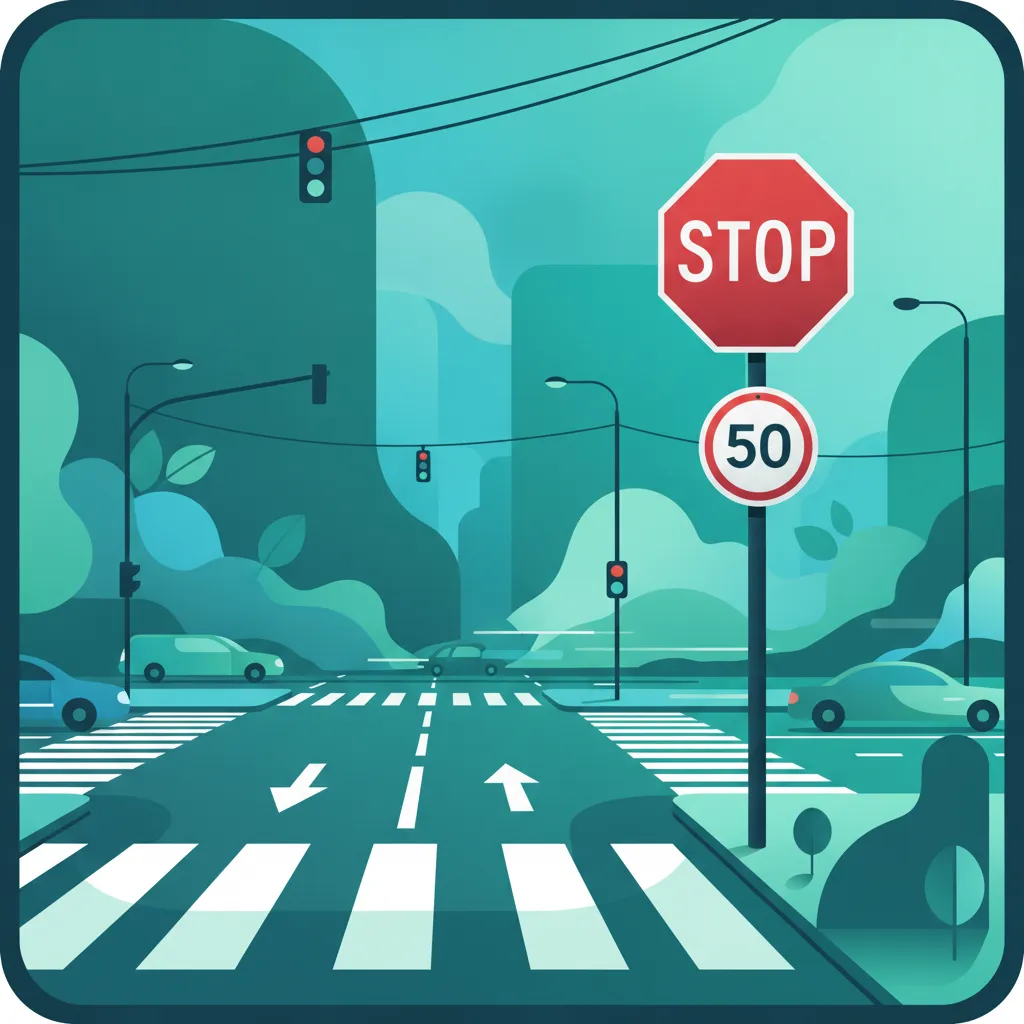
Learners will be introduced to the core set of French regulatory signs that dictate mandatory actions or prohibitions for all road users, including AM riders. The lesson explains the significance of signs such as stop, yield (cédez le passage), speed limit, and no entry, highlighting their specific implications for small vehicles. Understanding these signs is crucial for legal compliance and safe navigation through varied traffic environments.

This lesson focuses on French warning signs that alert drivers to potential hazards ahead, such as curves, animal crossings, or slippery surfaces, with particular attention to signs relevant to AM riders. Learners will examine how to interpret these signs, understand the associated risks, and adapt riding behavior accordingly. By mastering warning sign recognition, riders can proactively manage safety risks in diverse road conditions.

Regulatory signs are circular with red borders for prohibitions and blue backgrounds for mandatory instructions. This lesson details critical signs, such as speed limits, no-entry indicators, overtaking bans, and mandatory turning lanes. You will also learn about environmental zones restrictions, height limits for large vehicles, and the legal priority instructions conveyed by stop and yield signs.
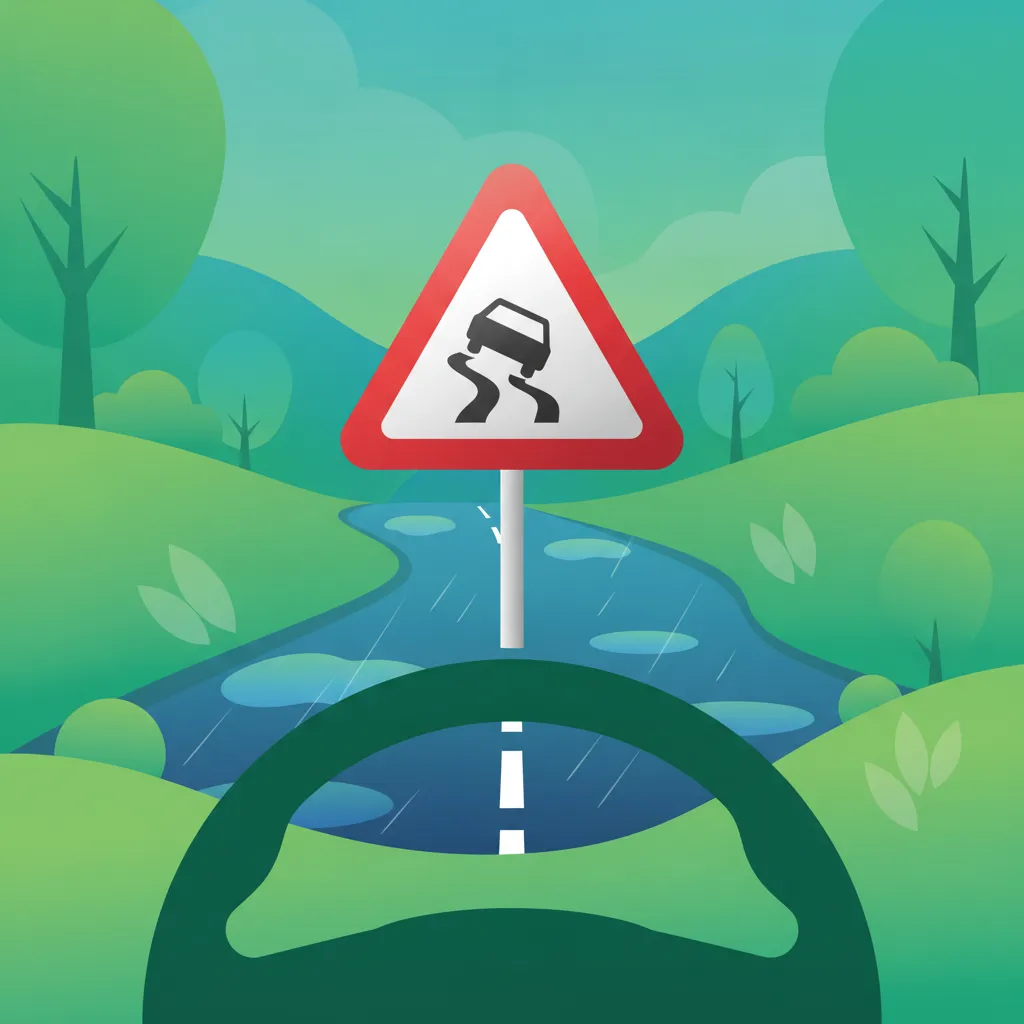
Warning signs on French roads are triangular with a red border, designed to alert drivers to upcoming dangers. This lesson teaches you how to interpret warnings for sharp curves, slippery surfaces, narrowing lanes, and wildlife or animal crossing hazards. You will understand the safety adjustments needed when approaching school zones, active roadworks, or crossings where vulnerable pedestrians are present.
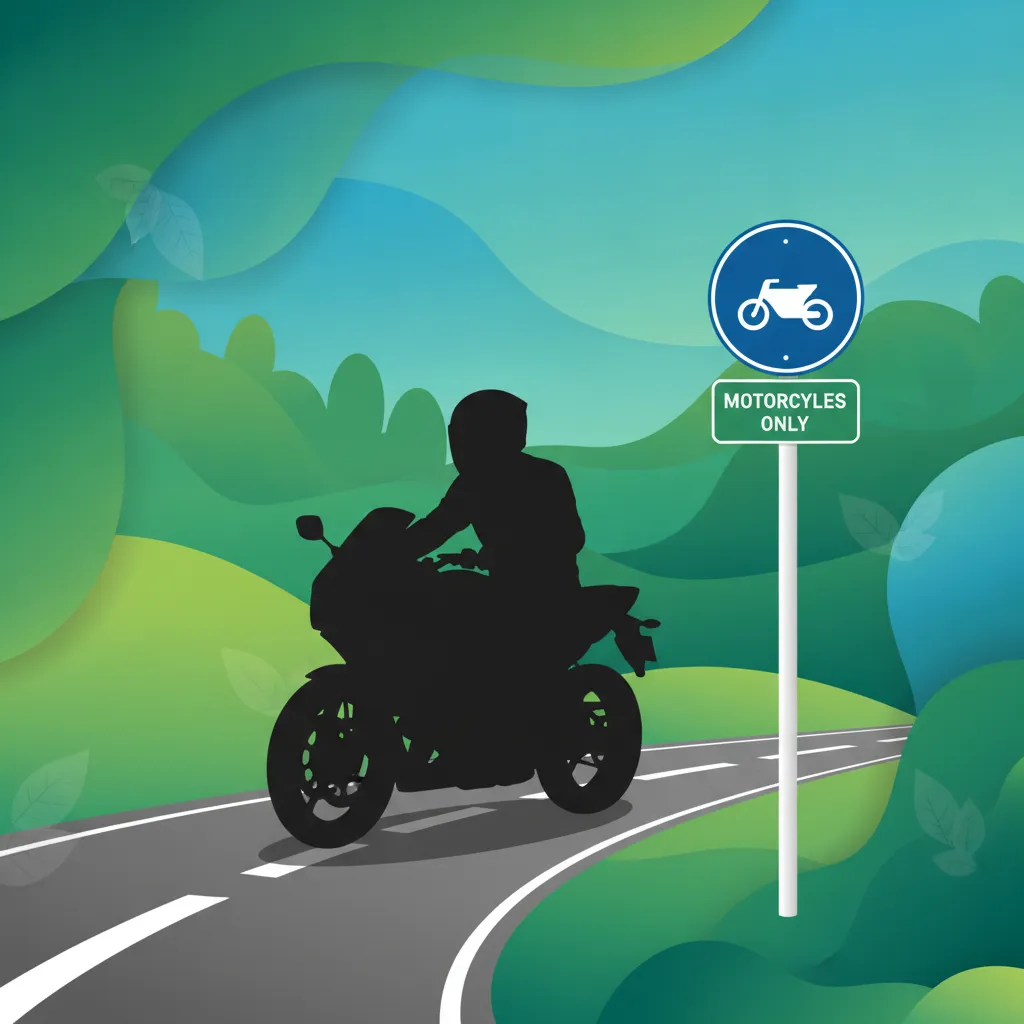
This lesson focuses on identifying regulatory signs, which are circular signs with red borders for prohibitions or blue backgrounds for obligations. You will learn about specific restrictions that impact motorcycle paths, including narrow lane access bans, motorcycle-specific speed limits, and overtaking prohibitions. Mastering these symbols is vital to ensuring compliance with French road law and avoiding immediate traffic penalty points.
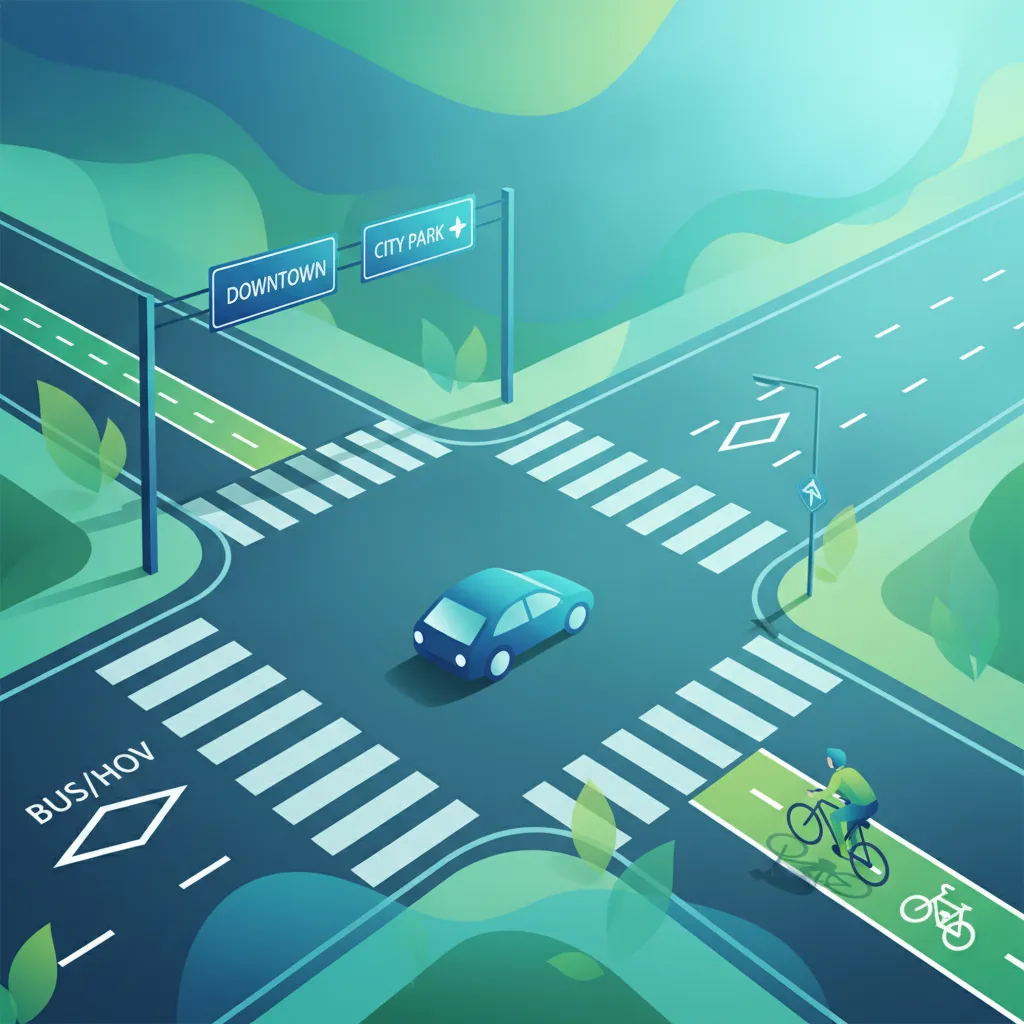
Learners will explore the variety of road surface markings that indicate lane boundaries, reserved spaces for different users, and pedestrian crossings in France. The lesson emphasizes how AM riders should interpret solid and broken lines, bike lane markings, and zebra crossings, ensuring appropriate lane usage and adherence to traffic flow. Understanding these markings is essential for maintaining order and safety on shared roadways.
This lesson breaks down triangular warning signs, which warn of upcoming safety hazards like reverse curves, narrowing lanes, or loose gravel. You will learn to translate these visual markers into proactive riding techniques, such as adjusting your entry speed or choosing an alternative lean angle. Special attention is given to signs indicating temporary roadworks or variable grip conditions, which pose elevated dangers to motorcycles.
This lesson covers the specific set of road signs and traffic lights that apply exclusively to buses, coaches, and heavy passenger vehicles in France. Learners will explore symbols indicating height restrictions, maximum allowed weight, and dedicated lane requirements under the Code de la route. Recognizing these traffic signs quickly prevents wrong-way offenses, physical collisions with low structures, and costly moving violations.

Learners will focus on the importance of clear and consistent signalling to convey intentions to other road users, thereby enhancing predictability and safety on French streets. The lesson covers both hand signals and vehicle indicators, detailing correct usage, timing, and the legal obligations associated with each. By mastering these communication techniques, AM riders can reduce misunderstandings and potential conflicts, contributing to a smoother traffic flow.
Temporary traffic configurations and construction sites are signaled using yellow-background signs to indicate their short-term nature. This lesson teaches you how to comply with temporary speed reductions, interpret lane shifts, and follow designated detour signs (deviation). Drivers will learn how to maintain high vigilance and safely navigate worksites while protecting road workers and oncoming traffic.
Find clear answers to common questions learners have about Understanding the Code de la route for AM. Learn how the lesson is structured, which driving theory objectives it supports, and how it fits into the overall learning path of units and curriculum progression in France. These explanations help you understand key concepts, lesson flow, and exam focused study goals.
In France, vehicles under the Category AM licence, such as cyclomoteurs, are legally restricted to a maximum speed of 45 km/h. Adhering to this limit is crucial for both legal compliance and the technical safety of the vehicle.
Yes, the rule of priority to the right (Priorité à droite) applies to all vehicles on French roads unless otherwise indicated by signs or markings. AM riders must be particularly vigilant at intersections where this rule is active.
Yes, AM riders must respect all standard road markings, including stop lines and zebra crossings. You must also be aware of dedicated lanes, such as those reserved for buses or cyclists, which you generally cannot use unless specifically permitted.
The Code de la route provides the legal foundation for all road users in France. Understanding these rules is essential to ensure your safety as a vulnerable road user and to pass the theoretical examination required for your licence.
Ready to focus your study? Use the practice search to find exactly the French driving theory questions you need for the Code de la route and permis de conduire ETG. Refine your knowledge on specific topics or challenging rules to boost your confidence and exam readiness.