
This lesson guides you through the fundamental regulatory road signs required for the French Category AM licence examination. By mastering these mandatory rules, you will gain the confidence to interpret signs effectively, ensuring both your safety and legal compliance on French roads.
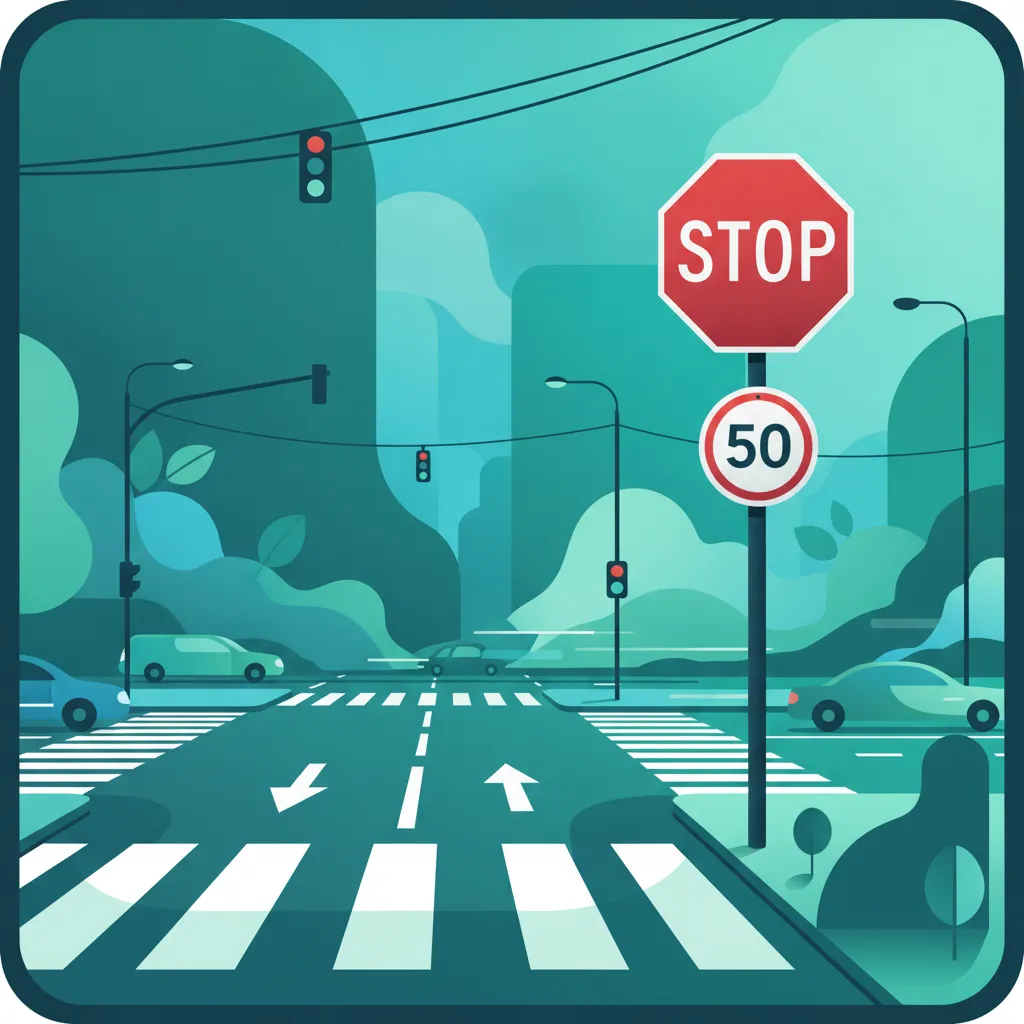
Lesson content overview
Navigating the French road network safely and legally requires an intimate understanding of the traffic signs established by the Code de la route (French highway code). For riders of Category AM vehicles—which includes light mopeds (cyclomoteurs) up to 50cc and light quadricycles (voiturettes) with a maximum design speed of 45 km/h—regulatory signs dictate absolute legal mandates.
Unlike warning signs, which advise you of upcoming hazards, regulatory signs (panneaux de prescription) require immediate compliance. Failing to respect these indicators is not only a direct path to stiff financial penalties and potential vehicle impoundment, but also drastically increases the risk of high-impact collisions.
To facilitate rapid cognitive processing at speed, French regulatory signs rely on a highly standardized system of shapes, colors, and borders. A rider's reaction time typically averages between 1.0 and 1.5 seconds. Standardized geometry ensures that you can identify a sign's core category (prohibition, obligation, or priority) from a distance, even in adverse weather conditions or low light.
At intersections, the baseline rule in France is "priority to the right" (priorité à droite). However, regulatory priority signs override this default rule. Understanding how to interact with these signs is the foundation of safe intersection management.
The Stop sign is one of the most critical regulatory markers on French roads. It demands an absolute, complete cessation of movement.
When approaching a Stop sign, Category AM riders must adhere to strict procedural steps:
Decelerate progressively: Position your vehicle in the center of your lane and scan the road ahead. Do not brake abruptly, as tailgating vehicles may not anticipate your stop.
Come to a complete halt: Your vehicle's wheels must stop moving entirely. A "rolling stop" (stop coulé), where you slowly roll through the intersection without coming to a complete standstill, is highly illegal.
Align with the stop line: Stop immediately behind the solid white line (ligne d'arrêt) painted on the road. If there is no painted line, stop at the limit of the intersecting roadway where you have a clear view of oncoming traffic.
Perform a full visual scan: Look left, then right, then left again. Because small vehicles like mopeds have low profiles, ensure you are fully visible to other motorists.
Proceed safely: Engage your clutch or throttle smoothly only when the intersection is completely clear of both vehicles and crossing pedestrians.
The Danger of the "Rolling Stop": Performing a rolling stop is a common infraction that police officers actively target. In France, failing to come to a complete stop at a Stop sign is a 4th-class contravention, carrying a hefty fixed fine and a potential suspension of your driving privileges.
The Yield sign indicates that you must give priority to all traffic on the intersecting road, but a complete stop is not mandatory if the way is entirely clear.
Unlike a Stop sign, which features a solid line, a Yield sign is accompanied by a thick, dashed white line painted across the lane (ligne d'effet de cédez le passage).
If you approach a Yield sign and the intersecting road is empty, you may proceed without stopping, provided you have slowed down sufficiently to verify safety. However, if any vehicle is approaching, you must halt behind the dashed line and wait for a safe gap.
This yellow diamond-shaped sign with a white border indicates that you are traveling on a main road that has priority over all intersecting side roads.
While driving on a route prioritaire, intersecting traffic will face either a Stop sign or a Yield sign. However, Category AM riders must remain highly defensive. Due to the small physical cross-section of 50cc scooters and microcars, drivers on side roads may misjudge your speed or fail to see you entirely. Always be prepared to react, even when you have the legal right-of-way.
Prohibitory signs (panneaux d'interdiction) protect vulnerable road users, preserve road infrastructure, and prevent dangerous conflicts by outlawing specific behaviors.
One of the most critical urban signs in France is the sens interdit. It indicates a one-way street where traffic is strictly prohibited from entering from your direction.
Moped riders are occasionally tempted to enter sens interdit streets, believing their small vehicle size exempts them or makes it safe. This is a severe error. Traveling against the flow of traffic on a narrow urban street leaves you with zero escape routes if a car emerges from a driveway or around a blind corner.
Speed limit signs are circular with a red border and black numbers indicating the maximum permissible speed in kilometers per hour (km/h).
For Category AM riders, speed limits require a dual-layer understanding:
Furthermore, you must proactively reduce your speed below the legal limit during adverse conditions, such as rain, heavy fog, or when navigating areas with high pedestrian density.
This sign features a red border enclosing two car silhouettes—one black on the right and one red on the left (the overtaking vehicle).
Under the Code de la route, the B3 sign prohibits you from overtaking any motor vehicle that has more than two wheels (such as cars, vans, or trucks). However, because two-wheeled vehicles are narrow, a car driver is generally permitted to overtake a moped, and a moped rider may overtake a bicycle, provided it can be done safely without crossing into the opposing lane of traffic and whilst maintaining the mandatory lateral safety margin (1 meter in urban areas, 1.5 meters in rural areas).
For AM riders, parking a small scooter or quadricycle might seem simple, but strict rules govern where you can leave your vehicle. The Code de la route distinguishes clearly between "stopping" and "parking."
The temporary immobilization of a vehicle for the time necessary to allow passengers to get in or out, or to load or unload goods, while the driver remains at or near the controls to move the vehicle if necessary.
The immobilization of a vehicle for any reason other than a temporary stop. This refers to leaving the vehicle unattended.
If you see this sign, you may temporarily stop to let a passenger off your moped, but you cannot leave the vehicle unattended on the side of the road.
This sign indicates a highly sensitive zone—such as a narrow street, a transit lane, or near a blind curve—where any stationary vehicle would pose an immediate hazard or block traffic flow. Under no circumstances may you stop or park here, even for a few seconds.
A restriction imposed by a regulatory sign remains in effect until you pass an intersection (which resets certain localized rules) or encounter an "End of Restriction" sign.
When you pass an "End of Speed Limit" sign (Fin de limitation de vitesse), the general speed limits of the road type apply once more. For Category AM riders, this means returning to the baseline urban limit (usually 50 km/h, though your vehicle is capped at 45 km/h) or the rural limits, while maintaining your absolute maximum design speed of 45 km/h.
| Rule | Applicability | Legal Status | Rationale | Example of Correct Application | Example of Incorrect Application |
|---|---|---|---|---|---|
| Stop Sign | All intersections with sign AB4 | Mandatory | Prevents t-bone collisions by giving crossing traffic absolute right-of-way. | Stopping completely behind the white line, counting to two, scanning, and proceeding. | Performing a rolling stop at 5 km/h because the road looked clear. |
| Yield Sign | Intersections with sign AB3a | Mandatory | Maintains smooth traffic flow while clearly establishing priority. | Decelerating, checking for traffic, and stopping only when cross-traffic is present. | Blasting through the intersection without slowing down or looking. |
| Speed Limits | All public roads | Mandatory | Keeps kinetic energy manageable, reducing stopping distance during emergencies. | Driving at 30 km/h in a designated residential "Zone 30." | Driving at 45 km/h in a wet "Zone 30" because the moped's top speed is 45 km/h. |
| No Entry | Street entrances with sign B1 | Mandatory | Eliminates head-on collisions on narrow, single-direction roads. | Diverting to a parallel street when encountering a sens interdit sign. | Riding down a one-way street against traffic because the scooter is narrow. |
| No Overtaking | Areas marked with sign B3 | Mandatory | Prevents head-on crashes in zones with highly restricted forward visibility. | Staying behind a slow-moving tractor on a winding road until the sign ends. | Squeezing past a car in a blind curve marked with a B3 sign. |
Obeying regulatory signs is not just a matter of avoiding fines; it is governed by the laws of physics and human biology.
Stopping distance consists of two parts: Reaction Distance (the distance traveled while you perceive a hazard and apply the brakes) and Braking Distance (the physical distance the vehicle travels once the brakes are engaged).
Kinetic energy () increases with the square of your speed:
If you double your speed, your kinetic energy quadruples, which approximately quadruples your physical braking distance. On a wet road, friction is cut in half, meaning your braking distance can double or triple. This is why respecting speed limits and stopping fully at Stop signs is critical—your lightweight Category AM vehicle requires stable traction to stop safely.
As a moped or light quadricycle rider, you lack the protective steel cage of a car. You are also physically smaller, making you harder for other drivers to detect.
When you ignore a regulatory sign—such as running a Stop sign or going the wrong way down a sens interdit—you strip away the predictability of the traffic ecosystem. Other drivers expect you to behave according to the signs; when you do not, their reaction times are delayed, often with catastrophic results for the rider.
Let's look at how to handle common, real-world situations you will encounter during your Category AM theory examination and daily riding.
This lesson covers the complete system of French regulatory signs required for Category AM riders, including Stop (AB4), Yield (AB3a), Priority Road (AB6), and key prohibitory signs like No Entry (B1) and Speed Limits (B14). The content explains the standardized visual grammar of French signs and provides procedural guidance for executing stops correctly. It emphasizes that Category AM vehicles are legally limited to 45 km/h regardless of posted limits, that complete stops are mandatory at Stop signs, and that stopping and parking rules differ significantly under French law. Practical scenarios illustrate how to apply this knowledge in wet conditions and Zone 30 environments, while physics explanations underscore why compliance protects vulnerable riders.
A short set of high-value points that capture the most important learning from this lesson.
Regulatory signs in France use standardized shapes and colors: circular red border for prohibitions, blue circle for obligations, octagon for Stop, and inverted triangle for Yield.
A complete stop at a Stop sign (AB4) is legally mandatory; a rolling stop is a fourth-class contravention in France and risks licence suspension.
Category AM vehicles are mechanically capped at 45 km/h regardless of posted speed limits, even when higher limits apply to other vehicles.
The End of Restriction sign (grey with diagonal slash) restores general road-type speed limits, not the vehicle's absolute maximum.
The No Entry sign (sens interdit) applies to all vehicles including mopeds; riding against traffic flow eliminates your escape route if a vehicle emerges from a driveway.
Explore all units and lessons included in this driving theory course.
At Stop signs: decelerate, halt completely behind the white ligne d'arrêt, scan left-right-left, then proceed only when the intersection is clear.
At Yield signs: slow down sufficiently to verify safety and stop only if cross-traffic is present; a complete halt is not required if the road is clear.
Stopping (arrêt) means temporary immobilization with the driver nearby; Parking (stationnement) means leaving the vehicle unattended.
The B3 No Overtaking sign prohibits overtaking motor vehicles with more than two wheels, but two-wheeled vehicles may still overtake each other with proper lateral margins.
Priority to the right (priorité à droite) is the default rule at uncontrolled intersections, but priority signs override this baseline.
Performing a rolling stop at an AB4 Stop sign because the road appears clear, exposing riders to fines and licence penalties.
Entering a sens interdit (No Entry) street believing a moped's small size makes it safe or exempt.
Driving at the posted speed limit instead of the vehicle's 45 km/h maximum when exiting a Zone 30 or lower-restriction area.
Confusing stopping and parking rules: B6a allows temporary stops for passenger exchange but prohibits leaving the vehicle unattended.
Assuming right-of-way on a route prioritaire means other drivers will see and yield to a small moped or quadricycle.
Lesson content overview
A short set of high-value points that capture the most important learning from this lesson.
Regulatory signs in France use standardized shapes and colors: circular red border for prohibitions, blue circle for obligations, octagon for Stop, and inverted triangle for Yield.
A complete stop at a Stop sign (AB4) is legally mandatory; a rolling stop is a fourth-class contravention in France and risks licence suspension.
Category AM vehicles are mechanically capped at 45 km/h regardless of posted speed limits, even when higher limits apply to other vehicles.
The End of Restriction sign (grey with diagonal slash) restores general road-type speed limits, not the vehicle's absolute maximum.
The No Entry sign (sens interdit) applies to all vehicles including mopeds; riding against traffic flow eliminates your escape route if a vehicle emerges from a driveway.
Explore all units and lessons included in this driving theory course.
At Stop signs: decelerate, halt completely behind the white ligne d'arrêt, scan left-right-left, then proceed only when the intersection is clear.
At Yield signs: slow down sufficiently to verify safety and stop only if cross-traffic is present; a complete halt is not required if the road is clear.
Stopping (arrêt) means temporary immobilization with the driver nearby; Parking (stationnement) means leaving the vehicle unattended.
The B3 No Overtaking sign prohibits overtaking motor vehicles with more than two wheels, but two-wheeled vehicles may still overtake each other with proper lateral margins.
Priority to the right (priorité à droite) is the default rule at uncontrolled intersections, but priority signs override this baseline.
Performing a rolling stop at an AB4 Stop sign because the road appears clear, exposing riders to fines and licence penalties.
Entering a sens interdit (No Entry) street believing a moped's small size makes it safe or exempt.
Driving at the posted speed limit instead of the vehicle's 45 km/h maximum when exiting a Zone 30 or lower-restriction area.
Confusing stopping and parking rules: B6a allows temporary stops for passenger exchange but prohibits leaving the vehicle unattended.
Assuming right-of-way on a route prioritaire means other drivers will see and yield to a small moped or quadricycle.
Explore search topics learners often look for when studying Regulatory Signs and Their Meanings. These topics reflect common questions about road rules, driving situations, safety guidance, and lesson level theory preparation for learners in France.
Browse additional driving theory lessons that cover connected traffic rules, road signs, and common driving situations related to this topic. Improve your understanding of how different rules interact across everyday traffic scenarios.
Understand the fundamental priority rules governing French roads, including the standard priorité à droite, the function of priority road signs, and how to safely navigate complex intersections and roundabouts as a Category AM rider according to the Code de la route.

In France, the default rule at any intersection without clear priority signage is priority-to-the-right (priorite a droite). This lesson explains how to identify unsignaled junctions in urban and rural environments and when you must yield to incoming vehicles. You will learn to spot the standard yellow diamond priority signs and triangular warning signs that indicate whether you hold the priority.

Negotiating crossroads that lack active traffic light signals requires a clear reading of signs and painted stop or yield lines. This lesson details the obligations of stopping completely at stop signs and slowing down to yield at 'cedez le passage' markings. You will learn to assess cross-traffic speeds, determine priorities when multiple vehicles arrive, and execute turns safely.

Controlled intersections use traffic lights and accompanying signs to manage busy crossings systematically. This lesson covers how to safely proceed on a green light, negotiate left turns when yielding to oncoming traffic, and obey flashing amber lights. You will also learn the hierarchy of traffic control, where police officer gestures overrule both traffic lights and priority signs.

Learners will study the fundamental priority rules that dictate right-of-way at intersections, focusing on the 'priorité à droite' principle prevalent in French road design. The lesson explains how to identify priority roads, interpret yield signs, and apply these rules safely when operating an AM vehicle. Understanding priority ensures orderly movement and reduces conflict points in mixed traffic scenarios.
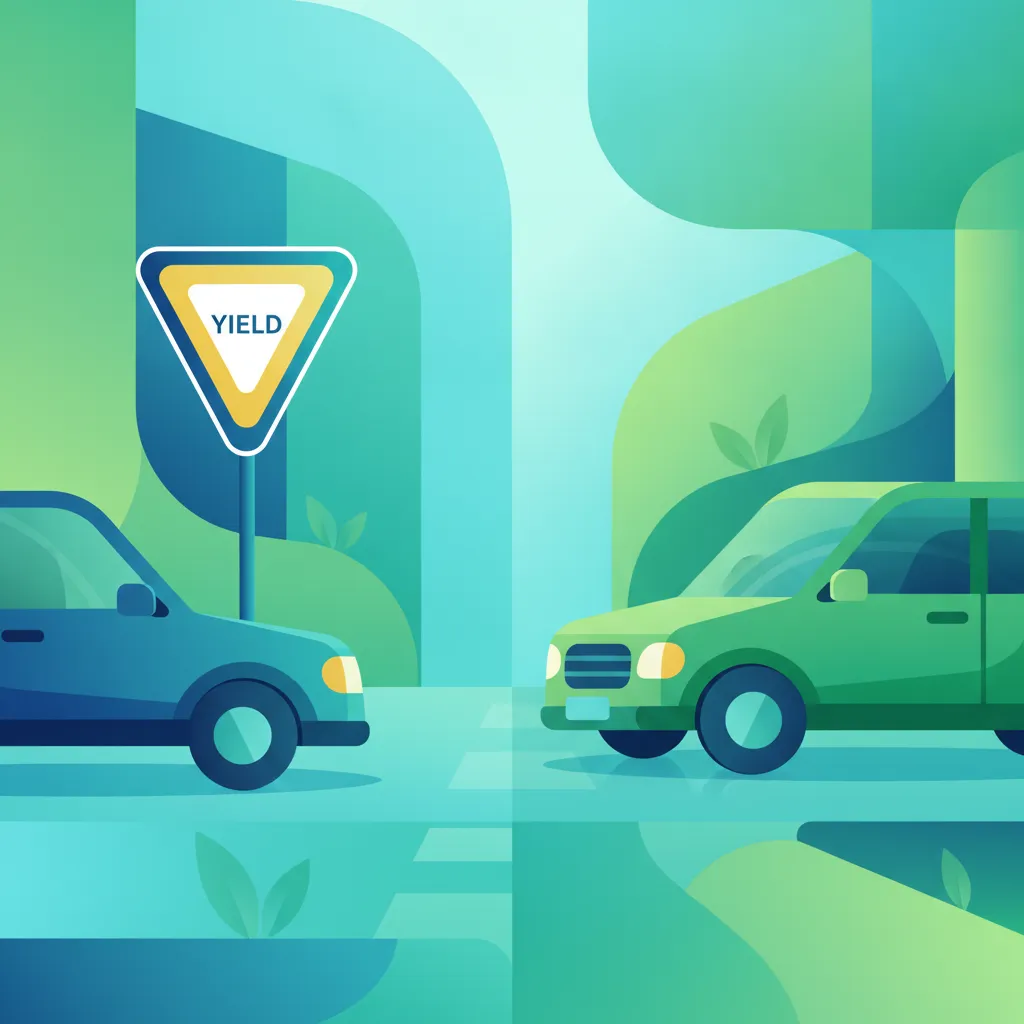
This lesson provides a comprehensive breakdown of priority rules under French law, with special focus on the default rule of priorité à droite. You will learn to recognize when this rule applies, even in the absence of explicit signage, and how to verify that entering vehicles see you. It also explains how to read priority road indicators, stop signs, and yield signs, helping you manage right-of-way safely and confidently.

France features a vast network of roundabouts (carrefours a sens giratoire) governed by specific entry and lane-use regulations. This lesson explains that vehicles entering a roundabout must yield to traffic already circulating inside. You will learn how to select the correct lane depending on your exit, use direction indicators properly, and yield to pedestrians and cyclists near roundabout exits.

Some crossroads feature complex layouts or specific signs that modify standard priority rules, such as schematic diagrams (panonceaux schematiques). This lesson teaches you how to read these auxiliary signs, which depict the thick line of the priority road and thin lines of secondary roads. You will learn how to maintain priority when the main road curves and how to navigate non-standard intersection layouts.

In France, pedestrians have clear legal priority when stepping onto or indicating an intent to use a crossing (passage pieton). This lesson details standard zebra crossings, refuge islands, and pedestrian crossings managed by synchronized traffic light systems. You will learn to scan crossings ahead, anticipate pedestrian movements, and safely come to a stop whenever a pedestrian attempts to cross.

Learners will explore the rules related to pedestrian crossings, focusing on the obligation to yield to pedestrians at zebra crossings and flashing pedestrian signals. The lesson highlights the importance of stopping before the stop line, reducing speed, and maintaining vigilance for pedestrian movement. Mastery of these practices ensures the safety of both pedestrians and AM riders at crossing points.
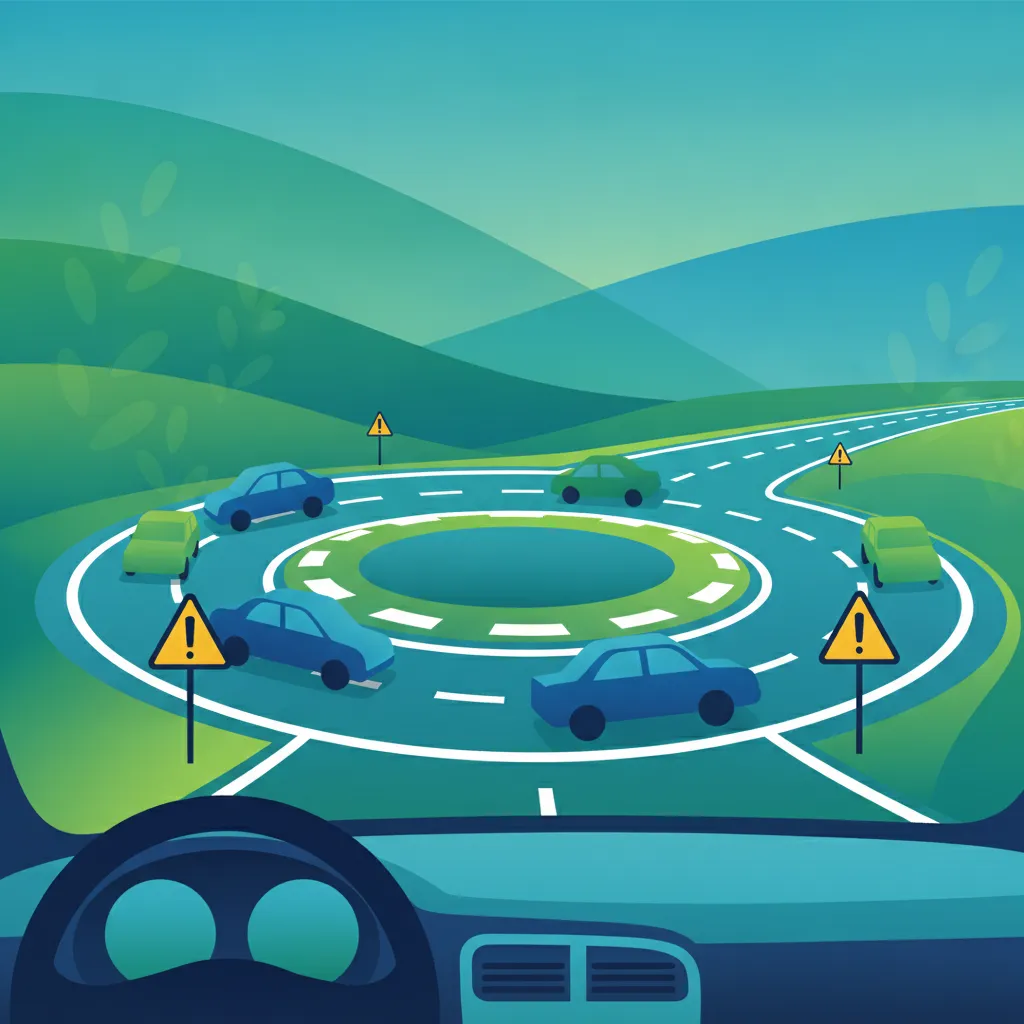
This lesson focuses on the skills required to safely enter, navigate, and exit roundabouts, a common feature in French urban environments. Learners will understand the need to yield to circulating traffic, select the appropriate lane upon entry, and signal intentions when exiting. By mastering these techniques, AM riders can safely integrate into roundabout traffic flow and reduce conflicts with other road users.
Learn to interpret common urban traffic signs and regulatory markers in France. This guide explains how to apply speed limits, understand prohibitions, and manage your positioning within city environments to ensure legal compliance and personal safety when riding your small vehicle.
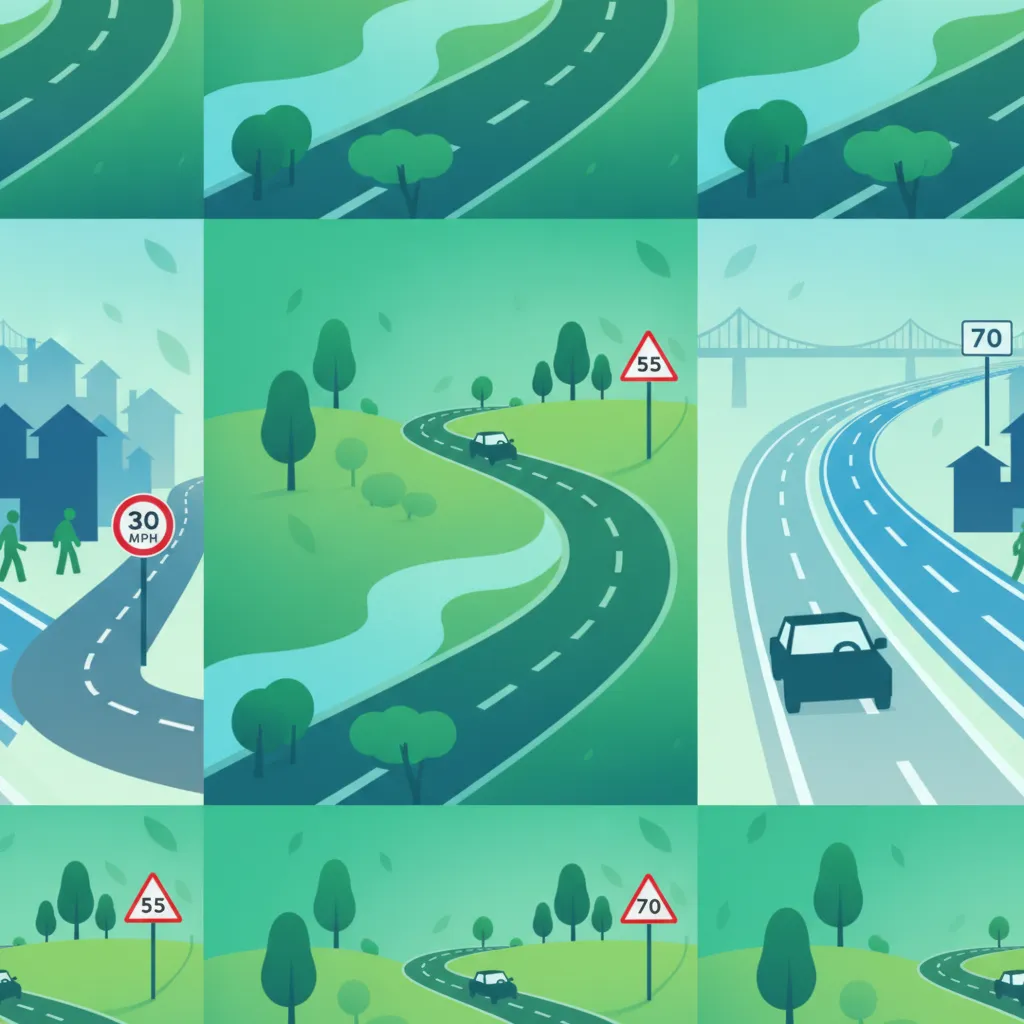
Speed limits in France are strictly regulated based on road category, weather conditions, and the driver's licensing status. This lesson covers standard speeds: 50 km/h in urban areas, 80 km/h on two-lane rural roads, 110 km/h on dual carriageways, and 130 km/h on motorways. You will also learn how these limits drop during rain or fog, and the reduced speed limits applicable to probationary drivers.

This lesson details the specific legal speed limits for passenger transport vehicles on motorways, rural trunk roads, and urban streets under French law. Drivers will learn how speed limits shift depending on overall vehicle weight, towing arrangements, and poor weather conditions like heavy rain. Developing a proactive approach to speed management helps maintain stable vehicle control and ensures full regulatory compliance.
French municipalities utilize distinct low-speed configurations to foster pedestrian safety in residential and educational neighborhoods. This lesson details speed restrictions in 'zone 30', pedestrian-only districts, and shared 'zones de rencontre' where speed is capped at 20 km/h. You will learn how priority hierarchies shift in these zones, giving pedestrians legal priority to use the entire roadway.
The legal speed limit is a maximum threshold, not a target speed that is always safe to maintain. This lesson teaches you how to select an appropriate, safe speed based on visibility, traffic congestion, and road topography. You will learn how to negotiate blind turns, approach summits with caution, and reduce speeds in heavy traffic to ensure you always maintain complete control of your vehicle.

Regulatory signs are circular with red borders for prohibitions and blue backgrounds for mandatory instructions. This lesson details critical signs, such as speed limits, no-entry indicators, overtaking bans, and mandatory turning lanes. You will also learn about environmental zones restrictions, height limits for large vehicles, and the legal priority instructions conveyed by stop and yield signs.
Learners will explore the specific speed limits applicable to AM vehicles across different road environments, including urban streets, residential zones, school areas, and highways in France. The lesson emphasizes interpreting speed sign information and adhering to the legally mandated maximum speeds, particularly the 45 km/h cap for light mopeds. Understanding and respecting these limits is vital for lawful and safe operation of AM vehicles.

French motorways (autoroutes) are fast, controlled-access roads with unique laws regulating lane discipline and emergencies. This lesson teaches standard lane-use: cruising in the right lane and reserving the middle or left lanes exclusively for passing. You will study emergency procedures, the use of orange emergency call boxes, safety barrier rules, and navigating toll booths (peages) safely.
In this lesson, drivers will learn the specific speed limits that apply to goods vehicles across different road types in France, including urban areas, rural roads, and motorways. The content covers the differences between speed limit signs for heavy vehicles and standard passenger cars, the legal basis for these limits, and the importance of speed adaptation based on vehicle category and load. Learners will also be introduced to speed enforcement methods used in France, such as radar and speed cameras.
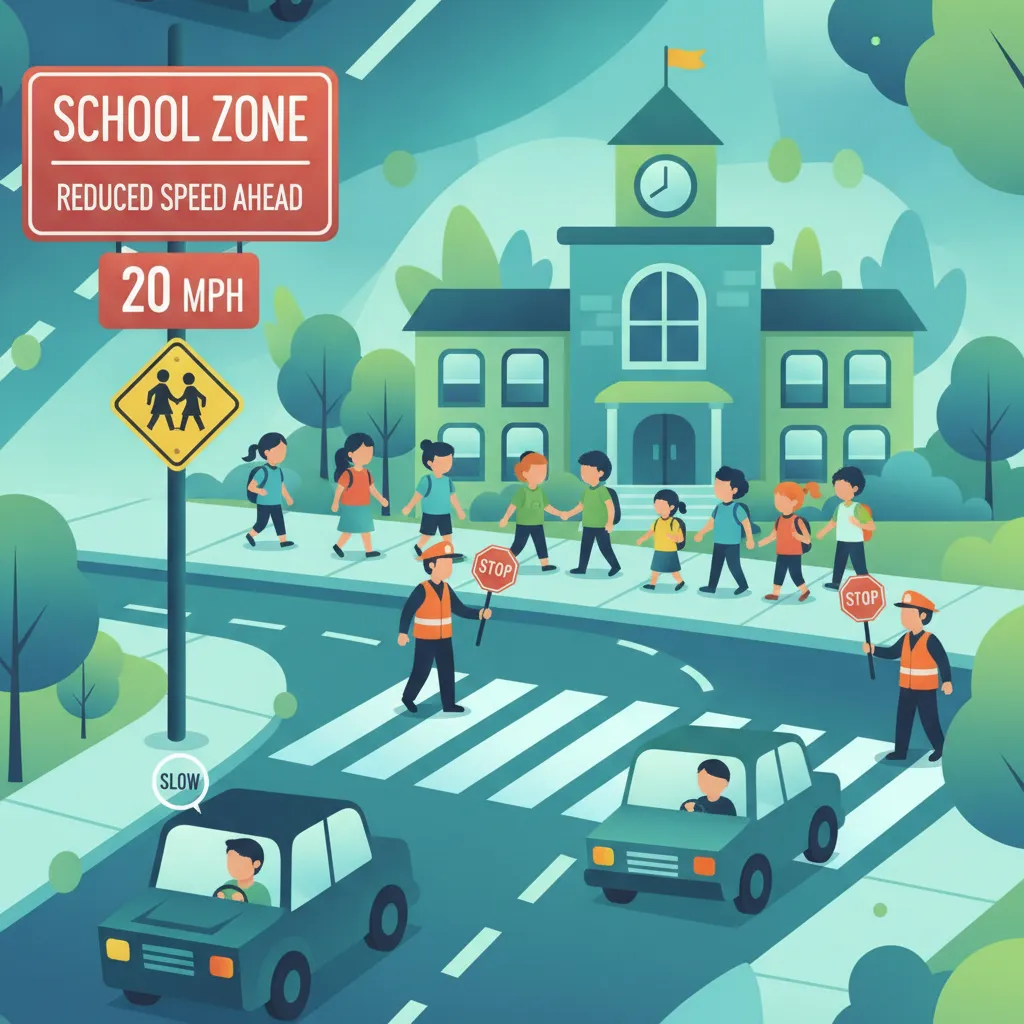
This lesson focuses on the legal rules and safety procedures required within school zones and during school transport (transport scolaire) services in France. Drivers will study strict speed limits, school bus warning sign applications, and mandatory stopping rules when children are boarding. It also details how to respond to official crossing guard signals and ensure students are safely clear before moving.

Traffic signals control flow and priority at busy intersections using precise color sequences. This lesson explains standard red, amber, and green cycles, as well as complex signals like flashing amber lights that indicate caution or a priority-to-the-right situation. You will learn the legal rules for turning on arrow signals and how to coordinate with dedicated pedestrian and cyclist light displays.
Find clear answers to common questions learners have about Regulatory Signs and Their Meanings. Learn how the lesson is structured, which driving theory objectives it supports, and how it fits into the overall learning path of units and curriculum progression in France. These explanations help you understand key concepts, lesson flow, and exam focused study goals.
Regulatory signs are intended to tell drivers about obligations, restrictions, or prohibitions. Failure to follow these instructions is a traffic violation that can lead to fines or safety hazards, especially for vulnerable AM riders.
Yes, unless a specific sign mentions an exception (like for authorized vehicles), all road users including riders of mopeds and light quadricycles must follow the instructions provided by regulatory signs, such as stop signs and speed limits.
In France, regulatory signs (mandatory/prohibitory) are generally circular with red borders or blue backgrounds. Warning signs are triangular with a white background and red border. Recognizing these shapes is a key technique for answering exam questions quickly.
A 'No Entry' (Sens interdit) sign means you must not enter the road or lane from that direction. Even if you are on a small scooter, you are strictly prohibited from entering, and doing so is a major test error.
Ready to focus your study? Use the practice search to find exactly the French driving theory questions you need for the Code de la route and permis de conduire ETG. Refine your knowledge on specific topics or challenging rules to boost your confidence and exam readiness.