This lesson covers the critical rules for safely interacting with pedestrians at marked crossings in France. You will learn to identify different types of crossings and the specific yielding obligations required for Category AM riders to ensure road safety.

Lesson content overview
Safeguarding vulnerable road users is one of the most critical responsibilities of any driver under the French traffic code (Code de la route). As an AM licence candidate operating a moped (cyclomoteur) or a light quadricycle (voiturette), you occupy a unique position on the road. Your vehicle is smaller and more maneuverable than a car, but you share the same legal obligations to protect those traveling on foot.
In France, pedestrian safety is treated with the utmost seriousness. Understanding when, where, and how to yield right-of-way at pedestrian crossings is not just a requirement for passing your AM theory exam—it is a foundational practice to prevent tragic accidents and avoid severe legal penalties.
The modern Code de la route operates on a clear hierarchy of vulnerability. Pedestrians (les piétons) sit at the absolute top of this hierarchy because they have no physical protection in the event of a collision.
Under French law, motorized vehicles must actively manage their speed and road positioning to shield these vulnerable users. This is especially true for AM vehicle riders. While a moped or light motor tricycle is lighter than a standard passenger car, it still possesses enough mass and speed to cause fatal injuries to a pedestrian.
Consequently, the law mandates a highly proactive approach to yielding priority. You must not merely react to a pedestrian already in your path; you must actively anticipate their intent to cross and adjust your riding behavior well in advance.
The most common crossing point you will encounter is the classic zebra crossing (passage piéton à rayures blanches). These are designated areas marked by wide, parallel white stripes painted across the road surface.
A zebra crossing grants pedestrians absolute priority over motorized traffic. The moment a pedestrian steps onto these markings—or even clearly demonstrates an intention to do so (such as stepping up to the curb edge, looking at oncoming traffic, or gesturing)—all vehicles must stop.
A crucial, relatively recent addition to many French crossings is the pedestrian stop line (ligne d'effet). This is a dashed white line painted on the roadway, usually located 2 to 5 metres before the zebra crossing.
The painted dashed line placed several metres before a zebra crossing to designate the exact legal stopping point for vehicles, creating a safety buffer zone that prevents blind-spot collisions.
This buffer zone serves several essential purposes:
If a pedestrian is present or waiting, you must bring your vehicle to a complete stop before this line, not on top of it or past it.
In busy urban areas or high-risk zones (such as near schools or major intersections), zebra crossings are often augmented with warning signals. One of the most common installations in France is the flashing pedestrian signal (boucle de feu pour piétons).
This system consists of an amber or yellow flashing beacon (feu jaune clignotant) installed alongside or above the pedestrian crossing. In many setups, this beacon is linked to a manual crossing button (bouton d'appel) mounted on a post at the curb.
When a pedestrian wishes to cross and presses the button, the amber light begins to flash. This serves as a highly visible, active warning to all approaching motorists.
Negotiating pedestrian crossings safely requires a structured, defensive approach. Use this step-by-step method every time you identify a crossing ahead:
Scan and Identify: Look far ahead to locate zebra markings, warning signs, or flashing beacons. Scan both sides of the sidewalk for pedestrians, paying close attention to blind spots created by parked cars, trees, or street furniture.
Eease the Throttle: Reduce your speed proactively. This gives you more time to react, shortens your overall braking distance, and signals to drivers behind you that you are preparing to decelerate.
Check Your Mirrors: Quickly glance at your rear-view mirrors to assess the distance and speed of vehicles behind you. Gradual braking prevents you from being rear-ended by an inattentive driver.
Analyze Pedestrian Intent: Observe the body language of anyone near the crossing. If they are looking at traffic, approaching the curb, or pushing a stroller, assume they will step out.
Stop Smoothly: If a pedestrian is crossing or preparing to cross, apply both brakes evenly to stop completely behind the designated stop line (ligne d'effet). Avoid sudden, aggressive braking which can cause your moped tires to slide, particularly on wet road markings.
Verify the Clearance: Wait until the pedestrian has fully crossed the street and stepped safely onto the opposite sidewalk before you slowly resume acceleration. Do not begin moving forward while they are still in your lane or the adjacent lane.
A common misconception among new riders is that pedestrians only have priority at designated, painted zebra crossings. In France, the Code de la route extends the priority rule much further to protect pedestrians in various road layouts.
This crucial legal article states that drivers must yield the right-of-way to any pedestrian who is regularly crossing the road, or who clearly indicates the intention to do so. This applies even if there is no marked zebra crossing within 30 metres of their position.
French Legal Standard: Under Article R415-11, if a pedestrian steps onto the roadway or indicates an immediate intent to cross at a location where no painted crosswalk exists (and there is no zebra crossing within 30 metres), you are legally obligated to stop and yield priority.
When you are turning at an intersection, entering a driveway, exiting a parking lot, or navigating a shared zone (zone de rencontre), you must yield to any pedestrians walking along the sidewalk or road edge.
The physical mechanics of stopping your AM vehicle, combined with pedestrian behavior, change significantly depending on external conditions.
Standard road markings in France are painted with thermoplastic materials. While these markings are designed to be durable, they become exceptionally slippery when wet.
Pedestrian visibility drops dramatically after sunset or during heavy rain and fog.
Different categories of pedestrians require different safety margins:
Failing to respect pedestrian priority is classified as a severe traffic infraction in France. The police actively monitor crossings, and modern urban areas increasingly use automated traffic cameras to penalize violators.
If you commit a refus de priorité piéton (failure to yield to a pedestrian):
If a car or truck has stopped before a pedestrian crossing, you must never overtake them. The stopped vehicle is highly likely blocking your view of a crossing pedestrian. Overtaking in this scenario is incredibly dangerous and carries severe criminal penalties.
Do not slowly roll forward while a pedestrian is still on the zebra crossing. This action is intimidating, reduces the safety buffer, and constitutes a failure to yield. Your vehicle must remain stationary until the pedestrian has completely exited the roadway.
Stopping directly on top of the zebra stripes or blocking the ramp of a sidewalk prevents wheelchair users or strollers from crossing safely. Always respect the physical boundaries of the crossing.
| Term (English) | Term (French) | Legal & Practical Definition |
|---|---|---|
| Zebra Crossing | Passage piéton | A marked area on the road surface with white parallel stripes where pedestrians have absolute priority. |
| Stop Line | Ligne d'effet du passage piéton | A dashed line painted 2 to 5 metres before a crossing, indicating the mandatory stopping point when yielding. |
| Flashing Pedestrian Signal | Boucle de feu pour piétons | An active yellow flashing beacon warning drivers of pedestrian presence or crossing intent. |
| Right-of-Way | Priorité de passage | The legal right to proceed first. Pedestrians always have this priority at or near crossings. |
| Vulnerable Road User | Usager vulnérable | Unprotected road users (pedestrians, cyclists) given priority protection under the Code de la route. |
| Low-Beam Headlights | Feux de croisement | Standard headlights used at night to illuminate the road ahead without blinding other users. |
Protecting pedestrians is not merely a set of rules to memorize; it is a fundamental mindset for any responsible road user. As an AM rider, you must always anticipate, decelerate, and stop whenever a pedestrian is near a crossing.
Remember:
By mastering these rules, you protect the most vulnerable members of your community while securing your own safety and legal standing on the roads of France.
Explore all units and lessons included in this driving theory course.
Lesson content overview
Explore all units and lessons included in this driving theory course.
Explore search topics learners often look for when studying Pedestrian Crossings and Right-of-Way. These topics reflect common questions about road rules, driving situations, safety guidance, and lesson level theory preparation for learners in France.
Browse additional driving theory lessons that cover connected traffic rules, road signs, and common driving situations related to this topic. Improve your understanding of how different rules interact across everyday traffic scenarios.
Learn the legal hierarchy of priority at junctions and intersections as defined by the French Code de la route. This guide covers how to identify priority signs, manage right-of-way, and safely navigate complex road layouts while respecting the rules of the road for motorized and non-motorized users.

Negotiating crossroads that lack active traffic light signals requires a clear reading of signs and painted stop or yield lines. This lesson details the obligations of stopping completely at stop signs and slowing down to yield at 'cedez le passage' markings. You will learn to assess cross-traffic speeds, determine priorities when multiple vehicles arrive, and execute turns safely.

In France, the default rule at any intersection without clear priority signage is priority-to-the-right (priorite a droite). This lesson explains how to identify unsignaled junctions in urban and rural environments and when you must yield to incoming vehicles. You will learn to spot the standard yellow diamond priority signs and triangular warning signs that indicate whether you hold the priority.

Controlled intersections use traffic lights and accompanying signs to manage busy crossings systematically. This lesson covers how to safely proceed on a green light, negotiate left turns when yielding to oncoming traffic, and obey flashing amber lights. You will also learn the hierarchy of traffic control, where police officer gestures overrule both traffic lights and priority signs.

Learners will study the fundamental priority rules that dictate right-of-way at intersections, focusing on the 'priorité à droite' principle prevalent in French road design. The lesson explains how to identify priority roads, interpret yield signs, and apply these rules safely when operating an AM vehicle. Understanding priority ensures orderly movement and reduces conflict points in mixed traffic scenarios.

Some crossroads feature complex layouts or specific signs that modify standard priority rules, such as schematic diagrams (panonceaux schematiques). This lesson teaches you how to read these auxiliary signs, which depict the thick line of the priority road and thin lines of secondary roads. You will learn how to maintain priority when the main road curves and how to navigate non-standard intersection layouts.
This lesson provides a comprehensive breakdown of priority rules under French law, with special focus on the default rule of priorité à droite. You will learn to recognize when this rule applies, even in the absence of explicit signage, and how to verify that entering vehicles see you. It also explains how to read priority road indicators, stop signs, and yield signs, helping you manage right-of-way safely and confidently.

In France, pedestrians have clear legal priority when stepping onto or indicating an intent to use a crossing (passage pieton). This lesson details standard zebra crossings, refuge islands, and pedestrian crossings managed by synchronized traffic light systems. You will learn to scan crossings ahead, anticipate pedestrian movements, and safely come to a stop whenever a pedestrian attempts to cross.

France features a vast network of roundabouts (carrefours a sens giratoire) governed by specific entry and lane-use regulations. This lesson explains that vehicles entering a roundabout must yield to traffic already circulating inside. You will learn how to select the correct lane depending on your exit, use direction indicators properly, and yield to pedestrians and cyclists near roundabout exits.

Traffic signals control flow and priority at busy intersections using precise color sequences. This lesson explains standard red, amber, and green cycles, as well as complex signals like flashing amber lights that indicate caution or a priority-to-the-right situation. You will learn the legal rules for turning on arrow signals and how to coordinate with dedicated pedestrian and cyclist light displays.

Learners will learn the critical steps for safely approaching and traversing intersections, emphasizing speed reduction, priority assessment, and adherence to right-of-way rules, including priorité à droite. The lesson covers recognizing stop lines, interpreting road markings, and maintaining a safe distance from other vehicles. By mastering these practices, AM riders can confidently navigate intersections while minimizing collision risk.
Explore the specific regulations for navigating dense urban environments, including shared zones and high-risk pedestrian areas. Discover how to adapt your riding behavior to interact safely with cyclists, pedestrians, and public transport within the legal framework of French traffic laws for AM licence holders.
French municipalities utilize distinct low-speed configurations to foster pedestrian safety in residential and educational neighborhoods. This lesson details speed restrictions in 'zone 30', pedestrian-only districts, and shared 'zones de rencontre' where speed is capped at 20 km/h. You will learn how priority hierarchies shift in these zones, giving pedestrians legal priority to use the entire roadway.
This lesson examines the regulatory limits and environmental controls applied to large passenger vehicles operating in dense French urban centers. Drivers will study the Crit'Air clean air sticker system and low-emission zones (ZFE) that restrict access for older, high-polluting vehicles. It also addresses navigating physical constraints, such as narrow streets, tight turning radii, and strict municipal weight limits.
In this lesson, drivers will learn how to navigate urban delivery zones, understanding the rules surrounding loading bays, time windows, and restricted access areas. The content includes the process for obtaining delivery permits, strategies for safe maneuvering in congested city streets, and best practices for minimizing impact on pedestrian traffic. Learners will also be introduced to French city-specific regulations that govern goods vehicle deliveries.
This lesson focuses on the legal requirement to yield to pedestrians on or about to step onto zebra crossings, a major focus of French road safety. You will learn how to approach school zones and pedestrian islands with heightened vigilance and reduced speed. Additionally, the lesson explores shared urban spaces, explaining how to maintain safe lateral distances when overtaking cyclists or personal electric scooters.
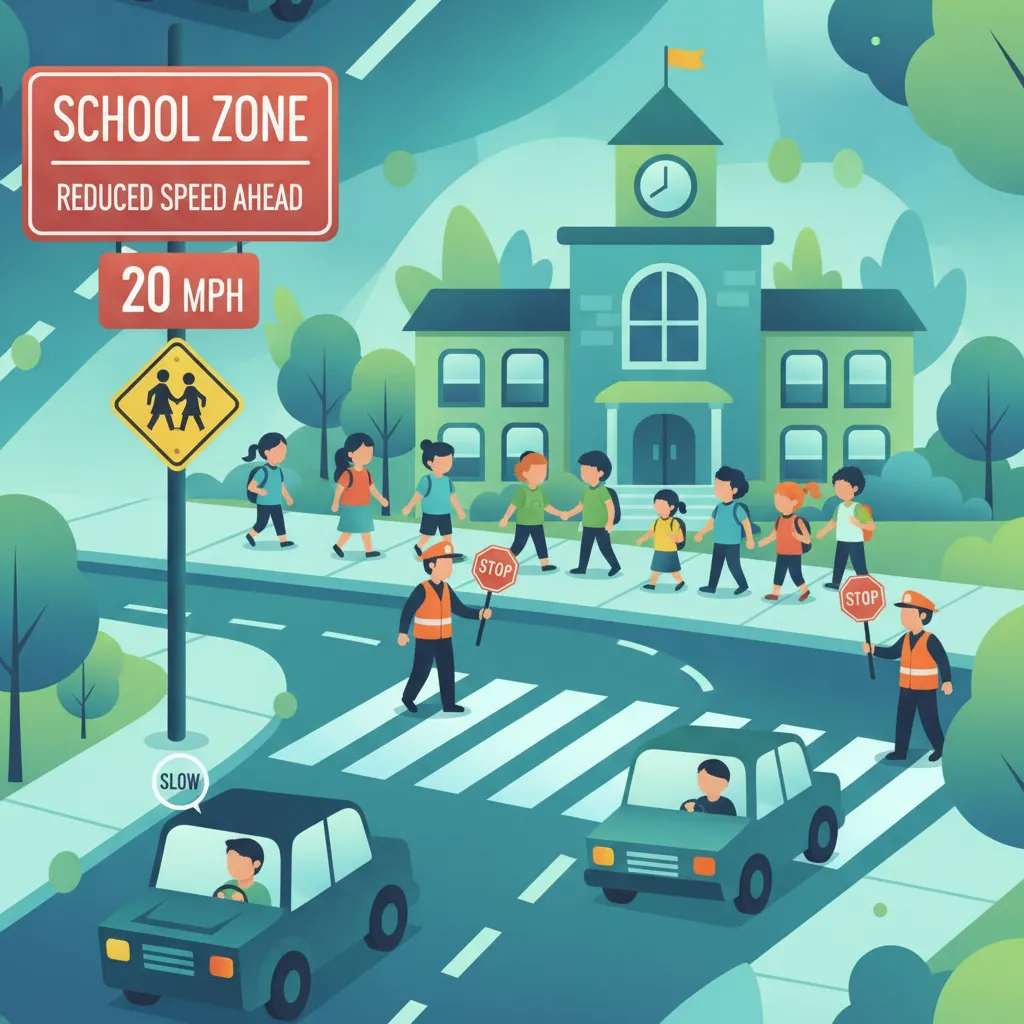
This lesson focuses on the legal rules and safety procedures required within school zones and during school transport (transport scolaire) services in France. Drivers will study strict speed limits, school bus warning sign applications, and mandatory stopping rules when children are boarding. It also details how to respond to official crossing guard signals and ensure students are safely clear before moving.
This lesson clarifies the legal boundaries of urban infrastructure, highlighting the strict ban on riding motorcycles within bus lanes or cycle paths. You will study French regulations concerning traffic flow, including where and when experimental lane filtering is permitted between lines of stationary cars. Understanding these boundaries ensures you can keep moving through congested areas without risking heavy fines or dangerous collisions.

This lesson analyzes the various traffic challenges unique to operating large passenger vehicles in historic and modern French urban areas. Drivers will learn to manage narrow street layouts, double-parked delivery trucks, and high-density multi-lane roundabouts safely. The lesson emphasizes defensive driving strategies, route adjustments, and maintaining mental focus under severe schedule and time pressures.

Public transit vehicles like city buses and streetcars (trams) have clear legal priorities and dedicated infrastructure in urban areas. This lesson teaches you to recognize reserved transit lanes and your legal obligation to yield to buses exiting their designated stops. You will also learn safe driving strategies near tram tracks, ensuring you never block public transit lines or risk passenger boarding areas.
This lesson detail the exact laws governing the use of reserved bus lanes, detailing who may enter them and during what hours of operation. Drivers will study the penalties for unauthorized passenger cars occupying these lanes and the safety protocols for lane sharing with taxi cabs or cyclists. The lesson also highlights safe lane-merging practices when exiting reserved spaces to merge back into general urban traffic.
Urban roads in France feature specialized lanes reserved for public transit, micro-mobility, and distinct parking options. This lesson covers how to recognize bus lanes, cycling lanes, and the specific rules that prohibit general traffic from blocking them. You will also learn to interpret parking bay outlines, loading zones, and spots reserved for electric charging or drivers with disabilities.
Find clear answers to common questions learners have about Pedestrian Crossings and Right-of-Way. Learn how the lesson is structured, which driving theory objectives it supports, and how it fits into the overall learning path of units and curriculum progression in France. These explanations help you understand key concepts, lesson flow, and exam focused study goals.
In the French Code de la route, if a pedestrian shows a clear intention to cross, you must yield. Even if they are waiting, it is safer to be prepared to stop to avoid any sudden movement or risk.
Failing to yield at a pedestrian crossing is a serious offence in France. In your exam, this will lead to a mark deduction, and in reality, it carries heavy fines and potential licence penalties.
Yes, the rules regarding yielding to pedestrians at marked crossings are universal for all motorized vehicles in France, including Category AM vehicles like scooters and light quadricycles.
Always stop well before the white line or the marking at the start of the crossing. Ensure you have clear visibility of the pedestrians without blocking the path for others.
Ready to focus your study? Use the practice search to find exactly the French driving theory questions you need for the Code de la route and permis de conduire ETG. Refine your knowledge on specific topics or challenging rules to boost your confidence and exam readiness.