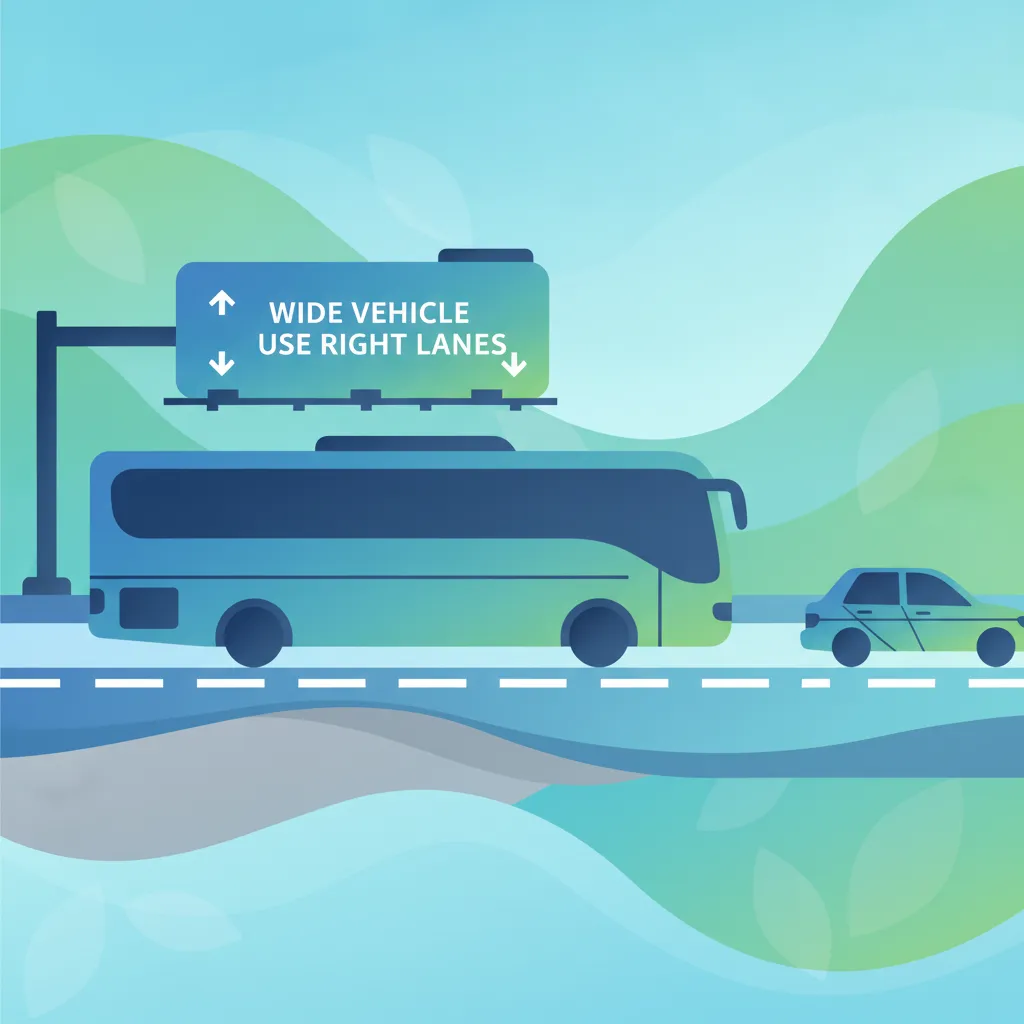
This lesson focuses on the critical lane discipline rules required for operating large passenger vehicles such as buses and coaches on French roads. It is an essential component of the Passenger Vehicle License course, helping you maintain safety and stability while maneuvering in diverse traffic conditions.
Lesson content overview
Operating a large passenger transport vehicle on the French road network requires a heightened level of precision and spatial awareness. Due to their extended length, significant width, and high center of gravity, vehicles in categories D1, D, D1E, and DE demand strict adherence to lane discipline (discipline de voie).
Proper lane positioning is not merely a legal requirement of the French Road Code (Code de la route); it is a fundamental safety practice. It prevents encroachment on adjacent lanes, protects vulnerable road users, and ensures the comfort and stability of passengers. This guide covers the essential principles of lane discipline, the step-by-step mechanics of executing safe lane changes, and the legal frameworks governing heavy passenger transport.
Maintaining proper lane discipline involves more than simply driving between two painted lines. It requires constant visual scanning, anticipating road geometry, and understanding how your vehicle's physical dimensions interact with the roadway.
For passenger transport vehicles, the general rule is to keep the vehicle’s longitudinal axis aligned precisely with the center of the lane.
Maintaining a central position offers several distinct advantages:
A common error among novice drivers is "hugging" the right-hand curb out of fear of oncoming traffic. This over-correction increases the risk of striking pedestrians on sidewalks, colliding with low-hanging tree branches, or damaging tires on curbs. Conversely, centering too close to the left lane line risks encroaching on oncoming traffic or faster vehicles in the overtaking lane.
Lane widths on French roads vary significantly depending on the environment. Standard motorway (autoroute) and national road (route nationale) lanes are typically between 3.0 and 3.5 metres wide. However, in historic city centers and older residential quarters, lanes may narrow to less than 3.0 metres.
The unauthorized or unsafe crossing of lane boundaries, where any portion of the vehicle's body, mirrors, or tires enters an adjacent lane, cycle lane, or sidewalk.
Before entering any roadway, a professional driver must evaluate whether the lane width is suitable for their vehicle category. Under the Code de la route, if a lane is too narrow to allow safe clearance, the driver must adapt by reducing speed, choosing an alternative route, or waiting for oncoming traffic to pass before proceeding through narrow pinch points.
Every lateral movement of a large vehicle introduces instability. Due to their high center of gravity, buses and coaches are vulnerable to lateral sway.
When changing lanes, the goal is to perform the maneuver with the smallest possible steering angle over a longer distance. This is known as minimizing lateral displacement. Gradual, progressive steering inputs keep the passenger cabin stable, prevent passengers from being thrown from their seats, and ensure that any trailer attachment (in category D1E or DE) follows the towing vehicle without swaying or jackknifing.
Executing a lane change in a passenger transport vehicle requires a structured visual and signaling routine. Because your blind spots (angles morts) are significantly larger than those of a standard passenger car, you must rely on a systematic sequence to verify that the path is clear before moving the steering wheel.
Pre-Maneuver Observation: Check the interior rearview mirror to assess passenger stability, then check the main exterior side mirrors and wide-angle mirrors to evaluate the traffic flow in the target lane.
Signal Intention: Activate the appropriate turn indicator (clignotant) at least 3 seconds before initiating any physical movement. This alerts surrounding drivers to your intent, giving them time to adjust their speed.
Secondary Verification (Blind Spot Check): Perform a quick, focused head check (glancing out of the side window or forward door glass) to verify the area immediately adjacent to the driver's cab that mirrors cannot capture.
Smooth Execution: Steer gently into the target lane with minimal lateral displacement, maintaining a steady speed to match the flow of traffic in the new lane.
Deactivate Indicator: Immediately after the vehicle (and trailer, if applicable) has fully entered the new lane, cancel the turn signal to avoid confusing following drivers.
Never rely solely on your mirrors. Due to the length of category D vehicles, a passenger car or motorcycle can easily become completely hidden in the blind spot areas directly alongside the passenger doors or the rear quarters of the bus.
Professional drivers are held to strict legal standards. Violations of lane discipline can lead to heavy fines, point deductions on the professional driving license, and administrative suspensions.
Under Articles R412-6 to R412-9 of the Code de la route, drivers must keep their vehicles entirely within the marked boundaries of their designated lane. Crossing or straddling continuous solid lines (lignes continues) is strictly prohibited, except in highly specific emergency situations or when passing stationary obstacles where permitted by local road signs.
According to Article R412-8 of the French Road Code, any driver intending to change the direction of their vehicle or move laterally must signal their intention clearly and early. For large passenger vehicles, signaling must occur at least 3 seconds before the vehicle changes its lateral path. Failing to signal, or signaling late (after the maneuver has already begun), is a punishable offense.
When overtaking or passing adjacent road users, passenger transport vehicles must maintain a strict lateral safety margin to accommodate vehicle sway, wind gusts, and unexpected movements by others.
Lane discipline cannot be practiced in a vacuum. A professional driver must constantly adapt their positioning and signaling to account for environmental factors, vehicle conditions, and the presence of vulnerable road users.
In rain, snow, or fog, traction is compromised, and visibility is severely reduced.
The dynamics of an articulated bus or a coach towing a luggage/passenger trailer are vastly different from a rigid vehicle.
Understanding where errors occur allows professional drivers to actively monitor their driving habits and avoid critical mistakes.
+-----------------------------------------------------------------------------+
|                         COMMON LANE DISCIPLINE ERRORS                       |
+-----------------------------------------------------------------------------+
|                                                                             |
|  [ Late Signaling ] -------------------> Surprises following traffic;       |
|                                         increases rear-end collision risk.  |
|                                                                             |
|  [ Encroaching on Sidewalks ] --------> Risks striking pedestrians; damages  |
|                                         tires and suspension.               |
|                                                                             |
|  [ Forgotten Turn Signals ] ----------> Misleads other road users; causes   |
|                                         unpredictable traffic flow.          |
|                                                                             |
|  [ Overshooting the Target Lane ] ----> Enters second adjacent lane;        |
|                                         creates multi-vehicle hazards.      |
|                                                                             |
+-----------------------------------------------------------------------------+
Explore all units and lessons included in this driving theory course.
Lesson content overview
Explore all units and lessons included in this driving theory course.
Explore search topics learners often look for when studying Lane Discipline for Large Passenger Vehicles. These topics reflect common questions about road rules, driving situations, safety guidance, and lesson level theory preparation for learners in France.
Browse additional driving theory lessons that cover connected traffic rules, road signs, and common driving situations related to this topic. Improve your understanding of how different rules interact across everyday traffic scenarios.
Learn the mechanics of safe turning and maneuvering for buses and coaches in dense urban traffic. This guide explains how to manage blind spots and vehicle overhang to navigate tight intersections, roundabouts, and restricted spaces according to the French Code de la route standards for heavy passenger transport vehicles.

This lesson analyzes the technical path a long wheelbase vehicle must take when turning at intersections and navigating roundabouts. Drivers will learn to calculate tail swing and rear-wheel tracking, intentionally swinging wide to clear roadside curbs and poles safely. The lesson emphasizes yielding protocols for pedestrians and cyclists who may be crossing the target street during the turn.

In this lesson, drivers will learn how to plan and execute wide turns with goods vehicles, taking into account turning radius, pivot points, and articulation angles. The content emphasizes the necessity of using the full width of the lane, correctly aligning the vehicle through the turn, and anticipating the movement of the trailer. Learners will also explore road marking guidelines for turning and the importance of giving clear signals to surrounding traffic.
This lesson focuses on maneuvering in extremely crowded areas, passenger terminals, or narrow streets blocked by parked vehicles and obstacles. Drivers will learn to assess clearance distances precisely before committing to narrow pathways. The content teaches steering techniques that maintain stability, optimize space usage, and prioritize public safety during slow-speed, high-difficulty maneuvers.

This lesson analyzes the various traffic challenges unique to operating large passenger vehicles in historic and modern French urban areas. Drivers will learn to manage narrow street layouts, double-parked delivery trucks, and high-density multi-lane roundabouts safely. The lesson emphasizes defensive driving strategies, route adjustments, and maintaining mental focus under severe schedule and time pressures.

This lesson covers the physical dimensions of passenger vehicles and how their high profile, length, and width alter spatial awareness on the road. Learners will study tail-swing mechanics and track the path of the rear wheels during sharp turns to avoid hitting roadside obstacles. Accurate measurement of overhead structures, bridges, and underpass clearances is taught to prevent catastrophic structural collisions.
Understand the impact of weather conditions and road surfaces on vehicle stability for Category D drivers. This theory guide covers techniques for managing lateral displacement and maintaining lane control during rain, high winds, and on varying road types to ensure passenger safety and professional driving standards in France.
This lesson covers the mechanical and physical adaptations required to drive a passenger coach in rain, heavy fog, snow, and crosswinds. Drivers will learn to recognize signs of aquaplaning and understand the dramatic traction loss associated with wet or icy roads. It also details French winter equipment regulations (Loi Montagne) requiring snow tires or chains in designated mountainous regions.

In this lesson, drivers will learn how to adjust their driving techniques in response to adverse weather conditions such as rain, fog, snow, ice, and strong winds. The content covers strategies for maintaining visibility, managing reduced traction on wet or icy surfaces, and adjusting speed and braking distances accordingly. Learners will also be introduced to the use of anti-skid and stability control systems under challenging weather.

Adverse weather reduces tyre traction and limits visibility, dramatically raising the risk of multi-car accidents on highways. This lesson details speed reductions required during rainfall, techniques for avoiding aquaplaning, and demisting windshields for visibility. You will learn how to maintain extra stopping distance on snow-covered roads and the correct headlight adjustments to make during fog.
Find clear answers to common questions learners have about Lane Discipline for Large Passenger Vehicles. Learn how the lesson is structured, which driving theory objectives it supports, and how it fits into the overall learning path of units and curriculum progression in France. These explanations help you understand key concepts, lesson flow, and exam focused study goals.
Buses and coaches have a much larger width and longer wheelbase, meaning they require more space within a lane. Improper positioning can lead to side-swiping other vehicles or mounting curbs, especially on bends or at intersections.
You must check your interior and exterior mirrors, signal your intention in advance, check your blind spots to ensure the maneuver is safe, and then move smoothly without abrupt steering, ensuring the entire vehicle has cleared the lane.
Maintain a central lane position where possible and reduce speed. Use your mirrors frequently to monitor your vehicle's alignment relative to road markings and street furniture.
Yes, large passenger vehicles are often restricted to the right-hand lanes on motorways except when overtaking, and strict lane discipline is required to avoid obstructing faster-moving traffic.
Ready to focus your study? Use the practice search to find exactly the French driving theory questions you need for the Code de la route and permis de conduire ETG. Refine your knowledge on specific topics or challenging rules to boost your confidence and exam readiness.