
This lesson explains how center of gravity (CoG) directly influences the stability of your heavy goods vehicle. You will learn the critical relationship between load height, weight distribution, and the risk of rollovers during cornering or emergency maneuvers, which is essential for your professional C, C1, and CE licensing exams.

Lesson content overview
For professional drivers operating heavy goods vehicles (HGVs) under an Italian Goods Vehicle License (C, C1, C1E, CE), understanding vehicle stability is paramount. A fundamental concept governing this stability is the Center of Gravity (CoG). The CoG is the hypothetical point where the entire weight of the vehicle and its load can be considered to act. Its position, particularly its height from the ground, critically determines a vehicle's susceptibility to tipping over, a dangerous event known as rollover.
This lesson delves into the definition and implications of the CoG, explaining how load placement directly influences its position and, consequently, the vehicle's stability. We will explore the dynamics of load transfer during maneuvers and outline best practices for loading and driving to mitigate rollover risk. A thorough grasp of these principles is not only vital for safety but also essential for complying with Italian legal regulations concerning vehicle loading and operation.
The Center of Gravity (CoG) is the single point where the combined weight of an object or system, such as a heavy goods vehicle and its cargo, appears to be concentrated. Imagine balancing the entire vehicle on the tip of a pencil; that balancing point would be its CoG. This point is crucial for analyzing how a vehicle will behave under various forces, especially those encountered during driving.
The exact location of the CoG is determined by the vehicle's design and, more importantly for HGVs, by the distribution of its load. Any change in the placement of goods, even relatively light items placed very high, will alter the overall CoG.
To fully understand vehicle stability, we consider the CoG in three dimensions:
The precise coordination of these three dimensions dictates how the vehicle will respond to forces like acceleration, braking, and cornering, directly impacting its overall stability and handling characteristics.
The CoG isn't a fixed point but can shift depending on the vehicle's state and movement:
The location of the Center of Gravity when the vehicle is completely stationary and at rest.
The static CoG is what loading managers and drivers plan for. It is used in calculations to ensure that a loaded vehicle meets legal requirements for stability and axle loads.
The effective Center of Gravity of a vehicle while it is in motion, influenced by forces such as acceleration, braking, and cornering, which cause weight to shift.
The dynamic CoG is the actual CoG during operation. When a vehicle accelerates, brakes, or turns, the effective weight distribution shifts, causing the dynamic CoG to move. This movement is known as load transfer, and it plays a significant role in vehicle stability during active driving. A driver must always be aware that even a perfectly loaded vehicle (static CoG within limits) can become unstable if the dynamic CoG shifts too much due to aggressive maneuvers or adverse conditions.
The most significant consequence of a high CoG, particularly a high vertical CoG, is an increased rollover risk. Heavy goods vehicles, by their nature, often carry substantial loads, making them inherently more prone to rollover than lighter passenger vehicles, especially when improperly loaded.
The rollover threshold defines the maximum lateral acceleration a vehicle can withstand before it begins to tip onto its side or roof. This threshold is primarily determined by two factors:
When a vehicle experiences lateral forces (e.g., during a turn or evasive maneuver), the force acts through the CoG. The higher the CoG, the greater the "moment arm" (the perpendicular distance from the CoG to the pivot point, usually the outer wheels). A larger moment arm makes it easier for the lateral force to generate a tipping motion, reducing the rollover threshold.
Consider a heavy goods vehicle navigating a curve. As it turns, centrifugal force pushes the vehicle outwards, creating a lateral force that attempts to tip it. If the CoG is high, this force has a greater leverage to lift the inner wheels off the ground.
A high CoG means that less lateral force is required to cause the vehicle's weight to shift sufficiently to lift the inner wheels. Once the inner wheels lift, the vehicle's effective base of support narrows, drastically increasing the likelihood of the vehicle continuing to tip and rolling over completely. This is why vehicles with naturally high loads (like tankers or double-decker buses) or improperly loaded HGVs must operate with extreme caution, particularly when cornering or making sudden steering inputs.
Even with speed within legal limits, a high CoG can lead to rollover on curves or during sudden evasive maneuvers. Speed is a factor, but CoG height is a primary determinant of rollover susceptibility.
Load transfer is the phenomenon where the effective weight distribution of a vehicle shifts among its wheels during acceleration, braking, or cornering. This is a dynamic process that directly influences the dynamic CoG and is critical for understanding vehicle stability in motion.
Lateral load transfer occurs when a vehicle turns or is subjected to side forces:
The most effective way to manage CoG and mitigate rollover risk in heavy goods vehicles is through meticulous load placement. Professional drivers and loading personnel must adhere to strict principles to ensure the vehicle remains stable under all anticipated operating conditions.
The golden rule for HGV loading is to place the heaviest items as low and as centrally as possible within the cargo area.
When loading mixed cargo, always place heavier items at the bottom and lighter items on top. This is a fundamental principle for maintaining a low CoG.
Beyond simply placing items low, proper distribution across the entire cargo area is essential:
Even a perfectly distributed load becomes a hazard if it is not properly secured. Loose cargo can shift during acceleration, braking, or cornering, causing an abrupt and unpredictable change in the dynamic CoG.
The Italian Codice della Strada (Highway Code) and related regulations impose strict requirements on heavy goods vehicle operators regarding load distribution and stability. These rules are designed to ensure public safety and prevent incidents such as rollovers.
While specific numerical CoG height limits can vary by vehicle type and configuration, Italian regulations generally require that loads are placed to maintain the lowest possible CoG.
The overarching principle is that the vertical CoG must remain within safe operational parameters to prevent rollover under typical driving conditions, including moderate cornering and braking. Loading vehicles in a way that creates an excessively high CoG is a violation of safe operating principles and potentially the law.
Failure to comply with load distribution and CoG limits can lead to severe consequences for the driver and the transport company:
Understanding the principles of CoG and stability is best reinforced by recognizing common mistakes that lead to increased rollover risk.
Safe driving practices are the final line of defense against rollover, especially when operating HGVs with potentially high centers of gravity. Drivers must constantly adapt their driving to account for the vehicle's load and environmental conditions.
Adverse weather conditions significantly reduce tire grip, making any instability caused by a high CoG even more perilous.
The type of road encountered directly impacts the forces acting on the vehicle and its load.
The mechanical condition of the vehicle plays a role in stability, particularly when combined with a challenging CoG.
Regular vehicle checks, including tire pressure and suspension integrity, are crucial for ensuring the vehicle can handle its load safely.
The concept of the Center of Gravity is far more than a theoretical physics principle; it is a fundamental aspect of daily operations for heavy goods vehicle drivers. A low and centrally positioned CoG is the bedrock of vehicle stability, directly influencing the rollover threshold and the vehicle's safe operating limits.
Understanding how load placement, vehicle maneuvers, and environmental conditions dynamically alter the CoG empowers drivers to make informed decisions. By adhering to strict loading protocols, practicing smooth and anticipatory driving, and respecting the Italian legal framework, professional drivers can significantly reduce rollover risk, ensuring their own safety, the integrity of their cargo, and the safety of all other road users. Mastery of these principles is an indispensable component of responsible and professional heavy goods vehicle operation.
The Center of Gravity (CoG) is the single point where a vehicle's total weight acts, and its vertical height is the primary determinant of rollover risk for heavy goods vehicles. When cornering, centrifugal force acts through the CoG, and a higher CoG creates greater leverage to tip the vehicle sideways. Load transfer during maneuvers redistributes weight dynamically among wheels, raising the effective CoG and reducing stability. Professional drivers must load heaviest items low and centrally, distribute weight evenly along the vehicle's length and width, and secure all cargo to prevent unexpected CoG shifts. Italian Codice della Strada regulations mandate compliance with GVW and axle load limits, with severe penalties for violations that compromise vehicle stability.
A short set of high-value points that capture the most important learning from this lesson.
The Center of Gravity (CoG) is the hypothetical point where a vehicle's entire weight appears to act, and its height critically determines rollover susceptibility
A higher vertical CoG creates a longer moment arm during cornering, requiring less lateral force to cause the vehicle to tip
The rollover threshold is determined by both the vertical CoG height and the vehicle's track width
Dynamic CoG shifts during motion as weight transfers between wheels during acceleration, braking, and cornering
Italian regulations require loads to maintain the lowest possible CoG, with strict GVW and axle load limits
Explore all units and lessons included in this driving theory course.
Heaviest cargo must always be placed as low and as centrally as possible within the cargo area
Lateral load transfer during cornering shifts weight to outer wheels, raising the dynamic CoG and increasing rollover risk
Even with speed within legal limits, a high CoG can cause rollover on curves or during evasive maneuvers
Loose or unsecured cargo can abruptly shift the dynamic CoG, making even a properly loaded vehicle unstable
Adverse weather reduces tire grip, making CoG-related instability even more dangerous
Stacking heavy items high creates a 'pyramid' effect that dramatically raises the vertical CoG
Uneven lateral distribution shifts the CoG to one side, making the vehicle highly prone to rollover when turning toward the lighter side
Placing too much weight at the rear reduces front axle load, impairing steering control and braking performance
Neglecting to secure upper loads even when heavy items are positioned correctly at the bottom
Drivers entering curves at speed without accounting for their vehicle's high CoG and the resulting lateral load transfer forces
Lesson content overview
A short set of high-value points that capture the most important learning from this lesson.
The Center of Gravity (CoG) is the hypothetical point where a vehicle's entire weight appears to act, and its height critically determines rollover susceptibility
A higher vertical CoG creates a longer moment arm during cornering, requiring less lateral force to cause the vehicle to tip
The rollover threshold is determined by both the vertical CoG height and the vehicle's track width
Dynamic CoG shifts during motion as weight transfers between wheels during acceleration, braking, and cornering
Italian regulations require loads to maintain the lowest possible CoG, with strict GVW and axle load limits
Explore all units and lessons included in this driving theory course.
Heaviest cargo must always be placed as low and as centrally as possible within the cargo area
Lateral load transfer during cornering shifts weight to outer wheels, raising the dynamic CoG and increasing rollover risk
Even with speed within legal limits, a high CoG can cause rollover on curves or during evasive maneuvers
Loose or unsecured cargo can abruptly shift the dynamic CoG, making even a properly loaded vehicle unstable
Adverse weather reduces tire grip, making CoG-related instability even more dangerous
Stacking heavy items high creates a 'pyramid' effect that dramatically raises the vertical CoG
Uneven lateral distribution shifts the CoG to one side, making the vehicle highly prone to rollover when turning toward the lighter side
Placing too much weight at the rear reduces front axle load, impairing steering control and braking performance
Neglecting to secure upper loads even when heavy items are positioned correctly at the bottom
Drivers entering curves at speed without accounting for their vehicle's high CoG and the resulting lateral load transfer forces
Explore search topics learners often look for when studying Center of Gravity and Rollover Risk. These topics reflect common questions about road rules, driving situations, safety guidance, and lesson level theory preparation for learners in Italy.
Browse additional driving theory lessons that cover connected traffic rules, road signs, and common driving situations related to this topic. Improve your understanding of how different rules interact across everyday traffic scenarios.
Explore how load placement, Center of Gravity (CoG), and load transfer impact heavy vehicle stability. Learn essential strategies for preventing rollover risks in Italian C and CE theory.

This lesson vividly illustrates the dangers of a load that moves during transit. It explains how a sudden load shift during braking can increase stopping distance or cause a jack-knife, while a shift during cornering can easily lead to a rollover. By understanding these dynamic forces, learners will appreciate the absolute necessity of ensuring every piece of cargo is properly and robustly secured before starting a journey.

This lesson details the legal restrictions on the weight that can be supported by a single axle or a group of axles. It explains the importance of distributing the load correctly across the vehicle's length to prevent exceeding these limits, which can cause significant road damage and compromise vehicle safety. Learners will understand the relationship between load placement, axle pressure, and overall stability, particularly during braking and cornering.

This lesson focuses on the practical skill of distributing the load's weight evenly across the vehicle's axles. It explains how improper placement can overload one axle while underloading another, leading to legal violations and poor vehicle handling, steering, and braking performance. Learners will understand how to create a balanced load plan that respects legal axle limits and ensures the vehicle remains stable and controllable.

This lesson explores the critical physics behind stopping a heavy vehicle. It breaks down the components of total stopping distance—thinking distance and braking distance—and explains how this is significantly increased by vehicle mass and speed. Learners will understand the necessity of maintaining a much greater following distance than a car to allow enough space to stop safely in all conditions.

This lesson addresses two major hazards of articulated vehicle operation: jack-knifing and rear swing. It explains how a jack-knife occurs when the trailer skids and pushes the tractor into a sharp, uncontrolled angle, often due to harsh braking or slippery conditions, and covers prevention and correction techniques. The lesson also describes rear swing (tail swing), where the back of the trailer swings wide during tight turns, posing a risk to nearby objects and people.

This lesson introduces the core physical principles behind effective cargo restraint. It explains how different methods—such as blocking to prevent sliding, and lashing to increase pressure and friction—work to counteract the forces of acceleration, braking, and cornering. Learners will become familiar with the various types of equipment, like straps and chains, and understand the basic concepts that underpin all secure loading practices.

This lesson synthesizes the unit's concepts through practical, real-world examples of load planning. Learners will work through scenarios that require calculating payload, distributing weight across axles, and checking dimensions to ensure full compliance with 'sagoma limite'. These exercises reinforce the importance of meticulous pre-trip planning to guarantee a safe, legal, and efficient transport operation from start to finish.

This lesson focuses on a key dynamic behavior of articulated vehicles known as 'off-tracking' or 'cut-in'. It explains why, during a turn, the trailer's wheels follow a path inside that of the tractor's wheels, which requires the driver to make wider turns to avoid hitting curbs, signs, or other vehicles. Understanding and anticipating off-tracking is a fundamental skill for safely maneuvering a combination vehicle, especially in tight spaces.

This lesson delves deeper into the dynamics of turning, introducing the concept of the 'swept path'—the total area a vehicle covers when making a turn. It builds on the idea of off-tracking, explaining how to position the vehicle before entering a turn to ensure the trailer safely clears corners, curbs, and other obstacles. Mastering this spatial judgment is essential for navigating junctions and roundabouts without incident.

This lesson explains the principles of safe load management to maintain vehicle stability and comply with legal requirements. It covers how to properly distribute and secure cargo inside the vehicle, the rules for using roof racks, and the specific signaling required for loads that project beyond the vehicle's rear. The content also provides a basic introduction to the rules and safety considerations when towing a small trailer.
Understand Italian regulations and practical methods for securing loads and distributing weight correctly in heavy goods vehicles. Learn how proper securing prevents load shifts and maintains vehicle stability.
This lesson details the legal restrictions on the weight that can be supported by a single axle or a group of axles. It explains the importance of distributing the load correctly across the vehicle's length to prevent exceeding these limits, which can cause significant road damage and compromise vehicle safety. Learners will understand the relationship between load placement, axle pressure, and overall stability, particularly during braking and cornering.
This lesson introduces the core physical principles behind effective cargo restraint. It explains how different methods—such as blocking to prevent sliding, and lashing to increase pressure and friction—work to counteract the forces of acceleration, braking, and cornering. Learners will become familiar with the various types of equipment, like straps and chains, and understand the basic concepts that underpin all secure loading practices.

This lesson provides a detailed overview of the legal framework for load securing in Italy, focusing on the relevant articles of the Codice della Strada. It outlines the driver's legal responsibility for ensuring the load is secure and covers the standards that securing equipment must meet. Learners will be made aware of the significant fines and other penalties that can be imposed for violations, reinforcing the importance of diligent compliance.
This lesson focuses on the practical skill of distributing the load's weight evenly across the vehicle's axles. It explains how improper placement can overload one axle while underloading another, leading to legal violations and poor vehicle handling, steering, and braking performance. Learners will understand how to create a balanced load plan that respects legal axle limits and ensures the vehicle remains stable and controllable.
This lesson vividly illustrates the dangers of a load that moves during transit. It explains how a sudden load shift during braking can increase stopping distance or cause a jack-knife, while a shift during cornering can easily lead to a rollover. By understanding these dynamic forces, learners will appreciate the absolute necessity of ensuring every piece of cargo is properly and robustly secured before starting a journey.
This lesson explains the principles of safe load management to maintain vehicle stability and comply with legal requirements. It covers how to properly distribute and secure cargo inside the vehicle, the rules for using roof racks, and the specific signaling required for loads that project beyond the vehicle's rear. The content also provides a basic introduction to the rules and safety considerations when towing a small trailer.
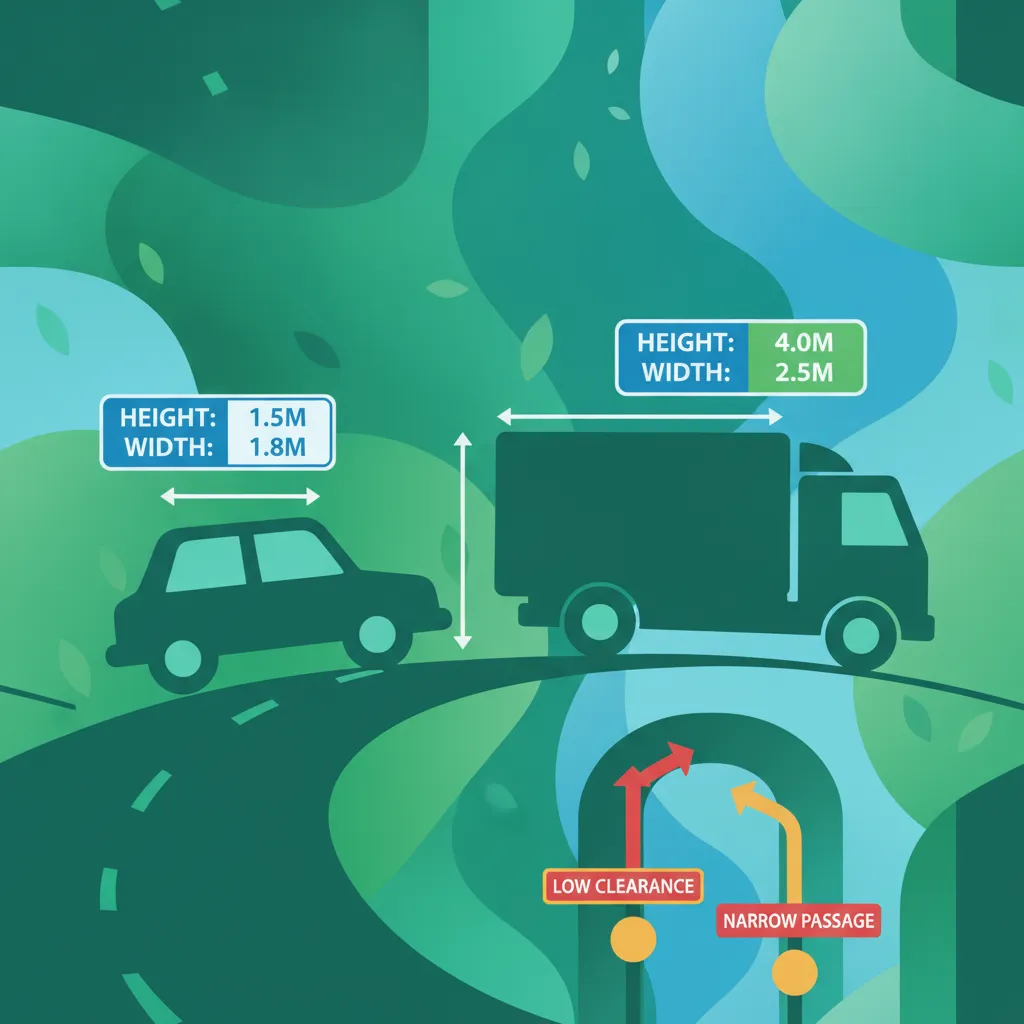
This lesson focuses on the specific dimensional limits that heavy goods vehicles must adhere to on Italian roads, as stipulated by the Codice della Strada. It covers the maximum permissible length, width, and height, explaining how these restrictions impact navigation through tunnels, under bridges, and within urban environments. Learners will also understand the conditions under which special permits for exceptional or oversized transport are required.

This lesson outlines the correct protocols for stopping to make a delivery in a public area. It covers the legal use of designated loading bays, the importance of making the vehicle highly visible with hazard lights, and ensuring that the parking brake is securely applied. The lesson stresses the need to conduct loading and unloading activities efficiently and safely, without causing undue obstruction or danger to other road users and pedestrians.

This lesson provides the practical knowledge needed to calculate the maximum permissible payload ('portata') for a goods vehicle. It explains how to subtract the vehicle's unladen weight (tare) from its maximum authorized mass to determine the available capacity for cargo. Mastering this calculation is essential for planning loads, ensuring legal compliance, and avoiding the risks associated with exceeding the vehicle's design limits.
Find clear answers to common questions learners have about Center of Gravity and Rollover Risk. Learn how the lesson is structured, which driving theory objectives it supports, and how it fits into the overall learning path of units and curriculum progression in Italy. These explanations help you understand key concepts, lesson flow, and exam focused study goals.
A low center of gravity significantly reduces the risk of the vehicle tipping over when cornering or performing sudden maneuvers. Because heavy vehicles have a high mass, any shift in weight creates large lateral forces that can easily cause a rollover if the weight is positioned too high.
When you turn, centrifugal force pushes the vehicle outward. If your center of gravity is high, this force acts over a longer lever arm, which increases the likelihood of the wheels lifting off the ground on the inside of the curve.
Not necessarily. If you distribute a full load correctly by placing the heaviest items on the floor of the cargo bed, the center of gravity stays low. The problem arises when heavy items are stacked high, which shifts the center of gravity upward and makes the vehicle unstable.
The primary factor is keeping the heaviest items as low as possible and centered within the cargo area. This configuration keeps the center of gravity near the road surface, ensuring the vehicle remains balanced even during difficult road conditions.
Start searching now to pinpoint exactly which Italian driving theory topics, road signs, or traffic rules you need to master. Use our advanced filters to build a custom practice session and ensure you're fully prepared for every aspect of your official driving licence exam.