
This lesson explores the physics and risks of jack-knifing and rear swing, essential topics for heavy vehicle safety in Italy. It provides the technical knowledge required for your C, C1, C1E, or CE license exam to ensure you can maneuver long, articulated vehicles with confidence and precision.

Lesson content overview
Operating heavy goods vehicles, particularly articulated combinations, demands an advanced understanding of vehicle dynamics. Two critical hazards that professional drivers must comprehend and actively prevent are jack-knifing and rear swing, also known as tail swing. This lesson, designed for the Italian Goods Vehicle License Theory Course (C, C1, C1E, CE), delves into the mechanics behind these phenomena, offering essential insights into prevention, control, and adherence to vital safety regulations.
Effective management of an articulated vehicle relies on a driver's ability to anticipate how the tractor and trailer will behave under various conditions. This includes understanding the interplay of weight, speed, braking forces, and the unique challenges posed by a hinged combination. By mastering these dynamics, drivers can significantly reduce the risk of accidents and ensure the safety of themselves and other road users.
The safe operation of an articulated vehicle is fundamentally governed by the dynamic interaction between its tractor and trailer components. These core principles dictate how forces are transferred and how the vehicle maintains stability during all phases of travel.
Articulation dynamics refers to the mechanical interaction between the pulling vehicle (tractor) and the towed unit (trailer) at their coupling point. This crucial connection allows the vehicle to navigate turns and uneven terrain, but it also introduces complexities in controlling the entire combination. Understanding how forces are distributed and reacted at this pivot point is paramount for safe driving.
Load transfer describes the shift of vehicle weight between the tractor and the trailer during acceleration, braking, and turning. For instance, during hard braking, weight shifts forward, placing more pressure on the tractor's front axles and potentially reducing the load on the trailer wheels. Uneven or sudden load transfer can lead to a loss of traction on certain axles, which can be a precursor to skidding or instability. Proper load distribution, therefore, is not just about staying within legal weight limits but also about maintaining balanced traction across all axles.
Friction is the gripping force between the tires and the road surface, providing the necessary traction for effective braking, acceleration, and steering. When friction is reduced, such as on wet, icy, or gravel surfaces, the tires' ability to grip the road diminishes significantly. This reduction in traction is a primary factor in the occurrence of skids, making it a critical consideration for preventing both jack-knifing and rear swing. Drivers must constantly assess road conditions and adjust their driving to match the available traction.
Braking force distribution is the allocation of deceleration effort between the tractor and the trailer. In an articulated vehicle, it is crucial that the braking forces are synchronized and balanced across all axles. If the trailer brakes too aggressively relative to the tractor, or if they lock up, the trailer can push the tractor, initiating a jack-knife. Modern heavy goods vehicles employ sophisticated air braking systems designed to distribute braking forces optimally, but driver awareness and proper maintenance are still essential.
The turning radius of an articulated vehicle is significantly larger than that of a rigid vehicle. Off-tracking refers to the phenomenon where the trailer's wheels follow a path that is inside the path of the tractor's wheels during a turn. This difference in path becomes more pronounced with longer trailers and sharper turns. Understanding off-tracking is vital for anticipating how much space the trailer will require, particularly in urban environments or tight corners, and it directly influences the extent of rear swing.
Jack-knifing is a severe and dangerous situation where the trailer skids and swings around, pushing the tractor into a sharp, uncontrollable angle, resembling a folding pocket knife. This loss of control can lead to catastrophic accidents, including collisions and rollovers.
A hazardous condition where the trailer skids and pushes the tractor into a sharp, uncontrollable angle, often leading to a loss of control.
Jack-knifing can occur in different forms. An instantaneous jack-knife happens abruptly, typically during hard or sudden braking, especially on slippery surfaces, where the trailer wheels lock up quickly. A progressive jack-knife, in contrast, develops more gradually as the trailer continuously loses traction, often due to a sustained imbalance in braking or acceleration. Both scenarios demand immediate and correct driver intervention to prevent a full loss of control. The practical meaning of jack-knifing is a complete loss of directional stability, making collision almost inevitable.
Several factors contribute to jack-knifing, often in combination:
Preventing jack-knifing requires proactive driving and vehicle maintenance:
If a jack-knife begins, quick and precise action is essential:
Immediately release the service brake pedal. This allows the trailer wheels to regain traction.
If equipped, lightly apply the trailer handbrake (if it controls trailer brakes independently and gently) to straighten the trailer, but only if you are experienced and can do so without over-braking. This is a highly advanced technique and often not recommended for inexperienced drivers.
Steer gently into the skid, in the direction the trailer is moving, to try and bring the combination back into line.
Do NOT apply power. Adding acceleration will only exacerbate the loss of traction.
The primary goal is to allow the wheels to roll freely and regain grip, which is why releasing the foot brake is the most critical first step.
Rear swing, also known as tail swing, is the lateral outward movement of the trailer's rear during a turn. This occurs because the trailer pivots around the coupling point, causing its rear section to swing wider than the tractor's path. While not as immediately catastrophic as a jack-knife, rear swing poses a significant risk of collision with objects, pedestrians, or other vehicles in adjacent lanes.
The lateral outward movement of the trailer's rear axle during a turn, which can encroach on adjacent lanes or endanger nearby road users and obstacles.
Off-tracking is an inherent characteristic of articulated vehicles during turns. As the tractor turns, its rear wheels follow a tighter arc than the front wheels. The trailer, connected at the articulation point, then pivots further inward, causing its rear wheels to track even tighter than the tractor's rear wheels. The longer the trailer and the sharper the turn, the greater the off-tracking effect.
The primary risk of rear swing is collision. The rear of the trailer can strike:
Preventing rear swing requires careful planning and execution of turns:
The overall stability of an articulated vehicle refers to its ability to maintain control and avoid incidents such as rollovers, jack-knifing, or excessive trailer swing. This encompasses both longitudinal and lateral stability.
Vehicle stability is a complex interaction of several factors:
Proper load distribution is perhaps one of the most fundamental aspects of maintaining articulated vehicle stability. It directly affects braking performance, steering, and the risk of both jack-knifing and rollover.
Cargo must be evenly distributed across the entire load area, both front-to-back and side-to-side. Concentrating heavy loads at one end of the trailer, or on one side, can lead to instability. The centre of gravity (CG) of the cargo should be kept as low and as centered as possible. A high CG significantly increases the risk of rollover during turns or on sloped surfaces, even at moderate speeds.
Every vehicle, including each axle of an articulated combination, has a maximum permissible weight, known as the axle load limit. These limits are set by regulations to protect roads and bridges, and to ensure the vehicle's structural integrity and safe handling characteristics. Exceeding axle load limits can:
Always verify the weight of your cargo and ensure it is distributed correctly to stay within legal axle load limits and the vehicle's Gross Vehicle Weight (GVW) and Gross Combination Weight (GCW). Overloading compromises safety and is illegal.
Articulated vehicles employ sophisticated braking systems designed to ensure maximum stopping power and stability. Understanding how these systems work together is crucial for safe operation.
Heavy goods vehicles utilize a combination of braking mechanisms:
Balanced braking between the tractor and trailer is critical. If the trailer brakes engage too early or too forcefully, the trailer wheels can lock up, leading to a jack-knife. Conversely, if the tractor brakes too hard while the trailer's brakes are insufficient, the trailer can push the tractor forward, causing instability. Regular maintenance and proper adjustment of all brake components are essential to ensure the entire braking system operates as a synchronized unit.
Professional drivers operating heavy goods vehicles in Italy must adhere to specific regulations outlined in the Codice della Strada and related decrees to ensure safety, particularly concerning jack-knifing and rear swing.
Rule Statement: When operating an articulated vehicle on a downgrade, the driver must apply trailer brakes in conjunction with service brakes and/or auxiliary braking systems (like engine brakes or retarders) to maintain control and prevent overheating of service brakes.
Rule Statement: Articulated vehicles must significantly reduce their speed in adverse conditions such as wet, icy, or snowy surfaces, or when visibility is poor, regardless of the posted maximum speed limit.
Rule Statement: Drivers of articulated vehicles must maintain a safe lateral distance from roadside objects, pedestrians, and other vehicles, particularly when turning, to account for the trailer's rear swing (off-tracking).
Rule Statement: Cargo must be properly secured to prevent movement during transport, and its weight must be evenly distributed such that no axle load or the vehicle's total weight exceeds legal limits.
Rule Statement: Prior to each departure, drivers must conduct a thorough inspection of the coupling devices connecting the tractor and trailer, and verify the full functionality of the trailer's braking system and all lights.
Understanding the rules is one step; applying them correctly on the road is another. Many incidents involving articulated vehicles stem from common driving errors.
The safe operation of an articulated vehicle is highly dependent on adapting driving techniques to ever-changing conditions.
In rain, snow, or ice, the friction coefficient between tires and the road surface drops dramatically. Drivers must reduce speed, increase following distances, and apply all inputs (braking, steering, acceleration) with extreme gentleness. On highways, maintaining stability at higher speeds requires greater awareness of trailer dynamics. In contrast, city streets with tight turns and frequent stops demand slower speeds and careful planning for rear swing and off-tracking.
An overloaded trailer, or one with a high centre of gravity, inherently increases the risk of jack-knifing and rollover. Poor vehicle maintenance, such as worn tires or improperly adjusted brakes, further compromises safety. The type of load also matters: liquids can surge, shifting weight and impacting stability, while unstable bulk loads can also shift, altering the centre of gravity mid-trip.
When maneuvering near vulnerable road users (pedestrians, cyclists, motorcyclists), the driver must be acutely aware of the trailer's rear swing radius. Even minor encroachment can lead to serious injury or fatality. On downhill gradients, especially long and steep ones, combined braking (engine brake/retarder plus service and trailer brakes) is essential to prevent brake fade and maintain control. Uphill gradients also require careful management of power and gear selection to maintain momentum without overwhelming the vehicle.
These scenarios illustrate how the concepts discussed are applied in real-world driving situations for an Italian Goods Vehicle License Theory Course.
Successfully navigating the complexities of articulated vehicle operation, particularly concerning jack-knifing and rear swing, relies on a holistic approach to safety.
Jack-knifing is a critical hazard, most often triggered by abrupt braking or loss of traction, causing the trailer to violently push the tractor. Its prevention hinges on balanced braking, proper load distribution, and careful speed management, especially in adverse conditions. When a jack-knife begins, the immediate release of the service brake is the paramount corrective action.
Rear swing (tail swing), a consequence of off-tracking, occurs when the trailer's rear moves laterally outwards during turns. Drivers must always account for this by making wide turns, checking mirrors continuously, and reducing speed to ensure clearance from obstacles, vehicles, and vulnerable road users.
The overall stability of heavy goods vehicles is a function of diligent load management, synchronized braking, and an acute awareness of environmental factors like weather and road type. Load distribution must strictly adhere to axle load limits and aim for a low, central centre of gravity to optimize handling and safety. Braking systems, encompassing service brakes, engine brakes/retarders, and trailer brakes, must be used in a coordinated manner, especially on declines, to prevent wheel lock-up and maintain control.
Speed management is fundamental; reducing speed significantly in adverse conditions is not merely a recommendation but a mandatory safety measure. Pre-trip checks of coupling devices and all braking components are non-negotiable legal and safety requirements. Finally, turn planning must explicitly factor in the unique dynamics of articulated vehicles, accounting for off-tracking and rear swing to prevent collisions.
By thoroughly understanding these principles, adhering to Italian regulations, and consistently applying best practices, professional drivers can master the challenges of articulated vehicle operation, ensuring safety for all on the road.
This lesson covers two critical hazards for articulated vehicle drivers: jack-knifing, where the trailer skids and pushes the tractor into a sharp uncontrolled angle, and rear swing, where the trailer's rear swings wide during turns due to off-tracking. Jack-knifing prevention centres on smooth progressive braking, using engine brakes on descents, proper load distribution, and speed reduction in adverse conditions—while the immediate corrective action is to release the service brake. Rear swing management requires anticipating that trailers follow tighter paths than tractors, making wide turns, checking mirrors continuously, and reducing speed before cornering. Italian regulations mandate coordinated braking on declines, significant speed reductions in bad weather, safe lateral clearances during manoeuvres, proper load securing within axle limits, and pre-trip inspections of coupling and brake systems. These principles, combined with awareness of how speed, load characteristics, and road conditions affect vehicle stability, are essential for safe heavy goods vehicle operation and exam success.
A short set of high-value points that capture the most important learning from this lesson.
Jack-knifing occurs when trailer wheels lock up and push the tractor into an uncontrollable angle, primarily caused by harsh braking on slippery surfaces or improper braking force distribution between tractor and trailer.
Rear swing (tail swing) is the lateral outward movement of the trailer's rear during turns, caused by off-tracking, which means the trailer wheels follow a tighter path than the tractor wheels.
Preventing jack-knifing requires progressive gentle braking, using engine brakes or retarders on descents, proper load distribution with a low centre of gravity, and significant speed reduction on wet or icy roads.
Managing rear swing demands wide turns by positioning the tractor opposite to the turn direction, constant mirror monitoring, and reduced speed before and during cornering.
Overall vehicle stability depends on coordinated braking across all axles, maintaining legal axle load limits, and adapting speed and technique to weather conditions and road type.
Explore all units and lessons included in this driving theory course.
If a jack-knife begins, immediately release the service brake pedal to allow trailer wheels to regain traction—this is the critical first corrective action.
When descending steep grades, drivers must use trailer brakes together with engine brakes or retarders to prevent brake fade and jack-knifing caused by the trailer pushing the tractor.
Load must be evenly distributed front-to-back and side-to-side, keeping the centre of gravity as low and centred as possible to prevent both jack-knifing and rollover.
The trailer does not follow the tractor's exact path; its rear swings wider during turns, requiring drivers to always maintain safe lateral clearance from obstacles and vulnerable road users.
Pre-trip inspections must verify coupling device security and full functionality of the trailer braking system before every journey.
Driving at dry-weather speed limits on wet or icy roads, greatly increasing stopping distances and the risk of jack-knifing during emergency braking.
Relying solely on the tractor's service brakes when descending long steep hills, leading to brake fade and potential loss of control from trailer surge.
Attempting tight corner cuts assuming the trailer will follow the tractor's path, resulting in the trailer's rear striking parked vehicles, street furniture, or pedestrians.
Loading cargo unevenly or concentrating heavy items at one end of the trailer, which overloads axles, reduces steering control, and increases instability risk.
Skipping pre-trip inspections of coupling mechanisms and brake connections, which can lead to undetected mechanical failures during transit.
Lesson content overview
A short set of high-value points that capture the most important learning from this lesson.
Jack-knifing occurs when trailer wheels lock up and push the tractor into an uncontrollable angle, primarily caused by harsh braking on slippery surfaces or improper braking force distribution between tractor and trailer.
Rear swing (tail swing) is the lateral outward movement of the trailer's rear during turns, caused by off-tracking, which means the trailer wheels follow a tighter path than the tractor wheels.
Preventing jack-knifing requires progressive gentle braking, using engine brakes or retarders on descents, proper load distribution with a low centre of gravity, and significant speed reduction on wet or icy roads.
Managing rear swing demands wide turns by positioning the tractor opposite to the turn direction, constant mirror monitoring, and reduced speed before and during cornering.
Overall vehicle stability depends on coordinated braking across all axles, maintaining legal axle load limits, and adapting speed and technique to weather conditions and road type.
Explore all units and lessons included in this driving theory course.
If a jack-knife begins, immediately release the service brake pedal to allow trailer wheels to regain traction—this is the critical first corrective action.
When descending steep grades, drivers must use trailer brakes together with engine brakes or retarders to prevent brake fade and jack-knifing caused by the trailer pushing the tractor.
Load must be evenly distributed front-to-back and side-to-side, keeping the centre of gravity as low and centred as possible to prevent both jack-knifing and rollover.
The trailer does not follow the tractor's exact path; its rear swings wider during turns, requiring drivers to always maintain safe lateral clearance from obstacles and vulnerable road users.
Pre-trip inspections must verify coupling device security and full functionality of the trailer braking system before every journey.
Driving at dry-weather speed limits on wet or icy roads, greatly increasing stopping distances and the risk of jack-knifing during emergency braking.
Relying solely on the tractor's service brakes when descending long steep hills, leading to brake fade and potential loss of control from trailer surge.
Attempting tight corner cuts assuming the trailer will follow the tractor's path, resulting in the trailer's rear striking parked vehicles, street furniture, or pedestrians.
Loading cargo unevenly or concentrating heavy items at one end of the trailer, which overloads axles, reduces steering control, and increases instability risk.
Skipping pre-trip inspections of coupling mechanisms and brake connections, which can lead to undetected mechanical failures during transit.
Explore search topics learners often look for when studying Jack-knifing, Rear Swing, and Stability. These topics reflect common questions about road rules, driving situations, safety guidance, and lesson level theory preparation for learners in Italy.
Browse additional driving theory lessons that cover connected traffic rules, road signs, and common driving situations related to this topic. Improve your understanding of how different rules interact across everyday traffic scenarios.
Explore the key factors influencing the stability of articulated vehicles. This lesson covers load distribution, centre of gravity, and their impact on preventing jack-knifing and rollover. Essential for your Italian CE license theory.

This lesson explains the critical concept of the center of gravity (CoG) and its direct impact on a vehicle's susceptibility to rolling over. It demonstrates how placing heavy items high up raises the CoG, making the vehicle less stable in corners or during evasive maneuvers. Learners will understand the importance of loading the heaviest goods as low and as centrally as possible to maximize stability and reduce rollover risk.

This lesson vividly illustrates the dangers of a load that moves during transit. It explains how a sudden load shift during braking can increase stopping distance or cause a jack-knife, while a shift during cornering can easily lead to a rollover. By understanding these dynamic forces, learners will appreciate the absolute necessity of ensuring every piece of cargo is properly and robustly secured before starting a journey.

This lesson focuses on the practical skill of distributing the load's weight evenly across the vehicle's axles. It explains how improper placement can overload one axle while underloading another, leading to legal violations and poor vehicle handling, steering, and braking performance. Learners will understand how to create a balanced load plan that respects legal axle limits and ensures the vehicle remains stable and controllable.
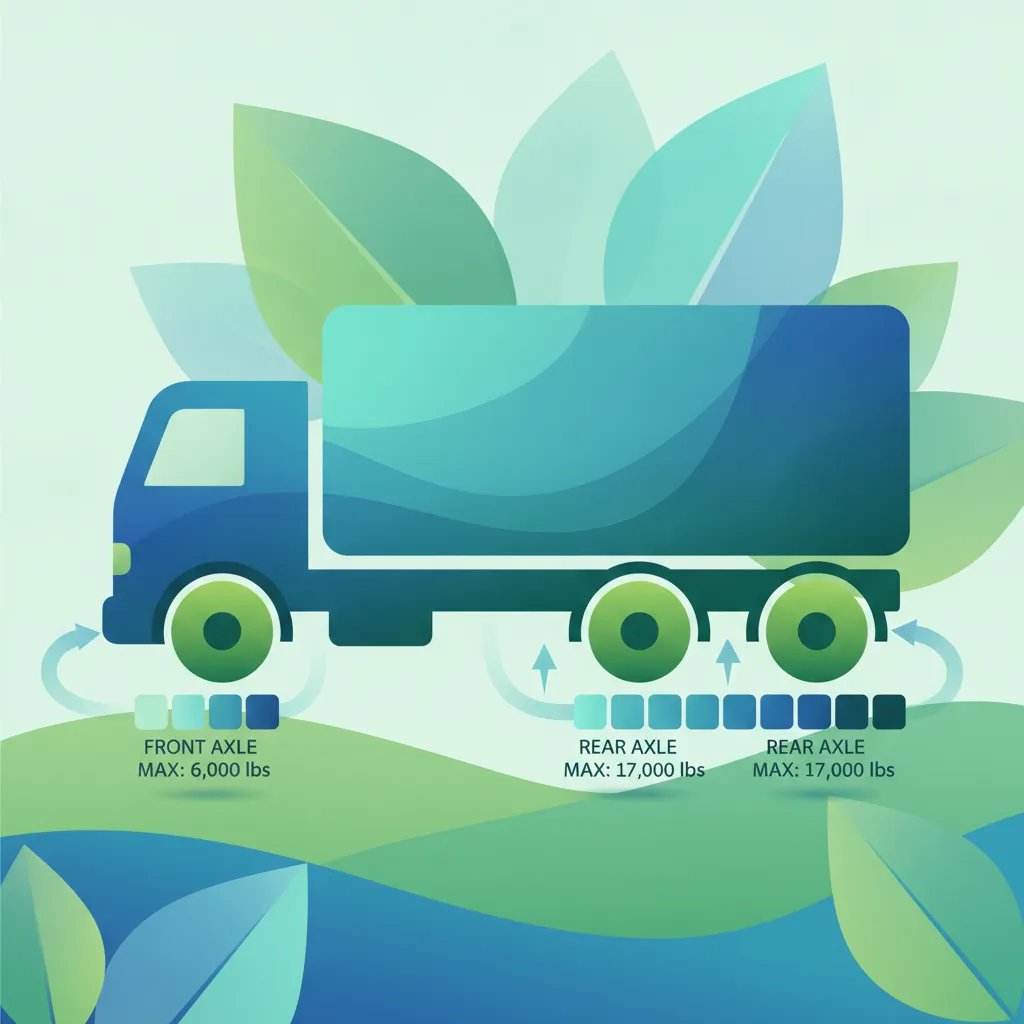
This lesson details the legal restrictions on the weight that can be supported by a single axle or a group of axles. It explains the importance of distributing the load correctly across the vehicle's length to prevent exceeding these limits, which can cause significant road damage and compromise vehicle safety. Learners will understand the relationship between load placement, axle pressure, and overall stability, particularly during braking and cornering.

This lesson focuses on a key dynamic behavior of articulated vehicles known as 'off-tracking' or 'cut-in'. It explains why, during a turn, the trailer's wheels follow a path inside that of the tractor's wheels, which requires the driver to make wider turns to avoid hitting curbs, signs, or other vehicles. Understanding and anticipating off-tracking is a fundamental skill for safely maneuvering a combination vehicle, especially in tight spaces.
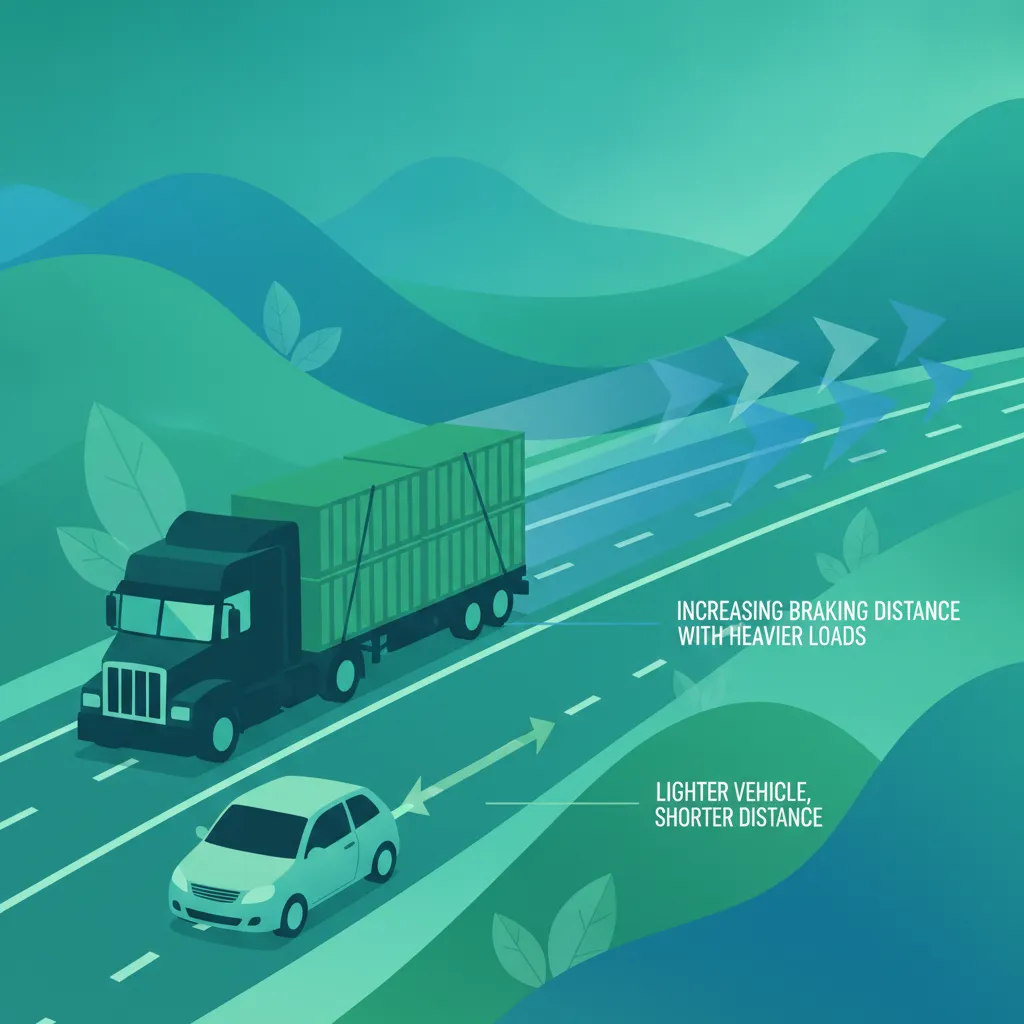
This lesson explores the critical physics behind stopping a heavy vehicle. It breaks down the components of total stopping distance—thinking distance and braking distance—and explains how this is significantly increased by vehicle mass and speed. Learners will understand the necessity of maintaining a much greater following distance than a car to allow enough space to stop safely in all conditions.

This lesson introduces the core physical principles behind effective cargo restraint. It explains how different methods—such as blocking to prevent sliding, and lashing to increase pressure and friction—work to counteract the forces of acceleration, braking, and cornering. Learners will become familiar with the various types of equipment, like straps and chains, and understand the basic concepts that underpin all secure loading practices.
Master the theory behind rear swing and off-tracking for articulated vehicles. Learn how to safely navigate urban environments and complex turns, avoiding collisions with obstacles and other road users. Crucial for Italian CE license theory.
This lesson focuses on a key dynamic behavior of articulated vehicles known as 'off-tracking' or 'cut-in'. It explains why, during a turn, the trailer's wheels follow a path inside that of the tractor's wheels, which requires the driver to make wider turns to avoid hitting curbs, signs, or other vehicles. Understanding and anticipating off-tracking is a fundamental skill for safely maneuvering a combination vehicle, especially in tight spaces.

This lesson provides instruction on the challenging skill of reversing a large vehicle. It covers techniques for straight-line reversing and the more complex task of reversing an articulated vehicle around a corner, explaining how steering inputs have an opposite effect on the trailer. The lesson also stresses the importance of slow, controlled speed, constant observation, and using a guide (banksman) whenever possible for maximum safety.
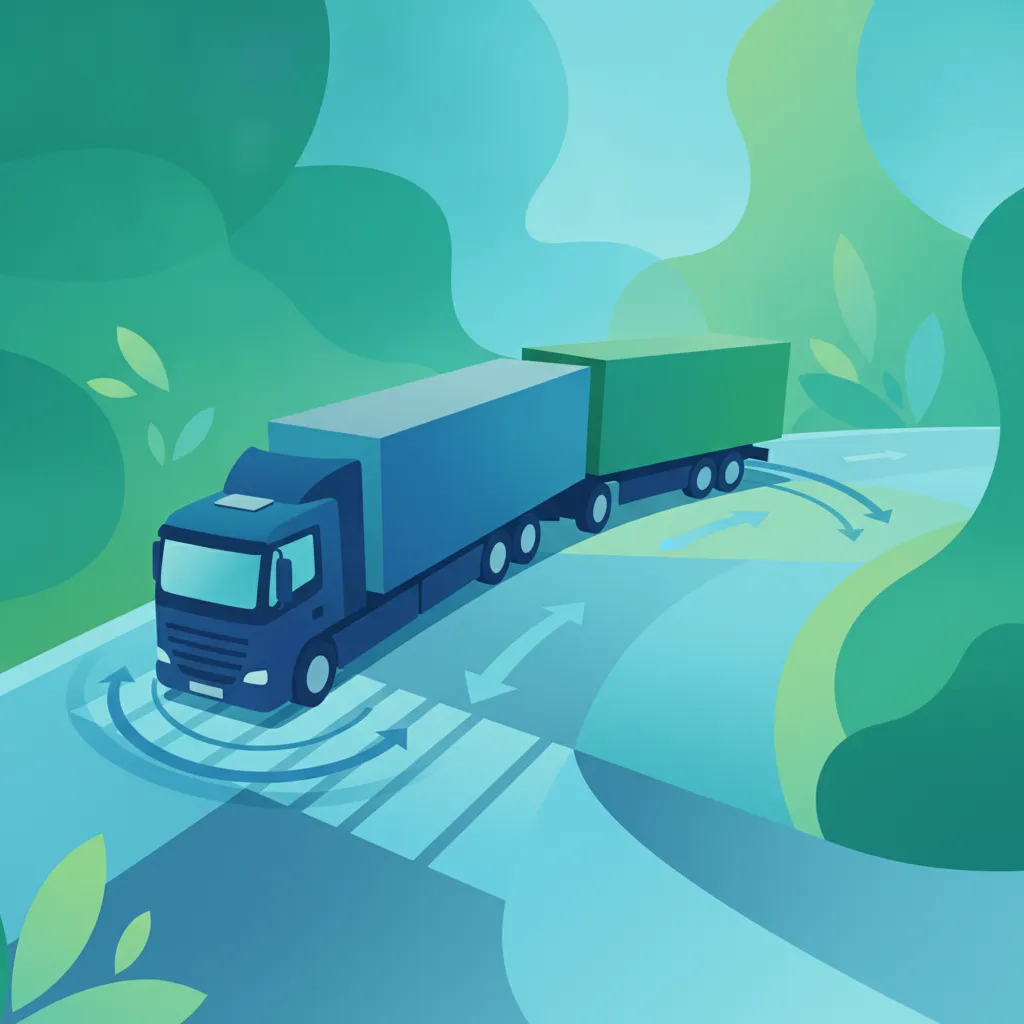
This lesson delves deeper into the dynamics of turning, introducing the concept of the 'swept path'—the total area a vehicle covers when making a turn. It builds on the idea of off-tracking, explaining how to position the vehicle before entering a turn to ensure the trailer safely clears corners, curbs, and other obstacles. Mastering this spatial judgment is essential for navigating junctions and roundabouts without incident.
This lesson vividly illustrates the dangers of a load that moves during transit. It explains how a sudden load shift during braking can increase stopping distance or cause a jack-knife, while a shift during cornering can easily lead to a rollover. By understanding these dynamic forces, learners will appreciate the absolute necessity of ensuring every piece of cargo is properly and robustly secured before starting a journey.

This lesson focuses on the importance of meticulous pre-journey planning for urban deliveries. It teaches drivers how to use maps and digital tools to plan routes that avoid physical restrictions (low bridges, narrow streets), legal restrictions (ZTLs, weight limits), and temporary disruptions. Effective route planning saves time, reduces stress, and ensures that all deliveries can be made legally and safely.

This lesson highlights the large blind spots—or 'no-zones'—that exist to the front, back, and sides of a heavy vehicle, where smaller vehicles, cyclists, and pedestrians can disappear from view. It teaches proactive scanning techniques, the importance of anticipating hazards, and how to use mirrors and direct vision effectively to manage these high-risk areas. Awareness and mitigation of blind spots are crucial for preventing collisions, especially in urban traffic.
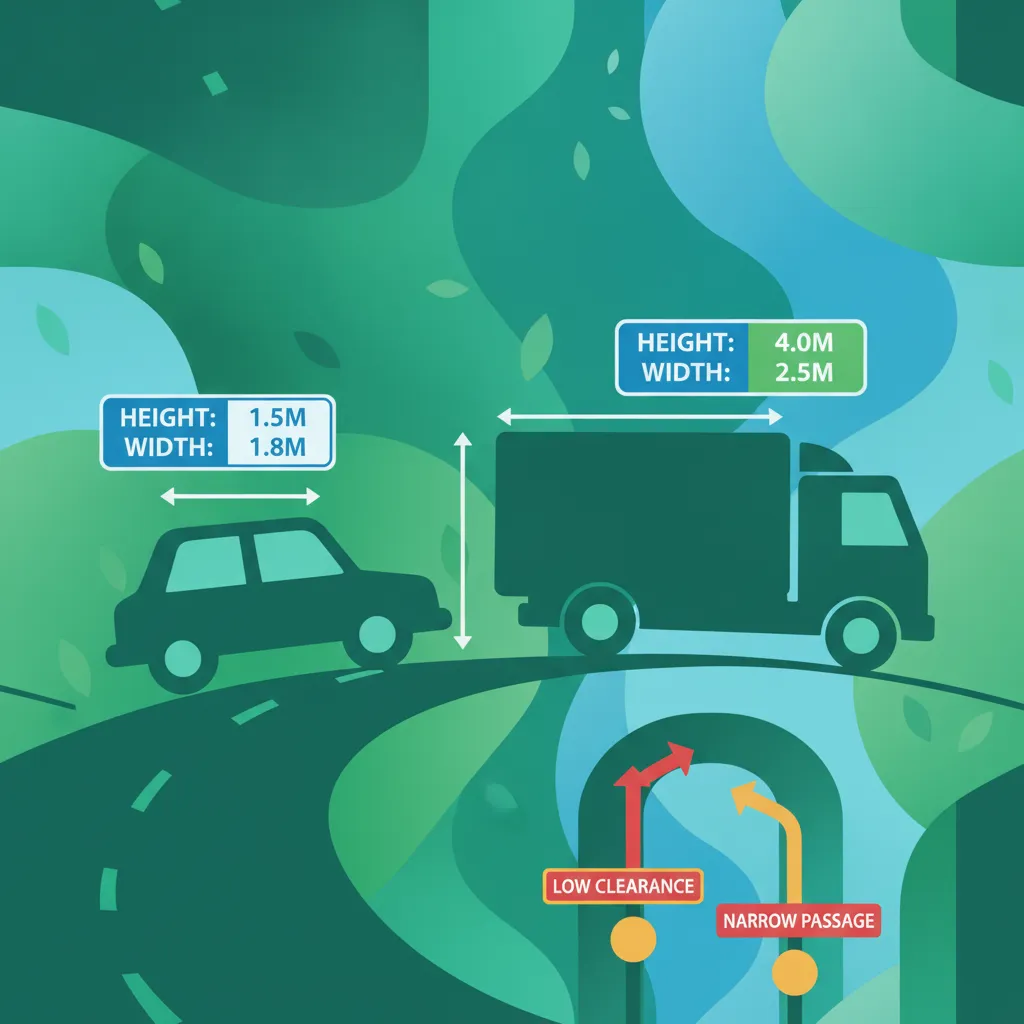
This lesson focuses on the specific dimensional limits that heavy goods vehicles must adhere to on Italian roads, as stipulated by the Codice della Strada. It covers the maximum permissible length, width, and height, explaining how these restrictions impact navigation through tunnels, under bridges, and within urban environments. Learners will also understand the conditions under which special permits for exceptional or oversized transport are required.

This lesson outlines the correct protocols for stopping to make a delivery in a public area. It covers the legal use of designated loading bays, the importance of making the vehicle highly visible with hazard lights, and ensuring that the parking brake is securely applied. The lesson stresses the need to conduct loading and unloading activities efficiently and safely, without causing undue obstruction or danger to other road users and pedestrians.
This lesson details the legal restrictions on the weight that can be supported by a single axle or a group of axles. It explains the importance of distributing the load correctly across the vehicle's length to prevent exceeding these limits, which can cause significant road damage and compromise vehicle safety. Learners will understand the relationship between load placement, axle pressure, and overall stability, particularly during braking and cornering.
This lesson provides a detailed, safety-focused procedure for detaching a tractor from a semitrailer. It covers selecting a suitable, firm, and level location, correctly deploying the trailer's landing gear to support its weight, and disconnecting the air and electrical lines in the proper order. Following these systematic steps is essential to prevent the trailer from tipping over or rolling away, ensuring the safety of the driver and anyone nearby.
Find clear answers to common questions learners have about Jack-knifing, Rear Swing, and Stability. Learn how the lesson is structured, which driving theory objectives it supports, and how it fits into the overall learning path of units and curriculum progression in Italy. These explanations help you understand key concepts, lesson flow, and exam focused study goals.
Prevention relies on smooth driving inputs. Avoiding harsh braking, especially when empty or on slippery road surfaces, is critical, as is ensuring the trailer's braking system is correctly synchronized with the tractor unit.
This is known as rear swing or tail swing, occurring because the rear wheels follow a shorter path than the front wheels of the trailer during a turn. The pivot point at the fifth wheel causes the back of the trailer to sweep outwards, necessitating extra caution near curbs and pedestrians.
An improperly loaded vehicle with a high center of gravity significantly increases the risk of instability during cornering. Correct weight distribution ensures the tractor unit retains enough traction to prevent the trailer from pushing it into an uncontrolled angle.
Yes, the Italian theory exam for C and CE categories frequently tests your understanding of the swept path. You must demonstrate knowledge of how much space a vehicle requires and how to avoid 'clipping' objects during maneuvers.
Start searching now to pinpoint exactly which Italian driving theory topics, road signs, or traffic rules you need to master. Use our advanced filters to build a custom practice session and ensure you're fully prepared for every aspect of your official driving licence exam.