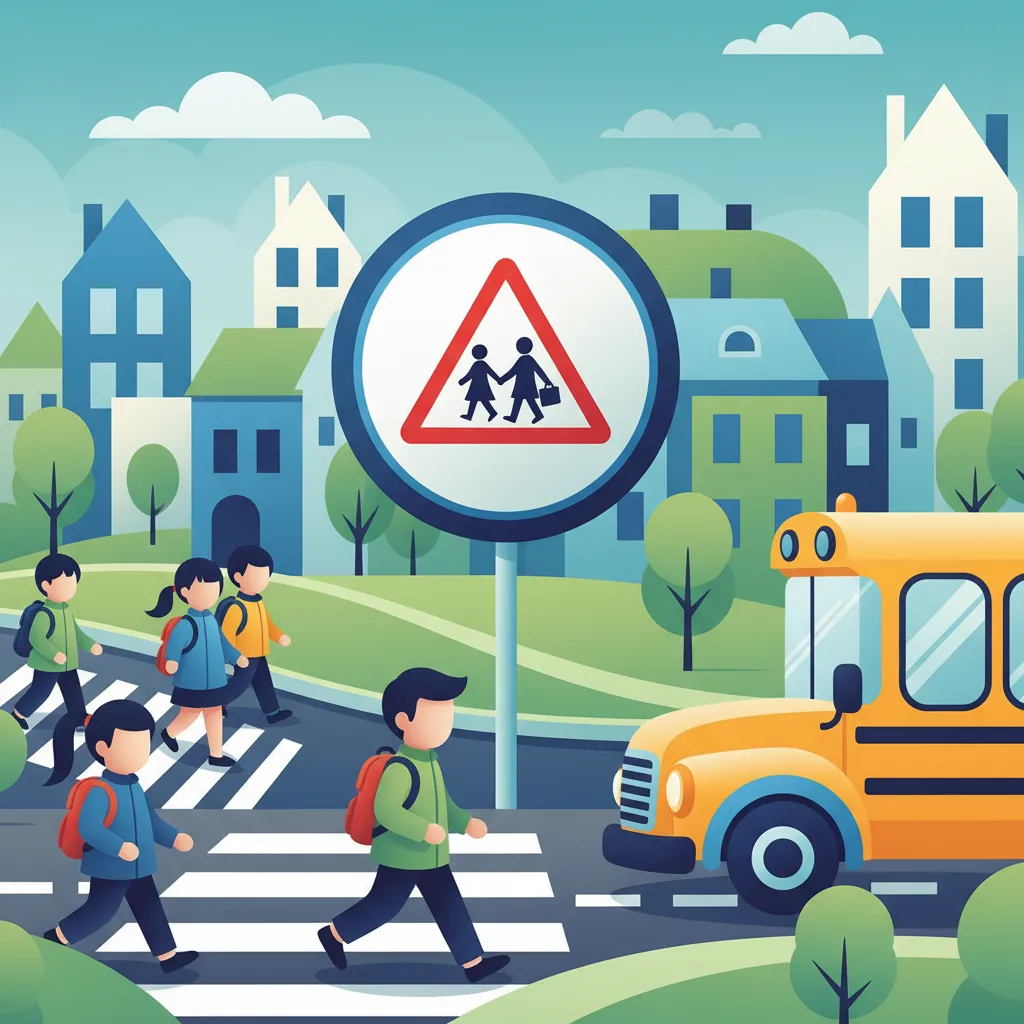
School zones are designated areas around educational facilities where children frequently gather, walk, or cross roads. In Poland, these areas demand heightened driver vigilance and reduced speeds, particularly during school arrival and dismissal times. This section outlines the specific responsibilities of drivers to ensure the safety of vulnerable child pedestrians.
Theory topic content overview
Read the full theory topic guide for School Zone Safety with structured, easy-to-scan content built for learners in Poland. This detailed section explains the exact rule, meaning, traffic context, comparison points, and exam logic behind this Polish driving theory topic so you can study faster, understand the concept more clearly, and avoid common interpretation mistakes on the theory test.
Driving through a school zone demands a different mindset and specific precautions from drivers in Poland. These are areas immediately surrounding schools, playgrounds, or other educational facilities where children are frequently present, walking, cycling, or crossing roads. The fundamental principle for driving in school zones is to prioritize the safety of child pedestrians, recognizing their inherent vulnerability and unpredictable behaviour.
The concept of a school zone extends beyond mere speed limits; it's about anticipating hazards that adult road users might not present and accepting a heightened level of driver responsibility.
The emphasis on caution in school zones is critical for several reasons:
Navigating areas with high concentrations of children requires constant vigilance and proactive hazard perception:
Several factors can amplify the risks in school zones:
It's crucial to distinguish between a general school zone and a Strefa Zamieszkania (Residential Zone) in Poland, as both involve heightened child presence but have different rules:
Strefa Zamieszkania (Residential Zone): Indicated by a specific sign (D-40), these zones are designed for residential use where pedestrians have absolute priority over vehicles across the entire width of the road, including the roadway itself. The maximum speed limit is 20 km/h. Crucially, children under 7 years old may use the road without adult supervision in a Strefa Zamieszkania (though not on other public roads). This makes Strefa Zamieszkania an even higher alert area for child safety, as children have much greater freedom and priority there. Understanding this distinction is vital for your Polish driving theory knowledge.Learners and even experienced drivers often make these errors:
The Polish driving theory exam will test your understanding of your obligations towards children in traffic. You will often encounter scenarios where a child makes a "mistake" (e.g., crossing outside a designated area). The correct answer will almost always involve the driver taking maximum preventative action: reducing speed, being prepared to stop, and ensuring the child's safety, regardless of who has theoretical right of way.
Remember, in the event of an accident involving a child, Polish law heavily scrutinizes the driver's actions, seeking evidence of whether all reasonable precautions were taken. Your license and future depend on demonstrating that you were driving with due care and attention, prioritizing the lives of the most vulnerable.
When you enter a school zone in Poland, adopt a mental model where you are driving with an "invisible shield" around every child. This means:
This mindset, combined with reduced speed and heightened vigilance, is your best defence against accidents and ensures you meet your legal and moral obligations as a driver around schools and vulnerable road users.
School zones in Poland require maximum driver vigilance and significantly reduced speeds due to children's inherent vulnerability and unpredictable behavior, which includes misjudging vehicle distances and acting impulsively without understanding traffic rules. The principle of limited trust obligates drivers to always anticipate that children might make mistakes, with legal consequences falling heavily on drivers in any incident involving child pedestrians. A critical distinction exists between general school zones and Strefa Zamieszkania (Residential Zone), where children under 7 have absolute road priority and may travel unsupervised. For the Polish theory exam, always select answers that demonstrate the driver's maximum preventative action - reduced speed and readiness to stop - regardless of who holds theoretical right of way when a child is involved.
A short set of high-value points that capture the most important ideas from this theory explanation.
Children have narrower peripheral vision, misjudge vehicle distances and speeds, and act impulsively without considering traffic rules
Polish traffic law applies the principle of limited trust (zasada ograniczonego zaufania) - you must always assume children may behave unexpectedly
School zones demand reduced speed to allow stopping within visible distance, not merely compliance with posted limits
When a child makes a mistake in traffic, the correct exam answer always prioritizes maximum driver precaution over right of way
Strefa Zamieszkania (Residential Zone) grants children absolute priority across the entire road width, unlike general school zones where pedestrians only have priority at crossings
Speed limits in school zones are maximum legal limits, not necessarily safe speeds - drive slower based on visibility and hazards
Children under 7 years old may use roads without adult supervision only within Strefa Zamieszkania, not in regular school zones
Always keep your foot hovering over the brake and maintain wider gaps from parked cars where children may emerge hidden
Obey crossing guard signals and exercise extreme caution near school buses during child loading and unloading
Peak danger times are early morning and late afternoon during school arrival and dismissal
Assuming children will wait at crossings or obey traffic signals - they frequently act impulsively and unpredictably
Driving at the posted speed limit as if it were a safe speed rather than adjusting based on conditions and visibility
Focusing only on the road directly ahead and failing to scan pavements, driveways, and parked cars for hidden children
Underestimating braking distances, especially during adverse weather when stopping power is reduced
Not anticipating group behavior - one child's impulsive action often leads others to follow
Start with a short, direct summary of School Zone Safety before reading the full explanation below.
When driving through a school zone in Poland, drivers must reduce their speed significantly and exercise extreme caution. Children can act unpredictably, crossing roads suddenly or stepping out from behind parked cars without looking. Always be prepared to stop instantly, remain alert for crossing guards and school buses, and prioritize the safety of all child pedestrians.
Review the most important terms, rule signals, and traffic concepts linked to School Zone Safety.
Explore related theory topic pages connected to School Zone Safety and continue with the next useful rule explanation.
See the common search queries learners use when trying to understand School Zone Safety in Poland.

Continue your preparation by exploring specific Polish driving theory topics in detail. Review each section to reinforce your understanding of traffic rules, road signs, and safe driving practices. Our comprehensive explanations are structured to support your learning journey and help you confidently approach the official driving licence theory exam.
Polish Driving Theory TopicsTheory topic content overview
A short set of high-value points that capture the most important ideas from this theory explanation.
Children have narrower peripheral vision, misjudge vehicle distances and speeds, and act impulsively without considering traffic rules
Polish traffic law applies the principle of limited trust (zasada ograniczonego zaufania) - you must always assume children may behave unexpectedly
School zones demand reduced speed to allow stopping within visible distance, not merely compliance with posted limits
When a child makes a mistake in traffic, the correct exam answer always prioritizes maximum driver precaution over right of way
Strefa Zamieszkania (Residential Zone) grants children absolute priority across the entire road width, unlike general school zones where pedestrians only have priority at crossings
Speed limits in school zones are maximum legal limits, not necessarily safe speeds - drive slower based on visibility and hazards
Children under 7 years old may use roads without adult supervision only within Strefa Zamieszkania, not in regular school zones
Always keep your foot hovering over the brake and maintain wider gaps from parked cars where children may emerge hidden
Obey crossing guard signals and exercise extreme caution near school buses during child loading and unloading
Peak danger times are early morning and late afternoon during school arrival and dismissal
Assuming children will wait at crossings or obey traffic signals - they frequently act impulsively and unpredictably
Driving at the posted speed limit as if it were a safe speed rather than adjusting based on conditions and visibility
Focusing only on the road directly ahead and failing to scan pavements, driveways, and parked cars for hidden children
Underestimating braking distances, especially during adverse weather when stopping power is reduced
Not anticipating group behavior - one child's impulsive action often leads others to follow
Start with a short, direct summary of School Zone Safety before reading the full explanation below.
When driving through a school zone in Poland, drivers must reduce their speed significantly and exercise extreme caution. Children can act unpredictably, crossing roads suddenly or stepping out from behind parked cars without looking. Always be prepared to stop instantly, remain alert for crossing guards and school buses, and prioritize the safety of all child pedestrians.
Review the most important terms, rule signals, and traffic concepts linked to School Zone Safety.
Explore related theory topic pages connected to School Zone Safety and continue with the next useful rule explanation.
See the common search queries learners use when trying to understand School Zone Safety in Poland.
Continue your preparation by exploring specific Polish driving theory topics in detail. Review each section to reinforce your understanding of traffic rules, road signs, and safe driving practices. Our comprehensive explanations are structured to support your learning journey and help you confidently approach the official driving licence theory exam.
Polish Driving Theory TopicsUse this exam-focused revision tip to understand how School Zone Safety is likely to appear in theory questions for learners in Poland. This section helps you identify the most testable part of the rule, avoid common traps, and remember the concept more effectively during Polish driving theory exam preparation.
In the Polish theory exam, questions about school zones often test your awareness of child behavior. Remember that children are not always predictable; they may not understand traffic rules or judge distances correctly. Always choose the answer option that demonstrates maximum caution, reduced speed, and a readiness to yield to ensure child safety, even if they appear to be in the wrong.
Read direct answers to the most common learner questions about School Zone Safety in Poland. This FAQ focuses on rule confusion, practical meaning, comparison with similar concepts, and the exact uncertainties that appear most often in Polish driving theory revision and exam preparation.
While there isn't always a specific "school zone" sign, areas near schools are identified by road signs indicating proximity to a school (e.g., A-14, 'children' sign) and increased presence of pedestrian crossings. Drivers must recognize these contexts and adapt their driving.
Even if a specific speed limit isn't posted, you must reduce your speed significantly to be able to stop immediately. The general principle is to drive at a speed that allows you to react safely to any sudden movement by a child.
Children have limited perception of danger, may misjudge speeds and distances, and can act impulsively without fully understanding traffic rules. Their smaller stature also makes them less visible to drivers.
If a school bus signals its intention to stop or move, especially when children are boarding or alighting, you must reduce your speed and, if necessary, stop to ensure their safe passage. Be extremely cautious when approaching or passing.
The principle of limited trust (zasada ograniczonego zaufania) means you cannot assume other road users, especially children, will always act correctly or predictably. In school zones, this principle demands you anticipate unexpected behavior and be prepared for anything.
Look for children playing near the road, stepping out from between parked cars, crossing outside of designated crossings, or cycling unpredictably. Be extra vigilant during school start and end times.
Speeding in any area, especially one with vulnerable road users, can lead to significant fines and penalty points. The consequences can be more severe if an accident involving a child occurs.
Build custom practice sessions tailored precisely to your needs. Focus on areas requiring improvement, review specific Polish road signs, or master complex traffic rules to ensure full preparation for your official driving license exam.