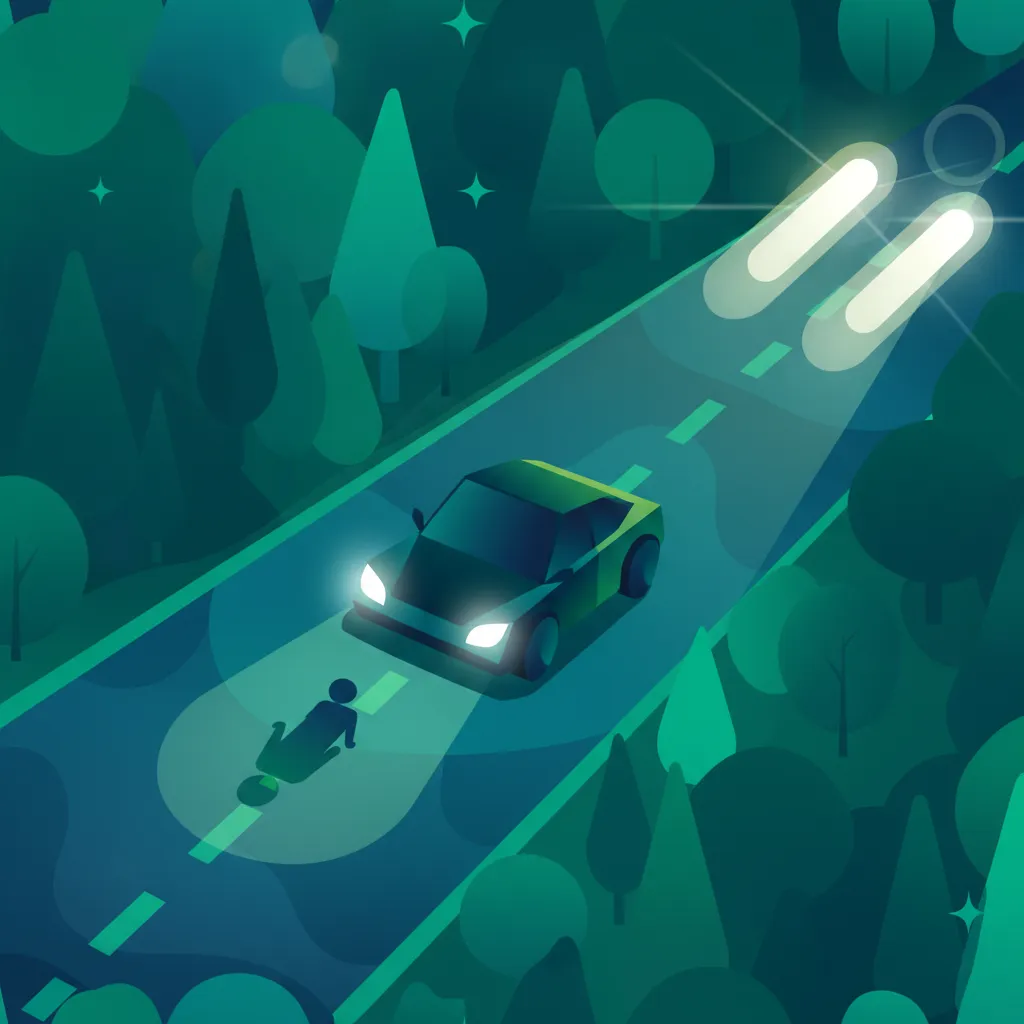
Driving at night presents distinct challenges that require drivers to adapt their perception and reactions. With reduced light, our ability to see and react to hazards diminishes, while factors like headlight glare and fatigue become more prominent. This section explains how to navigate these conditions safely, minimizing risks for yourself and others on the road.
Theory topic content overview
Read the full theory topic guide for Night Driving Safety with structured, easy-to-scan content built for learners in Turkey. This detailed section explains the exact rule, meaning, traffic context, comparison points, and exam logic behind this Turkish driving theory topic so you can study faster, understand the concept more clearly, and avoid common interpretation mistakes on the theory test.
Driving at night significantly alters the driving environment, introducing unique challenges primarily due to reduced visibility. Unlike daytime, drivers rely heavily on artificial light sources – their vehicle's headlights and street lighting – which severely limits the distance and clarity with which hazards, road signs, and other road users can be perceived. This diminished visual input directly impacts a driver's ability to react safely and effectively, making night driving a higher-risk activity.
Mastering night driving techniques is crucial for safety on all roads, including those in Türkiye. Reduced visibility increases the risk of collisions with unlit obstacles, pedestrians, or animals, particularly on rural or poorly lit Turkish roads. For your ehliyet sınavı (Turkish driving license exam), understanding these risks and the necessary adaptations is a frequent topic, testing your knowledge of safe speeds, appropriate lighting use, and hazard perception under dark conditions. A thorough understanding will not only help you pass the exam but also ensure your safety on the diverse road network across Türkiye after dark.
Several elements contribute to the heightened risk of driving at night:
Safe night driving requires proactive adjustments to your driving style:
The fundamental rule for night driving is to reduce your speed so that you can always stop within the distance illuminated by your headlights. If you cannot see a hazard, you cannot react to it in time. This means on unlit roads, your speed will likely be significantly lower than the posted speed limit. Always consider the safe speed for your visibility, not just the legal maximum speed.
Keep your windshield, mirrors, and headlight lenses clean. Dirt or streaks can scatter light, reduce visibility, and worsen glare. Ensure your headlights are correctly aimed and fully functional.
While night driving shares the challenge of reduced visibility with conditions like fog or heavy rain, it has unique aspects:
Turkish learners and experienced drivers alike can make crucial errors when driving after dark:
On Turkish roads, night driving presents particular considerations:
otoyol) and major urban streets to completely unlit rural roads or mountain passes. Adapting your speed and lighting use is paramount.The core principle for safe driving at night is: Drive only as fast as you can safely stop within the distance you can clearly see with your headlights. Prioritize hazard anticipation, actively manage glare, use your vehicle's lighting correctly, and never underestimate the impact of fatigue. By adopting these adaptive strategies, you significantly reduce the inherent risks of driving in darkness, ensuring a safer journey for yourself and others on Turkish roads.
Start with a short, direct summary of Night Driving Safety before reading the full explanation below.
Driving at night means significantly reduced visibility, making it harder to spot pedestrians, obstacles, or road signs. Drivers must reduce their speed to ensure they can stop within the range of their headlights. Be aware of glare from oncoming vehicles, and increase your focus on the road edges. Fatigue is also a greater risk, requiring extra caution and breaks.
Review the most important terms, rule signals, and traffic concepts linked to Night Driving Safety.
Explore related theory topic pages connected to Night Driving Safety and continue with the next useful rule explanation.
See the common search queries learners use when trying to understand Night Driving Safety in Turkey.

Dive deeper into specific Turkish driving theory topics like traffic signs, first aid, or vehicle mechanics. Each section offers clear explanations to enhance your understanding of official traffic legislation and prepare you effectively for every aspect of your upcoming ehliyet exam in Türkiye.
Explore Turkish Driving Theory TopicsTheory topic content overview
Start with a short, direct summary of Night Driving Safety before reading the full explanation below.
Driving at night means significantly reduced visibility, making it harder to spot pedestrians, obstacles, or road signs. Drivers must reduce their speed to ensure they can stop within the range of their headlights. Be aware of glare from oncoming vehicles, and increase your focus on the road edges. Fatigue is also a greater risk, requiring extra caution and breaks.
Review the most important terms, rule signals, and traffic concepts linked to Night Driving Safety.
Explore related theory topic pages connected to Night Driving Safety and continue with the next useful rule explanation.
See the common search queries learners use when trying to understand Night Driving Safety in Turkey.
Dive deeper into specific Turkish driving theory topics like traffic signs, first aid, or vehicle mechanics. Each section offers clear explanations to enhance your understanding of official traffic legislation and prepare you effectively for every aspect of your upcoming ehliyet exam in Türkiye.
Explore Turkish Driving Theory TopicsUse this exam-focused revision tip to understand how Night Driving Safety is likely to appear in theory questions for learners in Turkey. This section helps you identify the most testable part of the rule, avoid common traps, and remember the concept more effectively during Turkish driving theory exam preparation.
In the ehliyet sınavı, pay close attention to questions about how speed and observation must change at night. Remember the key principles: reduce speed to match your headlight range, look away from oncoming glare, and be extra vigilant for unseen hazards. Don't confuse normal night driving with driving in fog or heavy rain; each has specific requirements.
Read direct answers to the most common learner questions about Night Driving Safety in Turkey. This FAQ focuses on rule confusion, practical meaning, comparison with similar concepts, and the exact uncertainties that appear most often in Turkish driving theory revision and exam preparation.
Night driving is more dangerous primarily due to reduced visibility, making it difficult to see hazards, pedestrians, and road markings. This often leads to slower reaction times and an increased risk of accidents.
You must reduce your speed at night to ensure you can stop safely within the distance illuminated by your headlights. Overdriving your headlights is dangerous as you may not see a hazard until it's too late to react.
Headlight glare is the temporary blinding effect from bright lights of oncoming vehicles, which reduces your ability to see. To manage it, avoid looking directly at the lights; instead, focus slightly toward the right edge of your lane to maintain your orientation.
Reduced visibility makes it much harder to identify pedestrians, cyclists, animals, or objects on the road in time to react. The limited light restricts your field of vision and makes distant objects appear later.
Turkish traffic law requires the use of dipped headlights (low beam) from dusk till dawn and in tunnels. High beams (main beam) can be used on unlit roads when no other vehicles are approaching or ahead of you. Flashing headlights for signaling is also permitted.
Fatigue is a significant risk factor at night, as natural sleep cycles can make drivers drowsier. Tiredness slows reaction times, reduces concentration, and impairs judgment, increasing the chance of errors or falling asleep at the wheel.
In conditions like heavy fog or rain at night, reduce your speed drastically, use your dipped headlights (and fog lights if available and appropriate), increase following distance, and consider pulling over to a safe location if visibility becomes too poor to continue safely.
Use our comprehensive practice search to find exactly the Turkish driving theory questions you need to master. Whether reviewing specific road signs, traffic rules, or first aid scenarios, select your perfect practice set and boost your confidence for the official ehliyet sınavı.