
This lesson teaches you the critical skills of mirror awareness and signalling for Category AM moped riders in Austria. Understanding how to observe the road and communicate your intentions is essential for safe navigation in mixed traffic and for passing your theoretical driving exam.

Lesson content overview
Effective use of mirrors and indicators is fundamental to safe riding for AM category vehicles, such as mopeds, small scooters, and light quadricycles, in Austria. This lesson delves into the precise techniques required to maintain continuous awareness of surrounding traffic, clearly signal your intentions, and execute maneuvers safely and legally according to Austrian traffic law (StVO). By mastering these skills, you contribute significantly to predictable traffic flow and prevent misunderstandings with other road users, ultimately reducing collision risk.
Riding an AM vehicle safely relies on two critical elements: being aware of your environment and effectively communicating your intentions to others. Mirrors provide the necessary awareness, while indicators serve as your primary communication tool.
Situational awareness is your continuous, systematic observation of the traffic around you, especially using your mirrors. This involves regularly checking your rear-view and side mirrors to monitor vehicles approaching from behind or from adjacent lanes. For AM riders, this means not only detecting other vehicles but also assessing their speed and identifying safe gaps for any intended maneuver. A constant mental scan of your mirrors ensures you are never surprised by traffic.
Indicators, also known as turn signals, are your primary means of communicating your future movements. Activating them provides an advance warning to surrounding traffic about your planned turn or lane change. This communication is vital for other drivers, cyclists, and pedestrians to anticipate your actions and adjust their own behavior accordingly, preventing abrupt reactions or potential collisions. Austrian traffic law specifically mandates their use to promote clear communication.
Safety in traffic often comes down to precise timing and sequence. For any maneuver, there's a specific order in which you should check mirrors, perform head checks, and activate your indicators. This structured approach ensures that you have the most up-to-date perception of your surroundings before you signal and before you commit to a maneuver. Incorrect timing can negate the safety benefits, potentially catching other road users off guard.
Early communication is a cornerstone of proactive riding. Providing sufficient advance notice—typically several seconds—before a maneuver gives other road users adequate time to perceive your signal, process the information, and react safely. This predictability reduces the likelihood of sudden braking or swerving by others, particularly in busy urban areas or on higher-speed roads.
Understanding the function and limitations of your vehicle's observational and signaling tools is crucial.
Mirrors are optical devices strategically placed on your AM vehicle to expand your field of vision, showing you areas that would otherwise be out of your direct line of sight. Most AM vehicles typically have a central rearview mirror and two side mirrors.
Proper adjustment of your mirrors is paramount. They should be positioned so that you have the widest possible view of the road behind and to your sides with minimal body movement. While riding, your elbows or shoulders should not obstruct your view.
The blind spot is an area around your vehicle that cannot be seen directly through your mirrors or by looking straight ahead. Every vehicle has blind spots, and for AM riders, these areas can be particularly dangerous due to the smaller size of the vehicle.
Ignoring blind spots is a common cause of collisions during lane changes or turns. It is crucial to understand that mirrors, no matter how well-adjusted, cannot cover every angle. This is why a physical head turn, often called a shoulder check, is indispensable.
The indicator, or turn signal, is an electronic device that uses flashing lights to communicate your intention to turn or change lanes. It is a universal language on the road and a legal requirement in Austria.
Timely and correct use of your indicators alerts other drivers, cyclists, and pedestrians to your planned actions, allowing them to react safely. Failing to signal, or signaling incorrectly, is a leading cause of accidents involving AM vehicles.
Always check your dashboard after completing a maneuver to ensure your indicator has cancelled. A persistent flashing light can mislead other drivers about your next move.
A head turn, also known as a shoulder check, is a quick, decisive glance over your shoulder to visually confirm that your blind spot is clear. This physical action complements your mirror checks by providing a direct view of areas mirrors cannot show.
After checking your mirrors for traffic, briefly turn your head over the shoulder in the direction you intend to move.
This glance should be quick, typically lasting less than a second, to minimize the time your eyes are off the road ahead.
Return your gaze to the front and proceed with the maneuver only if the blind spot is clear.
The head turn is particularly vital before changing lanes, merging, or making turns where cyclists or other AM vehicles might be alongside you, hidden from your mirrors. It is a mandatory step under Austrian traffic law before lane changes.
Executing maneuvers safely requires precise timing of your observations and signals, following a clear sequence, and maintaining an appropriate road position.
In Austria, the indicator timing is legally prescribed to ensure other road users have adequate warning. According to StVO § 44.1:
Understanding these timings is critical. Activating your indicator too late gives others insufficient time to react, while activating it too early without immediate intent can cause confusion.
A lane change involves moving your AM vehicle from one lane to an adjacent one. This maneuver demands careful observation and clear signaling.
Signal Your Intention: Activate your indicator in the direction of the desired lane change well in advance, adhering to Austrian timing rules (StVO § 44.1).
Check Mirrors: Perform thorough checks of your rear-view and side mirrors to assess traffic conditions in the target lane and behind you. Look for safe gaps and closing speeds.
Perform a Head Turn (Shoulder Check): Swiftly glance over your shoulder in the direction of the lane change to clear your blind spot. This is a crucial step required by StVO § 15.
Confirm Safe Gap: Ensure there is enough space and time to move into the new lane without forcing other drivers to brake or swerve.
Steer Smoothly: Gently steer your vehicle into the adjacent lane, maintaining control and speed.
Cancel Indicator: Once fully in the new lane, immediately cancel your indicator.
Remember, in Austria, overtaking and thus moving into the left lane should be done to the left. Returning to your original lane should also involve signaling.
Turning at intersections, into driveways, or at roundabouts also requires a systematic approach.
Signal Early: Activate the appropriate indicator (left or right) well in advance of the turning point. Follow StVO § 44.1 and § 50 for timing and distance.
Check Mirrors: Use your rear-view and side mirrors to observe following traffic and any potential hazards in your path of turn (e.g., cyclists).
Assess Surroundings and Blind Spots: A quick head turn might be necessary if cyclists or pedestrians are likely to be present on the side you are turning towards.
Reduce Speed: Adjust your speed appropriately for the turn, ensuring you can execute it safely without losing balance or control.
Execute Turn: Make the turn, maintaining awareness of any pedestrians or oncoming traffic.
Cancel Indicator: Once the turn is completed and your vehicle is straightened, cancel the indicator.
Your road position—where you place your AM vehicle within your lane—significantly affects your ability to use mirrors effectively and be seen by others.
Maintaining a good road position is not just about your visibility; it's also about helping other drivers see you clearly and understand your intentions.
Austrian law provides clear directives on the use of mirrors and indicators to ensure road safety. Adhering to these rules is not only a legal obligation but a fundamental aspect of defensive riding.
Failing to use mirrors and indicators correctly is a frequent cause of traffic incidents. Be aware of these common errors:
Late Indicator Activation:
Skipping the Shoulder Check:
Misusing Hazard Warning Lights:
Forgetting to Cancel Indicators:
Improper Road Position:
Mirror Obstruction:
The effective use of mirrors and indicators is not static; it must adapt to varying environmental and traffic conditions.
Every rule and recommendation for mirror and indicator use is rooted in fundamental safety principles and traffic psychology.
Think of your mirrors and indicators as extensions of your senses and voice. They allow you to "see" more and "speak" your intentions to everyone else on the road, creating a safer, more harmonious traffic environment.
Let's look at how these principles apply in everyday Austrian riding situations.
Setting: You are on your AM scooter, approaching a traffic-light-controlled intersection in Vienna, intending to turn right. Weather is dry, traffic is moderate. Action: Well before the intersection, you activate your right indicator, ensuring it's on for at least 5 meters before the turning point as per StVO § 50. You check your rear-view and right side mirrors for any cyclists or other vehicles approaching from behind or on your right. You glance over your right shoulder to confirm no pedestrian or cyclist is in your blind spot about to cross. You then reduce your speed, wait for the green light, and execute the turn smoothly, constantly monitoring for crossing pedestrians. Once straight in the new road, you cancel your indicator. Outcome: Clear communication prevents any collision with a cyclist who might have been filtering up your right side, ensuring a safe turn for everyone.
Setting: You are riding your light quadricycle on a two-lane road outside the city, preparing to overtake a slower vehicle. Traffic is flowing steadily, daylight conditions. Action: You first ensure you are maintaining a central road position. You activate your left indicator for several seconds, providing ample warning at higher speeds as required by StVO § 44.1. You then check your rear-view mirror and left side mirror for any faster traffic approaching from behind or in the left lane. Crucially, you perform a quick left shoulder check (StVO § 15) to confirm there's no vehicle in your blind spot. Once clear, you smoothly steer into the left lane. After overtaking, you signal right, check mirrors and right shoulder, and return to your original lane. Outcome: The systematic checks ensure you safely move into the next lane without cutting off another vehicle or colliding with one in your blind spot, complying with StVO § 9c.
Setting: You are on an AM moped, entering a main road from a slip road, with moderate to heavy traffic. Action: Well in advance, you activate your right indicator. As you accelerate on the slip road, you continuously scan your rear-view and right side mirrors to assess the speed and position of vehicles on the main road. Just before the merging point, you perform a critical right shoulder check (StVO § 17.1) to ensure no vehicle is hidden. You adjust your speed to match the flow of traffic and merge into a safe gap. Once on the main road, you cancel your indicator. Outcome: Thorough checks and early signaling allow you to merge safely and smoothly into fast-moving traffic, preventing sudden braking or swerving by other drivers.
Setting: You are riding your scooter on a dimly lit rural road at night, preparing for a left turn into a side road. Action: Because of the reduced visibility, you activate your left indicator much earlier than the absolute minimum, giving any oncoming or following traffic maximum warning time. You double-check your mirrors and make a deliberate left shoulder check, compensating for the limitations of night vision and potential glare. You reduce your speed significantly and execute the turn carefully, being extra vigilant for unlit obstacles or animals. Outcome: Extended signaling time and careful observation prevent an oncoming vehicle from misinterpreting your intentions, ensuring a safe turn in challenging conditions.
Mastering the effective use of mirrors and indicators is not merely about passing your Austrian AM driving theory exam; it is about adopting a proactive, defensive, and legally compliant riding style that prioritizes safety for yourself and everyone else on the road. By consistently applying systematic mirror checks, head turns, and timely indicator use, you become a predictable and trustworthy road user. This commitment to clear communication and constant awareness is the hallmark of a responsible AM rider in Austria.
This lesson covers the essential skills of mirror use and indicator signaling for Austrian AM riders, grounded in specific StVO requirements. Key procedures include systematic mirror checks followed by shoulder turns before any lane change or turn, with legally defined timing: 3 seconds minimum at low speeds and 5 meters before urban turns. The content emphasizes that mirrors have blind spots requiring physical head checks, distinguishes hazard lights from turn signals, and stresses the importance of early, clear communication for predictable traffic flow. Learners also benefit from practical scenarios demonstrating these principles in urban, rural, and nighttime conditions.
A short set of high-value points that capture the most important learning from this lesson.
Mirror checks and shoulder turns must be performed in sequence before any maneuver to ensure complete situational awareness.
Indicator activation timing is legally mandated: at least 3 seconds before maneuvers at speeds up to 20 km/h, and at least 5 meters before turns in urban areas.
Mirrors alone cannot cover blind spots; a physical head turn over your shoulder is legally required by StVO § 15 before changing lanes.
Hazard warning lights signal a stationary vehicle and must never be used to indicate turns or lane changes.
Road position affects visibility—maintaining a central lane position optimizes mirror effectiveness and minimizes blind spots.
Explore all units and lessons included in this driving theory course.
StVO § 44.1 requires at least 3 seconds indicator lead time at low speeds; StVO § 50 requires signaling at least 5 meters before urban turns.
StVO § 15 mandates a physical shoulder check to clear blind spots, as mirrors cannot show every angle.
Hazard lights mean stationary hazard—always use left or right indicators for turns and lane changes.
Cancel your indicator immediately after completing a maneuver to avoid misleading other road users.
Cyclists and pedestrians are often hidden in blind spots; always perform a head turn before turns in urban traffic.
Activating indicators too late (just before or during a maneuver) gives other road users insufficient time to react safely.
Relying solely on mirrors and skipping the shoulder check, which can miss vehicles, cyclists, or pedestrians in the blind spot.
Using hazard warning lights instead of turn signals for turns or lane changes, confusing other drivers about your intentions.
Forgetting to cancel the indicator after completing a maneuver, misleading others about your next move.
Riding too close to the curb, which reduces side mirror effectiveness and creates unnecessary blind spots.
Lesson content overview
A short set of high-value points that capture the most important learning from this lesson.
Mirror checks and shoulder turns must be performed in sequence before any maneuver to ensure complete situational awareness.
Indicator activation timing is legally mandated: at least 3 seconds before maneuvers at speeds up to 20 km/h, and at least 5 meters before turns in urban areas.
Mirrors alone cannot cover blind spots; a physical head turn over your shoulder is legally required by StVO § 15 before changing lanes.
Hazard warning lights signal a stationary vehicle and must never be used to indicate turns or lane changes.
Road position affects visibility—maintaining a central lane position optimizes mirror effectiveness and minimizes blind spots.
Explore all units and lessons included in this driving theory course.
StVO § 44.1 requires at least 3 seconds indicator lead time at low speeds; StVO § 50 requires signaling at least 5 meters before urban turns.
StVO § 15 mandates a physical shoulder check to clear blind spots, as mirrors cannot show every angle.
Hazard lights mean stationary hazard—always use left or right indicators for turns and lane changes.
Cancel your indicator immediately after completing a maneuver to avoid misleading other road users.
Cyclists and pedestrians are often hidden in blind spots; always perform a head turn before turns in urban traffic.
Activating indicators too late (just before or during a maneuver) gives other road users insufficient time to react safely.
Relying solely on mirrors and skipping the shoulder check, which can miss vehicles, cyclists, or pedestrians in the blind spot.
Using hazard warning lights instead of turn signals for turns or lane changes, confusing other drivers about your intentions.
Forgetting to cancel the indicator after completing a maneuver, misleading others about your next move.
Riding too close to the curb, which reduces side mirror effectiveness and creates unnecessary blind spots.
Explore search topics learners often look for when studying Using Mirrors and Indicators Effectively. These topics reflect common questions about road rules, driving situations, safety guidance, and lesson level theory preparation for learners in Austria.
Browse additional driving theory lessons that cover connected traffic rules, road signs, and common driving situations related to this topic. Improve your understanding of how different rules interact across everyday traffic scenarios.
Gain a deeper understanding of mirror adjustment, correct blind spot identification, and the precise timing for indicator use. Essential theory for safe communication and maneuvers on Austrian roads for AM category vehicles.

This lesson teaches the correct technique for setting and using motorcycle mirrors to maintain awareness of traffic behind and to the sides. It emphasizes that mirrors alone are not enough, detailing the necessity of the 'lifesaver' shoulder check to cover critical blind spots. A disciplined observation routine is crucial for safe lane changes, merging, and navigating dense traffic.

This lesson provides a detailed guide on how to use a vehicle's mirrors and camera systems to their full potential. It explains the purpose of different types of mirrors (e.g., wide-angle) and how to integrate them into a continuous scanning pattern. This proactive observation is essential for detecting hazards early.

This lesson focuses on the critical role of mirrors, cameras, and other electronic aids in minimizing blind spots around a large vehicle. It provides guidance on how to properly adjust mirrors to maximize visibility. Effective use of these systems is vital for detecting smaller vehicles, cyclists, and pedestrians, especially during manoeuvres.

This lesson focuses on the safety-critical skill of reversing, emphasizing the importance of all-around observation before and during the manoeuvre. It covers the correct use of mirrors and the necessity of checking blind spots to ensure the path is clear of pedestrians, obstacles, and other vehicles. Learners will understand techniques for maintaining slow, controlled speed and making accurate steering adjustments while backing up in various situations.

Passive mirror use is not enough. This lesson teaches active, systematic scanning techniques, including moving your head to look around A-pillars and using all available mirrors and cameras in a set sequence. The focus is on building a constant mental map of the space around the vehicle, especially before any change of direction or speed, to account for unseen pedestrians or cyclists.

This lesson focuses on developing comprehensive observation skills, which are the foundation of safe driving. It teaches systematic scanning techniques, including the correct sequence for mirror checks and the critical importance of the shoulder check (Schulterblick) to cover blind spots. Learners will understand how to look far ahead down the road while also maintaining awareness of their immediate surroundings to detect potential hazards as early as possible.

Buses and coaches have significant blind spots that pose a major risk to pedestrians, cyclists, and other vehicles. This lesson teaches you how to correctly set up and systematically scan all mirrors, including wide-angle and kerb-view mirrors. It also covers the use of modern camera systems to gain a complete picture of the area surrounding the vehicle, especially before moving off.

This lesson details the mandatory lighting and reflector requirements for Category AM vehicles in Austria. It explains the functions of different light settings, including daytime running lights, and their importance for being seen. Additionally, it covers the legal standards for protective helmets, a critical component of rider safety.
This lesson categorizes and explains the different types of Austrian road signs, including warning, regulatory, and informational signs. It details how the shape and color of a sign indicate its function, such as communicating speed limits, prohibitions, or mandatory actions. Understanding this visual system is fundamental for making correct and safe decisions while riding.

This lesson focuses on clear communication with other road users through the correct use of signals. It covers the proper operation of turn indicators, including the importance of cancelling them after a maneuver, and the use of brake lights. Additionally, it reviews standard hand signals for turning and stopping, which serve as a vital backup or supplementary communication tool.
Explore practical scenarios illustrating how to use mirrors and indicators effectively in various Austrian traffic situations, from urban junctions to rural roads. Understand how clear communication prevents hazards and ensures safe maneuvers.
This lesson teaches the correct technique for setting and using motorcycle mirrors to maintain awareness of traffic behind and to the sides. It emphasizes that mirrors alone are not enough, detailing the necessity of the 'lifesaver' shoulder check to cover critical blind spots. A disciplined observation routine is crucial for safe lane changes, merging, and navigating dense traffic.
This lesson provides a detailed guide on how to use a vehicle's mirrors and camera systems to their full potential. It explains the purpose of different types of mirrors (e.g., wide-angle) and how to integrate them into a continuous scanning pattern. This proactive observation is essential for detecting hazards early.

This lesson focuses on the interpretation of traffic lights and road surface markings that guide riders through intersections. It covers the meaning of each traffic light phase, the rules for amber lights, and the significance of various lane lines and stop lines. Properly understanding these signals is essential for maintaining traffic flow and ensuring safety at junctions.
This lesson focuses on the critical role of mirrors, cameras, and other electronic aids in minimizing blind spots around a large vehicle. It provides guidance on how to properly adjust mirrors to maximize visibility. Effective use of these systems is vital for detecting smaller vehicles, cyclists, and pedestrians, especially during manoeuvres.
This lesson focuses on the safety-critical skill of reversing, emphasizing the importance of all-around observation before and during the manoeuvre. It covers the correct use of mirrors and the necessity of checking blind spots to ensure the path is clear of pedestrians, obstacles, and other vehicles. Learners will understand techniques for maintaining slow, controlled speed and making accurate steering adjustments while backing up in various situations.

This lesson addresses the specific challenges of interacting with larger vehicles like buses and trams in an urban environment. It explains how to signal intentions clearly and predictably to avoid conflicts in shared spaces. Key topics include safely crossing tram tracks and maintaining awareness around public transport stops.
This lesson focuses on clear communication with other road users through the correct use of signals. It covers the proper operation of turn indicators, including the importance of cancelling them after a maneuver, and the use of brake lights. Additionally, it reviews standard hand signals for turning and stopping, which serve as a vital backup or supplementary communication tool.
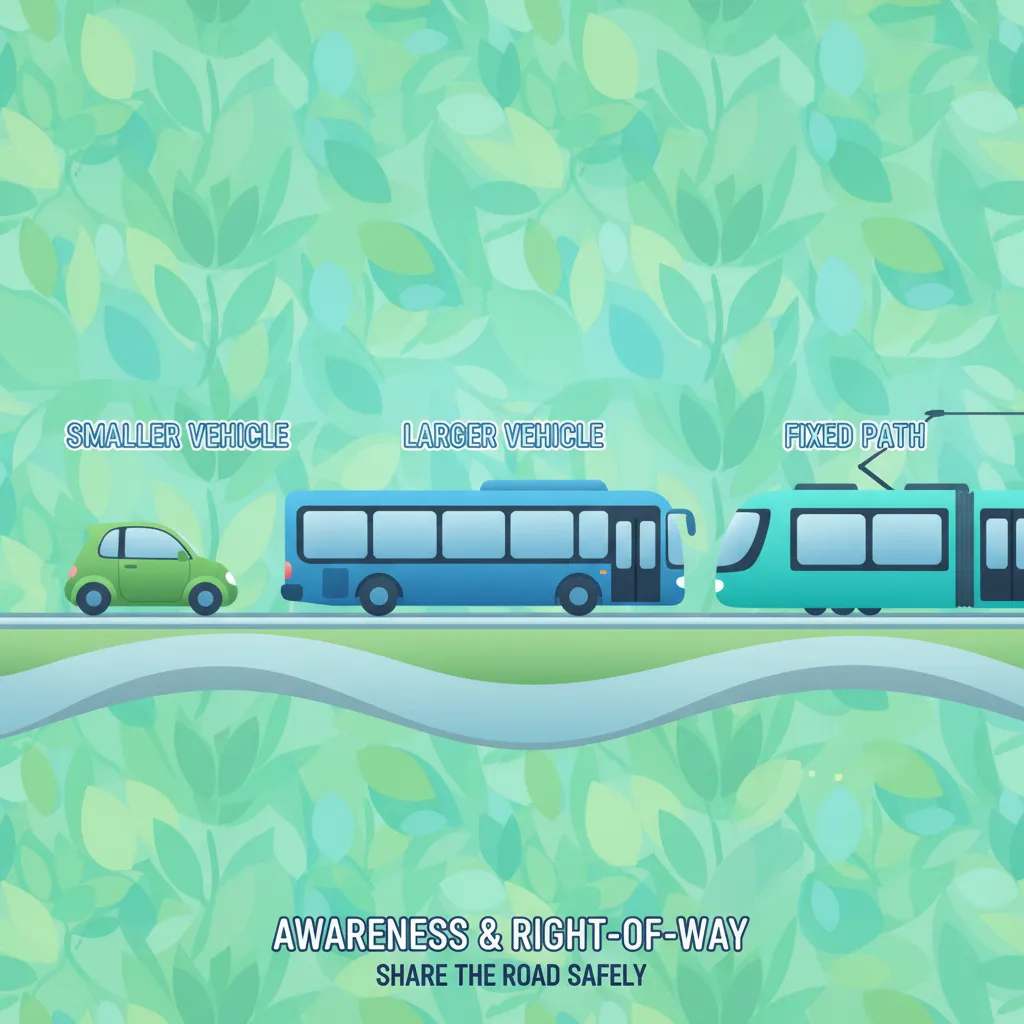
This lesson provides specific guidance for sharing the road with different types of vehicles in Austria. It covers the dangers of large vehicle blind spots, the rules for navigating near buses and dedicated tram tracks, and common conflict points at intersections. Understanding the behavior and limitations of other vehicles is key to safely navigating complex urban environments.
This lesson details the mandatory lighting and reflector requirements for Category AM vehicles in Austria. It explains the functions of different light settings, including daytime running lights, and their importance for being seen. Additionally, it covers the legal standards for protective helmets, a critical component of rider safety.
This lesson categorizes and explains the different types of Austrian road signs, including warning, regulatory, and informational signs. It details how the shape and color of a sign indicate its function, such as communicating speed limits, prohibitions, or mandatory actions. Understanding this visual system is fundamental for making correct and safe decisions while riding.
Find clear answers to common questions learners have about Using Mirrors and Indicators Effectively. Learn how the lesson is structured, which driving theory objectives it supports, and how it fits into the overall learning path of units and curriculum progression in Austria. These explanations help you understand key concepts, lesson flow, and exam focused study goals.
Mirrors have inherent blind spots where cars or cyclists can easily hide. A quick shoulder check is a critical safety habit for moped riders to verify the area is clear before moving or turning.
You must signal in good time before making a turn or changing lanes to give other road users sufficient warning. Signaling too late is a frequent cause of accidents and common errors in the theory exam.
Yes. Signaling is a legal requirement under the StVO to communicate your intentions, regardless of whether you see other road users. It establishes a habit of safety that keeps you prepared for sudden hazards.
Incorrectly adjusted mirrors reduce your field of vision, forcing you to turn your head for longer periods and taking your attention away from the road ahead. Proper adjustment ensures you can monitor traffic efficiently while keeping your eyes on the path.
Refine your study plan by searching for specific Austrian driving theory practice sets. Pinpoint questions related to particular road rules, signs, or challenge levels, and begin practicing immediately to reinforce your knowledge and excel in your official exam with confidence. Get started with focused revision today.