
This lesson teaches you the vital art of active observation, the foundation of safe driving in Austria. You will learn how to combine systematic mirror checks and shoulder glances (Schulterblick) to maintain total situational awareness. This knowledge is essential for both your theory exam and your practical competence on Austrian roads.

Lesson content overview
Safe driving in the Austrian Category B driver's license context is built upon a fundamental pillar: effective observation. It is not merely about looking ahead, but a sophisticated, continuous process of scanning, interpreting, and anticipating the dynamic environment around your vehicle. This lesson will equip you with the essential skills to develop comprehensive observation habits, including systematic scanning techniques, correct mirror usage, and the critical importance of checking blind spots, particularly the Austrian Schulterblick. By mastering these techniques, you will significantly enhance your ability to detect potential hazards early, maintain safe distances, and execute maneuvers with confidence and safety across Austria's diverse road network.
Visual scanning is the systematic process of moving your eyes to gather information from your entire driving environment. Unlike simply staring straight ahead, effective scanning involves continuously shifting your gaze to cover the road ahead, to the sides, and to the rear of your vehicle. This active information gathering is crucial because the human eye can only focus clearly on a small area at any given time. Regular eye movement prevents "tunnel vision" and ensures that no potential hazard goes unnoticed.
Effective scanning incorporates several dimensions to ensure comprehensive awareness:
Looking far ahead, often referred to as "Blickführung weit nach vorne" in Austrian driving education, means extending your visual search to cover a distance equivalent to 20-30 seconds of travel time. At typical urban speeds (50 km/h), this means looking approximately 275-415 metres ahead. On motorways (130 km/h), this range extends to 720-1080 metres.
Why Far-Ahead Scanning is Crucial: It provides maximum reaction time, allowing you to identify changes in traffic flow, upcoming intersections, potential hazards (like a stopped vehicle or roadworks), and traffic signs well in advance. This enables smooth adjustments to your speed and lane position, avoiding sudden braking or steering.
While far-ahead scanning provides foresight, close-ahead scanning focuses on the area immediately in front of your vehicle, typically covering the next 3-5 seconds of travel distance. This helps you maintain proper lane position, detect immediate road surface hazards, and react to sudden movements of vehicles directly in front of you.
Combining far-ahead and close-ahead scanning ensures a balanced perception of your driving environment, preventing both short-sighted reactions and delayed responses to immediate threats. You should not fixate on one point for too long; instead, let your eyes dance across the road and its surroundings.
Mirrors are indispensable tools for safe driving, providing critical information about traffic behind and to the sides of your vehicle without requiring you to turn your head excessively. However, they are only effective if properly adjusted and regularly utilized.
Every vehicle is equipped with at least three mirrors, as mandated by Austrian traffic law (StVO § 14):
Proper mirror adjustment (Spiegel einstellen) is a foundational step before you even start driving. Incorrectly positioned mirrors create unnecessary blind spots and limit your awareness.
Adjust Your Seating Position First: Ensure you are comfortably seated with good posture and can easily reach all controls. Your mirrors should be adjusted after your seat.
Interior Rear-View Mirror: Position this mirror so that it frames the entire rear window, providing a full, unobstructed view directly behind your vehicle. You should not have to move your head significantly to see behind you.
Side Mirrors (Left and Right): Lean slightly towards the mirror you are adjusting. Adjust the mirror outwards until you can just barely see the side of your own vehicle. This maximizes the view of the lanes beside you and minimizes your blind spots. When sitting upright, you should no longer see your own car in the side mirrors, or only a very tiny sliver of it.
Mirror checks should not be reserved only for maneuvers. They should be an integral part of your continuous scanning routine.
Despite correctly adjusted mirrors, every vehicle has areas that remain unseen. These are known as blind spots or, in German, Tote Winkel. These hidden zones are particularly dangerous because they can conceal other vehicles, cyclists, or motorcyclists, leading to serious collisions if not properly checked.
Blind spots typically exist:
Because mirrors cannot cover all areas, the Shoulder Check (Schulterblick) is a mandatory and life-saving technique in Austrian driving. It involves a brief, quick turn of your head over your shoulder in the direction you intend to move, allowing you to directly check the blind spot.
Never rely solely on your mirrors for lateral maneuvers. The Schulterblick is essential to confirm that your blind spot is clear.
The Schulterblick must be performed immediately before any lateral movement:
Check Mirrors First: Always begin with a quick check of your side and rear-view mirrors to get an initial assessment of the traffic situation.
Signal Your Intention: Activate your indicator to signal your planned maneuver.
Quick Head Turn: Just before you begin to steer, turn your head swiftly over the shoulder in the direction of your intended movement. This is a quick glance, not a prolonged stare, to minimize time taking your eyes off the road ahead.
Confirm Clearance: If clear, execute your maneuver smoothly. If not, abort the maneuver and wait for a safe opportunity.
To ensure comprehensive observation, it's helpful to mentally divide your driving environment into distinct zones. This systematic approach helps you allocate your attention effectively and ensures no area is neglected.
By consciously scanning across all three zones in a continuous, flowing pattern, you build a complete picture of your surroundings, fulfilling the legal obligation to maintain a proper lookout.
Effective observation isn't just about reacting to immediate threats; it's about anticipating them before they fully develop. This proactive approach is a cornerstone of defensive driving, allowing you to predict potential dangers and plan your responses well in advance.
Hazard anticipation involves:
"What if?" Thinking: As you scan, constantly ask yourself "what if?" What if that parked car door opens? What if that child runs into the street? What if the driver ahead suddenly brakes? This mindset helps you prepare for contingencies.
Austrian traffic law, specifically the Straßenverkehrsordnung (StVO), places clear obligations on drivers regarding observation, emphasizing its importance for road safety.
die Straße beobachten) and anticipate hazards. This broad requirement forms the legal basis for all the scanning and observation techniques discussed. Neglecting this duty can lead to legal consequences in case of an accident.Schulterblick). This regulation directly underlines the importance of checking blind spots.Adherence to these legal provisions is not merely about avoiding penalties; it is about actively contributing to the safety of all road users.
Your observation strategy must be flexible and adapt to different driving conditions. The effectiveness of your scanning directly impacts your ability to navigate challenging environments safely.
Even experienced drivers can fall into poor observation habits. Recognizing and correcting these common mistakes is vital for continuous improvement and maintaining safety.
| Violation | Why It's Wrong | Correct Behavior | Potential Consequence |
|---|---|---|---|
| Neglecting Schulterblick | Vehicles in blind spots are invisible, leading to collisions during maneuvers. | Always perform a quick over-the-shoulder glance immediately before initiating a lane change, merge, or turn. | Side-swipe collision; serious injury to cyclists/motorcyclists. |
| Over-relying on Mirrors | Mirrors have limitations and do not cover all zones, especially at close range. | Combine mirror checks with a mandatory Schulterblick and active side scanning, particularly in heavy traffic. | Near-misses or collisions during lane changes or merging. |
| Fixating on a Distant Point | Staring straight ahead causes "tunnel vision," missing hazards closer or to the sides. | Adopt a continuous scanning routine: far ahead, close ahead, side, mirrors, and blind spots, without prolonged staring. | Delayed hazard detection; abrupt braking or steering required. |
| Scanning Only the Road Ahead on Curves | Curves limit far-ahead visibility; side hazards and oncoming traffic can be missed. | Increase side scanning frequency on curves; anticipate vehicles emerging from bends; adjust speed accordingly. | Head-on collision or unexpected obstacle. |
| Insufficient Observation in Adverse Weather | Reduced visibility requires more effort to gather information. | Extend scanning range (if possible), increase frequency of all checks, and significantly reduce speed. | Collision due to lack of early hazard detection and reaction time. |
| Failing to Adjust Mirrors Before Driving | Misaligned mirrors restrict vital rear and side views, creating larger blind spots. | Adjust all mirrors to their optimal positions before moving the vehicle. | Incomplete visual information leading to unsafe maneuvers. |
| Shoulder Checking While Turning | Diverts attention from the intended path of the turn and potential hazards in the turn's arc. | Complete the turn while maintaining vision in the direction of travel; perform shoulder checks before initiating the turn if necessary. | Missed pedestrian or vehicle in the turn's path, causing collision. |
Observation is the cornerstone of safe and defensive driving. It's a skill that requires continuous practice and conscious effort until it becomes a natural, ingrained habit. By diligently applying the principles of systematic scanning (far-ahead, close-ahead, side, rear), mastering mirror checks, and consistently performing the vital Schulterblick to conquer blind spots, you empower yourself to anticipate hazards and react smoothly.
Remember that Austrian traffic laws, particularly the StVO, reinforce these observation duties, not just as rules to follow, but as essential practices for the safety of everyone on the road. As you progress through your Austrian Driving License B Theory Course, continue to connect these observation techniques with other lessons, understanding how they enable safe lane changes, confident turning, and proactive hazard anticipation in all conditions.
This lesson teaches systematic visual scanning techniques essential for safe driving and the Austrian theory exam, covering horizontal, vertical, and temporal scanning methods. It details proper mirror adjustment (interior, left, and right side mirrors) with specific intervals for checks during normal driving, maneuvers, and braking situations. The critical role of the Schulterblick (shoulder check) is emphasized as the mandatory method to eliminate blind spots before lane changes, merging, or turns, with a clear step-by-step procedure provided. The lesson also covers observation zone divisions, hazard anticipation strategies, and how observation requirements adapt under adverse weather, at night, and on different road types, grounded in specific Austrian traffic law (StVO) provisions.
A short set of high-value points that capture the most important learning from this lesson.
Effective observation is a continuous, systematic process covering far-ahead, close-ahead, side zones, and rear zones—not just looking straight ahead
Far-ahead scanning should cover 20-30 seconds of travel distance: approximately 275-415m in urban areas (50 km/h) and 720-1080m on motorways (130 km/h)
Mirror checks must be combined with the Schulterblick shoulder check before any lateral movement because mirrors alone cannot eliminate blind spots
Austrian StVO §48 mandates continuous proper lookout as a legal obligation, not merely an optional driving habit
Proactive hazard anticipation through 'what if?' thinking and reading road environment clues enables defensive driving
Explore all units and lessons included in this driving theory course.
Perform mirror checks every 5-8 seconds even on straight roads, plus before braking, signaling, changing lanes, turning, and overtaking
The Schulterblick must always be performed immediately before—not during—a maneuver to cover the blind spot (Toter Winkel)
In adverse weather (fog, heavy rain, snow) or reduced visibility (night, tunnels), increase scanning frequency and lower speed to compensate
Side mirrors should show only a tiny sliver of your own vehicle when seated upright to maximize coverage of adjacent lanes
Cyclists and motorcyclists often hide in blind spots due to their smaller size; always shoulder check before opening doors or making lateral maneuvers
Neglecting the Schulterblick and relying solely on mirrors, which leaves blind spots unchecked and risks hitting vehicles positioned there
Fixating on a distant point forward causes tunnel vision, making you miss hazards closer to the vehicle or in adjacent lanes
Shoulder checking while already turning the steering wheel diverts attention from the intended path and hazards within the turn's arc
Insufficient observation on curves, where far-ahead visibility is limited, leading to missed oncoming traffic or emerging obstacles
Failing to adjust mirrors before driving creates larger blind spots, providing incomplete visual information for all subsequent maneuvers
Lesson content overview
A short set of high-value points that capture the most important learning from this lesson.
Effective observation is a continuous, systematic process covering far-ahead, close-ahead, side zones, and rear zones—not just looking straight ahead
Far-ahead scanning should cover 20-30 seconds of travel distance: approximately 275-415m in urban areas (50 km/h) and 720-1080m on motorways (130 km/h)
Mirror checks must be combined with the Schulterblick shoulder check before any lateral movement because mirrors alone cannot eliminate blind spots
Austrian StVO §48 mandates continuous proper lookout as a legal obligation, not merely an optional driving habit
Proactive hazard anticipation through 'what if?' thinking and reading road environment clues enables defensive driving
Explore all units and lessons included in this driving theory course.
Perform mirror checks every 5-8 seconds even on straight roads, plus before braking, signaling, changing lanes, turning, and overtaking
The Schulterblick must always be performed immediately before—not during—a maneuver to cover the blind spot (Toter Winkel)
In adverse weather (fog, heavy rain, snow) or reduced visibility (night, tunnels), increase scanning frequency and lower speed to compensate
Side mirrors should show only a tiny sliver of your own vehicle when seated upright to maximize coverage of adjacent lanes
Cyclists and motorcyclists often hide in blind spots due to their smaller size; always shoulder check before opening doors or making lateral maneuvers
Neglecting the Schulterblick and relying solely on mirrors, which leaves blind spots unchecked and risks hitting vehicles positioned there
Fixating on a distant point forward causes tunnel vision, making you miss hazards closer to the vehicle or in adjacent lanes
Shoulder checking while already turning the steering wheel diverts attention from the intended path and hazards within the turn's arc
Insufficient observation on curves, where far-ahead visibility is limited, leading to missed oncoming traffic or emerging obstacles
Failing to adjust mirrors before driving creates larger blind spots, providing incomplete visual information for all subsequent maneuvers
Explore search topics learners often look for when studying Observation Principles and Scanning Techniques. These topics reflect common questions about road rules, driving situations, safety guidance, and lesson level theory preparation for learners in Austria.
Browse additional driving theory lessons that cover connected traffic rules, road signs, and common driving situations related to this topic. Improve your understanding of how different rules interact across everyday traffic scenarios.
Master complex observation strategies including systematic scanning patterns, optimal mirror adjustment, and effective blind spot detection. Learn how to anticipate hazards proactively for safer driving in Austria.

This lesson provides a detailed guide on how to use a vehicle's mirrors and camera systems to their full potential. It explains the purpose of different types of mirrors (e.g., wide-angle) and how to integrate them into a continuous scanning pattern. This proactive observation is essential for detecting hazards early.

This lesson teaches the correct technique for setting and using motorcycle mirrors to maintain awareness of traffic behind and to the sides. It emphasizes that mirrors alone are not enough, detailing the necessity of the 'lifesaver' shoulder check to cover critical blind spots. A disciplined observation routine is crucial for safe lane changes, merging, and navigating dense traffic.

This lesson focuses on the safety-critical skill of reversing, emphasizing the importance of all-around observation before and during the manoeuvre. It covers the correct use of mirrors and the necessity of checking blind spots to ensure the path is clear of pedestrians, obstacles, and other vehicles. Learners will understand techniques for maintaining slow, controlled speed and making accurate steering adjustments while backing up in various situations.

This lesson focuses on the critical role of mirrors, cameras, and other electronic aids in minimizing blind spots around a large vehicle. It provides guidance on how to properly adjust mirrors to maximize visibility. Effective use of these systems is vital for detecting smaller vehicles, cyclists, and pedestrians, especially during manoeuvres.

Passive mirror use is not enough. This lesson teaches active, systematic scanning techniques, including moving your head to look around A-pillars and using all available mirrors and cameras in a set sequence. The focus is on building a constant mental map of the space around the vehicle, especially before any change of direction or speed, to account for unseen pedestrians or cyclists.

This lesson introduces the proactive mindset of defensive driving, which focuses on anticipating potential hazards rather than just reacting to them. It teaches techniques for systematic risk assessment, including scanning the road ahead, checking mirrors frequently, and being aware of the potential actions of other road users. By adopting these safe habits, drivers can create a buffer of safety around their vehicle and significantly reduce the likelihood of being involved in an accident.

Buses and coaches have significant blind spots that pose a major risk to pedestrians, cyclists, and other vehicles. This lesson teaches you how to correctly set up and systematically scan all mirrors, including wide-angle and kerb-view mirrors. It also covers the use of modern camera systems to gain a complete picture of the area surrounding the vehicle, especially before moving off.

This lesson explains the correct techniques for using mirrors to maintain awareness of surrounding traffic and for checking blind spots. It details the proper timing and use of indicators to signal turns and lane changes effectively. The content reinforces that clear, early communication is key to preventing misunderstandings with other drivers.

This lesson explores the specific characteristics and hazards of rural roads (Landstraßen). It emphasizes the need for careful speed adjustment due to factors like narrow lanes, poor road surfaces, and hidden entrances. Learners will understand how to safely navigate blind curves, use passing places, and anticipate the presence of slow-moving agricultural vehicles or livestock on the road.

Rural Austrian roads present unique challenges, including lack of markings, tight spaces, and slow-moving agricultural vehicles. This lesson teaches how to read the road ahead, anticipate hazards around blind bends, and use passing places effectively when meeting other large vehicles. It emphasizes adjusting speed to suit the limited visibility and variable road conditions.
Identify frequent observation errors and learn how to better protect vulnerable road users like cyclists and pedestrians. This lesson focuses on real-world scenarios and Austrian specific rules for safe interaction.

This lesson provides advanced strategies for proactively managing interactions with vulnerable road users to prevent conflicts before they arise. It teaches drivers to predict the likely behavior of pedestrians, cyclists, and e-scooter riders, especially at intersections and in congested areas. Key techniques include maintaining larger safety distances, covering the brake, and making eye contact to ensure mutual awareness and avoid accidents.
This lesson introduces the proactive mindset of defensive driving, which focuses on anticipating potential hazards rather than just reacting to them. It teaches techniques for systematic risk assessment, including scanning the road ahead, checking mirrors frequently, and being aware of the potential actions of other road users. By adopting these safe habits, drivers can create a buffer of safety around their vehicle and significantly reduce the likelihood of being involved in an accident.

This lesson teaches a safe, methodical process for navigating intersections. It stresses the importance of proper lane positioning on approach, comprehensive visual scans for cross-traffic, pedestrians, and cyclists, and clear communication of intent. Special attention is given to the increased risks associated with left turns across oncoming traffic.

This lesson reinforces the critical importance of protecting vulnerable road users in dense urban settings. It teaches drivers to be hyper-aware of pedestrians and cyclists, especially near intersections and crosswalks. Key techniques include reducing speed, making eye contact to confirm intentions, and giving ample space.

This lesson focuses on warning signs, which are designed to alert drivers to potential hazards ahead. Learners will explore the meanings of signs indicating sharp curves, changes in road surface, potential animal crossings, and upcoming construction zones. The content explains how the characteristic triangular shape and symbols convey specific dangers, enabling drivers to anticipate conditions and adjust their speed and attention accordingly.

This lesson teaches a safe and systematic process for approaching and crossing intersections. It covers how to correctly assess priority based on signs and general rules, adjust speed appropriately, and perform thorough visual checks. Emphasis is placed on anticipating the actions of other road users to prevent conflicts at junctions.

This lesson teaches drivers how to safely coexist with cyclists and pedestrians, who are prevalent in urban areas. It covers the rules for dedicated bike lanes (Radweg), the importance of yielding to pedestrians in designated zones, and the need for extra caution when turning or opening car doors. Maintaining safe overtaking distances and anticipating the movements of these vulnerable road users are key themes for preventing accidents.

This lesson focuses on the critical skill of sharing the road safely with vulnerable users, such as pedestrians, cyclists, and e-scooter riders. It details the legally required distance buffers for overtaking and emphasizes heightened awareness in sensitive areas like school zones and designated pedestrian crossings. The content provides guidelines for interacting with bicycle lanes and shared spaces to foster a protective and respectful driving attitude towards those most at risk.
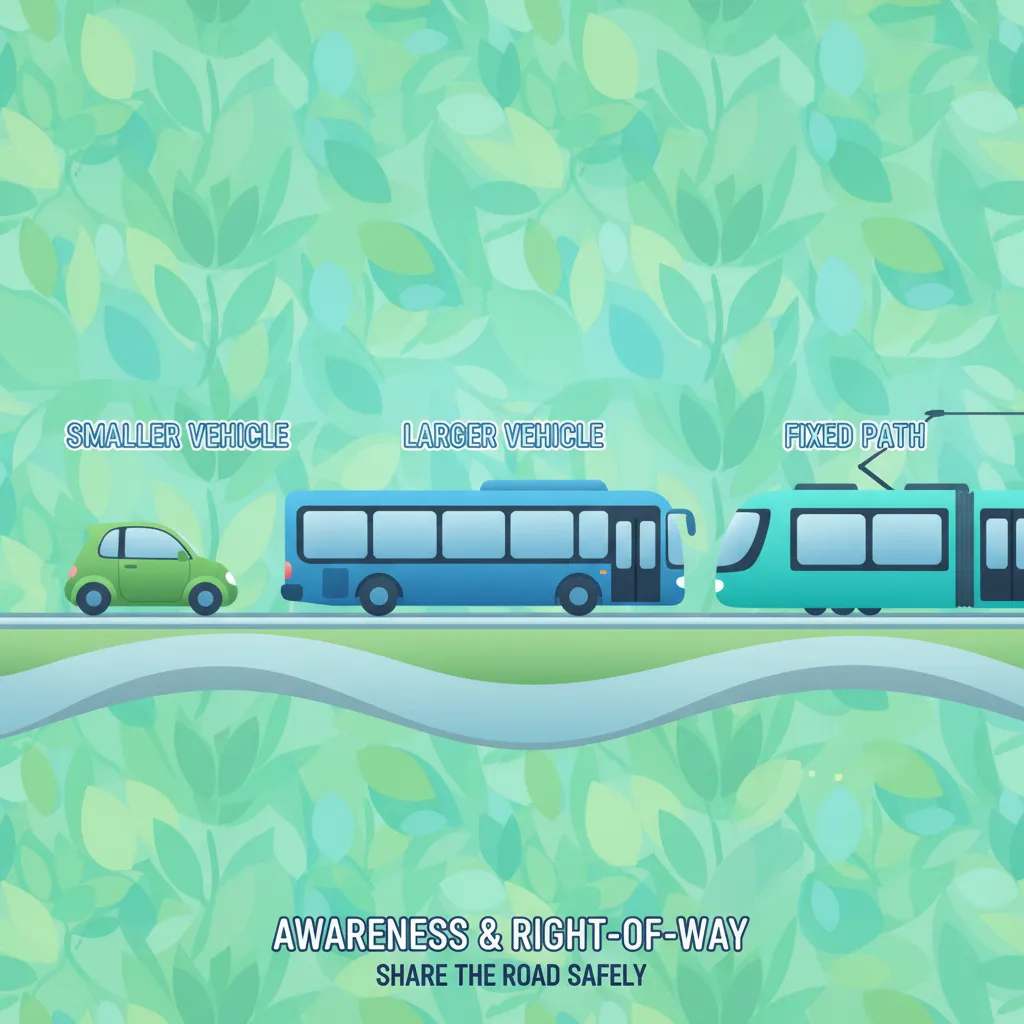
This lesson provides specific guidance for sharing the road with different types of vehicles in Austria. It covers the dangers of large vehicle blind spots, the rules for navigating near buses and dedicated tram tracks, and common conflict points at intersections. Understanding the behavior and limitations of other vehicles is key to safely navigating complex urban environments.

This lesson addresses the specific danger of right-hand turns, where cyclists and pedestrians in the vehicle's right-side blind spot are at high risk. It covers the defensive driving techniques required, including careful observation, slow speed, and yielding the right-of-way. These procedures are critical for preventing serious accidents in urban areas.
Find clear answers to common questions learners have about Observation Principles and Scanning Techniques. Learn how the lesson is structured, which driving theory objectives it supports, and how it fits into the overall learning path of units and curriculum progression in Austria. These explanations help you understand key concepts, lesson flow, and exam focused study goals.
Yes, in Austrian driving practice, a shoulder check (Schulterblick) is essential before any lateral movement, such as changing lanes or pulling away from the curb, to ensure the blind spot is clear.
On motorways, you should be looking as far ahead as the road conditions and visibility allow, typically focusing on traffic events occurring several hundred meters in front of you.
The test will assess your understanding of systematic observation; you must identify the correct sequence of checking mirrors and blind spots before executing maneuvers safely.
Traffic conditions can change instantly. Maintaining a habit of regular mirror checks ensures you remain aware of fast-approaching vehicles or cyclists, even when you believe the road is clear.
Refine your study plan by searching for specific Austrian driving theory practice sets. Pinpoint questions related to particular road rules, signs, or challenge levels, and begin practicing immediately to reinforce your knowledge and excel in your official exam with confidence. Get started with focused revision today.