
Understanding the hierarchy of road priority is a fundamental requirement for every learner driver in Great Britain. This guide breaks down the essential rules for handling junctions, roundabouts, and traffic flow, ensuring you can make quick, safe decisions that align with the Highway Code. Mastering these concepts is critical for both passing your theory test and ensuring long-term road safety.
Article content overview
Mastering the rules of priority at junctions is one of the most critical skills for any learner driver in Great Britain. Whether you are navigating busy urban streets or quiet country lanes, understanding exactly who has the right of way is essential for both your safety and your success in the DVSA theory test. Confusion at junctions is a frequent source of serious driving faults and theory exam failures, often because learners fail to correctly interpret road signs, markings, and the intent of other road users.
In the United Kingdom, priority is dictated by a clear hierarchy of signs, road markings, and general traffic rules. At the most fundamental level, you must obey traffic light signals, followed by police or traffic officer directions, then road signs, and finally road markings. When you approach any junction, you should begin your observation sequence early, checking your mirrors, signaling your intention, and adjusting your speed well before reaching the point of turn.
Unmarked junctions—those without traffic lights, stop signs, or give-way markings—are often the most intimidating for new drivers. Contrary to common myths, there is no absolute rule that traffic on a "major" road always has priority over traffic on a "minor" road if the signs do not explicitly state it. However, the Highway Code suggests that you should approach these junctions with extreme caution, slowing down and being prepared to stop to allow other vehicles to pass if they have already established themselves in the junction.
When you are unsure of priority at an unmarked junction, the safest approach is to treat the situation as if no one has the right of way. Eye contact with other drivers can be a helpful, though not guaranteed, method of communication to determine who intends to move first. Always expect the unexpected; if you are in any doubt, it is far safer to wait than to attempt to force your way through.
Roundabouts are designed to keep traffic moving, but they require precise lane discipline and observation. The golden rule of the roundabout in Great Britain is to give priority to traffic approaching from your right. Once you have entered the roundabout, you generally have priority over those waiting to enter, provided you are in the correct lane and signaling correctly for your exit.
Always be aware that other drivers may not follow correct lane discipline. Never assume that a vehicle signaling left intends to exit at the first available turn; they may have forgotten to cancel their signal from a previous maneuver.
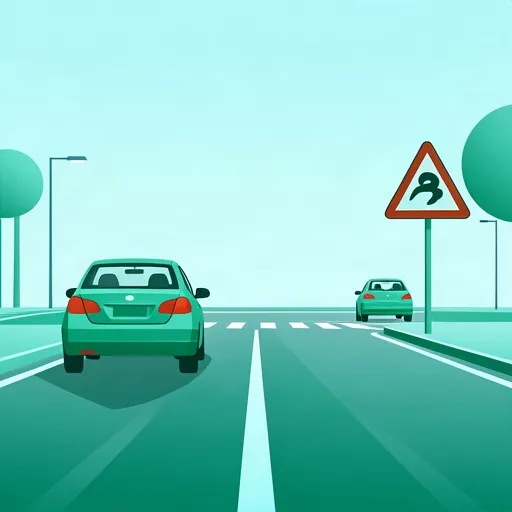
The DVSA theory test frequently assesses your ability to identify and respond to priority-related signage. Familiarizing yourself with these signs is not just about passing the test; it is about developing the instincts required to read the road environment accurately while driving.
In the theory test, you may encounter questions regarding scenarios where a larger vehicle, such as a bus or a heavy goods vehicle (HGV), is attempting to maneuver. You should always show consideration to larger vehicles, as they may need to straddle lanes to make a turn. The test often probes your understanding of "assertiveness" versus "aggression"—you must be assertive enough to move safely, but never aggressive enough to force other road users to take evasive action.
Understanding priority rules at junctions is essential for both road safety and passing the DVSA theory test. The priority hierarchy runs from traffic signals through to road markings, and at unmarked junctions you should approach with the assumption that no one has automatic right of way. Roundabouts require giving way to traffic from the right and maintaining correct lane discipline throughout your manoeuvre. Always verify other road users' intentions rather than making assumptions, and remember that larger vehicles may need additional space to complete their turns.
A short set of high-value points that capture the most important ideas from this article.
Priority at junctions follows a hierarchy: traffic signals, then police directions, then road signs, then road markings
At unmarked junctions, treat the situation as if no one has priority and approach with extreme caution
On roundabouts in Great Britain, always give way to traffic approaching from your right
Always observe and mirror-check before signaling or changing lane position at junctions and roundabouts
Larger vehicles may need extra space to maneuver and you should be assertive but never aggressive when sharing the road with them
Unmarked junctions have no absolute rule favouring major or minor roads without visible signs or markings
Once you have entered a roundabout correctly, you generally have priority over traffic waiting to enter
A Stop sign legally requires a complete standstill, unlike a Give Way which only requires you to be prepared to stop
Never assume a vehicle signalling left is taking the first exit - they may have forgotten to cancel it
Eye contact with other drivers at junctions is helpful but not guaranteed to communicate intentions safely
Assuming traffic on a 'major' road always has priority at unmarked junctions without checking for signs or markings
Believing that a left signal always means a vehicle will exit at the first roundabout turn
Relying solely on eye contact instead of proper observation of signals and road markings
Forgetting to cancel your own signal after passing your intended exit on a roundabout
Failing to slow down and adjust speed early enough when approaching unfamiliar junctions
Article content overview
A short set of high-value points that capture the most important ideas from this article.
Priority at junctions follows a hierarchy: traffic signals, then police directions, then road signs, then road markings
At unmarked junctions, treat the situation as if no one has priority and approach with extreme caution
On roundabouts in Great Britain, always give way to traffic approaching from your right
Always observe and mirror-check before signaling or changing lane position at junctions and roundabouts
Larger vehicles may need extra space to maneuver and you should be assertive but never aggressive when sharing the road with them
Unmarked junctions have no absolute rule favouring major or minor roads without visible signs or markings
Once you have entered a roundabout correctly, you generally have priority over traffic waiting to enter
A Stop sign legally requires a complete standstill, unlike a Give Way which only requires you to be prepared to stop
Never assume a vehicle signalling left is taking the first exit - they may have forgotten to cancel it
Eye contact with other drivers at junctions is helpful but not guaranteed to communicate intentions safely
Assuming traffic on a 'major' road always has priority at unmarked junctions without checking for signs or markings
Believing that a left signal always means a vehicle will exit at the first roundabout turn
Relying solely on eye contact instead of proper observation of signals and road markings
Forgetting to cancel your own signal after passing your intended exit on a roundabout
Failing to slow down and adjust speed early enough when approaching unfamiliar junctions
Explore related topics, search based questions, and concepts that learners often look up when studying Priority and Junction Safety Rules. These themes reflect real search intent and help you understand how this topic connects to wider driving theory knowledge in Great Britain.
Find clear and practical answers to common questions learners often have about Priority and Junction Safety Rules. This section helps explain difficult points, remove confusion, and reinforce the key driving theory concepts that matter for learners in Great Britain.
There is no formal rule giving priority to any specific road at an unmarked junction. You must approach with extreme caution, check for other traffic, and be prepared to stop and give way if necessary.
When approaching a roundabout, you should give priority to traffic approaching from your right, unless road signs, markings, or traffic lights direct otherwise.
You must give way to traffic on the major road. You do not always have to stop if the road is clear, but you must be prepared to stop if there is any traffic approaching.
Explore our extensive library of Great Britain driving theory articles to clarify any topic, review specific road rules, or gain deeper insights into vehicle safety and the Highway Code. Use the search to find exactly what you need for comprehensive DVSA theory test preparation.