
Navigating the rules of the road requires a solid grasp of speed limit regulations and sign interpretation. This guide covers the essential theory you need to identify speed restrictions in various environments and understand what supplementary signs mean for your driving. Perfect for your theory test preparation, this resource focuses on helping you apply Highway Code principles to real-world driving scenarios.
Article content overview
Successfully passing your DVSA theory test requires more than just memorising the Highway Code; it demands a deep understanding of how speed limits and traffic signs dictate safe, legal driving behaviour. In Great Britain, speed limits are not merely suggestions—they are legal requirements enforced to maintain traffic flow and ensure road safety for all users. Whether you are driving on quiet country lanes or navigating complex urban motorways, you must be able to recognise and react to signs immediately.
One of the most frequent errors made by learner drivers in the theory exam involves misidentifying the speed limit in rural environments. Many learners assume that because a road is outside of a built-up area, the National Speed Limit (indicated by a white circular sign with a single black diagonal stripe) automatically applies. However, local authorities frequently impose lower limits on winding or hazardous country roads. You must always look for terminal speed limit signs at the start of a road and remember that repeater signs are used to remind you of the limit in areas where there is no street lighting.
In urban areas, the rules are different. Unless signs indicate otherwise, a system of street lighting is generally your primary indicator that a 30 mph speed limit is in force. This is a vital piece of knowledge for your theory exam; if you see street lights but no speed limit signs, you must assume the limit is 30 mph.
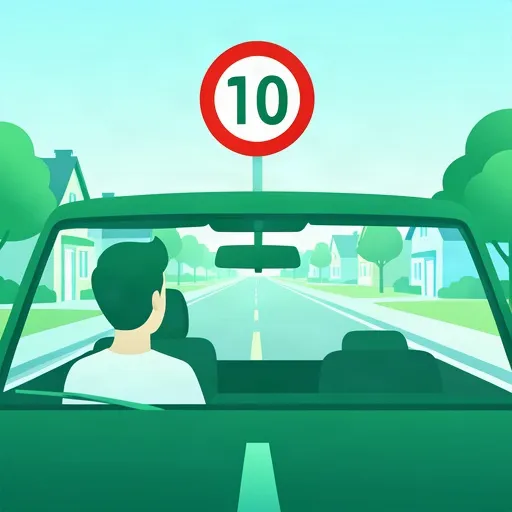
Road signs in Great Britain follow a standardised system of shapes and colours designed to provide information at a glance. Circular signs are generally used for instructions or prohibitions—meaning they tell you what you MUST or MUST NOT do. For instance, a red circle containing a number is a mandatory speed limit, and ignoring it is a legal offence. Triangular signs are used for warnings, such as alerting you to a hidden junction, a sharp bend, or a school crossing ahead.
Understanding the context of these signs is critical. When a warning sign is accompanied by a supplementary plate, such as "for 1/2 mile," you must remain cautious for that entire distance. Failing to account for these supplementary instructions is a common trap in the DVSA theory test.
| Sign Type | Shape | Primary Purpose |
|---|---|---|
| Regulatory | Circular | Mandatory instructions (MUST/MUST NOT) |
| Warning | Triangular | Alerts to potential hazards |
| Information | Rectangular | Guidance and local directions |
| Expressway | Blue Background | Specific to motorway or primary route rules |
While the law dictates the maximum speed you are allowed to travel, your driving must always be adjusted for the conditions. The Highway Code emphasises that the legal limit is not a target. In adverse weather conditions, such as heavy rain, fog, or ice, you must reduce your speed significantly.
In the hazard perception part of your test, you will be expected to demonstrate an awareness of "developing hazards." If you see a warning sign for a sharp bend or a pedestrian crossing, you should begin to ease off the accelerator early. This proactive approach shows the examiner that you are prioritising safety over reaching the legal speed limit.
Learners often lose marks by confusing speed limits for different vehicle types. For example, the speed limit for a car towing a caravan is lower than that for a standard car. Always check the specific question regarding the vehicle class. Furthermore, remember that motorway rules are specific; you must never stop on the hard shoulder except in an emergency, and you must obey variable speed limits displayed on overhead gantries. These electronic signs are just as legally binding as physical roadside signs.
This guide covers the essential theory for understanding speed limits and traffic signs in Great Britain, distinguishing between National Speed Limit areas and urban 30 mph zones where street lighting is present. It explains the standardised sign system by shape and colour, emphasising that circular signs impose legal obligations while triangular signs warn of developing hazards. The article stresses that the legal speed limit is a maximum you must reduce when conditions deteriorate, and it highlights common traps involving supplementary plates, vehicle-specific limits, and motorway variable speed limits. Mastering these concepts will help you apply Highway Code principles correctly during the DVSA theory test and on the road.
A short set of high-value points that capture the most important ideas from this article.
Speed limits in Great Britain are legal requirements, not suggestions, and must be obeyed to avoid penalties
Street lighting generally indicates a 30 mph limit applies in built-up areas unless signs show otherwise
Traffic signs follow a hierarchy: circular for mandatory instructions, triangular for warnings, rectangular for information
The legal speed limit is a maximum, not a target—you must always adjust for weather, visibility, and road conditions
Supplementary plates on signs (e.g., 'for 1/2 mile') require sustained caution for the full distance stated
National Speed Limit (white circle with black diagonal) means 60 mph on single carriageways and 70 mph on dual carriageways/motorways for cars
If you see street lights without a speed limit sign, assume the limit is 30 mph
Red circular signs with numbers are mandatory maximum speed limits you must obey
Variable speed limits on motorway gantries are legally binding, just like physical roadside signs
A dual carriageway is defined by a central reservation separating opposing traffic, regardless of lane count
Assuming National Speed Limit applies on all roads outside built-up areas without checking for terminal signs imposing lower limits
Failing to look for supplementary plates that extend the application of a warning sign beyond its immediate location
Confusing speed limits for different vehicle types (e.g., cars towing caravans have lower limits than standard cars)
Believing the speed limit is always safe to drive at regardless of weather conditions or visibility
Ignoring the start of a speed limit zone because a previous limit sign was seen further back—terminal signs mark where new limits begin
Article content overview
A short set of high-value points that capture the most important ideas from this article.
Speed limits in Great Britain are legal requirements, not suggestions, and must be obeyed to avoid penalties
Street lighting generally indicates a 30 mph limit applies in built-up areas unless signs show otherwise
Traffic signs follow a hierarchy: circular for mandatory instructions, triangular for warnings, rectangular for information
The legal speed limit is a maximum, not a target—you must always adjust for weather, visibility, and road conditions
Supplementary plates on signs (e.g., 'for 1/2 mile') require sustained caution for the full distance stated
National Speed Limit (white circle with black diagonal) means 60 mph on single carriageways and 70 mph on dual carriageways/motorways for cars
If you see street lights without a speed limit sign, assume the limit is 30 mph
Red circular signs with numbers are mandatory maximum speed limits you must obey
Variable speed limits on motorway gantries are legally binding, just like physical roadside signs
A dual carriageway is defined by a central reservation separating opposing traffic, regardless of lane count
Assuming National Speed Limit applies on all roads outside built-up areas without checking for terminal signs imposing lower limits
Failing to look for supplementary plates that extend the application of a warning sign beyond its immediate location
Confusing speed limits for different vehicle types (e.g., cars towing caravans have lower limits than standard cars)
Believing the speed limit is always safe to drive at regardless of weather conditions or visibility
Ignoring the start of a speed limit zone because a previous limit sign was seen further back—terminal signs mark where new limits begin
Explore related topics, search based questions, and concepts that learners often look up when studying Speed Limits and Signs Guide. These themes reflect real search intent and help you understand how this topic connects to wider driving theory knowledge in Great Britain.
Find clear and practical answers to common questions learners often have about Speed Limits and Signs Guide. This section helps explain difficult points, remove confusion, and reinforce the key driving theory concepts that matter for learners in Great Britain.
The national speed limit for a car on a single carriageway road is 60 mph, unless traffic signs indicate otherwise.
You should always look for circular signs with a red border which indicate the maximum permitted speed for that specific stretch of road.
Yes, learner drivers must obey all posted speed limits and the national speed limit rules that apply to their vehicle type at all times.
This sign indicates the end of a previous restriction, such as a temporary speed limit, and denotes that the national speed limit now applies.
Explore our extensive library of Great Britain driving theory articles to clarify any topic, review specific road rules, or gain deeper insights into vehicle safety and the Highway Code. Use the search to find exactly what you need for comprehensive DVSA theory test preparation.