
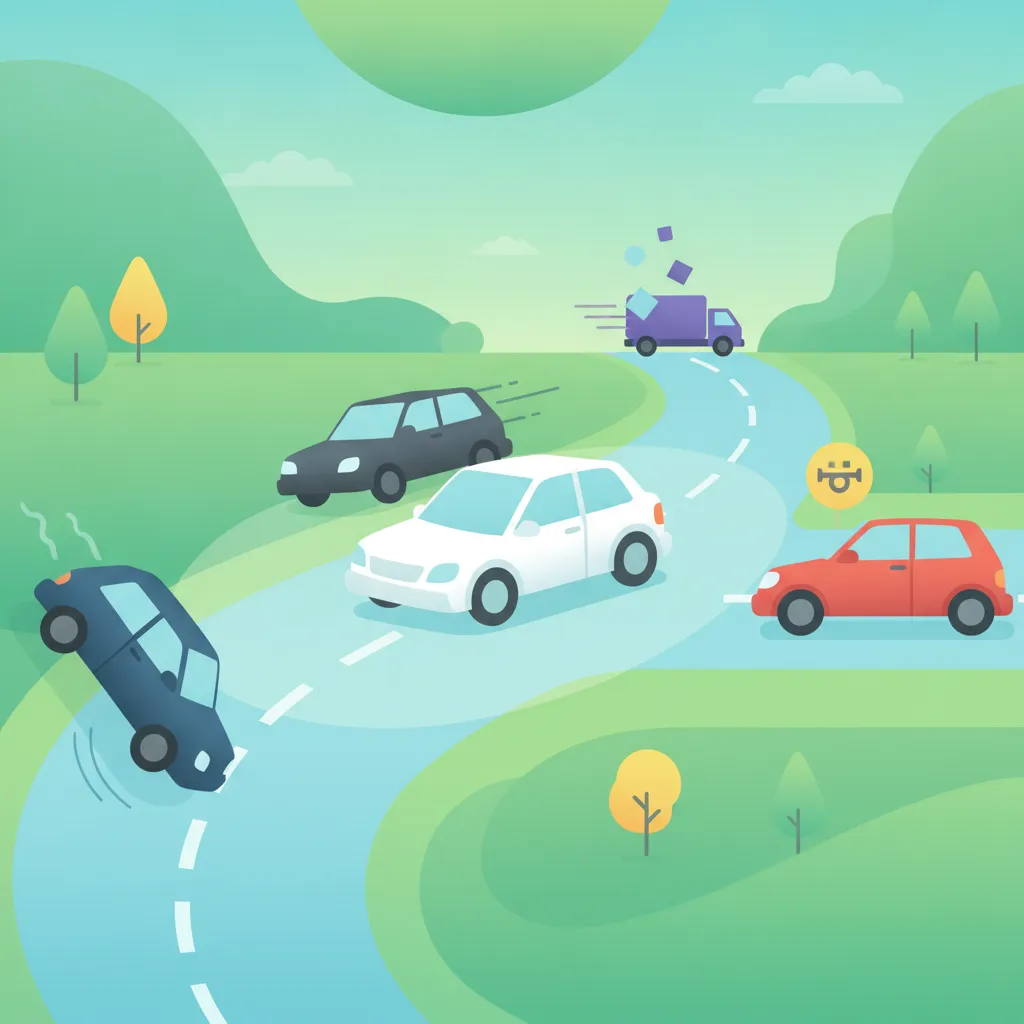
Defensive driving is a crucial approach to staying safe on Danish roads. It's about being proactive rather than reactive, constantly scanning your environment, anticipating potential dangers, and adjusting your driving to minimize risk. By understanding and applying these principles, you prepare yourself for a wide range of situations, reducing the likelihood of collisions regardless of others' actions.
Theory topic content overview
Read the full theory topic guide for Defensive Driving with structured, easy-to-scan content built for learners in Denmark. This detailed section explains the exact rule, meaning, traffic context, comparison points, and exam logic behind this Danish driving theory topic so you can study faster, understand the concept more clearly, and avoid common interpretation mistakes on the theory test.
Defensive driving is a proactive approach to road safety that goes beyond simply obeying traffic laws. It's about developing a mindset where you constantly anticipate potential hazards, assume other road users might make mistakes, and adapt your driving behaviour to reduce risk and prevent accidents. Instead of merely reacting to dangers as they arise, a defensive driver actively scans their environment, predicts potential problems, and creates sufficient time and space to respond safely to unexpected situations.
This strategy is fundamental to driving safely in Denmark, where diverse road users, varying infrastructure, and changing weather conditions demand constant vigilance. It's not about being overly cautious or slow, but about being consistently prepared.
Mastering defensive driving is crucial for both passing your Danish driving theory test and ensuring lifelong safety on the road. Denmark's traffic environment presents unique challenges that underscore the importance of this approach:
Defensive driving is built upon several core principles that empower you to manage risks effectively:
This is about constantly observing everything around your vehicle, not just what's directly in front of you.
Giving yourself enough time and space to react is a hallmark of defensive driving.
This is where proactive driving truly shines.
Your driving behaviour must always match the prevailing conditions, not just the speed limit.
It's important to differentiate defensive driving from other approaches:
Let's illustrate defensive driving principles with examples relevant to Danish roads:
Many new drivers in Denmark struggle with fully embracing defensive driving principles. Common errors include:
Defensive driving isn't a technique you apply occasionally; it's a fundamental mindset that becomes second nature. By consistently practicing situational awareness, maintaining safe margins, anticipating hazards, and adapting to conditions, you empower yourself to navigate Danish roads safely and confidently. This proactive approach not only helps you pass your driving theory test but also ensures you're a responsible and resilient driver, capable of preventing accidents even when faced with the unexpected actions of others. Make defensive driving your default mode behind the wheel.
Defensive driving is a proactive mindset that goes beyond obeying traffic laws, focusing on anticipating hazards, maintaining situational awareness, and creating time and space to react safely when others make mistakes. In Denmark, this approach is especially important due to extensive cycling infrastructure, complex priority situations, variable weather, and high traffic density on motorveje. The core skills include 360-degree scanning, safe following distances using the two-second rule (extended in poor conditions), anticipating the actions of vulnerable road users, and continuously adapting speed to match conditions. These principles are directly tested in the Danish theory exam and form the foundation of safe, lifelong driving.
A short set of high-value points that capture the most important ideas from this theory explanation.
Defensive driving means being proactive rather than reactive—anticipating hazards before they happen, not just responding to them
Constant 360-degree situational awareness through scanning ahead, mirror checks, and blind spot checks is essential
Maintaining adequate time and space margins gives you escape options and reaction time when others make mistakes
Speed should always match conditions (weather, visibility, traffic density), not just the posted speed limit
In Danish traffic, cyclists, pedestrians, and unpredictable road users require heightened anticipation and flexible driving strategies
Look 10-15 seconds down the road and check mirrors frequently to maintain full awareness of your surroundings
The two-second rule for following distance must increase significantly in rain, snow, or icy conditions
Always perform a physical head check before changing lanes, turning, or merging—cyclists can be in your blind spot
If an accident can be prevented by yielding even when you have priority, a defensive driver will do so
Speed limits are maximums, not targets—adapt to visibility, road surface, and traffic conditions
Assuming other road users will always signal correctly, follow rules, or have adequate reaction time
Tunnel vision—focusing only on the vehicle directly ahead and missing cyclists, pedestrians, or hazards in peripheral vision
Neglecting blind spot checks, particularly dangerous in Danish urban areas with heavy cycling infrastructure
Following too closely, especially during Denmark's variable weather conditions where stopping distances increase dramatically
Failing to anticipate predictable hazards like children near schools, car doors opening on parked cars, or buses stopping ahead
Start with a short, direct summary of Defensive Driving before reading the full explanation below.
Defensive driving is a proactive approach to driving that prioritizes anticipating potential hazards and adapting your behavior to reduce risk. It involves maintaining constant situational awareness, assuming other road users might make mistakes, and leaving sufficient time and space to react safely. This strategy is vital for preventing accidents and navigating diverse traffic conditions effectively, as emphasized in Danish driving theory.
Review the most important terms, rule signals, and traffic concepts linked to Defensive Driving.
Explore related theory topic pages connected to Defensive Driving and continue with the next useful rule explanation.
See the common search queries learners use when trying to understand Defensive Driving in Denmark.

Dive into detailed explanations of Danish traffic legislation, road signs, and driving conventions. Solidify your understanding of key theory topics and prepare confidently for all sections of your official Danish driving license theory exam.
Explore Driving Theory TopicsTheory topic content overview
A short set of high-value points that capture the most important ideas from this theory explanation.
Defensive driving means being proactive rather than reactive—anticipating hazards before they happen, not just responding to them
Constant 360-degree situational awareness through scanning ahead, mirror checks, and blind spot checks is essential
Maintaining adequate time and space margins gives you escape options and reaction time when others make mistakes
Speed should always match conditions (weather, visibility, traffic density), not just the posted speed limit
In Danish traffic, cyclists, pedestrians, and unpredictable road users require heightened anticipation and flexible driving strategies
Look 10-15 seconds down the road and check mirrors frequently to maintain full awareness of your surroundings
The two-second rule for following distance must increase significantly in rain, snow, or icy conditions
Always perform a physical head check before changing lanes, turning, or merging—cyclists can be in your blind spot
If an accident can be prevented by yielding even when you have priority, a defensive driver will do so
Speed limits are maximums, not targets—adapt to visibility, road surface, and traffic conditions
Assuming other road users will always signal correctly, follow rules, or have adequate reaction time
Tunnel vision—focusing only on the vehicle directly ahead and missing cyclists, pedestrians, or hazards in peripheral vision
Neglecting blind spot checks, particularly dangerous in Danish urban areas with heavy cycling infrastructure
Following too closely, especially during Denmark's variable weather conditions where stopping distances increase dramatically
Failing to anticipate predictable hazards like children near schools, car doors opening on parked cars, or buses stopping ahead
Start with a short, direct summary of Defensive Driving before reading the full explanation below.
Defensive driving is a proactive approach to driving that prioritizes anticipating potential hazards and adapting your behavior to reduce risk. It involves maintaining constant situational awareness, assuming other road users might make mistakes, and leaving sufficient time and space to react safely. This strategy is vital for preventing accidents and navigating diverse traffic conditions effectively, as emphasized in Danish driving theory.
Review the most important terms, rule signals, and traffic concepts linked to Defensive Driving.
Explore related theory topic pages connected to Defensive Driving and continue with the next useful rule explanation.
See the common search queries learners use when trying to understand Defensive Driving in Denmark.
Dive into detailed explanations of Danish traffic legislation, road signs, and driving conventions. Solidify your understanding of key theory topics and prepare confidently for all sections of your official Danish driving license theory exam.
Explore Driving Theory TopicsUse this exam-focused revision tip to understand how Defensive Driving is likely to appear in theory questions for learners in Denmark. This section helps you identify the most testable part of the rule, avoid common traps, and remember the concept more effectively during Danish driving theory exam preparation.
In the Danish theory test, questions related to defensive driving often focus on hazard perception, safe following distances, and knowing how to react to unexpected situations caused by other road users. Always consider the safest, most proactive option that prevents an accident, even if another driver makes a mistake.
Read direct answers to the most common learner questions about Defensive Driving in Denmark. This FAQ focuses on rule confusion, practical meaning, comparison with similar concepts, and the exact uncertainties that appear most often in Danish driving theory revision and exam preparation.
The core principle is to anticipate potential hazards and continually adjust your driving to reduce risk, rather than simply reacting to dangers as they appear. It's about proactive prevention.
Defensive driving is crucial in Denmark due to varied traffic (cyclists, pedestrians, urban density) and diverse road conditions. It helps you safely navigate complex situations and mitigate risks from unpredictable road users, aligning with Danish road safety standards.
Situational awareness involves constantly monitoring your surroundings – front, sides, and rear – to detect potential hazards early. This broader observation allows you to anticipate problems and prepare a safe response well in advance.
No, defensive driving doesn't necessarily mean driving slowly. It means adapting your speed appropriately to conditions, maintaining safe distances, and being prepared to react, ensuring you always have enough time and space to respond safely.
Practice by maintaining a safe following distance, constantly scanning the road ahead and around you, anticipating actions of other drivers and vulnerable road users, and positioning your vehicle to maximize visibility and escape routes.
Proactive driving (defensive driving) means you anticipate and prepare for hazards before they fully develop. Reactive driving means you only respond to dangers once they are immediately present, which leaves less time for a safe maneuver.
Use our powerful search tool to pinpoint specific Danish driving theory topics, road signs, or traffic situations you need to review. Start exploring relevant practice sets now to reinforce your knowledge and build confidence for your upcoming driving licence exam.