
The stop sign (B13) is a critical regulatory sign in Denmark, requiring drivers to bring their vehicle to a complete halt before a stop line or intersection. Unlike a yield sign, a full stop is mandatory, regardless of perceived traffic. This rule ensures all drivers can assess the intersection thoroughly and safely yield to all other road users before proceeding.
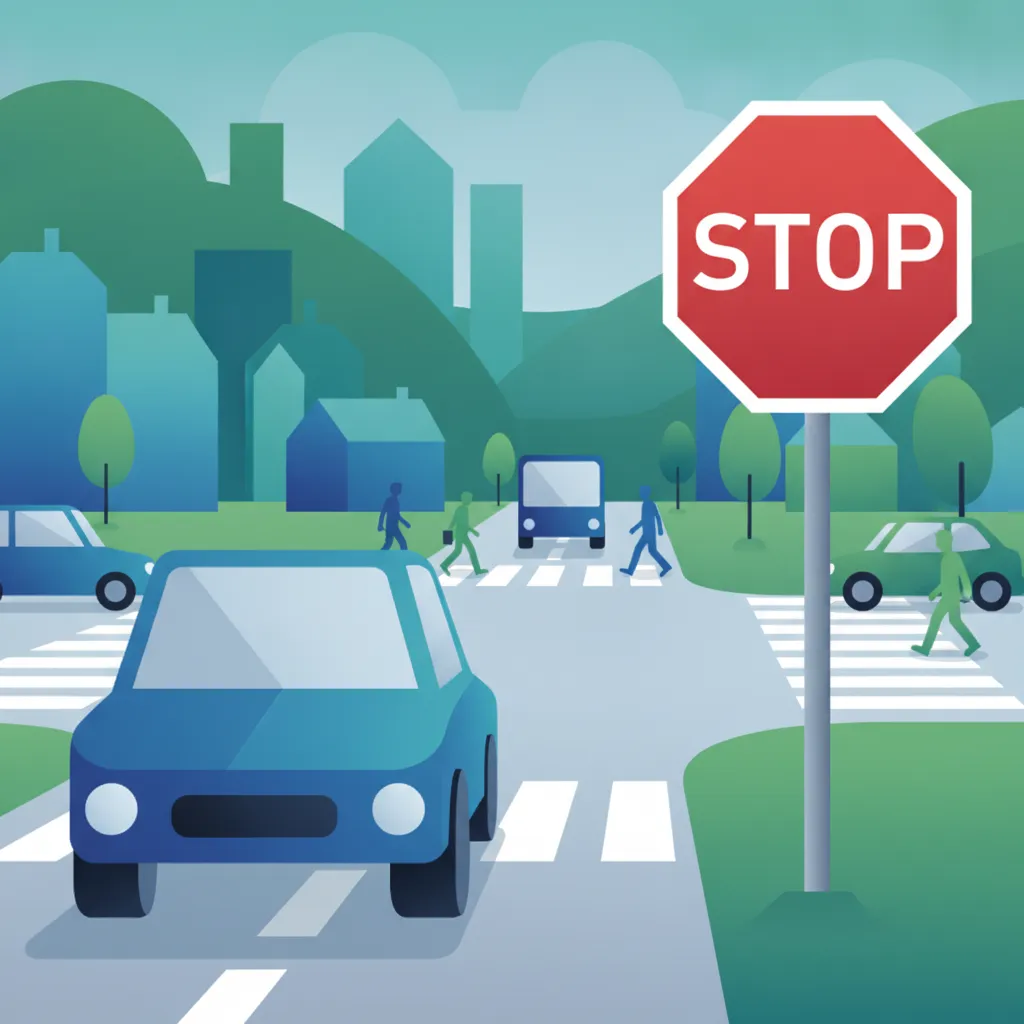
Theory topic content overview
Read the full theory topic guide for Stop Sign Rules (B13) with structured, easy-to-scan content built for learners in Denmark. This detailed section explains the exact rule, meaning, traffic context, comparison points, and exam logic behind this Danish driving theory topic so you can study faster, understand the concept more clearly, and avoid common interpretation mistakes on the theory test.
The Stop Sign (B13) is one of the most critical regulatory signs in Danish traffic, demanding an absolute and unmistakable action from drivers. It signifies that you must bring your vehicle to a complete halt before proceeding, coupled with an unconditional duty to yield to all other traffic. In Danish, this is known as ubetinget vigepligt.
This distinctive red octagonal sign, often accompanied by a thick white stop line on the road, is placed at intersections or junctions where it is essential to ensure maximum safety due to limited visibility, complex traffic flows, or a history of collisions.
The Danish road rules are designed to prevent conflicts, and the stop sign (B13) serves as a critical fail-safe at high-risk points. Its importance stems from several factors:
ubetinget vigepligt, are frequently featured in the Danish driving theory test. A thorough understanding is essential for passing.Understanding and correctly executing the stop sign rule (B13) involves a precise sequence of actions:
Stoplinjen): You must bring your vehicle to a complete stop before the white stop line (stoplinjen) painted across the road. If no stop line is present, you must stop before entering the actual intersection, at a point where you have the best possible view of the crossing traffic without obstructing it.ubetinget vigepligt. You must yield to all of them.Ubetinget Vigepligt): This means you must not cause other traffic to slow down, swerve, or take any evasive action because of your movement. You proceed only when the road is completely clear and your entry will not affect anyone else.A common point of confusion for Danish learners is differentiating between a stop sign and a yield (or give way) sign. While both relate to priority, their requirements are fundamentally different:
ubetinget vigepligt) to all crossing traffic.vigepligt) to all crossing traffic.The key takeaway is that the B13 stop sign adds the mandatory full stop on top of the yielding requirement. This distinction is crucial for both safety and the Danish theory test.
Consider these common situations when encountering a B13 stop sign:
ubetinget vigepligt applies here, meaning you take extra care not to force traffic on the main road to react.Learners frequently make these errors when encountering stop signs:
stoplinjen is your precise stopping point.ubetinget vigepligt demands a comprehensive check.The stop sign (B13) is non-negotiable in Denmark. Always remember: Stop completely, check thoroughly, and yield unconditionally. This isn't just about passing your theory test; it's about making Danish roads safer for everyone. Prioritise that full stop and comprehensive traffic assessment every time you see the red octagonal sign, and you'll embody safe and responsible driving.
The B13 stop sign in Denmark mandates a complete vehicle stop at the stop line before an intersection, followed by an unconditional duty to yield to all other traffic. This contrasts with yield signs where stopping is only necessary if required. The rule applies without exception—even on empty roads—and drivers must check all directions for cars, cyclists, and pedestrians before proceeding safely. The distinction between the absolute stopping requirement of B13 and the conditional yielding of B11/B12 is a frequent exam focus point.
A short set of high-value points that capture the most important ideas from this theory explanation.
The B13 stop sign requires an absolute, complete halt at the stop line regardless of whether traffic is visible
After stopping, you have an unconditional duty to yield (ubetinget vigepligt) to ALL other road users before proceeding
Stop at the white stop line (stoplinjen); if no line exists, stop before entering the intersection with the best possible view
Unlike a yield sign, proceeding without stopping is never permitted at a B13 sign, even on empty roads
Always check left, right, and straight ahead for all users including cyclists and pedestrians before moving
B13 is the red octagonal stop sign; B11/B12 are triangular yield signs
The stopping requirement is absolute (ubetinget) while yielding at a yield sign is conditional
Stop before the stop line, never past it or too far from it
You must yield to all traffic without causing anyone to slow down or swerve
Full stop means wheels must stop moving entirely—a rolling stop is illegal
Making a rolling stop without bringing the vehicle to a complete halt
Stopping beyond the stop line or too far from it instead of at the designated stoplinjen
Checking only for cars and missing cyclists, pedestrians, or other vulnerable road users
Confusing the stop sign with a yield sign and proceeding without stopping when the road appears clear
Hesitating excessively after stopping, causing confusion for other road users about your intentions
Start with a short, direct summary of Stop Sign Rules (B13) before reading the full explanation below.
A stop sign (B13) in Denmark mandates that drivers must bring their vehicle to a complete stop at the stop line, or at the intersection if no line is present. After stopping, you have an unconditional duty to yield (ubetinget vigepligt) to all other traffic before proceeding. This strict rule ensures maximum safety at high-risk intersections where clear visibility or complex traffic flows require a full pause and careful assessment.
Review the most important terms, rule signals, and traffic concepts linked to Stop Sign Rules (B13).
Explore related theory topic pages connected to Stop Sign Rules (B13) and continue with the next useful rule explanation.
See the common search queries learners use when trying to understand Stop Sign Rules (B13) in Denmark.

Dive into detailed explanations of Danish traffic legislation, road signs, and driving conventions. Solidify your understanding of key theory topics and prepare confidently for all sections of your official Danish driving license theory exam.
Explore Driving Theory TopicsTheory topic content overview
A short set of high-value points that capture the most important ideas from this theory explanation.
The B13 stop sign requires an absolute, complete halt at the stop line regardless of whether traffic is visible
After stopping, you have an unconditional duty to yield (ubetinget vigepligt) to ALL other road users before proceeding
Stop at the white stop line (stoplinjen); if no line exists, stop before entering the intersection with the best possible view
Unlike a yield sign, proceeding without stopping is never permitted at a B13 sign, even on empty roads
Always check left, right, and straight ahead for all users including cyclists and pedestrians before moving
B13 is the red octagonal stop sign; B11/B12 are triangular yield signs
The stopping requirement is absolute (ubetinget) while yielding at a yield sign is conditional
Stop before the stop line, never past it or too far from it
You must yield to all traffic without causing anyone to slow down or swerve
Full stop means wheels must stop moving entirely—a rolling stop is illegal
Making a rolling stop without bringing the vehicle to a complete halt
Stopping beyond the stop line or too far from it instead of at the designated stoplinjen
Checking only for cars and missing cyclists, pedestrians, or other vulnerable road users
Confusing the stop sign with a yield sign and proceeding without stopping when the road appears clear
Hesitating excessively after stopping, causing confusion for other road users about your intentions
Start with a short, direct summary of Stop Sign Rules (B13) before reading the full explanation below.
A stop sign (B13) in Denmark mandates that drivers must bring their vehicle to a complete stop at the stop line, or at the intersection if no line is present. After stopping, you have an unconditional duty to yield (ubetinget vigepligt) to all other traffic before proceeding. This strict rule ensures maximum safety at high-risk intersections where clear visibility or complex traffic flows require a full pause and careful assessment.
Review the most important terms, rule signals, and traffic concepts linked to Stop Sign Rules (B13).
Explore related theory topic pages connected to Stop Sign Rules (B13) and continue with the next useful rule explanation.
See the common search queries learners use when trying to understand Stop Sign Rules (B13) in Denmark.
Dive into detailed explanations of Danish traffic legislation, road signs, and driving conventions. Solidify your understanding of key theory topics and prepare confidently for all sections of your official Danish driving license theory exam.
Explore Driving Theory TopicsUse this exam-focused revision tip to understand how Stop Sign Rules (B13) is likely to appear in theory questions for learners in Denmark. This section helps you identify the most testable part of the rule, avoid common traps, and remember the concept more effectively during Danish driving theory exam preparation.
The Danish theory exam often tests the difference between a stop sign and a yield sign. Remember: a stop sign (B13) *always* requires a full, complete stop – even if the road appears empty. Yielding is conditional, stopping is absolute. Pay close attention to this distinction.
Read direct answers to the most common learner questions about Stop Sign Rules (B13) in Denmark. This FAQ focuses on rule confusion, practical meaning, comparison with similar concepts, and the exact uncertainties that appear most often in Danish driving theory revision and exam preparation.
A stop sign (B13) means you must bring your vehicle to a complete halt at the stop line, or before the intersection if there is no line. You then have an unconditional duty to yield to all other traffic before proceeding.
The key difference is that a stop sign (B13) requires a mandatory, complete stop, regardless of traffic. A yield sign (Vigepligtstavle) requires you to slow down and be prepared to stop if necessary, yielding to priority traffic, but you may proceed without stopping if the road is clear.
You must stop immediately before the stop line marked on the road. If there is no stop line, you must stop at a point where you have a clear view of the intersecting traffic without obstructing it.
Yes, the requirement for a complete stop at a stop sign is absolute, regardless of whether you see any approaching traffic. You must stop, then assess the situation before proceeding.
"Ubetinget vigepligt" (unconditional yielding duty) is the Danish term for the priority rule enforced by a stop sign (B13). It means you must yield to all other road users from all directions before entering the intersection or crossing their path.
Failing to come to a complete stop at a stop sign is a serious traffic violation in Denmark. It can result in a fine, penalty points on your license, and can lead to dangerous collisions due to ignoring priority rules.
Drivers must yield to cyclists and pedestrians who are already in the intersection or crossing when regulated by a stop sign. The unconditional yielding duty applies to all other road users.
Use our powerful search tool to pinpoint specific Danish driving theory topics, road signs, or traffic situations you need to review. Start exploring relevant practice sets now to reinforce your knowledge and build confidence for your upcoming driving licence exam.