
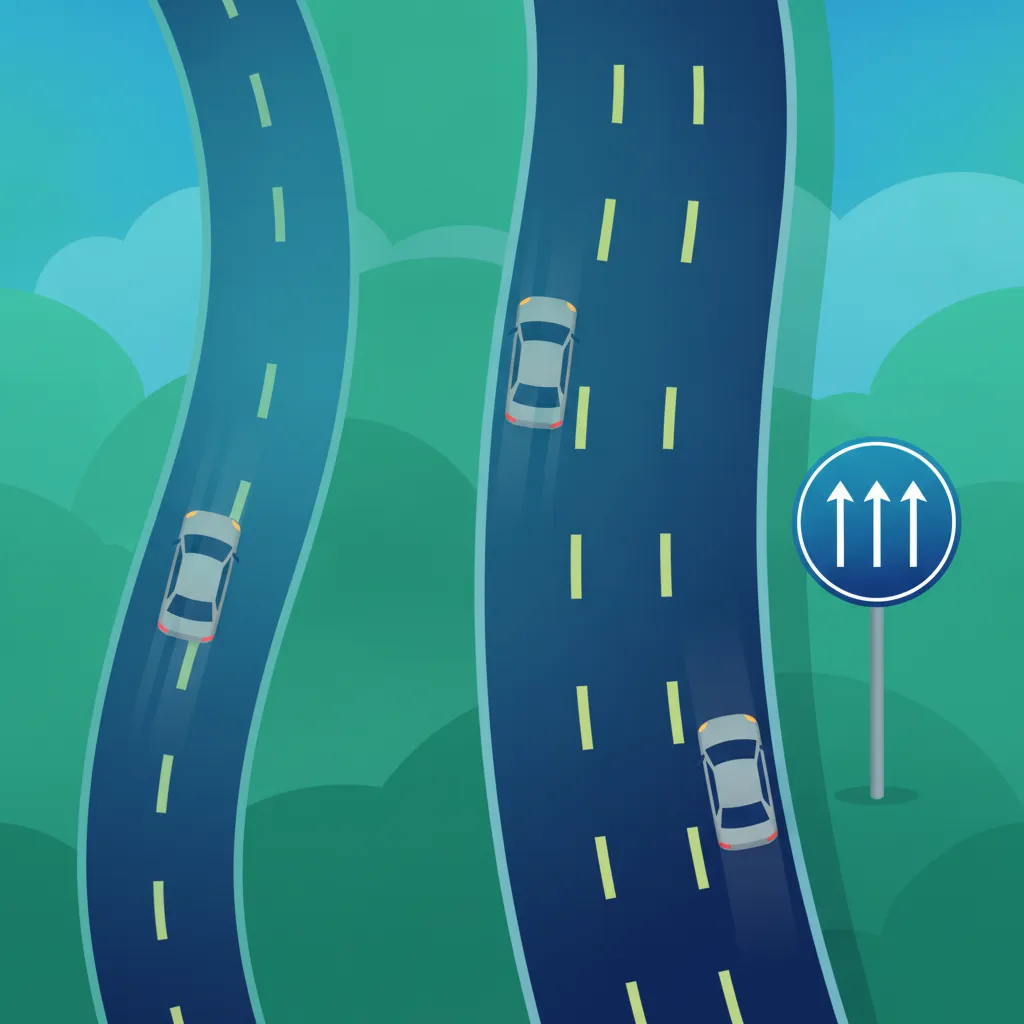
Lane discipline refers to the fundamental practice of maintaining a consistent and appropriate position within traffic lanes. It involves not only keeping a steady path but also understanding which lane to use on multi-lane roads, especially motorways. Proper lane discipline enhances safety, reduces confusion for other road users, and ensures efficient traffic movement in Denmark.
Theory topic content overview
Read the full theory topic guide for Lane Discipline Rules with structured, easy-to-scan content built for learners in Denmark. This detailed section explains the exact rule, meaning, traffic context, comparison points, and exam logic behind this Danish driving theory topic so you can study faster, understand the concept more clearly, and avoid common interpretation mistakes on the theory test.
Vognbanedisciplin – or "lane discipline" in English – refers to the fundamental practice of maintaining a consistent and appropriate position within a traffic lane and making deliberate, safe choices about which lane to use on multi-lane roads. It’s about more than just staying between the lines; it encompasses predictable driving behaviour that is crucial for road safety and efficient traffic flow in Denmark.
Essentially, good lane discipline means:
Mastering lane discipline is not just a polite driving habit; it's a critical component of Danish traffic safety and a frequent focus in the Danish driving theory test. Its importance stems from several key aspects:
motorveje).motorvej) can hinder faster traffic from overtaking, leading to frustration and potentially unsafe situations.Færdselsloven) clearly outlines rules for lane use, particularly the "keep right" principle. Theory test questions frequently assess a learner's understanding of these rules, especially concerning multi-lane roads, motorways, and roundabouts (rundkørsler). Failing to demonstrate good lane discipline can result in failing the practical driving test.Good lane discipline involves both maintaining your current position and making informed decisions about lane changes.
On multi-lane roads (flersporede veje) and motorways (motorveje) in Denmark, the fundamental rule is Højrekørselsreglen – the "keep right" rule. This means:
overhaling): If you are overtaking another vehicle, you use the lane to its left. Once the manoeuvre is complete and safe, you must return to the right-most lane.overhaling (overtaking) on the right is generally not permitted unless traffic is moving in defined lanes and the vehicle in front is clearly slowing or stopped for a turn.Vognbaneskift)Changing lanes requires a precise sequence of actions:
Tegngivning): Check your mirrors (rear-view and side mirrors) and, crucially, your blind spots (blinde vinkler). Signal your intention well in advance using your indicator.Several factors influence how you apply lane discipline:
Motorveje): The "keep right" rule is most strictly applied here, with lanes primarily for progression and overtaking.zigzagkørsel) is still discouraged.Vejstriber): Arrows on the road, destination signs, and solid/broken lines dictate lane usage, especially at complex junctions and roundabouts.Learners often confuse lane discipline with other concepts or misinterpret the "keep right" rule.
vognbanetyveri): This is the term for staying in a middle or left lane unnecessarily when the right lane is open, particularly on motorways. It's a breach of lane discipline, can impede traffic flow, and is a common mistake that can lead to failing the driving test.Let's look at how lane discipline applies in typical Danish driving situations:
Motorvej): You are driving on a three-lane motorvej. You should primarily use the right-most lane. If you need to overtake a slower vehicle, you indicate, check mirrors and blind spot, move to the middle lane, complete the overhaling, and then indicate and return to the right-most lane when safe. Remaining in the middle or left lane after overtaking, or when the right lane is clear, demonstrates poor lane discipline (vognbanetyveri).Rundkørsel): Before entering a rundkørsel, lane markings and signs will guide you. If you intend to take the first exit (usually a right turn), you should position yourself in the right-most lane. If you intend to take a later exit (e.g., straight or left), you might use a middle or left lane. Incorrect lane choice here creates chaos and is a major cause of accidents.Flersporet byvej): You are driving on a road with two lanes in your direction. If you are not overtaking and simply proceeding straight, you should stay in the right lane. If you are preparing to turn left at the next intersection, you would move into the left lane well in advance. Unnecessary switching between these lanes to gain a slight advantage is poor lane discipline.Learners and even experienced drivers often make these mistakes regarding lane discipline in Denmark:
Zigzagkørsel): Constantly changing lanes in heavy traffic to try and gain a few car lengths. This is dangerous, causes frustration, and rarely saves significant time.rundkørsel or approaching an intersection in the wrong lane, then having to make sudden, unsafe manoeuvres to correct.blinde vinkler.vognbaneskift), leaving other drivers no time to react.In the Danish driving theory test (teoriprøve), questions about lane discipline are designed to ensure you understand the rules for safe and efficient road use in Denmark. The emphasis is heavily on:
Højrekørselsreglen): Scenarios on motorways and multi-lane roads will test your knowledge of when to use the right-most lane and when it's permissible to use other lanes for overhaling.Overhaling): Questions will cover the safe execution of overtaking, including observation, signalling, and returning to the right lane.vognbanetyveri and zigzagkørsel affect traffic flow and safety.These rules are enshrined in the Færdselsloven, which forms the basis of all Danish driving instruction. Your ability to apply these rules will be a significant part of your practical driving test, where instructors closely observe your lane positioning and lane changing habits.
For effective lane discipline in Danish traffic, remember this simple mantra: "Drive predictably, stay right, and only change lanes when necessary and safe."
Always consider how your lane choice and movements affect others. A disciplined driver contributes to a safer, smoother, and more enjoyable experience for everyone on the road.
Lane discipline in Danish traffic means consistently maintaining your position within your chosen lane and selecting the appropriate lane based on road type and conditions. The fundamental rule on multi-lane roads and motorways is Højrekørselsreglen (keep right), requiring drivers to use the right-most lane as their default and only move left for overtaking, turning, or lane closures. Safe lane changes follow a strict sequence: assess need, check mirrors and blind spots, signal clearly, ensure a safe gap, steer smoothly, and cancel the signal after completing the manoeuvre. Common violations include lane hogging (vognbanetyveri) and weaving (zigzagkørsel), both of which reduce traffic flow efficiency and create safety hazards. Theory test questions frequently focus on the keep right rule, overtaking procedures, and correct lane selection at roundabouts and junctions, as these scenarios are commonly tested and essential for safe driving practice in Denmark.
A short set of high-value points that capture the most important ideas from this theory explanation.
In Denmark, always keep to the right-most lane on multi-lane roads and motorways unless you are actively overtaking or preparing to turn left.
The keep right rule has exceptions: you may use left lanes for overtaking, preparing to turn, navigating lane closures, or in dense stop-and-go traffic.
Lane discipline means maintaining a steady, predictable path within your lane and only changing lanes when necessary and safe.
Returning to the right-most lane after completing an overtake is a legal requirement, not optional.
Lane hogging (unnecessarily occupying middle or left lanes on motorways) is a common violation that impedes traffic flow and can result in fines.
The keep right rule applies most strictly on motorways (motorveje), where the right lane is the default travel lane.
Overtaking on the right (højre overhaling) is generally prohibited but permitted in defined lanes at similar speeds or when a vehicle is clearly turning left.
Before entering roundabouts (rundkørsler), lane markings and signs must guide your lane choice based on your intended exit.
Changing lanes requires a sequence: assess need, check mirrors and blind spots, signal, ensure gap, steer smoothly, then cancel signal.
Lane discipline is the overall principle; lane changes are specific manoeuvres performed within that framework.
Lane hogging (vognbanetyveri): staying in the middle or left lane unnecessarily when the right lane is clear, especially on motorways.
Weaving in traffic (zigzagkørsel): constantly changing lanes in heavy traffic to gain a few car lengths, which is dangerous and rarely saves time.
Entering a roundabout or junction in the wrong lane and then making unsafe corrective manoeuvres.
Relying solely on mirrors when changing lanes and failing to check blind spots where motorcycles and cyclists may be hidden.
Late or absent signalling for lane changes, leaving other drivers insufficient time to react.
Start with a short, direct summary of Lane Discipline Rules before reading the full explanation below.
Lane discipline is the practice of consistently staying within your designated lane and choosing the appropriate lane based on road conditions, speed, and traffic rules. In Danish traffic, this typically means keeping to the right-most lane unless overtaking or preparing to turn. Good lane discipline makes your driving predictable, which is vital for road safety and smooth traffic flow.
Review the most important terms, rule signals, and traffic concepts linked to Lane Discipline Rules.
Explore related theory topic pages connected to Lane Discipline Rules and continue with the next useful rule explanation.
See the common search queries learners use when trying to understand Lane Discipline Rules in Denmark.

Dive into detailed explanations of Danish traffic legislation, road signs, and driving conventions. Solidify your understanding of key theory topics and prepare confidently for all sections of your official Danish driving license theory exam.
Explore Driving Theory TopicsTheory topic content overview
A short set of high-value points that capture the most important ideas from this theory explanation.
In Denmark, always keep to the right-most lane on multi-lane roads and motorways unless you are actively overtaking or preparing to turn left.
The keep right rule has exceptions: you may use left lanes for overtaking, preparing to turn, navigating lane closures, or in dense stop-and-go traffic.
Lane discipline means maintaining a steady, predictable path within your lane and only changing lanes when necessary and safe.
Returning to the right-most lane after completing an overtake is a legal requirement, not optional.
Lane hogging (unnecessarily occupying middle or left lanes on motorways) is a common violation that impedes traffic flow and can result in fines.
The keep right rule applies most strictly on motorways (motorveje), where the right lane is the default travel lane.
Overtaking on the right (højre overhaling) is generally prohibited but permitted in defined lanes at similar speeds or when a vehicle is clearly turning left.
Before entering roundabouts (rundkørsler), lane markings and signs must guide your lane choice based on your intended exit.
Changing lanes requires a sequence: assess need, check mirrors and blind spots, signal, ensure gap, steer smoothly, then cancel signal.
Lane discipline is the overall principle; lane changes are specific manoeuvres performed within that framework.
Lane hogging (vognbanetyveri): staying in the middle or left lane unnecessarily when the right lane is clear, especially on motorways.
Weaving in traffic (zigzagkørsel): constantly changing lanes in heavy traffic to gain a few car lengths, which is dangerous and rarely saves time.
Entering a roundabout or junction in the wrong lane and then making unsafe corrective manoeuvres.
Relying solely on mirrors when changing lanes and failing to check blind spots where motorcycles and cyclists may be hidden.
Late or absent signalling for lane changes, leaving other drivers insufficient time to react.
Start with a short, direct summary of Lane Discipline Rules before reading the full explanation below.
Lane discipline is the practice of consistently staying within your designated lane and choosing the appropriate lane based on road conditions, speed, and traffic rules. In Danish traffic, this typically means keeping to the right-most lane unless overtaking or preparing to turn. Good lane discipline makes your driving predictable, which is vital for road safety and smooth traffic flow.
Review the most important terms, rule signals, and traffic concepts linked to Lane Discipline Rules.
Explore related theory topic pages connected to Lane Discipline Rules and continue with the next useful rule explanation.
See the common search queries learners use when trying to understand Lane Discipline Rules in Denmark.
Dive into detailed explanations of Danish traffic legislation, road signs, and driving conventions. Solidify your understanding of key theory topics and prepare confidently for all sections of your official Danish driving license theory exam.
Explore Driving Theory TopicsUse this exam-focused revision tip to understand how Lane Discipline Rules is likely to appear in theory questions for learners in Denmark. This section helps you identify the most testable part of the rule, avoid common traps, and remember the concept more effectively during Danish driving theory exam preparation.
In Danish theory tests, questions about lane discipline often focus on multi-lane roads and motorways, specifically the 'keep right' rule and the correct procedure for overtaking. Pay close attention to scenarios involving heavy traffic, lane closures, and roundabout entry/exit, as these are common areas for mistakes. Remember that maintaining a consistent lane and making safe, signaled changes are key principles.
Read direct answers to the most common learner questions about Lane Discipline Rules in Denmark. This FAQ focuses on rule confusion, practical meaning, comparison with similar concepts, and the exact uncertainties that appear most often in Danish driving theory revision and exam preparation.
Lane discipline means consistently maintaining your vehicle's position within a traffic lane and making deliberate, appropriate choices about which lane to use, especially on roads with multiple lanes in the same direction.
Good lane discipline is crucial for road safety and efficient traffic flow in Denmark. It makes your actions predictable to other drivers, reduces the risk of collisions, and prevents unnecessary congestion, particularly on busy roads and motorways.
In Denmark, as in many European countries, drivers must generally keep to the right-most available lane on multi-lane roads and motorways. You should only use left lanes for overtaking or when preparing to turn left, returning to the right lane once safe to do so.
You should only change lanes when it is necessary and safe to do so, for example, to overtake another vehicle, to make a turn, or to navigate around an obstruction. Always signal clearly, check your mirrors and blind spot, and ensure sufficient space before moving.
Lane drifting refers to unintentionally allowing your vehicle to move gradually out of its lane without signaling. It's dangerous because it confuses other drivers, increases the risk of side-swipe collisions, and can lead to fines if it's considered negligent driving.
Yes, lane discipline is very important in roundabouts. You must choose the correct lane before entering based on your intended exit, maintain your lane while circling, and signal clearly before exiting. Improper lane use in roundabouts is a common mistake.
On motorways, poor lane discipline, such as hogging the overtaking lane or frequent unnecessary lane changes, can disrupt traffic flow, cause congestion, and lead to road rage incidents. Adhering to the 'keep right' principle helps maintain smooth and predictable traffic.
Use our powerful search tool to pinpoint specific Danish driving theory topics, road signs, or traffic situations you need to review. Start exploring relevant practice sets now to reinforce your knowledge and build confidence for your upcoming driving licence exam.