
Understanding how to safely navigate adverse weather is a core component of the French driving theory exam. This article breaks down the legal obligations for French drivers, including critical adjustments to speed and safety distances on slippery surfaces. You will learn the specific conditions that require the use of fog lights and how to avoid common pitfalls in the exam regarding hazard perception.
Article content overview
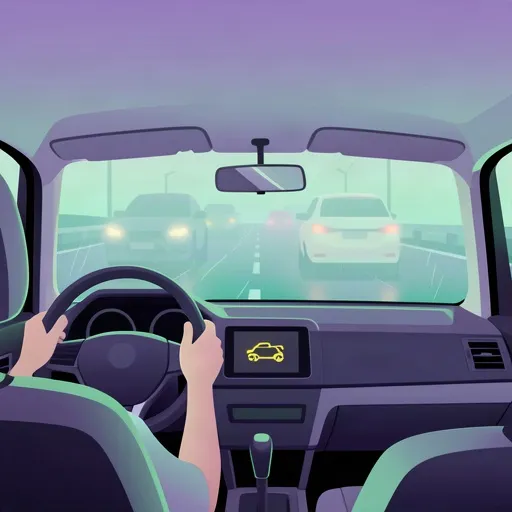
Driving under adverse weather conditions is a fundamental competence evaluated in the French Épreuve Théorique Générale (ETG). The Code de la route places significant emphasis on a driver's ability to anticipate reduced adhesion and visibility. When the road surface is wet, your vehicle’s braking distance increases dramatically, and your tires’ ability to grip the pavement is compromised. Passing the ETG requires more than just memorizing signs; it demands an understanding of how to adapt your driving behavior to maintain safety margins in environments where conditions are constantly changing.
On a dry road, you are expected to maintain a safety distance of at least two seconds behind the vehicle in front of you. However, when the road is wet, this rule is insufficient. Rain creates a film of water on the asphalt, which significantly reduces the coefficient of friction between your tires and the road surface. In the context of the ETG exam, you must always choose the option that suggests increasing safety distances. Harsh, sudden braking on a slippery surface often leads to loss of vehicle control and skidding, making progressive deceleration the only safe approach.
Common Exam Trap: Never assume that modern vehicle features like ABS exempt you from increasing your safety distance. While these systems help prevent wheel lock-up, the laws of physics still dictate that a longer distance is required to come to a complete stop on a wet or greasy surface.
Visibility is often severely restricted during heavy rain, fog, or snow. The French Code de la route provides strict rules on when to use specific lighting systems. Misusing fog lights is a common error in theoretical exams because candidates often confuse mandatory light usage with optional visibility aids.
Dipped headlights (feux de croisement) are mandatory when visibility is reduced due to rain, snow, or fog. Front fog lights (feux de brouillard avant) are optional but allowed during heavy rain or snow, and they may be used in fog. However, rear fog lights (feux de brouillard arrière) are strictly prohibited when it is only raining, as they are blinding to following drivers. They must only be used in cases of dense fog or falling snow.
Known as feux de croisement, these must be used at night and during the day when visibility is significantly reduced, such as during heavy downpours or thick fog, to ensure you see and are seen by others.
The ETG exam often presents scenarios where a vehicle is traveling on a highway or secondary road during poor weather. You are expected to demonstrate that you can identify a hazard before it becomes an emergency. If you see signs of standing water or fog, you must reduce your speed immediately. This adaptation is not just a recommendation; it is a legal requirement to ensure you can stop within the distance of your visible range.
The reason these topics appear so frequently in the official exam bank is that they test your judgment under pressure. The Code de la route requires drivers to be "maître de son véhicule" (in control of their vehicle) at all times. When you answer a question about rain, the exam authority is looking for the "defensive driving" mindset. You should always opt for the most cautious behavior, such as slowing down or increasing distance, rather than trying to maintain a normal flow of traffic when environmental conditions are suboptimal.
This article addresses critical ETG exam content on driving in rain and fog, focusing on three core areas: adhesion and braking physics, legal light usage requirements, and speed adaptation rules. Learners must understand that wet roads dramatically extend stopping distances and that safety margins must be increased proactively. The specific rules governing when to use dipped headlights versus fog lights—particularly the prohibition on rear fog lights during rain—frequently appear as exam distractors. The defensive driving mindset required by the Code de la route demands choosing the most cautious option when conditions are suboptimal.
A short set of high-value points that capture the most important ideas from this article.
Wet road conditions dramatically increase braking distance, requiring safety distances well beyond the standard 2-second rule
Dipped headlights (feux de croisement) are legally mandatory whenever visibility is reduced by rain, fog, or snow
Rear fog lights are strictly prohibited during rain alone and must only be used in dense fog or falling snow
Proactive speed reduction is a legal requirement, not merely a recommendation, to ensure stopping within visible range
Modern vehicle safety systems like ABS do not exempt drivers from needing longer stopping distances on wet surfaces
The 2-second safety distance rule applies only to dry roads; wet conditions demand significantly greater distances
Front fog lights are optional but permitted during heavy rain, snow, or fog
Rear fog lights (feux de brouillard arrière) = prohibited in rain, allowed only in dense fog or snowfall
Progressive deceleration is the only safe braking approach on slippery surfaces; sudden braking causes skidding
Drivers must always be maître de son véhicule (in control of their vehicle) regardless of conditions
Assuming that ABS technology allows you to maintain normal safety distances on wet roads
Using rear fog lights during rain, which blinds following drivers and is prohibited by the Code de la route
Reducing speed too late instead of responding proactively to early signs of reduced adhesion or visibility
Applying harsh, sudden braking on slippery surfaces, which leads to loss of vehicle control
Confusing optional front fog light usage with the mandatory requirement for dipped headlights
Article content overview
A short set of high-value points that capture the most important ideas from this article.
Wet road conditions dramatically increase braking distance, requiring safety distances well beyond the standard 2-second rule
Dipped headlights (feux de croisement) are legally mandatory whenever visibility is reduced by rain, fog, or snow
Rear fog lights are strictly prohibited during rain alone and must only be used in dense fog or falling snow
Proactive speed reduction is a legal requirement, not merely a recommendation, to ensure stopping within visible range
Modern vehicle safety systems like ABS do not exempt drivers from needing longer stopping distances on wet surfaces
The 2-second safety distance rule applies only to dry roads; wet conditions demand significantly greater distances
Front fog lights are optional but permitted during heavy rain, snow, or fog
Rear fog lights (feux de brouillard arrière) = prohibited in rain, allowed only in dense fog or snowfall
Progressive deceleration is the only safe braking approach on slippery surfaces; sudden braking causes skidding
Drivers must always be maître de son véhicule (in control of their vehicle) regardless of conditions
Assuming that ABS technology allows you to maintain normal safety distances on wet roads
Using rear fog lights during rain, which blinds following drivers and is prohibited by the Code de la route
Reducing speed too late instead of responding proactively to early signs of reduced adhesion or visibility
Applying harsh, sudden braking on slippery surfaces, which leads to loss of vehicle control
Confusing optional front fog light usage with the mandatory requirement for dipped headlights
Explore related topics, search based questions, and concepts that learners often look up when studying Rain and Fog Driving Rules. These themes reflect real search intent and help you understand how this topic connects to wider driving theory knowledge in France.
Find clear and practical answers to common questions learners often have about Rain and Fog Driving Rules. This section helps explain difficult points, remove confusion, and reinforce the key driving theory concepts that matter for learners in France.
Drivers must reduce their speed and significantly increase safety distances, as rain reduces tyre adhesion and increases the total braking distance.
Rear fog lights must only be used in cases of fog or heavy snowfall; they are strictly prohibited during rain as they can cause glare for following drivers.
On wet roads, the braking distance is considerably longer due to reduced road grip, meaning that a distance sufficient for dry conditions will likely result in a collision.
Yes, even in light rain, drivers should adapt their driving style by increasing safety margins and ensuring their dipped headlights are on to remain visible to others.
Continue your preparation for the French permis de conduire exam. Dive deeper into specific Code de la route sections, practice scenarios, or review official procedures. Use our comprehensive article collection to master every aspect of driving theory.